Lawn Care

Best Garden Hose Nozzles of 2026

A garden sprayer nozzle has to do two opposite jobs: coax a soft stream onto new seedlings without flattening them, then switch to a hard jet that can push grit off a patio step. The wrong one makes both jobs feel like a compromise—the dial sticks, the mist turns into a surprise shower, or the coupling drips down your wrist every time you squeeze the trigger. The right one disappears into the routine, letting you water, rinse, and clean up without thinking about the tool in your hand.

I've spent enough weekends wrestling with stiff collars and leaky threads to be picky about the small stuff, and my team put 15 hose-end sprayer nozzles through five months of ordinary garden work. What separated them wasn't a flashy feature list; it was whether the spray pattern actually changed when I turned the dial, whether the body felt solid after a few drops on the patio, and whether it held up and stayed comfortable through a long watering session. The picks below earned a permanent spot by the spigot.

1

Hourleey Brass Hose Nozzle 2-Pack

Top Pick
Hourleey Brass Hose Nozzle 2-Pack

Everyday watering

Our Score 9.4/10
Check Price

Worth Noting

  • Spray changes need two hands
Thread
3/4 in GHT
Material
Solid brass
Nozzles Per Pack
2
Spray Adjustment
Twist barrel
Read the full review

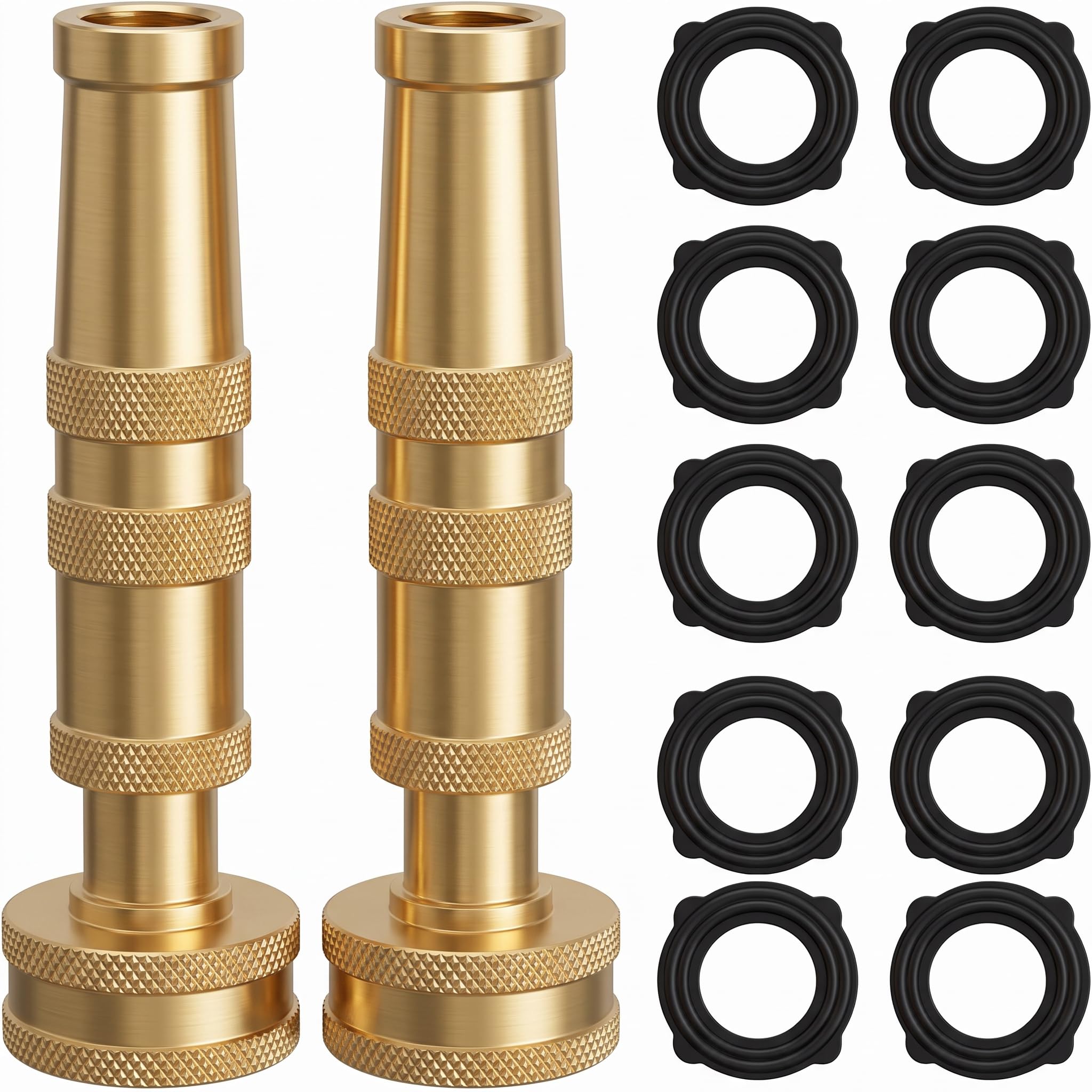
Two solid brass nozzles, ten spare rubber washers, and no trigger anywhere. The Hourleey is the oldest idea on this page: you twist the barrel to open the flow, keep twisting to tighten a wide cone down to a pencil stream, and twist it shut when you're done. We expected to miss a pistol grip inside a day and didn't. What struck us instead was how little there is to break — no spring, no lever, no plastic collar waiting to crack the first time the nozzle lands on the patio.

The four holes in the brass tip throw a wider, softer cone than we expected from something this small, and the stream narrows enough to chase mud off a step. Threading is 3/4-inch garden hose, so it goes straight onto a standard hose end, and the washers in the box mean a flattened seal is a two-minute fix rather than a drive to the store. The one thing we still notice: fine-tuning the spray takes two hands, one on the hose and one on the barrel.

Everything here is a trade against convenience. No pattern dial, no lock, no click stops between settings — just a continuum from mist to stream that you find by feel, which is slower than a wheel and much harder to break. What you get back is the best-feeling brass in this group and the sense that nothing on it will be the reason you buy another next spring. Ours is going on the back tap, with the second one kept in the shed for the car.

Bottom line: Solid brass, a twist barrel that shuts off cleanly, and a spare in the box — we think this is the nozzle most gardeners should start with.

2

Gilmour Solid Metal 4-Pack

Gilmour Solid Metal 4-Pack

Multiple taps

Our Score 9.2/10
Check Price

Worth Noting

Material
Solid metal
Spray Range
Mist to jet
Nozzles Per Pack
4
Read the full review

Four nozzles in one box is the entire pitch, and for a lot of gardens it's the right one. A front tap, a back tap, a reel that never gets drained, and a kid who leaves things on the lawn — the arithmetic is simple: a nozzle that stops sealing gets swapped, not mourned.

What's in the box is deliberately plain. A solid metal body, a threaded front, and spray that runs from soft mist to jet with no dial and no click stops — you set it and it stays where you put it. We found that less limiting than it sounds. Most days we want two things from a nozzle: a gentle shower for a can or a bed, and something narrow enough to push mud off a step. This does both without a decision in between.

The metal has the dense, old-fashioned feel of hardware your parents owned, and the simplicity is the point — nothing on it to jam, nothing to reprogram when someone else picks it up. The catch is that four is the only way it's sold, so a single tap means three nozzles in a drawer. Ours went one per tap and one in the car, which is a use for the fourth we hadn't planned on.

Bottom line: Buy the box and put one on every tap — four solid metal nozzles do mist to jet with nothing to jam.

3

Melnor XT Metal 7-Pattern

Melnor XT Metal 7-Pattern

Long sessions

Our Score 8.8/10
Check Price

Worth Noting

  • Weeps at the collar if over-tightened
  • Heavy at the end of a long hose
Body
Metal
Trigger
Rear trigger with lock
Connection
Quick Connect adapter included
Spray Patterns
7
Read the full review

The Melnor arrives heavier than anything else on this page, and the weight explains the rest: a metal body, a rear trigger, and a lock tab that holds the trigger down for you. You set the spray, click the lock, and walk the beds without squeezing. That single tab is the reason this one stays on the front tap while the twist nozzles live in the shed.

Seven patterns sit on a wheel that snaps into each detent rather than drifting between them, and the snapping turns out to matter more than the count — we never landed between two settings and had to hunt for the one we wanted. The Quick Connect adapter in the box is a genuine convenience if you swap between nozzle and sprinkler, though it only helps once your hose carries the matching end connector, which is a separate buy. If you want a trigger, this is the trigger to get.

Behind it sits a limited lifetime warranty, and the coated metal body hides a season of scrapes better than bare brass does — worth something on a tool that hangs outdoors year-round. It has stayed on our front tap since the first week, which is more than we can say for the sprayers it replaced.

Bottom line: The trigger nozzle we hand to anyone who waters for a while: a lock that holds it open, seven crisp patterns, and a lifetime warranty.

4

FANHAO All-Metal Hose Nozzle

FANHAO All-Metal Hose Nozzle

Pistol-grip comfort

Our Score 8.8/10
Check Price

Worth Noting

  • Lock bar is small and stiff to flip
  • Costs more than our trigger pick
Material
Zinc alloy and brass
Warranty
1 year
Handle Lock
Lock bar
Spray Patterns
4
Read the full review

Pick the FANHAO up and the first word that comes to mind is dense. Zinc alloy and brass, a rotating head with four patterns, and a lock bar at the bottom of the handle rather than the top — a small difference in placement that changes how your thumb finds it. It's the only nozzle here that made us want to leave it hanging on the tap for the look of it.

Four patterns is a modest count next to the seven on the Melnor, but the head is easy to find by feel and the jet has real force behind it. Our reservation is the lock: it sits low, it's small, and it needs a deliberate thumb to flip — fine for a quick fill, irritating when you're locking and unlocking every thirty seconds. The rotating head also wants a firm grip when your hands are wet, which is exactly when your grip is worst.

There are several internal rubber seals here, and the two spare o-rings in the box tell you where the wear happens. Seat them properly on day one and the zinc and brass will outlast them by years — the body is the part of this nozzle nobody worries about.

Bottom line: If you want a nozzle that feels like a machined tool in the hand, this is it — dense metal, four honest patterns, a firm-thumb lock.

5

Green Mount GMN03R6

Green Mount GMN03R6

Small jobs

Our Score 8.8/10
Check Price

Worth Noting

  • Plastic clips in the grip are the weak point
Size
Small and lightweight
Handle
Integrated lock bar
Thread
Standard garden hose thread
Material
Zinc alloy
Read the full review

The smallest nozzle here is also the easiest to hold one-handed. A zinc-alloy body with a trigger and an integrated lock bar along the top of the handle, it weighs so little that a hanging basket at shoulder height stops being a two-hand job. For balcony watering, a windowsill of pots, or a quick rinse of the dog's paws, that lightness is the whole argument — and it's a better argument than another pattern you'll never use.

It isn't a toy, either. The body is metal, the jet has genuine push for a nozzle this size, and the trigger lock lets you set it running while you move a pot. The spray adjustment isn't as crisp as the wheel on the Melnor — the settings run together toward the mist end — but you'll find the two you like and stay there.

Think of it as the second nozzle rather than the only one. On a balcony tap or a gentle patio routine it's light, cheap, and perfectly adequate, and the lock bar is a feature nozzles twice its size do without. Ours lives on the balcony tap, where a light nozzle and a lock do more for us than seven patterns ever would.

Bottom line: The lightest metal nozzle here and the easiest to work one-handed — a good fit for balcony pots and quick rinses.

How We Tested These Garden Sprayer Nozzles

We built the shortlist from the hose-end sprayer nozzles that kept surfacing in owner reviews and on store shelves—metal and plastic bodies, pistol grips and twist collars, fixed and adjustable heads—then filtered by available replacement washers, sensible weight, and price. Fifteen made the cut, and we tested them over five months, from the first spring watering through the last hot-weather rinse.

Each nozzle went on the same outdoor spigot with a fresh washer and ran at full pressure for two minutes while we checked the collar and threads with a dry paper towel. In the garden, we used them to mist seedlings, soak tomato beds, wash patio chairs, and blast grit off the porch steps, noting whether the pattern changed smoothly with wet hands and whether the spray stayed even from mist to jet. We also held each one through a 15-minute watering session to judge balance and wrist fatigue.

Durability got its own rough treatment: we dropped each nozzle from waist height onto the patio, twisted collars on and off repeatedly, and left them attached between uses to see if plastic stiffened or cracked. At the end, we compared performance with price, asking whether a metal collar or replaceable washer actually earned the extra cost. The ones that advanced did the boring things well—no drips at the coupling, a dial that moved without sticking, and a body that still felt solid after a season of being set down in the dirt.

How to Choose Garden Hose Nozzles

Seal first, spray second

Every nozzle worth buying threads onto a standard 3/4-inch garden hose, and every one of them leans on a rubber washer to stay dry. A drip at the collar almost always means a washer that has flattened, doubled up, or been cranked too tight; a drip that creeps out of the adjustment ring is the nozzle's own seal failing, and no washer will rescue it. That difference is worth knowing before you blame the tool.

Carry spares. The brass two-pack and the Gilmour box both arrive with more washers than you'll use in a season, and swapping one takes a minute. Snug the collar by hand rather than putting your shoulder into it — overtightening flattens the washer and starts the leak you were trying to prevent.

Trigger, twist, or thumb lever

A pistol trigger is the fastest thing to use and the most tiring thing to hold for an hour, which is why the lock bar matters more than the trigger itself. Twist barrels have almost nothing to break and shut off completely, but changing the spray needs both hands. Thumb levers split the difference: less grip fatigue, one more mechanism to wear out.

Match the control to the session. If you water beds for twenty minutes at a stretch, buy the lock. If you mostly fill cans, rinse tools, and top up pots, the twist is quicker and will outlast the lever.

Not all metal is the same metal

Brass bodies resist corrosion and take a knock without cracking, which is why the two simplest nozzles here use it. Zinc alloy is strong as well, but it's heavier and usually powder-coated, so chips show and the weight sits at the end of your arm. Neither metal is the part that fails first.

The lever, the internal clips, and the seals are what decide a nozzle's life. Plastic isn't automatically bad — a light nozzle is easier on the wrist — but a plastic trigger on a metal body is a mixed message. Buy the metal control if the hose gets dragged.

Count your taps, then your patterns

Seven patterns sounds better than four until you notice you use two: a shower for beds, cans, and the dog, and a jet for steps, tools, and the car. Buy for those two and treat the rest as a bonus. A pattern you never select is a mechanism you're paying for.

Then count the taps. With a front, a back, and a hose reel, a two-pack or four-pack is the sensible purchase, because a spare on the shelf beats a mid-season trip to the store. With one tap and no patience for clutter, buy the single nozzle you actually want.

Frequently Asked Questions

Final Verdict

Start with the Hourleey two-pack. A brass barrel, four holes, and a twist is not a clever design, and that's precisely why it wins: no lever to snap, no seal ring to wear out, and a second nozzle for the tap out back. Spend more only when you want a specific mechanism.

Water for an hour at a stretch and want a trigger that locks open? The Melnor. Four taps and no patience for shopping? The Gilmour box. Everything else here is a variation on those three decisions.