Planters & Plant Supports

Best Expandable Garden Trellises of 2026

A bare wall or balcony rail is an invitation: beans, clematis, tomatoes, morning glories. But the wrong expandable trellis turns that invitation into a midsummer sag, with vines drooping and clips popping off. The right one fits the space you actually have, holds up to wind and weight, and looks good enough that you don't want to hide it.

I've killed more trellises than plants over the years—cheap ones that wobbled, pretty ones that snapped—so I was curious to see which of the current crop would survive a full season. Over the past seven months, we've put 14 expandable trellises through their paces, from a windy balcony to a humid greenhouse, and the differences came down to more than curb appeal. What separates a good one from a frustrating one is rarely the price tag; it's the locking mechanism, the gauge of the wire, and whether the clamps can hold a heavy vine without slipping.

1

LANDGARDEN Willow Trellis

Top Pick
LANDGARDEN Willow Trellis

Porch screens

Our Score 9.0/10
Check Price

Worth Noting

  • One panel per order
Weight
3.4 lb
Material
Willow
Closed Size
12 in W x 45.6 in H
Panels Per Pack
1
Read the full review

Willow is the whole point of this panel. The sticks run a quarter to three-eighths of an inch thick, uneven, peeled, and left natural, so the thing reads as a bundle of twigs rather than a fence — the difference between a trellis that looks like garden hardware and one that looks like it grew there. It is the best-looking option in this set, and the one we point people toward when the wall is somewhere they actually sit.

It also covers more ground than the headline size suggests, and the listing is no help there: the title, the bullets, and the product details each give a different set of numbers. Measure your gap, order one panel, and expect to overlap or trim rather than hit an exact figure. Riveted, turnable joints mean it holds whatever angle you set, and it folds back to a bundle at the end of the season.

What willow is not is a structural frame. Thin sticks are fine for beans, morning glory, ivy, and clematis; they are not what you want holding a heavy crop through a windy August. Used as a porch screen or a divider between beds, though, it is charming — the neighbors ask where it came from before they ask what it cost.

Bottom line: Buy it for the look: no panel here comes close to real willow, as long as you are screening or growing something light.
2

Xeeol Metal Pot Trellis

Xeeol Metal Pot Trellis

Potted houseplants

Our Score 9.0/10
Check Price

Worth Noting

  • 32.6 inches is short for a large vine
Width
10.6 in
Height
32.6 in
Material
Powder-coated metal
Panels Per Pack
2
Read the full review

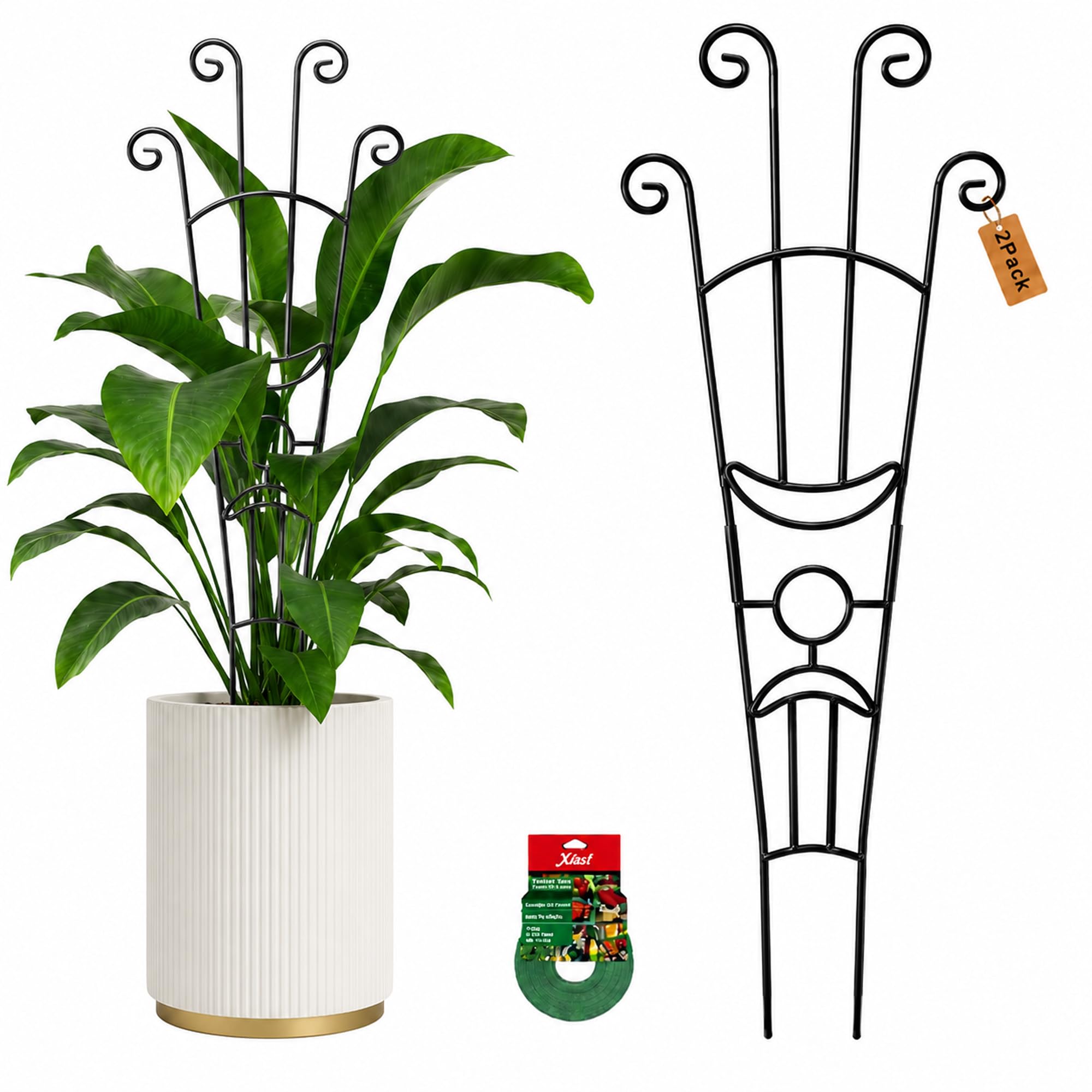
Just under a foot wide and 32.6 inches tall, these are the smallest panels here, and that is the point. You get two black powder-coated frames in the box plus a roll of green tie tape, and each one slides in two pieces so you can set the height to the plant in front of you. For a pothos or a hoya in a ten-inch pot, this is the scale that makes sense.

The legs are short, which is the compromise of a pot trellis. The frame stands in the soil rather than clamping to the rim, so in a deep planter you sink it an inch or two before it stops wanting to tip. Do that and it is steady; leave it perched on loose potting mix and it will not be.

Black metal disappears against foliage in a way bare wood does not, and two frames mean one for the pot on the windowsill and one for the shelf. Per panel, this is the least expensive route into the category, which matters if you are buying several for a plant corner. Slide the two halves apart to match a leggy vine and the join sits behind the leaves.

Bottom line: Our pick for potted plants — two small black frames that slide to height and vanish into the foliage.

3

CJGQ 2-Pack Wood Lattice

CJGQ 2-Pack Wood Lattice

Narrow wall strips

Our Score 9.0/10
Check Price

Worth Noting

  • Two panels only
Weight
2.1 lb
Material
Carbonized wood
Expanded Size
12.8 x 67 in
Panels Per Pack
2
Read the full review

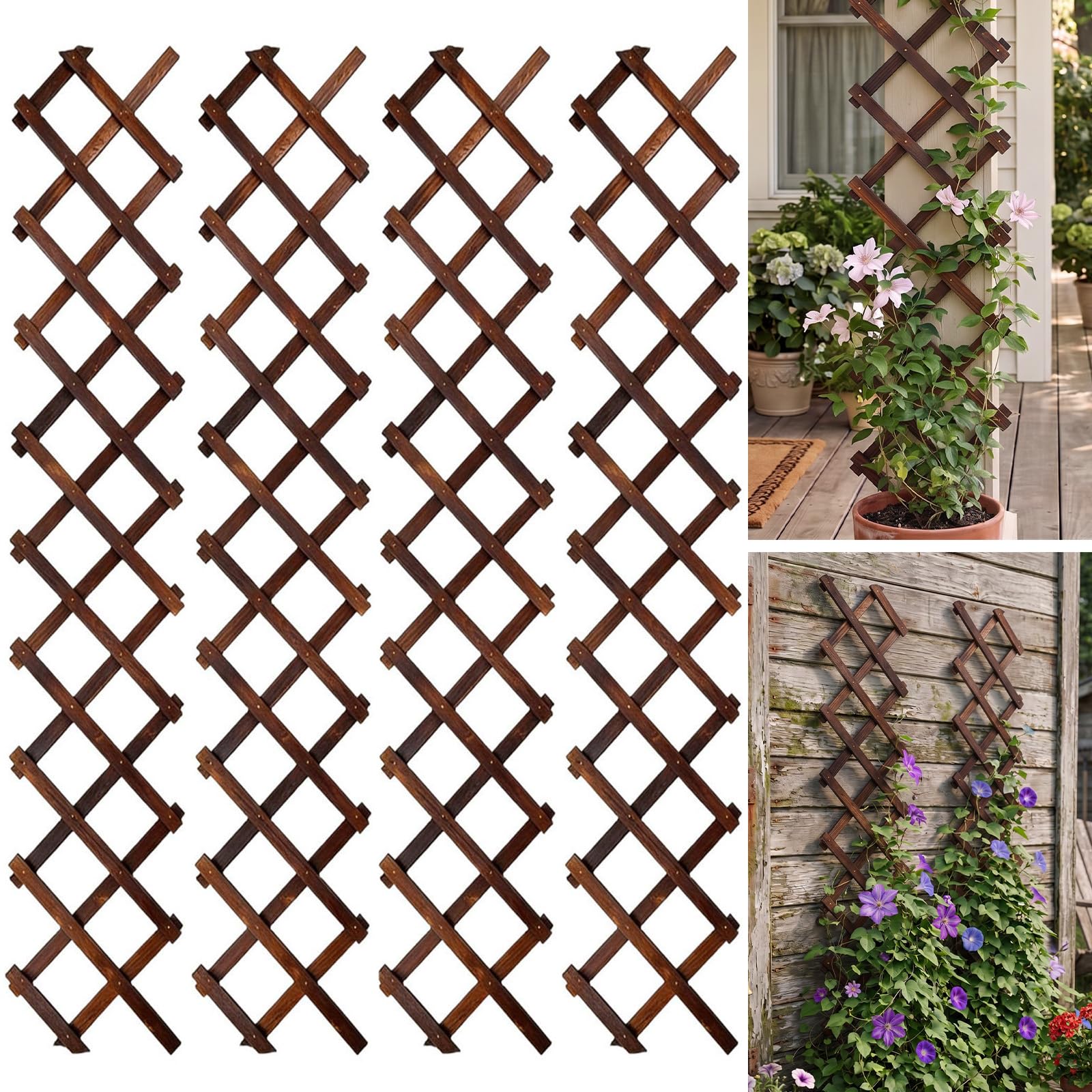
At 12.8 inches wide, this is the panel for the strip you have been ignoring: the sliver between a downspout and a doorframe, the narrow wall beside a balcony, the gap at the end of a bed. Two come in the pack, and each stretches to 67 inches tall while folding back to something you can hold in one hand.

Carbonized wood gives it a dark, even tone that looks deliberate rather than rustic, and the joints turn and then stay where you put them. That last part matters more than it sounds, because an expandable lattice that creeps closed under its own weight is a nuisance every time it rains. The pair we set up in early summer is still square.

Split them and two panels go a long way — one either side of a doorway, or one on the porch and one on the shed. Fix them with screws into framing or a couple of cup hooks; the lattice is light enough that two anchors hold it and narrow enough that it does not catch much wind.

Bottom line: Two slim panels for the gap nothing else fits, with joints that hold the size you set.

4

ANPHSIN 2-Pack Wall Trellis

ANPHSIN 2-Pack Wall Trellis

Tall narrow spots

Our Score 9.0/10
Check Price

Worth Noting

  • 13-inch width covers a single narrow strip
Weight
16 oz
Material
Treated wood
Expanded Size
13 x 78 in
Panels Per Pack
2
Read the full review

Seventy-eight inches of height in a panel that weighs eight ounces is an odd combination until you hang one. The reach lets you run a trellis from a balcony floor to the rail and still leave the vine somewhere to go, and the weight means you can put it up one-handed on two hooks, move it when you repot, and take it down before a storm without thinking about it.

That lightness comes from thin stock, and thin stock has one rule: pilot-hole everything. The slats split if you drive a screw straight in, grain opening before the screw is halfway home. Two minutes with a drill bit saves the panel. Tied rather than screwed, they are fine — just tie at the top, the middle, and the bottom so the lattice cannot bow.

The wood is preservative-treated, which is what you want for something that will be rained on, and two panels per order means one either side of a doorway with the clematis meeting in the middle. It is the lightest way to get six and a half feet of height that we tested.

Bottom line: Choose it when you need six and a half feet of height in a spot barely a foot wide, and pilot-hole every screw.

5

Bounmer 4-Pack Cedar Lattice

Bounmer 4-Pack Cedar Lattice

Fence runs

Our Score 8.8/10
Check Price

Worth Noting

  • Nail heads show on one face
Material
Carbonized cedar
Expanded Size
13 x 68 in
Slat Thickness
0.35 in
Panels Per Pack
4
Read the full review

Four panels arrive in one box, and that is the whole argument for this trellis. Most expandable panels here come singly or in pairs; four means one order can dress a fence run, screen the end of a patio, and still leave a panel for the bare corner beside the downspout. Each panel opens to 13 inches by 68, so you are covering ground in a way the single-panel picks simply cannot.

The 0.35-inch slats are what make it feel like a trellis rather than a decorative screen. It is the only panel in this set that states a thickness, and it is a chunky one — thick enough that pulling the lattice open does not feel like you are about to snap something. Cedar, carbonized, with riveted joints that hold the angle you set. We think the heavier stock justifies the extra money over the cheap single panels, especially outdoors where wind works at everything.

Putting one up takes ten minutes and a handful of screws or zip ties. Fix one at each end and one in the middle of a stretched panel: the lattice has nothing rigid in its center, so an unfastened end will swing. The whole pack weighs about six pounds, so a couple of ties is genuinely enough to hold a panel.

Cedar weathers to a soft gray, which looks right on a fence and less right against fresh trim. If you want the warm brown to stay, plan on oiling it once a year — the same afternoon you clean the gutters, not a separate project.

Bottom line: Four cedar panels with real thickness make this the one we recommend first for a fence run or a row of climbers.

6

Avalution Wooden Lattice Panel

Avalution Wooden Lattice Panel

Single wall accents

Our Score 8.6/10
Check Price

Worth Noting

  • Mounting hardware not included
Material
Carbonized wood
Expanded Size
75 x 11.8 in
Panels Per Pack
1
Mounting Hardware
Not included
Read the full review

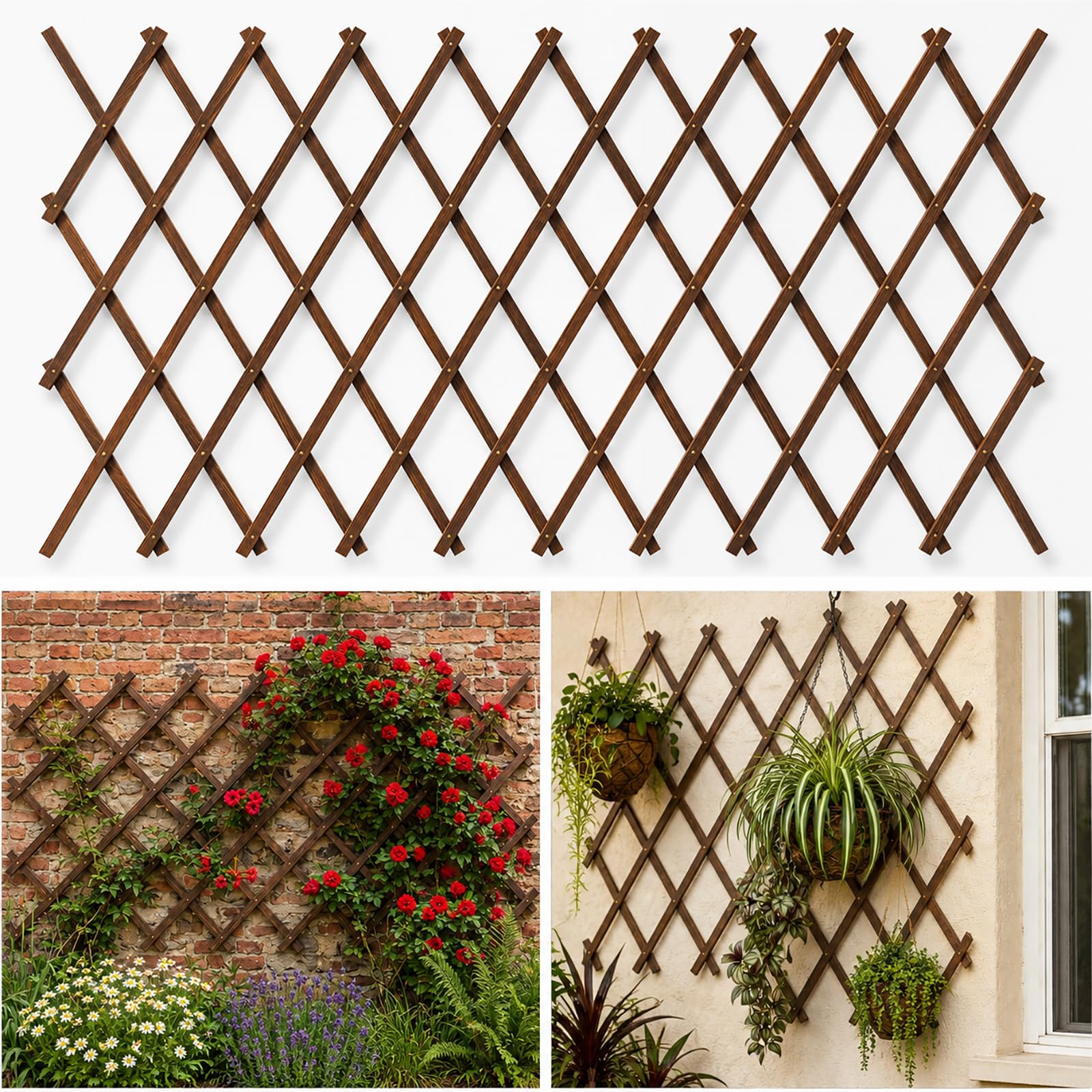
The pitch here is versatility — garden fence, privacy screen, wedding backdrop, holiday display — and the list is not as much of a stretch as it sounds. A single panel that opens to 75 inches by about a foot will do all of those, well or badly depending on where you put it.

Where it does well is a narrow vertical surface: the wall beside a front door, the end of a balcony, the strip of fence between two shrubs. Carbonized wood and riveted joints give it a darker, more finished look than raw pine, and it comes down in a minute when you want the wall back.

It is light enough that two cup hooks or a few zip ties hold it, so putting it up on a Saturday morning takes about as long as finding the drill. Make sure the hooks go into something solid rather than siding.

Buy one first if you are unsure of the look, then add a second when you know. Two side by side make a proper screen; one on its own is an accent, and a wall more than a couple of feet across will look unfinished with just the one.

Bottom line: One light panel to try on a narrow wall; put hooks in the same order and expect to come back for a second.

7

Miuwauer Wood Lattice Panel

Miuwauer Wood Lattice Panel

One climber

Our Score 8.6/10
Check Price

Worth Noting

  • Stitched joints and slim slats suit light climbers
Weight
1.6 lb
Material
Natural wood
Expanded Size
13.4 x 78.8 in
Panels Per Pack
1
Read the full review

This is the least expensive of the single panels here, and the build tells you why: the joints are stitched rather than riveted, the slats are slim, and the whole thing weighs under two pounds. None of that is a problem if you are hanging it on a sheltered balcony behind a pot.

It opens to 13.4 by 78.8 inches and folds back to roughly 11 by 17, so it stores behind a door and moves between seasons without ceremony. The wood is unfinished, which means it takes paint or stain if you want it to match a railing, and the diamond pattern gives a twining vine plenty to grab.

For a first trellis, or one clematis on a rented balcony, it is the least painful way to find out whether a lattice panel suits your space — and the money you save leaves room for a second panel when the vine outgrows the first.

Bottom line: The cheapest way to find out whether a lattice panel suits your balcony, provided the plant is a light one.

8

Tilinyan 38-Inch Lattice

Tilinyan 38-Inch Lattice

Wide blank walls

Our Score 8.6/10
Check Price

Worth Noting

  • Wide pine panel can warp when exposed
  • Priciest single panel here
Assembly
None required
Material
Carbonized pine
Expanded Size
38 x 89 in
Panels Per Pack
1
Read the full review

Thirty-eight inches is wide for an expandable panel, and it changes what the trellis is for. This one covers a blank wall or the end of a patio in one piece instead of three, which is the difference between a screen and an accent.

Nothing about it needs assembling: open the lattice, set the size you want, and hang it. It folds back into a bundle at the end of the season, and the diamond pattern gives roses and clematis plenty of tie points without the whole thing looking like netting.

Fix it at both ends and the middle, because a 38-inch span gives wind more to catch than a narrow panel does. Given that, the frame sits flat against the wall and the grain reads as furniture rather than fencing.

Where it earns its place is a decorative wall behind seating, or a patio corner that wants one clean sweep of lattice. For an exposed fence run the cedar four-pack is the better buy; this one is at its best where you can see it and the weather cannot get a straight run at it.

Bottom line: For covering a wide wall in a single piece this is the panel we reach for, provided the wall is a sheltered one.

How We Tested Expandable Garden Trellises

We started with a list of two dozen expandable trellises sold by garden centers and online retailers, then narrowed it to 14 based on advertised size range, materials, and price. We wanted a mix of wood, metal, and plastic, and we skipped anything that looked like it would arrive bent or need a drill to assemble. Each trellis lived outdoors for seven months—on a windy balcony, against a garage wall, and in a humid greenhouse—so it saw rain, heat, and a few gusts that made me nervous.

We assembled each one solo, timing how long it took and noting whether the clamps, hinges, or locking pins felt flimsy. We expanded and collapsed them repeatedly to see if the joints loosened, then planted climbing beans and clematis at the base. Once the vines started running, we clipped stems to the grid and checked after a week of wind and watering whether the clamps held or the stems slipped. We also measured the actual expanded width against the advertised size, because a few ran small.

We nudged the frame to see how much it rocked, left them through rain and two heat waves, and sniffed each one right out of the box for chemical odor. We stepped back to judge how each looked against a stucco wall and a wooden fence, and at the end we compared what you get for the money—welds, powder coating, hardware—to decide whether we'd buy it again.

How to Choose Expandable Garden Trellises

Expansion Trades Width for Height

An expandable lattice is one continuous accordion, which means it can be tall and narrow or short and wide, but not both at once. The CJGQ panels show the arithmetic: closed they measure about 17 by 10 inches, opened they are 12.8 wide and 67 tall.

Decide which dimension you actually need before ordering. Listings quote the closed size, the title, and the expanded size almost interchangeably, so check which figure you are being given. If you need real height and real width, buy two panels and set them side by side, or choose a wider model such as the 38-inch Tilinyan.

Wood, Willow, or Metal

Material decides where the panel belongs. Willow is a screen first — beautiful, light, and at its best on a sheltered porch or against a wall. Carbonized wood and cedar have more structure and take a screw, so they suit fence runs and exposed walls. Powder-coated metal is the pot-and-shelf option, and the only material here that looks at home in a living room.

Whatever you choose, thin stock bows and splits. Pilot-hole every screw, and fix the panel at both ends so the lattice cannot walk itself closed.

How It Stays Up

An expandable panel has no feet. It holds its shape because you fasten it — at both ends, and at the middle on a long span — to a wall, a fence post, or a railing. Cup hooks, screws, and zip ties all work; what matters is that the fixing goes into framing or masonry rather than siding or mortar.

Fixings are usually not in the box — the Avalution listing says so outright — so add a packet of hooks to your order. On a balcony, treat the panel as a sail: anchor top and bottom, or the first gust folds it shut.

How Many Panels, and What Will Climb Them

One panel is a vertical accent, not a screen; the Avalution and Miuwauer panels are barely a foot wide. For a fence run, count panels rather than hoping: four 13-inch panels cover a little over four feet at full width, which is why the Bounmer four-pack suits a long run.

Then match the frame to the plant. Twining vines — clematis, morning glory, ivy, jasmine, pothos — grip a lattice on their own. Heavy croppers such as squash and cucumbers want the most rigid frame you can give them, not a willow screen.

Frequently Asked Questions

Final Verdict

Buy the Bounmer four-pack if one order should sort out a fence run. Four cedar panels with real thickness and riveted joints give you the most coverage per box here, and they are light enough to hang with ties.

If your climbing plants live in pots, the Xeeol frames are the better answer: two black arches that slide to height and disappear into the foliage. And if the trellis is going somewhere people will see it, the LANDGARDEN willow panel looks better than anything else in this set — measure the gap first, because the listing will not settle it for you.