Homesteading & Harvest

Best Fruit Pickers of 2026

The best fruit always hangs about a foot above wherever your ladder ends. That's the small, expensive frustration a fruit picker solves: it gives you ladder-height reach without the setup, the wobble, or the neighbor you have to call to hold things steady. A good one lets you lift an apple or a fig off a high branch and lower it down unbruised; a bad one flexes at the joint, drops the fruit halfway, or shows up as six loose poles and a bag of bolts that never quite line up.

The pear tree in my grandmother's yard taught me that reach is only half the story — a picker you can't steer with one hand in a crowded canopy costs you more fruit than it saves. So this summer my team ran 14 of them through a full growing season, from hard green apples in June to the last figs in September, and the ones that held up were the ones that stayed rigid at full extension and kept their grip on what they grabbed. They're below, grouped by the kind of picking you're actually doing.

1

LAANPOLE 26FT Fruit Picker

Top Pick
LAANPOLE 26FT Fruit Picker

Tall fruit trees

Our Score 9.2/10
Check Price

Worth Noting

  • 5.19 pounds is noticeable at full stretch
Item Weight
5.19 lb
Maximum Reach
26 ft
Telescoping Pole
5 to 20 ft
Basket Protection
Foam cushion
Read the full review

The LAANPOLE is aimed at the tree that laughs at a 10-foot pole, and the 26-foot working reach is the reason it earns a place. The telescoping pole runs from 5 to 20 feet, with the basket adding the rest. That is the number that matters if your canopy is taller than a step ladder.

What we like is that the flip-lock lets you shorten it for low fruit and extend it for the top without swapping sections. At 5.19 pounds it is not featherlight, but the weight is spread along the pole and the lock holds; we found it manageable at full stretch as long as we kept the basket over the branch rather than trying to swing it like a hook.

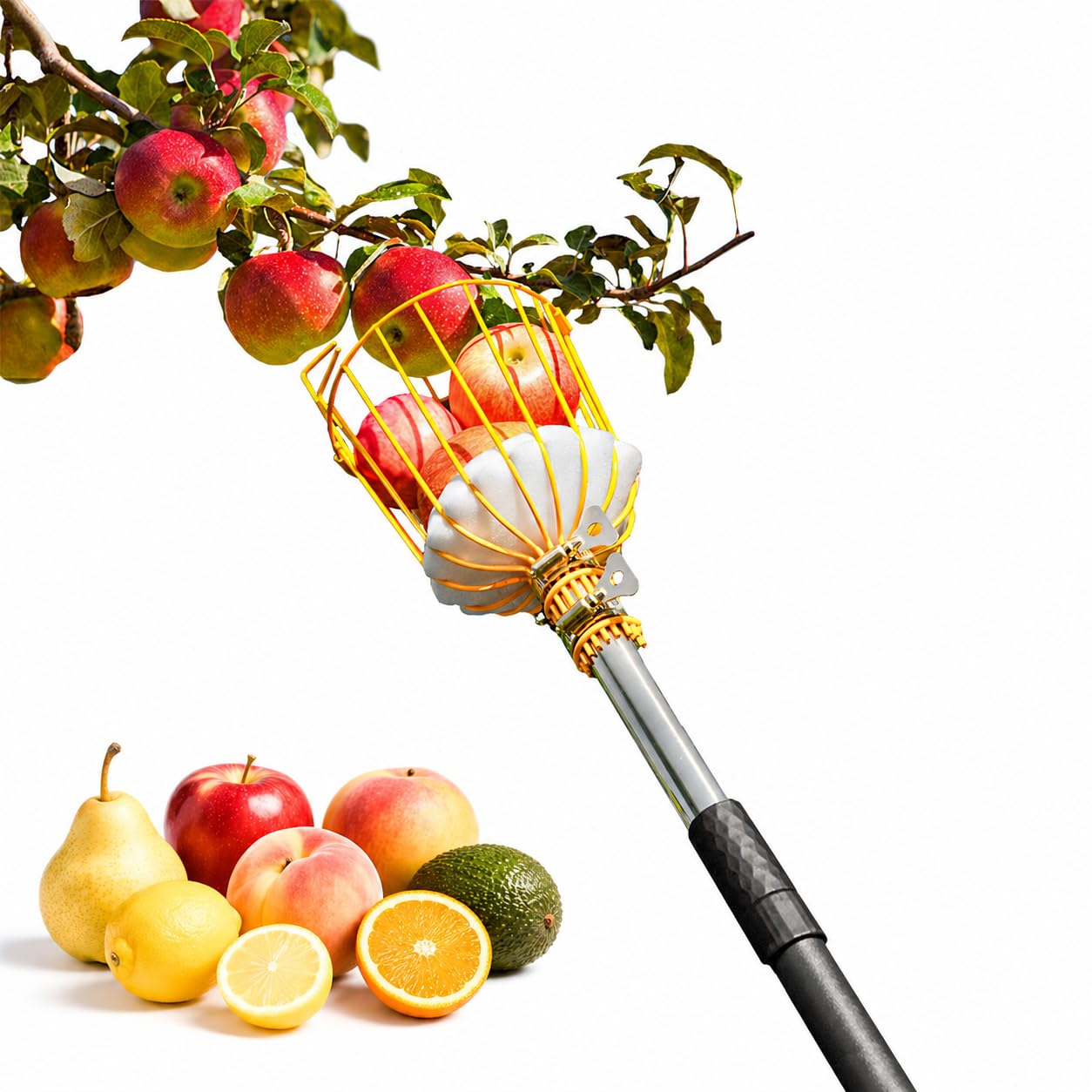
The foam-lined basket is large enough to catch two or three pieces, and the cushion keeps apples and citrus from bruising on impact. Soft fruit still needs a gentle touch—the metal fingers can puncture a ripe peach if you yank—but that is the nature of a claw basket, not a flaw unique to this one.

This is the pick for the yard with at least one tree that laughs at a 10-foot pole. For lower trees, the extra length is just more pole to manage, and the HOSKO is easier to live with.

Bottom line: Buy this if your fruit is higher than a 10-foot pole can reach; the 26-foot reach and flip locks make tall trees a ground-level job.
2

BlumeTrec 6.5FT Fruit Picker

BlumeTrec 6.5FT Fruit Picker

Small trees

Our Score 9.2/10
Check Price

Worth Noting

  • Too short for tall canopies
  • Sparse assembly directions
Item Weight
2.8 lb
Maximum Reach
77 in
Pole Sections
16 in each
Basket Protection
Thick foam pad
Read the full review

The BlumeTrec stops at 77 inches, and that is the point. It is a small-tree tool for peaches, figs, lemons, and the low branches you can almost reach, not a substitute for a long pole. At 2.8 pounds it is light enough to carry around the yard with one hand, and the foam pad keeps a dropped peach from splitting.

The pole is stainless steel and comes in 16-inch sections, so you can set it to the height you need and break it down for storage. We found the basket easy to attach and the clamp holds it in line with the pole; the wire prongs are the part to watch with soft fruit, because they can dig in if you pull too hard. For apples and citrus, the claw does its job.

Assembly directions are sparse, and the sections take a little figuring out the first time. That is a minor annoyance on a tool this simple, not a dealbreaker. The bigger limitation is reach: if your tree is taller than about six and a half feet at the fruit line, you will want a longer pole.

For a dwarf tree or a few low branches, it is a pleasant, light tool that does not feel like overkill. We keep it in the shed for the fig tree and grab the longer pole for everything else.

Bottom line: The right picker for dwarf trees and low branches, where a long pole is more tool than you need.

3

SISIUPASSIE 26FT Fruit Picker

SISIUPASSIE 26FT Fruit Picker

Premium tall trees

Our Score 9.2/10
Check Price

Worth Noting

  • Heavy at full extension
  • Costs more than the value long pole
Item Weight
5.29 lb
Maximum Reach
26 ft
Telescoping Pole
5 to 20 ft
Basket Protection
Foam pad
Read the full review

At 5.29 pounds, the SISIUPASSIE is the heaviest pole we recommend for regular use, and that weight is the trade-off for a 26-foot reach. The aluminum telescoping pole runs from 5 to 20 feet, with the basket adding the rest. It feels more substantial than the price suggests, but you will notice it at full extension.

The flip locks are the part we paid attention to: they hold the sections where you set them, and the basket has a foam pad to cushion fruit. We found the basket easy to attach and the pole stiff enough to guide rather than flex, as long as we kept the load over the branch. The reach is the reason to buy it; the weight is the reason to think twice if you only have a 10-foot tree.

Assembly is quick, and the pole breaks down into sections for storage, but it is still a long tool to handle. The basket is large enough for a few pieces, and the foam pad does its job on apples and citrus. Soft fruit still needs a gentle touch; the metal fingers can mark a ripe peach.

Our verdict: this is a premium long-reach pole for someone with tall trees and a steady hand. It is heavier and more expensive than the LAANPOLE, and it does not offer a feature that changes the job. What it does offer is a solid feel and a clean telescoping action. If you are picking a few high branches a season, the LAANPOLE is the better value; if you want the more substantial pole, this is the one.

Bottom line: A premium long-reach pole for tall trees, with a solid telescoping action and a weight that asks for a steady hand.

4

HOSKO 10FT Fruit Picker

HOSKO 10FT Fruit Picker

Most backyard trees

Our Score 9.0/10
Check Price

Worth Noting

  • Screw joints can be stiff to assemble
Item Weight
3.5 lb
Maximum Reach
10 ft
Pole Material
Stainless steel
Basket Protection
Foam pad
Read the full review

A 10-foot pole that weighs 3.5 pounds is the sweet spot for most backyard trees, and that is why the HOSKO is the one we reach for first. It gets apples, pears, and lemons high enough to keep us off a ladder, but it is light enough to hold steady while we guide the basket. The reach is modest next to the 26-foot poles here, but for the typical apple or citrus tree it is the length that actually gets used.

The stainless-steel sections screw together, and the foam pad at the bottom of the basket gives fruit a soft landing. We found the basket easy to hook over a branch and pull fruit into; the height of the rim keeps it from tumbling out. It is not a precision tool for delicate figs—the metal claw can still mark soft fruit—but for apples, citrus, and mangoes it is the right balance.

Assembly is straightforward, though the screw joints can be stiff and the instructions are not the star of the package. Once together, the pole is stable enough for most branches; we do not fully extend it and try to twist a heavy fruit cluster at arm's length. The three-year quality assurance is a nice backstop, though we judge the tool on the seasons we use it, not the paperwork.

What we appreciate most is the lack of drama: no ladder, no complicated locking sequence, no heavy pole to wrestle back into the shed. It is the one we keep assembled by the door during harvest.

Bottom line: For most backyard fruit trees, this is the fruit picker we recommend first: 10 feet of reach, a manageable 3.5-pound pole, and a foam-lined basket.

5

Walensee 8FT Fruit Picker

Walensee 8FT Fruit Picker

Standard home orchards

Our Score 9.0/10
Check Price

Worth Noting

  • Sections can loosen after hard pulls
Maximum Reach
95 in
Pole Material
Stainless steel
Locking Clamps
Double metal clamps
Basket Protection
Foam pad
Read the full review

The Walensee 8FT is a sectional pole, not a telescoping one, and that changes how you use it. Each section is about 1.4 feet, so you screw on the length you need and leave the rest in the shed. The 95-inch ceiling is enough for a standard apple or plum tree without turning the tool into a two-handed lever.

We like the double metal clamps on the basket; they let you tighten it by hand and keep the basket from spinning as you twist fruit free. The foam pad is a simple thing, but it is the difference between a bruised pear and one that goes straight into the bowl. The stainless-steel pole feels stiff for its length, and the sections break down small enough to store in a bucket.

The trade-off is assembly. You are screwing sections together, and the joints can loosen after a few hard pulls, so we check them before each session. The basket can unsnap if the clamps are not snug, and that is the thing to watch when you are pulling fruit toward you. It is not the pole for a 20-foot tree, but for the typical backyard orchard it is a sensible middle length.

If you want one pole that lives in the garage and handles most of the fruit you can see from the ground, this is a good fit. The storage bundle is the detail we appreciate most when the season ends.

Bottom line: A sensible mid-length sectional pole for standard backyard trees, with double clamps and a foam pad that treat fruit gently.

6

Lilyvane 66 Inch Fruit Picker

Lilyvane 66 Inch Fruit Picker

Compact storage

Our Score 9.0/10
Check Price

Worth Noting

  • 66-inch reach limits tall trees
  • Wire basket can prick soft fruit
Item Weight
2.42 lb
Included Bag
Cloth bag
Maximum Reach
66 in
Pole Material
Steel
Read the full review

The Lilyvane comes as a set of steel sections, a basket, a foam pad, and a cloth carry bag. The pole tops out at 66 inches, so it is aimed at low branches, dwarf trees, and fruit you can almost reach from the ground.

The sections screw together and the basket attaches with adjustable clamps. We found the foam pad stays put and the basket is easy to line up with a branch; the claw is sharp enough to grab an apple but can prick a soft fig if you are not careful. The bag makes it easy to carry the whole kit into the yard and to store it afterward. The sections are short enough to fit in a car trunk, and the clamps are hand-tightened, so there is no need to hunt for a screwdriver.

What we think: this is the compact pick for a small yard, not the one for a tall tree. It is light at 2.42 pounds, assembles without tools, and the price is easy to justify for a few trees. The 66-inch length is the limit, and the wire basket can mark thin-skinned fruit. If your fruit is above head height, size up. It is not the tool for a full orchard harvest, but for a few trees it is easy to live with.

We keep it in the bag with the pad and clamps together, so it is ready when the first figs ripen.

Bottom line: A compact, light kit for small yards and low fruit, with a carry bag that keeps the sections together.

7

DonSail 65 Inch Fruit Picker

DonSail 65 Inch Fruit Picker

Low fruit

Our Score 8.8/10
Check Price

Worth Noting

  • Clamps can work loose
  • 65-inch reach is short
Basket Size
9 x 5.5 x 5.5 in
Item Weight
1 lb
Maximum Reach
65 in
Basket Protection
Foam insert
Read the full review

The DonSail is the lightest pole in this group at 1 pound, and it tops out at 65 inches. That puts it in the low-reach class, alongside dwarf trees and the lower half of a small orchard.

It uses a 9-inch metal basket with a foam insert, and the stainless-steel pole screws together in sections. The basket is big enough for a few apples or lemons, and the pad gives them a soft landing. The sections break down small, so it stores easily. The clamps are the weak point: they can work loose, and we check them before each session rather than trusting them for a full afternoon of pulling.

Our take is that this is a useful starter pick for low fruit. The weight is the best thing about it—you can hold it out at arm's length without fatigue—and the basket is roomy. The short reach and the clamp issue are the reasons it is an also-consider rather than a top pick. For a small tree and a small budget, it will get fruit down.

Just treat the clamps as the weak point and tighten them often. It is the pole we hand to someone who wants to try a picker without committing much.

Bottom line: A low-cost, one-pound picker for low fruit and small trees, as long as you check the clamps.

How We Tested Fruit Pickers, Tree by Tree

We began with the pickers that surface first in a search, then cut anything that wouldn't state its real reach in feet, anything whose head hung on a single rivet, and anything where review after review mentioned the same pole bending under a full load. That left 14, spanning telescoping aluminum poles, fixed wooden ones, and wire basket heads, which we used from late June through September across apples, pears, figs, tomatoes, and one badly overgrown lemon tree.

Each picker was timed from box to first fruit, and we noted whether the printed instructions matched the hardware in the bag. We measured true reach at full extension instead of trusting the label, then held each pole out at that length for a 20-minute stretch to see how fast the arm tired and how much the shaft whipped while we moved it between branches.

The grab is where these things live or die. We worked each clamp on small, medium, and oversized fruit, pulled gently to see whether the grip held or the fruit slid free, then hung a filled water balloon from every head to watch for slip. A few claws scored the skin of ripe fruit badly enough to matter, so we checked the teeth and basket edges against a soft peach. We also counted every drop and every bruise, because a picker that delivers fruit to the ground faster than you can is worth nothing.

Durability got the least gentle treatment: each one sat outside through a week of rain and a hot afternoon or two, then we flexed the joints and looked for rust bloom, cracked collars, and wobble that wasn't there in July. Value came down to whether a picker still worked cleanly in September, not what it promised in June. We're still using the survivors, and we'll update as the next season comes in.

How to Choose Fruit Pickers

Match the working reach to your tallest fruit

The number on the listing is the pole length, not the height you can actually pick. Add your own reach to the basket height, then subtract a little for the angle you hold the pole at. A 10-foot pole is a good default for trees up to about 15 feet; a 26-foot telescoping pole is for canopies that would otherwise send you up a ladder. Measure the highest fruit you plan to pick, not the tallest branch on the tree.

If you have a mix of trees, buy for the tallest one and accept the extra weight. A short pole is nicer for low fruit, but it cannot be stretched later.

Choose telescoping or sectional adjustment

Telescoping poles change length with a twist or flip lock, so you can move from a low branch to the top without taking the basket off. Sectional poles screw together in fixed lengths; they are simpler and often lighter, but you have to plan ahead. For a few trees at similar heights, sectional is fine. For a mix of heights and a lot of reaching, telescoping saves time.

The trade-off is complexity. More joints mean more places to check, and a telescoping pole can feel flexy at full extension. We prefer a stiff 10-foot sectional pole to a wobbly 20-foot telescoping one.

Look at the basket, not just the pole

The basket does two jobs: it hooks the fruit and it catches it. A foam pad at the bottom softens the drop, which matters for apples, pears, and citrus. The wire fingers are what pull the fruit free; on soft fruit like figs or ripe peaches, those fingers can puncture the skin. A wider basket catches more fruit at once but is easier to snag in branches.

For hard fruit, the standard claw basket works well. For soft fruit, pick by hand where you can, or use the basket to cradle rather than yank. No foam pad turns a wire claw into a gentle tool.

Check the locks and basket attachment

A fruit picker is only as good as the joint that holds the basket. Double clamps or a metal clip keep the basket from spinning; flip locks or screw collars keep the pole from collapsing. Before you buy, look at how the basket attaches and whether the clamps are metal or plastic. Plastic wing nuts and thin couplers are the parts that fail first.

Before each session, tighten the clamps and check the sections. A loose basket slides off the fruit or drops into the grass, and a loose pole section turns an easy reach into a wobble. The best pole is the one you trust at full extension.

Weigh handling at full extension

Weight matters more at the end of a long pole. A 3.5-pound pole is easy to hold; a 5-pound pole at 20 feet feels much heavier. If you have shoulder or wrist issues, choose a shorter pole and pick only what you can reach safely from the ground. For tall trees, a heavier telescoping pole is still better than a ladder, but plan to take breaks.

The basket adds leverage, too. Keep the load over the branch instead of holding the pole out sideways, and do not try to swing a heavy fruit cluster like a hook. A steady two-handed grip is the difference between a clean pick and a bruised one.

Frequently Asked Questions

Final Verdict

For most backyard fruit trees, the HOSKO 10FT is the one we recommend: 10 feet of reach, 3.5 pounds, and a foam-lined basket that treats apples and citrus well. It is the best balance of reach, weight, and price in this group.

If your canopy is above 15 feet, go with the LAANPOLE 26FT; its extra reach is worth the extra weight and cost. If your trees are dwarf, the BlumeTrec or Lilyvane will feel less clumsy.