Homesteading & Harvest

Best Food Dehydrators of 2026

A food dehydrator is really just a heating element and a fan in a box, which is why it's easy to assume they all work the same. They don't. The good ones hold a low, steady temperature for eight or ten hours, push air evenly across every tray, and hum quietly enough that you forget they're running overnight — which is the difference between jars of jerky and dried apples in January and a sheet pan of scorched, half-damp mush.

Over the past six months my team and I have kept 12 dehydrators running on our counters, and the pattern that emerged had less to do with how many trays a unit advertises than with temperature control that actually holds, airflow that reaches the back corners, and racks that don't need a chisel afterward. One thing nobody tells a first-time buyer: the drying times printed in the manuals are optimistic, usually by hours. Below are the machines that earned their counter space.

1

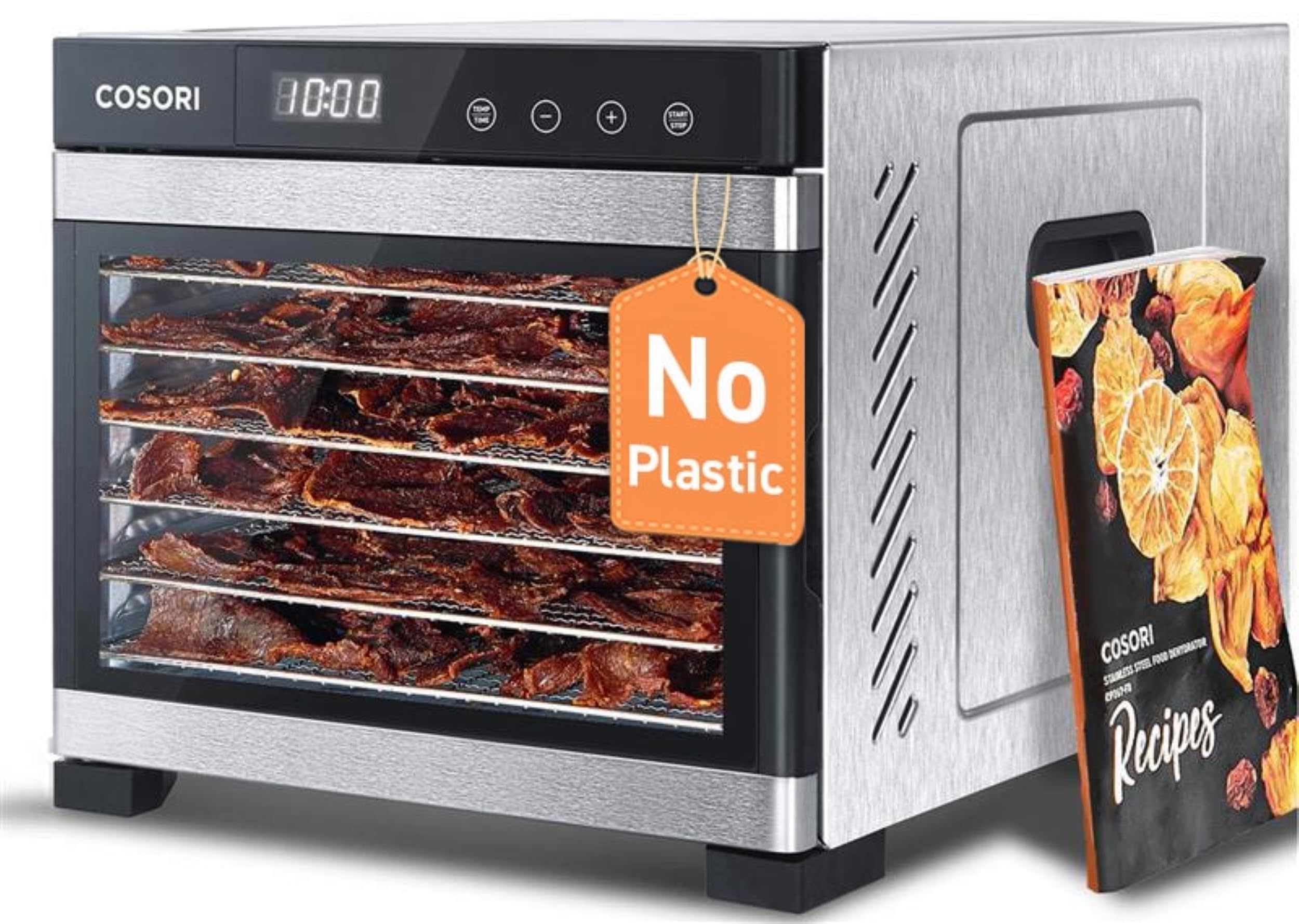
Cosori 6-Tray Dehydrator

Top Pick
Cosori 6-Tray Dehydrator

All-round home drying

Our Score 9.4/10
Check Price

Worth Noting

  • One fruit roll sheet for six trays
Timer
48 hours
Trays
6 stainless steel
Drying Area
6.5 sq ft
Temperature Range
95-165 °F
Read the full review

Forty-eight decibels is the number that decided it for us. A dehydrator runs for hours, often overnight, and the Cosori is quiet enough that we stopped registering it from the next room. That's the rear-mounted fan and the brushless motor earning their keep, and it's why this is the machine we hand most people first.

The rest of the machine holds up. Six stainless trays give you 6.5 square feet, enough that a five-pound batch of sliced meat goes in at once, and the temperature runs from 95 to 165 °F in single-degree steps with a timer up to 48 hours and automatic shutoff. That spread does the whole job: fruit leather and herbs down low, jerky at the top. Stainless doesn't hold on to smoke or onion the way plastic does, the trays go in the dishwasher, and the box includes a mesh screen, a fruit roll sheet and a recipe book.

Where it asks something of you is space. At 18.1 pounds and 12.4 inches tall it wants a shelf or a counter corner of its own; hauling it in and out of a cupboard every weekend gets old fast. Give it a permanent spot and the size stops being a problem — which is true of every machine worth owning in this category.

The Magic Mill Pro is the alternative if jerky is your main event, since it goes 11 degrees hotter and lines the cabinet in stainless. The Cosori answers with two years of manufacturer coverage, more than anything else here, and a quieter run. For a kitchen that dries a bit of everything, that's the better trade.

Bottom line: Our pick for most kitchens: quiet enough to run overnight, big enough for a five-pound jerky batch, and precise from 95 to 165 °F.
2

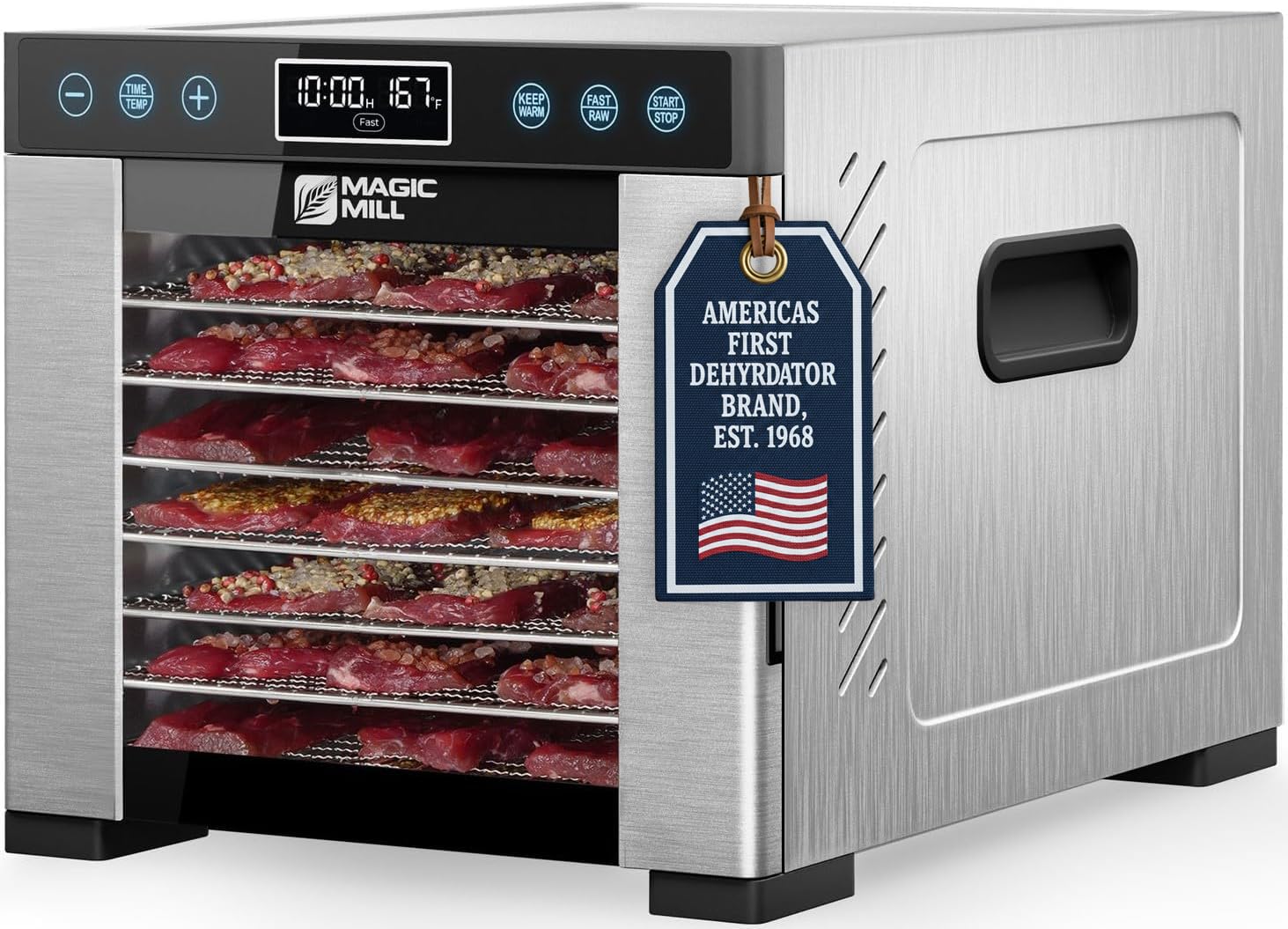
Magic Mill Pro 7-Tray

Magic Mill Pro 7-Tray

Jerky and meat

Our Score 9.4/10
Check Price

Worth Noting

  • No stated warranty period
Build
Stainless interior and exterior
Timer
48 hours
Trays
7 stainless steel
Temperature Range
95-176 °F
Read the full review

No plastic walls. That's the short version of why we kept coming back to the Magic Mill Pro: the interior is stainless, not just the trays, and the heat climbs to 176 °F where the Cosori stops at 165. For jerky, that headroom is the difference between drying meat and fussing over it.

It's also the more compact of the two. The cabinet measures 15.5 by 11.3 by 10.8 inches — smaller than the Cosori in every direction — yet it holds seven trays, and it's lighter despite the extra one. The rear fan moves air across all of them, so nothing needs rotating halfway through a long run, and the controls step in single degrees with a 48-hour timer in half-hour increments and automatic shutoff. It's ETL listed with overheat protection, which we care about on a machine people leave running while they sleep.

The trade is coverage. Cosori backs its machine for two years and Magic Mill doesn't state a warranty term for this one, which matters once a fan or an element is out of coverage. If jerky and high-heat work are the point, that's a reasonable gamble; if you want the safest ownership, the Cosori is the safer buy.

Bottom line: We recommend it for jerky above all: stainless inside and out, 176 °F of headroom, and even airflow without rotating trays.

3

Presto 06300 Dehydro

Presto 06300 Dehydro

Simple meat batches

Our Score 9.2/10
Check Price

Worth Noting

  • Fixed temperature, so herbs dry too hot
  • No timer or automatic shutoff
Trays
4, expands to 8
Wattage
600 W
Dimensions
15.25 x 14.25 x 6.5 in
Temperature
165 °F, single setting
Read the full review

There's no thermostat. The Presto runs at a single heat — the spec lists 165 °F, and it holds in that neighborhood — so you plug it in, and you unplug it when the batch is done. No timer, no dial, no automatic shutoff. That's either a dealbreaker or exactly what you want, and which one depends entirely on what you plan to dry.

For jerky, fruit leather and dog treats, it's the best value here. A 600 W element and a top-mounted fan push air down through four trays without any rotating, and the stack expands to eight trays if you buy more later, so the batch grows without replacing the machine. Cleanup is straightforward: the trays are dishwasher safe and the base wipes down.

Where it falls down is anything that wants low heat. Herbs dried at a fixed 160-odd degrees lose the oils that made them worth growing, and vegetables come out case-hardened — leathery outside, still damp within. If your drying is mostly basil and kale chips, spend more on a machine with a real range. If it's mostly meat, this one is simple, cheap to own and honest about what it does.

Bottom line: We rate it for jerky and fruit leather on a tight budget, and steer it away from herbs — there's no thermostat, just one heat.

4

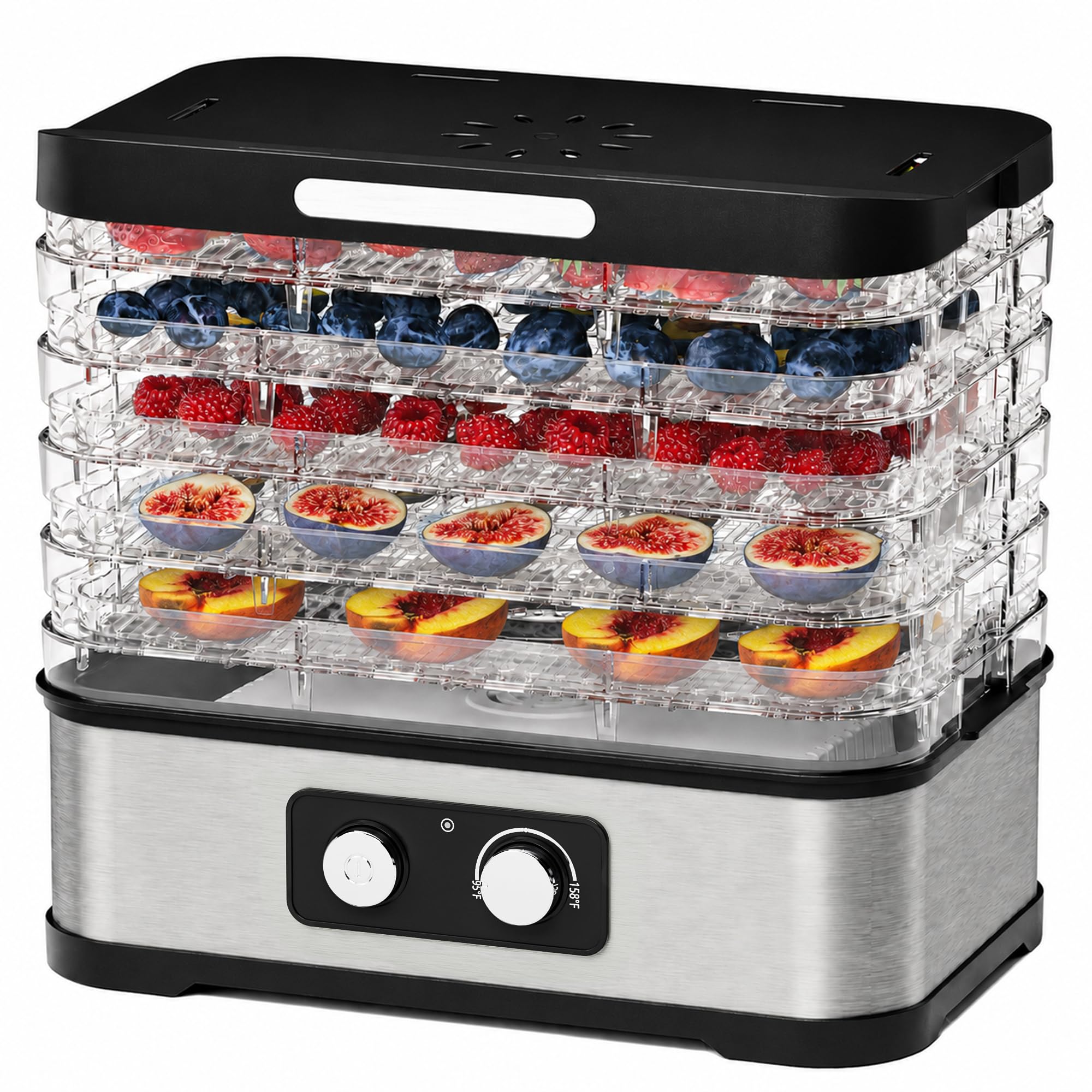
Konfintos 5-Tray Dehydrator

Konfintos 5-Tray Dehydrator

Small kitchens

Our Score 8.8/10
Check Price

Worth Noting

  • Small batches: 250 W and a 158 °F ceiling
Timer
Up to 72 hours
Trays
5, height adjustable
Dimensions
11.81 x 7.28 x 7.87 in
Temperature Range
95-158 °F
Read the full review

Eleven and three-quarter inches wide, under eight inches tall, under four pounds: the Konfintos fits where the others won't. That's the whole argument. It's the machine for a galley kitchen, a dorm room, an RV, or a counter that already has a coffee maker and a toaster fighting over it.

Five clear trays stack inside that footprint, and each sits at one of two heights, so thicker pineapple slices or a layer of jerky strips don't have to fight the slot. The knob covers 95 to 158 °F and the timer runs to 72 hours, long enough for mushrooms or a tough cut, and the trays are dishwasher safe as long as the wash stays under 158 °F — which is worth remembering before you run a hot cycle.

We like it precisely because it doesn't take over. It sips power at 250 W, it's quiet enough to leave running in a small apartment, and when the batch is done it goes back in a cupboard. The catch is throughput: five small trays and a 158 °F ceiling mean a few apples or a small batch of jerky at a time, not a garden harvest. For herbs, dog treats and snack-sized loads, that's the right trade.

Bottom line: For a small kitchen, this is the one we reach for: five trays in under a foot of counter, quiet, and easy to put away.

5

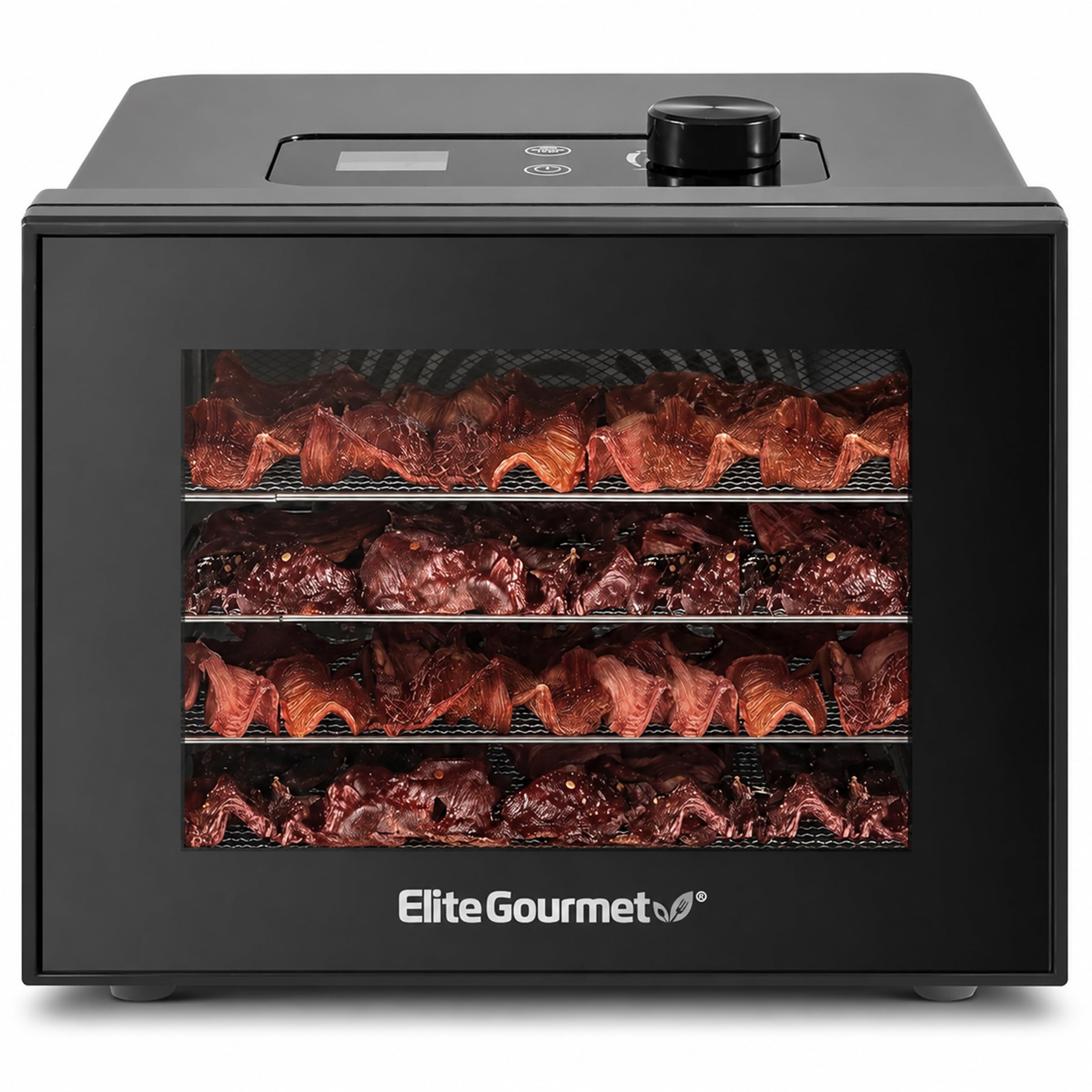
Elite Gourmet EFD308

Elite Gourmet EFD308

Herbs and snacks

Our Score 8.8/10
Check Price

Worth Noting

  • Four shallow trays hold very little
Timer
24 hours
Trays
4 stainless steel
Dimensions
11.5 x 10 x 8 in
Temperature Range
95-158 °F
Read the full review

Four trays, and shallow ones. A sliced onion or a heap of kale fills a single layer and leaves the rest of the stack empty, which is the honest limitation of the Elite Gourmet: this is a small-batch machine and it doesn't pretend otherwise.

What you get in exchange is real control at a tiny size. The temperature adjusts from 95 to 158 °F and the digital timer runs to 24 hours with automatic shutoff, so you can set it and walk away — more than the simplest machines here manage. The trays are stainless and dishwasher safe, and the cabinet is eight inches tall, which means it lives under a shelf or on top of a microwave without complaint.

We kept it on this list for herbs and small snacks: basil, parsley, mushroom slices, apple rings, one batch of jerky at a time. It's ETL listed, quiet, and light enough to move with one hand. If your drying is measured in handfuls rather than pounds, the size is the feature; if you're processing a harvest, it will drive you up the wall.

Bottom line: A herb-and-snack machine we're happy to recommend when four shallow trays are enough and the counter is short.

6

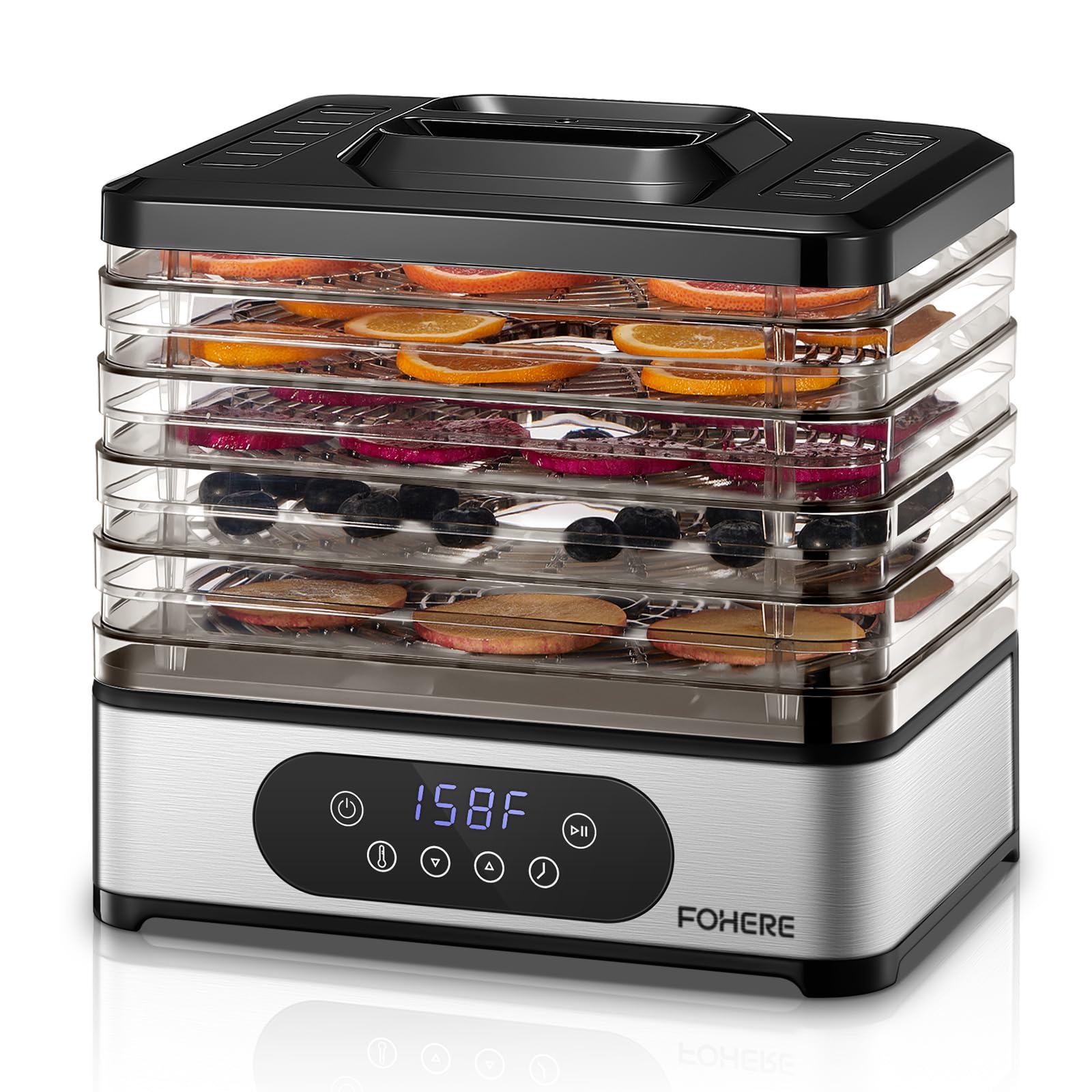
FOHERE 5-Tray Dehydrator

FOHERE 5-Tray Dehydrator

First-time buyers

Our Score 8.2/10
Check Price

Worth Noting

  • Slow on dense, wet food
  • Plastic trays rather than stainless
Timer
48 hours
Trays
5, two heights
Dimensions
11.42 x 8.27 x 8.66 in
Temperature Range
95-158 °F
Read the full review

The trays are the interesting part, and they're why this one made the list. Five of them stack inside an 11.42-inch frame, and each sits at one of two heights — 0.59 or 0.98 inch — so you can make room for thicker slices without buying another accessory. When the batch is over they nest down and the cord wraps around the base, which is more thought than the design strictly needs.

It's a 400 W machine with 95 to 158 °F of adjustment and a 48-hour timer, so the controls match anything else at this end of the group: set a temperature, walk away, come back to food that's done rather than a machine still running. The trays and lid are dishwasher safe and the whole thing weighs 4.2 pounds.

What it isn't is fast. Dense, wet food — peach halves, tomato slices — takes its time at 400 W, and the plastic trays won't age like stainless. As a first dehydrator, or a second one for herbs and dog treats, it earns its place: honest controls, a small footprint, and the least expensive tier in this group.

Bottom line: We point beginners here: five trays, a 48-hour timer, and slow going on wet fruit.

How We Tested the Best Food Dehydrators

We started by pulling every dehydrator we could find from brands shoppers actually review — tray-stacking workhorses, stainless cabinet styles, budget models sold everywhere — then cut the list to 12 based on price, usable drying area, and whether the thermostat adjusted in real increments rather than a single on/off switch. Over six months, each one ran the same four jobs: a two-pound batch of beef jerky, a full load of apple rings, strawberry fruit leather, and garden herbs.

Temperature was checked with a probe at the low, middle, and high end of each machine's range, left an hour to settle, so we could see which ran hot, which ran cold, and which swung. We timed every batch to doneness rather than to the manual, then checked top and bottom trays separately to see whether the back corners dried as fast as the front.

Noise got measured the way you'd actually notice it: a decibel reading at counter height, and a second one from the doorway of the next room with a batch running overnight. Size was judged on a real counter pushed back under the cabinets, watching how much work space disappeared and whether the lid cleared the overhead.

Cleaning came after the fruit leather, which is the honest test — which racks needed soaking, which seams trapped sticky residue, which parts were dishwasher-safe. Value came down to usable square feet of drying area per dollar, not the tray count printed on the box.

How to Choose Food Dehydrators

Start with the temperature range

Herbs want 95 to 115 °F, vegetables around 125 to 135, fruit about 135, and jerky 145 to 165. A machine with a real range covers all of that on one box. A single-heat machine like the Presto, which holds somewhere around 165 °F, makes very good jerky and disappointing basil, because the oils that give herbs their flavor cook off well below that.

Check both ends of the range, not just the top number. A machine that stops at 158 °F is fine for meat and fruit and has no low gear for delicate leaf drying; one that starts at 100 °F can't hit the herb window either. Single-degree steps matter if you plan to follow recipes closely.

Where the fan sits matters more than wattage

A rear-mounted fan pushes air across every tray, which is why the Cosori and the Magic Mill Pro don't ask you to rotate anything mid-run. Bottom- and top-mounted designs work, but plan on swapping tray positions once or twice during a long batch, especially with a full stack.

Wattage tells you how much heat is available to move moisture, not how evenly it lands. A 600 W machine with a rear fan is usually the better bet than a more powerful one blowing up from the base, and it will generally dry a mixed load more consistently.

Match drying area to what you actually dry

Six trays aren't automatically better than four; tray area and spacing matter more. The Cosori spreads 6.5 square feet across six trays and takes a five-pound batch of sliced meat. The Elite Gourmet's four shallow trays hold roughly an onion's worth per layer, which is a different appliance for a different job.

If you dry herbs in small bunches, several small trays beat two deep ones. If you make jerky for a family, buy area and accept the footprint — a big machine that stays out on the counter is more useful than a small one you don't bother setting up.

Plan for noise, timers, and where it lives

A batch runs six to twelve hours, so it will overlap with sleep or work. A timer with automatic shutoff is what lets you start a load at bedtime; without one, somebody has to get up and unplug it. The Presto has neither, and that shapes how you use it more than any other feature.

Quiet matters in an open kitchen — the Cosori's brushless motor is rated under 48 dB, and the Konfintos is small and quiet enough for an apartment. Then check the weight: the Cosori is 18.1 pounds, and machines in that class want a permanent shelf rather than a cupboard you lift them in and out of.

Cleaning is a weekly job, not an annual one

Stainless trays go in the dishwasher and don't hold on to smoke or onion the way plastic does over time. Plastic trays are lighter and cheaper, and they're fine on a machine that only ever makes jerky — less so if you also dry herbs and fruit and don't want last week's batch in this week's.

Check what ships in the box, too. A mesh screen for herbs and a solid sheet for fruit leather are the two accessories you'll actually reach for, and buying them later is an annoying second order. The Cosori includes both, plus a recipe book.

Frequently Asked Questions

Final Verdict

The Cosori is the machine we point most people toward, and the reason is blunt: it covers the whole range of home drying, from 95 °F herbs to 165 °F jerky, quietly enough to run overnight, with six stainless trays that go straight into the dishwasher.

Pick the Magic Mill Pro instead if jerky is your main project and you want the extra 11 degrees of headroom and a stainless cabinet. Pick the Konfintos if counter space is the constraint — you trade batch size and top-end heat for a machine that disappears into a cupboard.