Lawn Care

Best Robot Lawn Mowers of 2026

A robot mower doesn't cut your lawn so much as move onto it. Instead of one weekly pass, it slips out every day or two for a small, quiet bite — which is why the turf often looks better than it ever did under my push mower, and why you're handing a machine the run of your yard while you're inside making dinner. Cheap ones wander into flower beds and stall halfway up a slope; good ones learn an edge, climb a grade, and dock themselves. What you're buying, really, is an hour or two back each week.

Over the past eight months we've lived with seven of them, on lawns that slope, on side yards barely wide enough to turn around in, and in one garden crowded with sprinkler heads and a swing set. The surprise for most first-timers is that these machines cut little and often rather than in tidy stripes, so the grass is healthier but the lawn never looks quite freshly mowed. Which ones managed it, and which sent me outside to untangle them, is what follows.

1

Mammotion LUBA mini 2 AWD 1500H

Top Pick
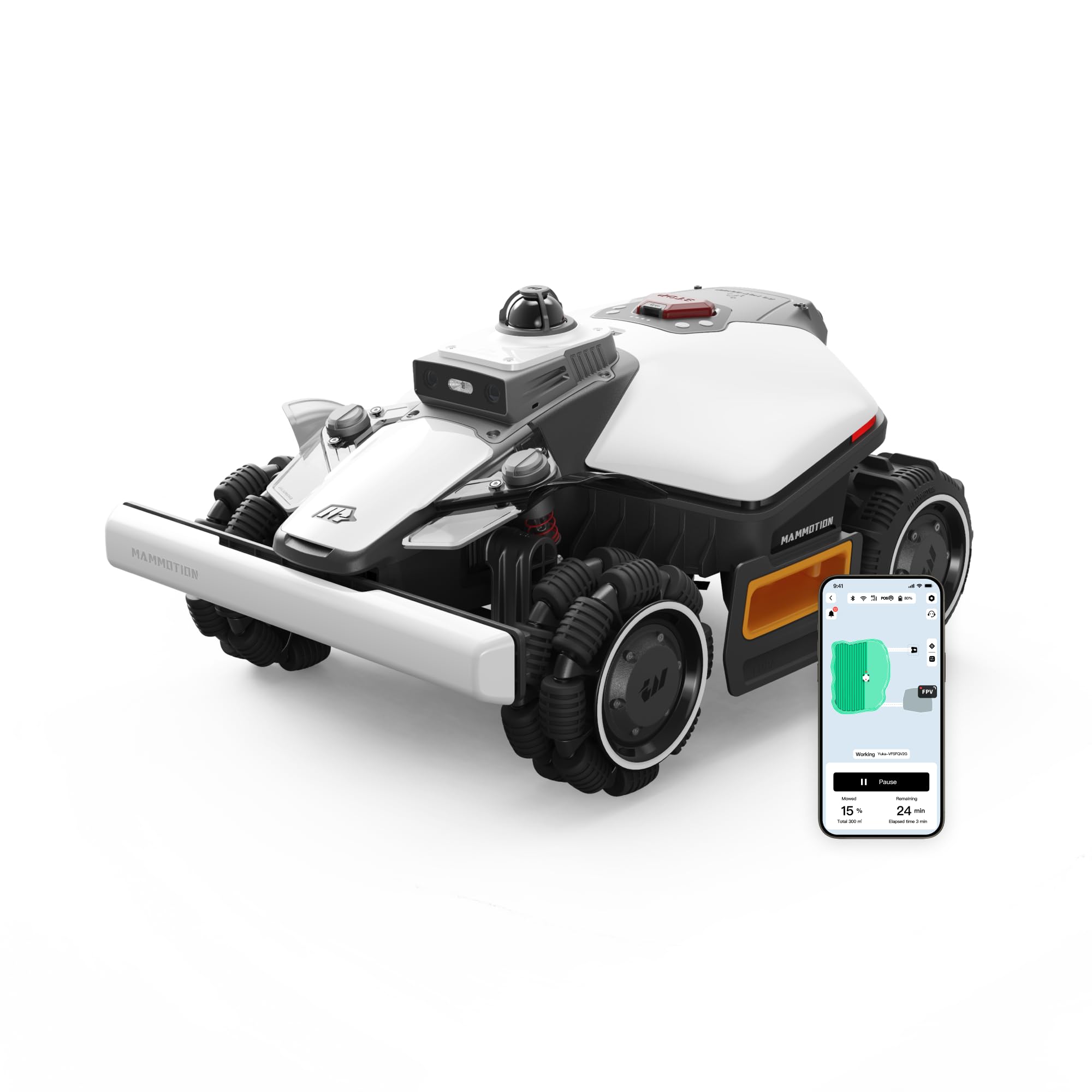
Mammotion LUBA mini 2 AWD 1500H

Most yards

Our Score 9.0/10
Check Price

Worth Noting

  • First map takes a second pass
  • Premium price for a 0.37-acre rating
Coverage
0.37 acre
Navigation
360° LiDAR + dual camera
Slope Rating
Up to 80%
Cutting Width
7.9 inches
Read the full review

A second cutting disc is the detail that separates the LUBA mini 2 from everything else in this guide. Most robot mowers run a single disc in the middle of the deck, which leaves a fringe along every fence line, path, and flower bed for you to finish by hand. Mammotion adds a dedicated edge disc that drops into play when one side of the mower is on grass and the other is over pavement or mulch. It is the sort of thing that only matters after you have spent a summer tidying up behind a robot, and it is the first reason we point people here.

The rest of the hardware backs it up. There is no perimeter wire and no RTK reference station to bolt to a post, because the 360-degree LiDAR and dual cameras build the map themselves, which is exactly what you want in a yard with mature trees and a house on one side. Two independent 88W hub motors pull it up grades of up to 80%, well beyond the 45% the mid-range Segways are rated for. It carries the strongest buyer rating in this set, and the areas people write about most, performance and setup, land firmly positive.

The charge management is a small, thoughtful touch: you can cap the battery at 80% so it is not sitting full on the dock all week. Coverage runs to 0.37 acre across up to 20 zones, and the cut height adjusts from 2.2 to 4 inches over seven positions, a top setting matched here only by the Dreame. The 7.9-inch deck is narrow next to that Dreame's 15.75 inches, so this is a quality-over-speed machine if your lawn is a wide open field.

Mapping takes patience. You walk the mower around the boundary with the app, and the first map is worth doing twice before you trust it. Positioning can also wander near dense planting, where a camera sees stems and shrubs rather than a clean edge. And it sits at the premium end of this group, so it is a considered purchase rather than an impulse one.

Bottom line: The strongest all-round mower here: it navigates without wires or a reference station, climbs grades most of this group cannot, and cuts its own borders.
2

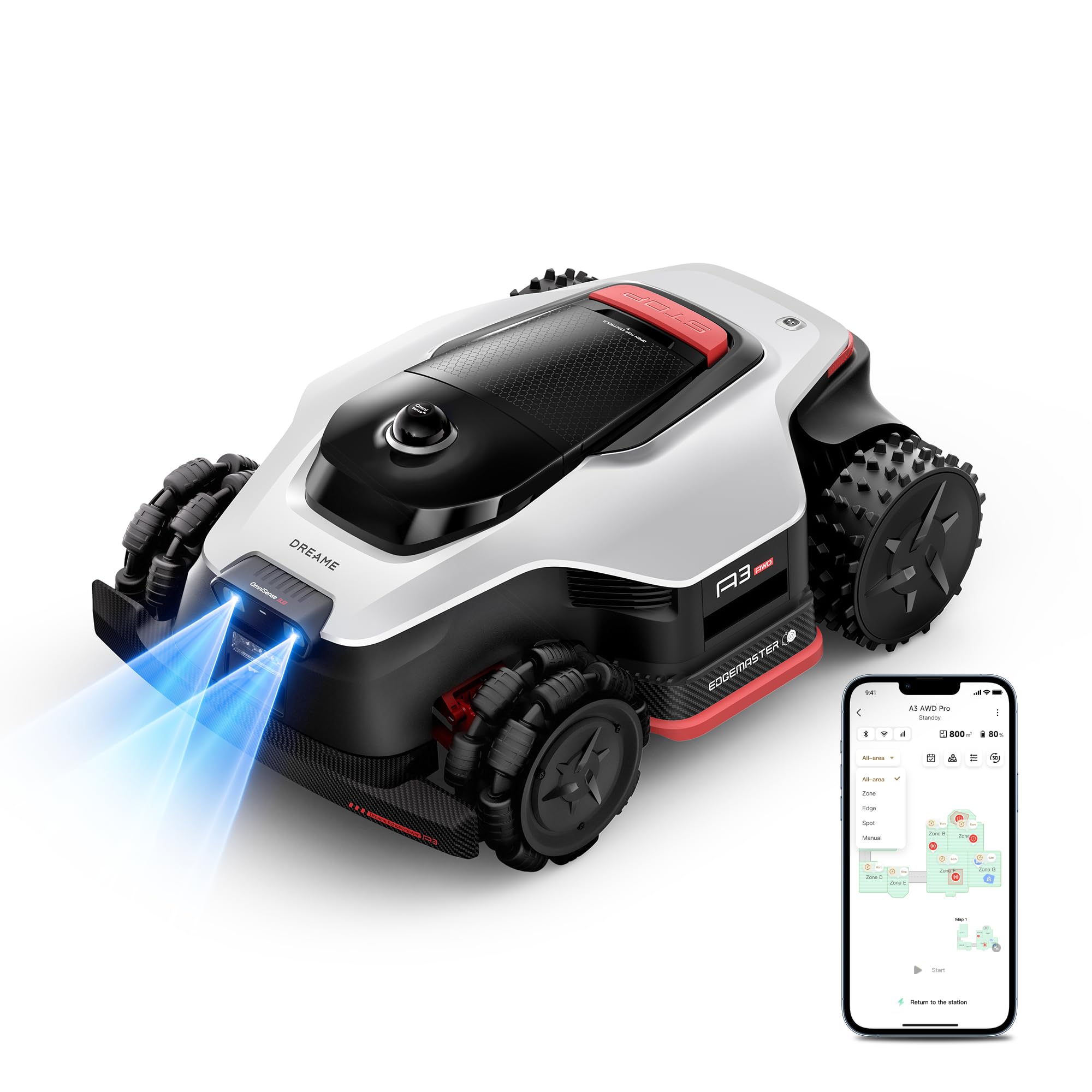
Dreame A3 AWD Pro 3500

Dreame A3 AWD Pro 3500

Large open lawns

Our Score 8.4/10
Check Price

Worth Noting

  • The most expensive mower here
  • Large body needs dock space and wide gates
Coverage
0.87 acre
Navigation
360° 3D LiDAR + AI vision
Cutting Width
15.75 inches
Cutting Height
1–4 inches
Read the full review

15.75 inches is roughly double the cutting width of most mowers in this guide, and on a lawn measured in fractions of an acre, width is time. Dreame pairs two floating discs with 4WD hub motors, rates the climb at 38.7 degrees, and quotes up to 8,611 square feet an hour in its rush mode. Those numbers only mean something if your lawn is big enough to need them, and this one is rated for 0.87 acre.

There is no RTK station in the box. A 360-degree 3D LiDAR and AI vision do the navigating, which suits yards where buildings, hedges, and trees crowd out the sky. The suspension rides over roots, curbs, and thresholds up to 2.2 inches instead of stopping dead at them, and the height adjusts from 1 to 4 inches in four steps with separate profiles for warm- and cool-season grass.

For a big, open, gently rolling lawn this is the mower we reach for. Nothing else here comes close on acreage, and the wide deck means the coverage rating is achievable in a working day rather than a working week. The three-year warranty and bundled 4G service also go beyond the two-year support the Sunseeker carries.

The trade is bulk and money. The body is big enough that it wants a proper parking spot at the dock and a wide route to get there, so a narrow gate between beds is a non-starter. It is also the most expensive mower in the guide, which is easier to justify when you are replacing a ride-on than when your lawn is a quarter acre and most of that capability goes unused.

Bottom line: The mower for a genuinely large lawn: a 15.75-inch twin-disc deck and a 0.87-acre rating turn an all-day job into a routine one.

3

Segway Navimow i105N

Segway Navimow i105N

Small flat lawns

Our Score 8.2/10
Check Price

Worth Noting

  • Wheels slip on slopes and wet grass
  • Mapping takes careful joystick driving
Coverage
0.125 acre
Navigation
RTK + vision
Mowing Zones
Up to 12
Cutting Width
7.1 inches
Read the full review

The i105N is the cheapest way into wire-free mowing in this guide, and for a small fenced backyard it is genuinely hard to argue with. It covers 0.125 acre, holds its position with RTK and a camera rather than a buried wire, and runs at 58 dB, quiet enough to schedule while you are working in the yard. For a first robot mower on a city lot, that combination is the whole pitch.

What keeps it here is reliability. Set it to run every other day and it stays on top of a small lawn; the mowing pattern shifts direction between passes so the grass is not pushed into stripes. Mapping up to 12 zones happens from the phone, and the 140-degree camera picks out a long list of common garden objects instead of bumping into them. Give it a lawn it can finish in one go and it just quietly works.

Two things to plan around. A full eighth of an acre can outlast a charge, so treat it as a mower that runs little and often rather than one that clears the whole lawn on a Saturday morning. And the camera-led cutting gets ragged when the grass is long, which is another argument for a schedule you actually keep.

Bottom line: Buy this if your lawn is small, flat, and fenced: it is the least expensive wire-free mower here and it keeps a modest yard tidy without fuss.

4

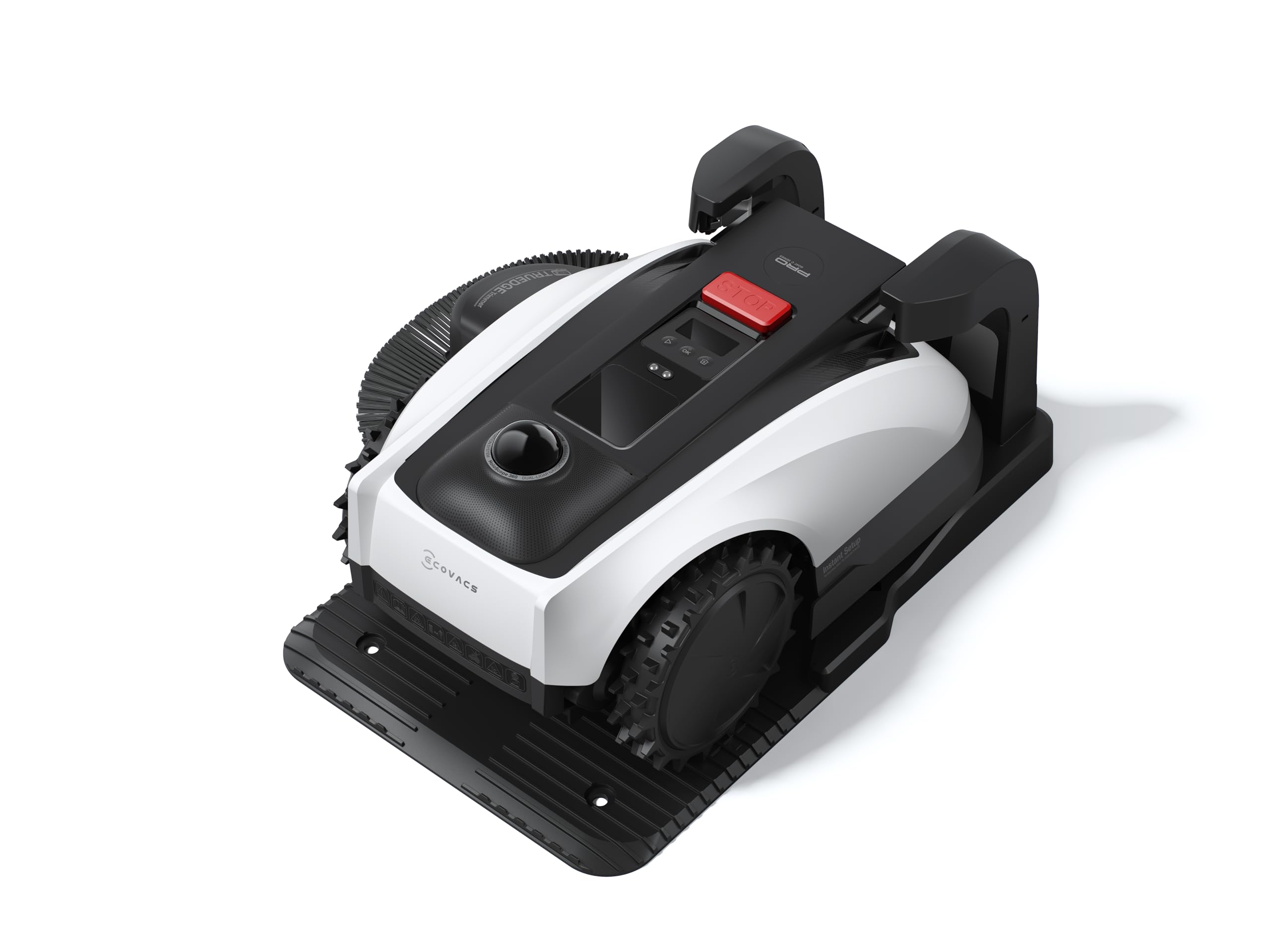
ECOVACS Goat O1000 LiDAR PRO

ECOVACS Goat O1000 LiDAR PRO

Narrow side yards

Our Score 8.2/10
Check Price

Worth Noting

  • Slow going over a full quarter acre
  • Boundary tracking can drift at the edge
Coverage
0.25 acre
Navigation
Dual 360° LiDAR
Cutting Width
8.66 inches
Narrowest Passage
31.5 inches
Read the full review

31.5 inches is the number to start with. That is the narrowest passage the Goat O1000 LiDAR PRO will thread, and it is the reason this mower earns a place even though it is not the strongest all-rounder in the group. A body barely a foot wide helps it slip down the side of a house, between beds, and through the gap behind a shed where the wider machines have to be carried.

ECOVACS skips RTK entirely, using two 360-degree LiDAR units to build the map and AI vision with 3D ToF sensing to spot obstacles, a list the company puts at more than 200 types. There is also a built-in edge-trimming system meant to cut closer along driveways, sidewalks, and beds, which is the same idea as the Mammotion's second disc in a different form. No station on a pole is a real convenience on a tight lot where there is nowhere sensible to put one.

This is the pick for a yard with side passages, tight borders, and beds to thread between. It is rated for a quarter acre with an 8.66-inch cut, and on that kind of layout it beats the bigger machines on usefulness per square foot. Expect to spend time dialling it in: the zone boundaries and the trimming behaviour reward a careful first week, and the map is the thing to walk through before you trust it unattended.

Bottom line: Made for the yard that is more corridor than field: it slips through 31.5-inch gaps and trims borders without any RTK hardware to site.

5

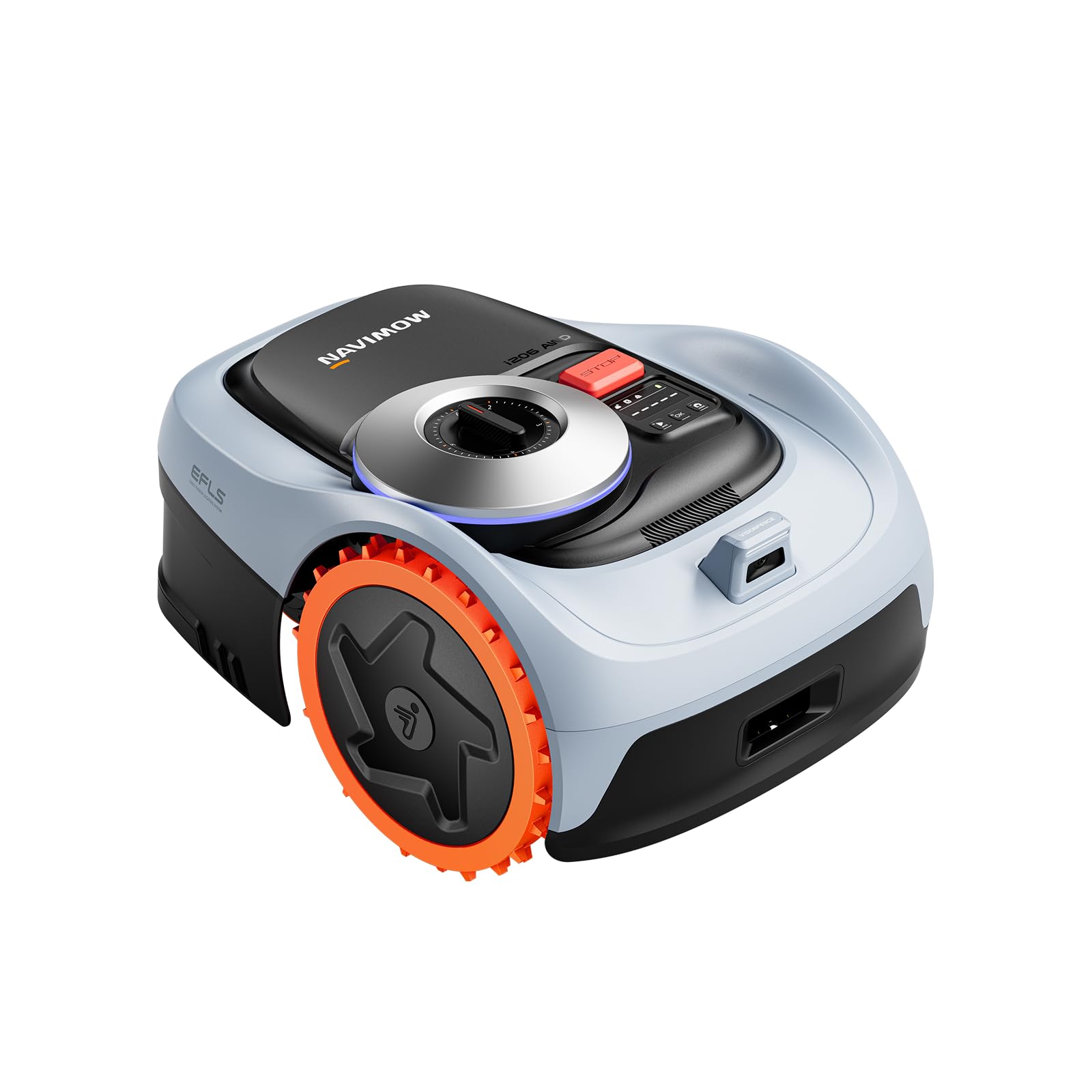
Segway Navimow i206 AWD

Segway Navimow i206 AWD

Small sloped yards

Our Score 8.2/10
Check Price

Worth Noting

  • Coverage ceiling of 0.15 acre
Drive
All-wheel drive
Coverage
0.15 acre
Navigation
Network RTK + vision
Slope Rating
Up to 45%
Read the full review

Small and flat is the usual pairing, and it is why so many compact robot mowers come unstuck on a real yard. The i206 AWD is aimed squarely at the other kind: a modest lawn with a bank, a terrace, or a stretch that stays soft for days after rain. All-wheel drive and a 45% slope rating are the whole pitch, and they are what you are paying for.

The traction is backed by zero-turn steering, which pivots the mower on the spot rather than scrubbing round and tearing turf, and by torque that ramps up in thick grass or on an incline and eases off on the flat. Coverage is 0.15 acre with a 7.1-inch deck, so this is a small-yard machine with big-yard hardware underneath it.

Setup is app-driven: one-tap auto mapping on the network RTK and vision positioning, then up to 20 zones with their own schedules. Auto-resume charging keeps a long job moving without intervention, and GPS alerts tell you if someone picks the mower up. The map is the part to babysit, so walk the first few runs and check the boundary held before you hand over the schedule.

At a mid-range price for a lawn that caps out at 0.15 acre, the money buys grip rather than ground covered, and that is the right trade when the alternative is a mower that beaches itself on your slope every third run. On flat ground the i105N does the same job for less, and the Sunseeker X3 Plus covers twice the lawn for barely more.

Bottom line: Buy it for the slope, not the acreage: all-wheel drive and a 45% grade rating make a small, awkward yard its natural home.

6

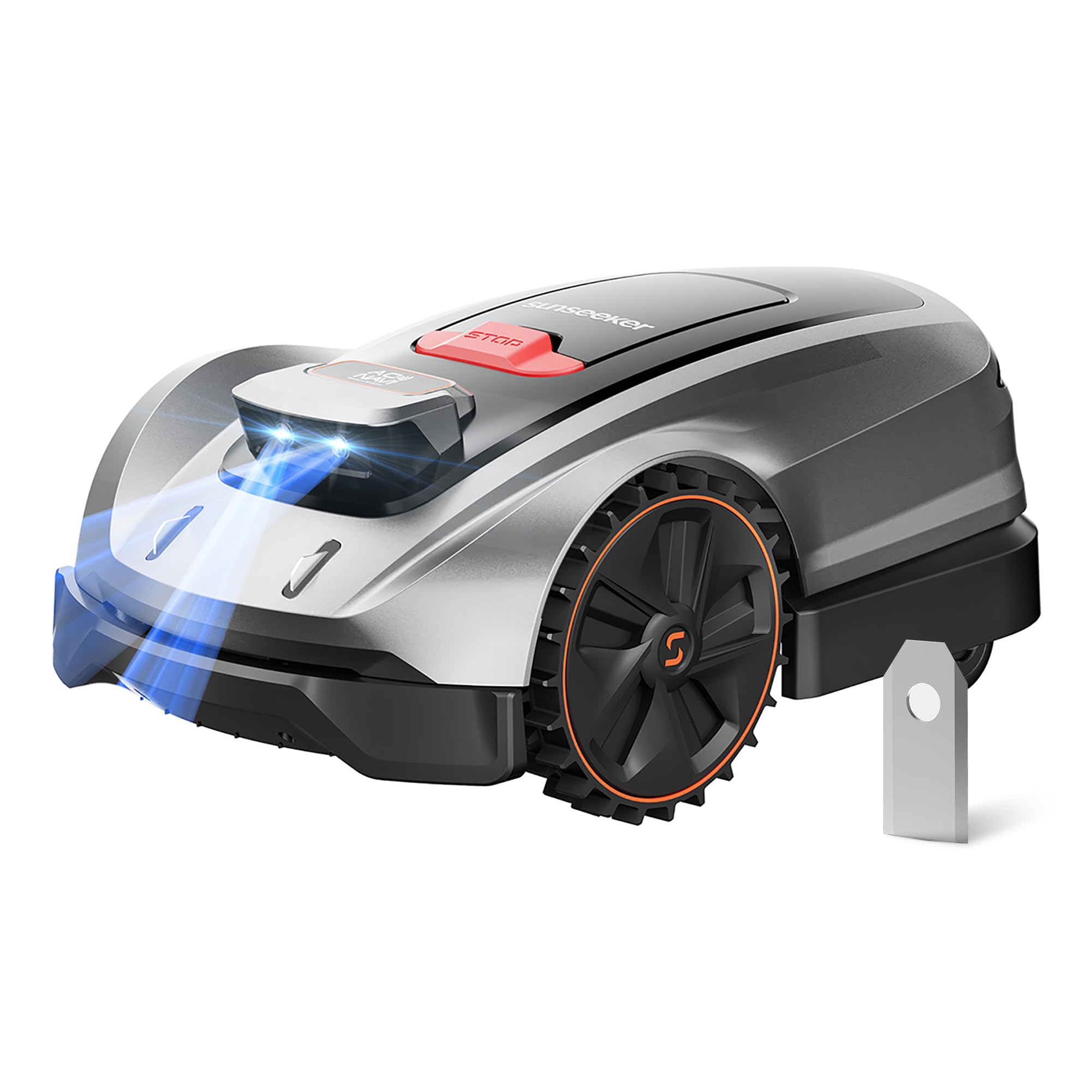
Sunseeker X3 Plus

Sunseeker X3 Plus

Value coverage

Our Score 8.2/10
Check Price

Worth Noting

  • Only two cutting-height positions
  • Can ride over low edging and stray out of bounds
Coverage
0.3 acre
Navigation
RTK + VSLAM
Cutting Width
8 inches
Cutting Height
1.6–3.2 inches
Read the full review

Coverage per dollar is the reason this one is on the list. The X3 Plus is rated for 0.3 acre, two and a half times what the cheapest mower in this guide handles, and it asks only a little more for the privilege. If your lawn is bigger than a courtyard and you are not ready to spend Mammotion money, that ratio is the entire argument.

The design is competent rather than clever. RTK positioning is backed by visual mapping, there is no boundary wire to bury, and the offset blade is set to cut closer along fences and walkways than a centred deck manages. At 19.9 pounds it is light enough to lift over a step or carry to a second zone, and the camera and ultrasonic sensing steer it around everyday clutter rather than into it.

Two things to weigh. The cutting height has just two positions, 1.6 and 3.2 inches, so you are choosing between short and long rather than dialling in a height as the season changes. And the mower can ride over low edging and wander past a boundary that looked fine on the map, which is worth watching on the first few runs before you leave it unattended. Replacement blades are worth pricing before you commit, too.

Bottom line: The best coverage per dollar in this guide: a third of an acre for barely more than the cheapest mower here, with an offset blade for tidier edges.

7

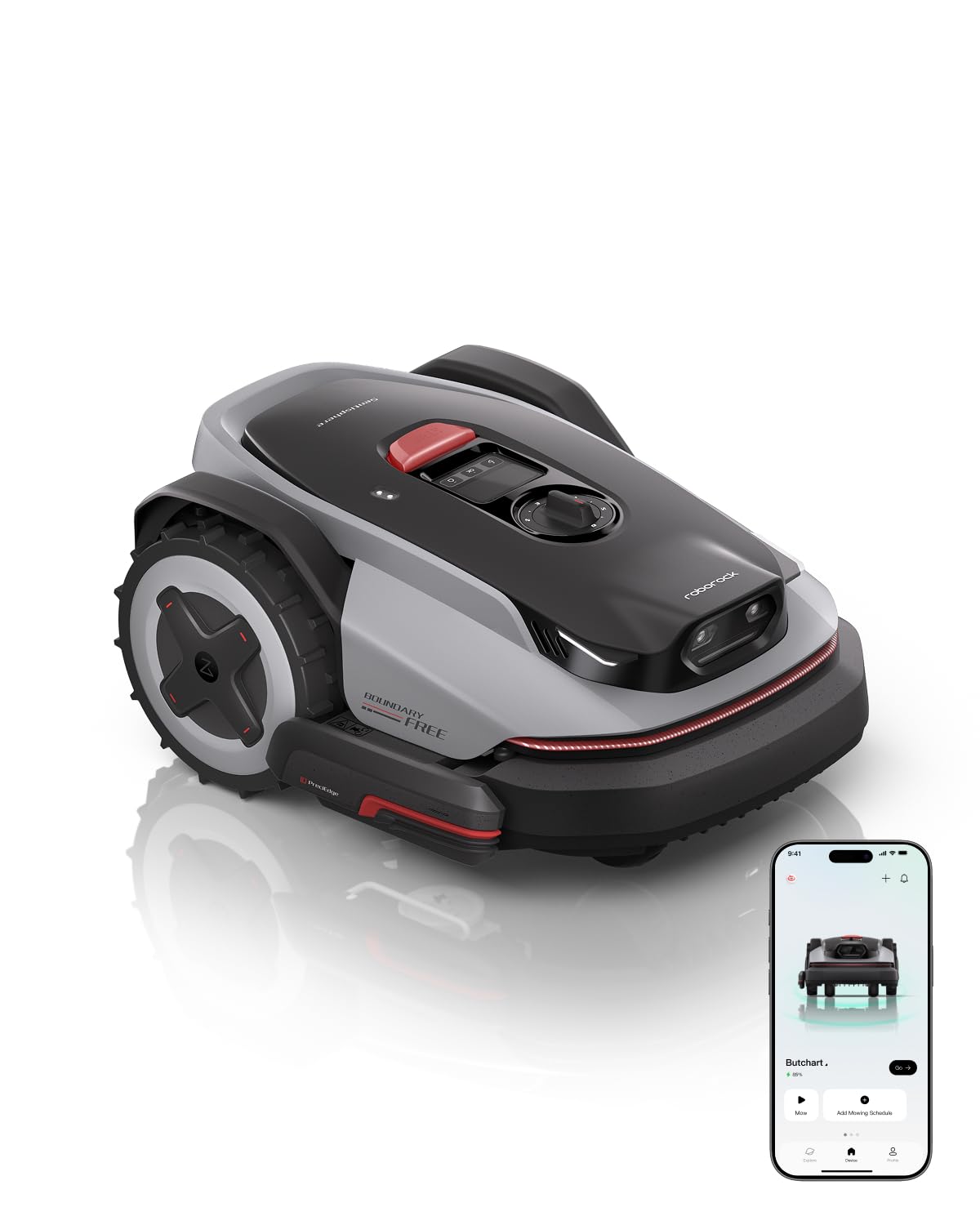
Roborock RockNeo Q110H

Roborock RockNeo Q110H

Uneven terrain

Our Score 8.2/10
Check Price

Worth Noting

  • One of the heavier mowers here at 27 pounds
Coverage
0.25 acre
Navigation
Full-band RTK + VSLAM
Battery Life
130 minutes
Cutting Width
8.7 inches
Read the full review

Full-band RTK is the interesting part here. Satellite positioning is excellent in open sky and shaky within a few feet of a wall or under a canopy, so Roborock pairs the RTK fix with VSLAM, giving the mower a visual fallback when the sky view goes. Add stereo dual-camera obstacle avoidance and a floating cutting deck that follows ground contours, and the Q110H reads like a mower designed for lumpy, cluttered yards rather than show lawns.

The rest of the spec sheet is sensible middle ground: a quarter acre, 45% slopes, obstacles up to 1.57 inches, an 8.7-inch deck, and a 1.6-to-3.1-inch cutting range with a 130-minute battery. If your yard is the kind that defeats a satellite-only mower, this is the one to look at first, because the redundancy is the feature rather than the acreage.

Practicalities worth knowing before you order: multiple mapping modes give you a choice on awkward sites, and the app handles multi-zone schedules with a real-time progress view and an anti-theft lock. It wants a home in one place rather than being shuttled between zones, so pick a dock site with power and a clean approach before the first run.

Bottom line: A sensible middle-of-the-road mower whose dual navigation and floating deck are built for the awkward, cluttered yard that defeats RTK-only machines.

How We Tested the Best Robot Lawn Mowers

We started with every current model we could find and cut the list by lawn-size rating, whether it needed a boundary wire or navigated by GPS, cutting-height range, and price against the area it claimed to handle. Seven made it to the grass, from a bare-bones bump-and-turn unit to a camera-guided machine that maps as it goes. Each one stayed for the full eight months rather than a week.

Setup was timed solo, from unboxing to first cut, including laying and pegging boundary wire where a model needed it. We watched how each mower learned the yard: how many passes it took to build a map, whether it held that map after a storm or a dead battery, and whether it drifted into beds it had already been taught to avoid. Navigation got the harshest test — a side gate narrower than the manual promised, a birdbath, a swing set, two sprinkler heads, and a slope that turns slick after rain.

After every run we looked at the cut: whether blades sliced grass cleanly or tore it, and how the turf held up where a mower pivoted repeatedly on that slope. We logged run time and recharge against each machine's rated coverage, changed the cutting height twice on every model to see how fiddly it was, and counted every time we had to walk out and free a stuck mower — the number that decides whether the thing genuinely saves you time. Reliability and value came last, weighed as hours bought back against the price paid.

How to Choose Robot Lawn Mowers

Match the rating to your lawn, then add headroom

A coverage figure describes an unobstructed rectangle mowed on a routine schedule. Beds to steer around, a narrow gate, a slope that slows the climb, and a zone you have to carry the mower to all eat into it. Buy one step above your measured area rather than at it: a quarter acre of grass is better served by a 0.3-to-0.37-acre machine than by a 0.25-acre one.

The Segway i105N is the clearest illustration. At 0.125 acre it is exactly right for a small fenced city lot and wrong for anything bigger, no matter how good the price looks.

RTK, LiDAR, or cameras, and what each one dislikes

RTK fixes position against a reference point, either a station you mount or a correction service, and it is superb in open sky. Beside a wall, under a dense canopy, or in a narrow passage between buildings the fix degrades, which is why wire-free does not automatically mean trouble-free under trees.

LiDAR builds its own map by measuring the surroundings, so it does not need the sky at all, which is why the Mammotion LUBA mini 2 and the ECOVACS Goat O1000 are our picks for treed, cluttered yards. Camera and VSLAM systems are the cheapest route and the most affected by low sun and deep shade. Look at where the mower will spend most of its time, not the tidy middle of the lawn.

Slope ratings, traction, and the stuck mower

Grade and angle are the same measurement in different clothes: 45% is roughly 24 degrees and 80% is roughly 39. A two-wheel-drive mower rated to 45% will handle a bank in dry grass and struggle once the ground softens. If a slope is the reason you are shopping, all-wheel drive is worth paying for, which is the case for the Navimow i206 and the LUBA mini 2.

Pull the boundary in a few feet from the bottom of a slope, too. Most stuck-mower stories start with a machine that slid past a line it was asked to turn on.

Cutting width and height decide the rest

Most mowers here cut a strip 7 to 9 inches wide. The Dreame's 15.75-inch twin-disc deck roughly halves the number of passes on a large lawn, and on a smaller one that advantage mostly disappears. Height range matters more than the number of settings: you want a spread that covers your grass through the season, and two positions with a 1.6-inch gap between them gives you no fine tuning.

Edge handling is the other dividing line. A dedicated edge disc or an offset blade gets closer to fences and beds, but none of them removes the trimmer entirely.

Siting the dock and getting the first map right

Where the dock goes shapes how well the mower navigates. Pick flat ground with power nearby, an approach run that does not require reversing through a gate, and, for an RTK machine, a clear view of the sky. A dock tucked under a deck is the fastest way to a mower that wanders.

The first map is the other half of the job. Drive the perimeter slowly, walk it twice, and set no-go zones around beds before you let it run unattended. A boundary that was rushed is the usual reason a mower shaves a corner three weeks later.

Frequently Asked Questions

Final Verdict

For most yards, the Mammotion LUBA mini 2 AWD 1500H is the mower to buy. No wire, no reference station, a LiDAR-and-camera navigator that holds its map under trees, an 80% slope rating nothing else here matches, and a second disc that cuts the borders so you spend less time behind a trimmer.

Two requirements change the answer. On a small flat city lot, the Segway i105N does the job for the least money in this guide. On a big open lawn, the Dreame A3 AWD Pro 3500 finishes in roughly half the passes with its 15.75-inch deck. Everything else is a compromise on one of those three.