Soil & Fertilizer

Best Fertilizer Spikes of 2026

Fertilizer spikes work on a simple premise: push a concentrated feed stick into the soil and let moisture release nutrients a little at a time. That convenience is also where the trouble starts. Push too hard into dry soil and a brittle spike snaps; leave a box in a humid garage and you pull out a fused lump that never comes apart. What a good one fixes is the maintenance problem — the plant you forget to feed gets a steady supply for months.

I've killed more houseplants by overfeeding than neglect, so I'm wary of anything that feeds on its own schedule. Over seven months, from the first spring watering through early fall, my team and I ran 11 different spikes through patio pots, a sulking indoor ficus, and a row of boxwoods. The ones worth buying slide in without crumbling and get a visible response within weeks, not months. Value counts double here — a cheap box is no bargain if the dose is wrong for your pot. The picks below are the ones I'd hand to a neighbor.

1

Jobe's Tree & Shrub Spikes

Top Pick
Jobe's Tree & Shrub Spikes

General tree feeding

Our Score 9.2/10
Check Price

Worth Noting

  • Snaps easily in hard, dry ground
NPK
16-4-4
Spike Count
15
Target Plants
Trees and shrubs
Feeding Schedule
Twice a year
Read the full review

Two feedings a year, once in early spring and once in late fall, is the whole routine with these. The box holds 15 pre-measured spikes with a 16-4-4 analysis, and because the dose is set by the spike rather than by your hand, there's no scoop, no mixing, and no chance of dumping half a bag on one shrub to make up for the ones you skipped last year.

We recommend this box to most people with trees and shrubs to feed, and the reason is less about the analysis than about how little the job asks of you. The 16-4-4 ratio is a sensible all-rounder for deciduous shade trees, flowering trees, boxwood, and the acid-lovers that so many spike formulas quietly skip: azaleas, hydrangeas, magnolias. Application is the part that sold us. Where the soil was moist, these went in with a firm push and a couple of taps, and nothing about the task required a spreader, a hose-end sprayer, or an hour of cleanup afterward.

Dry ground is the catch. A day after rain, or a ten-minute soak with the hose, changes everything; where the soil is baked clay, start the hole with a pick, a sturdy screwdriver, or a bulb auger and the spike drops in whole instead of cracking at the shoulder. The plastic caps in the box exist for the same reason, so set one over the top before you tap.

What you're buying is a season's feeding for several trees without lifting a bag of granules. If your ground is workable and your trees are the ordinary mix of shade, flowering, and acid-loving types, this is the box to start with. The evergreen and fruit formulas below are for yards that are mostly one thing, and the SimplyGro pegs are the ones to look at if your soil has beaten you before.

Bottom line: We tell most people with a mixed yard of shade, flowering, and acid-loving trees to start here: the dose is pre-measured, the schedule is twice a year, and 16-4-4 suits nearly everything you'll plant.

2

Jobe's Evergreen Spikes

Jobe's Evergreen Spikes

Evergreens and conifers

Our Score 9.2/10
Check Price

Worth Noting

  • Shatters when pounded into dry, hard ground
NPK
13-3-4
Spike Count
15
Target Plants
Evergreens and acid lovers
Feeding Schedule
Twice a year
Read the full review

Arborvitae, spruce, and pine that have gone flat and yellowish are what this box is for, and it's the one we reach for when an evergreen is the patient. The 13-3-4 analysis leans on nitrogen, the nutrient behind needle color and new growth, and the label names the plants it was built around: cypress, arborvitae, pine, cedar.

Fifteen pre-measured spikes, twice a year, early spring and late fall, is the same routine as the rest of Jobe's line, which is a large part of why we keep recommending it to people who don't want a fertilizer hobby. On a young screen of arborvitae, one box goes a fair distance; a long established hedge will want a second.

Worth being straight about how different this is from a general tree spike. 13-3-4 isn't far from the 16-4-4 in the box above, and a mixed yard does fine on one all-round formula. The evergreen version earns its place on a property that is mostly conifers, or on an acid-loving planting that has never been fed. Expect deeper color more than a growth spurt: this is a feed that shows up across a season.

Bottom line: For a yard that's mostly conifers, we think this is the better-matched box: the nitrogen-heavy 13-3-4 targets needle color and new growth, and the twice-a-year routine is as simple as it gets.

3

SimplyGro Tree & Shrub TruSpikes

SimplyGro Tree & Shrub TruSpikes

Hard, dry soil

Our Score 9.2/10
Check Price

Worth Noting

  • Costs more per spike than the other tree spikes here
  • Can be dug up by skunks
NPK
8-8-8
Spike Count
24
Spike Length
5 inches
Release Period
Up to 3 months
Read the full review

Compared with the Jobe's and Miracle-Gro spikes above, these are noticeably denser: a five-inch TruSpike that goes into the ground without a plastic cap over the top, and without a pilot hole in anything but the hardest soil. The shape is the whole pitch, a solid tapered peg rather than a crumbly pressed oval.

The 8-8-8 analysis is balanced rather than tailored, which makes it a reasonable one-box answer for a mixed row of trees and shrubs. The number that changes your calendar is the release: up to three months of continuous feed per spike. The twice-a-year products are on a spring-and-fall rhythm; these are closer to quarterly rounds if you want nutrition running all season.

Where these earn their place is ground that has beaten you before. If you've watched a cheaper spike shatter on contact, the extra money buys a peg that goes in whole, and that is a real convenience rather than a marginal one. Two things to weigh: the cost per spike is higher than the big tree-and-shrub brands, and in skunk country the spikes can get dug up, so set them just below the surface and firm the soil over them.

Bottom line: Worth the extra for hard or stony ground: these dense spikes go in whole where crumbly ones break, and the three-month feed keeps a young tree supplied through the season.

4

Old Farmer's Almanac TruSpikes

Old Farmer's Almanac TruSpikes

One small tree

Our Score 9.2/10
Check Price

Worth Noting

  • Breaks if the ground is dry
  • Small box runs out fast on a full yard
NPK
13-3-3
Spike Count
6
Target Plants
Trees, evergreens, shrubs
Package Weight
1.5 lb
Read the full review

Six spikes in a 1.5-pound box is a small purchase, and that's the point. This is a box for one tree, or for someone who wants to see whether spikes suit them before committing to a case of seventy.

The 13-3-3 analysis is nitrogen-forward and aimed at trees, evergreens, and shrubs, the same territory as the Jobe's evergreen box in a much smaller commitment. Six spikes won't stretch to a hedge and aren't meant to; on a single specimen at the drip line, the box does a season's feeding.

Driving them is simple in soft ground, since the TruSpike shape takes a hammer better than the pressed ovals do, but dry ground splits them like any other spike, so water first. Behind the box is a 30-day Happy Plant Promise, a refund-or-replacement offer that is a better safety net than anything else in this guide carries, and a genuine reason to try a new brand on one tree rather than five.

We like it as a trial size and as a top-up box for a single specimen. Per spike it costs more than the big tree-and-shrub packs, and what you're paying for is a small quantity and a plant-specific ratio, so it makes sense for one tree and not for a yard.

Bottom line: A sensible trial size: six spikes of a nitrogen-forward formula with a 30-day refund behind them, sized for one tree rather than a whole yard.

5

Miracle-Gro Fruit & Citrus Spikes

Miracle-Gro Fruit & Citrus Spikes

Fruit and citrus

Our Score 9.0/10
Check Price

Worth Noting

  • Formulated for fruit and palm, not shade trees
NPK
10-15-15
Spike Count
12
Target Plants
Fruit, citrus, palm
Feeding Schedule
Twice a year
Read the full review

Fruit trees are where spike shopping gets pricey, and this is the least costly way into it among the fruit formulas worth recommending. Twelve spikes with a 10-15-15 analysis, aimed at apple, orange, lemon, lime, avocado, and palm: a spread wide enough to cover a small home orchard plus the potted citrus on the patio.

We rate it as the budget route into fruit-tree feeding rather than a compromise. The high phosphorus and potassium numbers are the point, since those are the nutrients behind blossom and fruit rather than leafy growth, and the schedule, early spring and again in mid-fall, puts the feed in the ground before and after the fruiting season. Palms on the target list make it a reasonable single box for a mixed subtropical yard.

What keeps it out of the top spot is the way the spikes handle. The tops crack easily in firm ground, and starting each hole with a pick is the difference between a clean job and a pocketful of fragments. A high-phosphorus feed applied too generously can also drop leaves on a young tree, so measure by drip-line diameter rather than adding a spare spike for luck.

Bottom line: A good, inexpensive way to feed citrus, apples, and palms twice a year — we rate it for backyard fruit trees and budget-minded growers, not for the shade tree out front.

6

Miracle-Gro Indoor Spikes

Miracle-Gro Indoor Spikes

Houseplants

Our Score 9.0/10
Check Price

Worth Noting

  • Two-month feed means re-dosing every couple of months
NPK
6-12-6
Spike Count
48
Target Plants
Indoor potted plants
Release Period
Up to 2 months
Read the full review

The spikes arrive stuck to each other. That's the first thing to know about this box, and it's a storage problem rather than a formula problem: the sticks pick up moisture in the pack and fuse into little bundles, so you'll spend a minute working them apart. A paring knife tip or a firm twist does it, and the ones that crumble are still usable pushed into the soil in pieces.

Get past that and this is the indoor feed we keep coming back to, mainly because of the arithmetic of a windowsill full of pots. Forty-eight spikes across two packs, a 6-12-6 analysis that suits foliage plants and flowering ones, and a two-month feed per spike means the pothos, the fern, the spider plant, and the croton all get fed from one box without anyone measuring liquid concentrate into a watering can. Ferns, spider plants, pothos, and croton are named on the label, and it's cleared for indoor potted plants when used as directed.

Two months is the number to plan around. This isn't a feed-it-and-forget-it-for-a-year product; it's a nudge every couple of months, which suits anyone who already walks the plants with a watering can. Follow the pot-size count on the label rather than guessing, and keep the box sealed and dry between rounds, which is what stops the next batch from arriving fused.

Bottom line: The houseplant spike we keep on the shelf: 48 pre-measured sticks, a two-month feed, and a formula that suits foliage and flowers alike — just expect to pry a few apart.

7

Landscaper Pack Tree & Shrub

Landscaper Pack Tree & Shrub

Big yards

Our Score 9.0/10
Check Price

Worth Noting

  • 18-pound case is awkward to store
  • Crumble in hard, unwatered ground
NPK
15-10-9
Spike Count
70
Target Plants
Trees and shrubs
Package Weight
18 lb
Read the full review

Seventy spikes in one case is a different kind of purchase from the little twelve-count boxes. This is the one for the person who has just planted a hedge line, a windbreak, or a dozen shrubs along a fence and doesn't want to run out halfway down the row, or drive back to the store for a second box.

The 15-10-9 analysis is an all-round ratio rather than a specialist one, which is exactly right for mixed plantings: evergreens on one side of the yard, flowering shrubs on the other, and no appetite for buying three different boxes. The case runs about 18 pounds, so plan on a shelf in the garage rather than a corner of the potting bench.

Driving them is where the case earns or loses its keep. A bulb auger or a long screwdriver makes short work of the job, and the difference between a clean insertion and a handful of crumbs is usually the hole you made first. In ground that's been watered they go in with a few taps; in July clay, bore first.

Per spike, this is the best value in this guide by a wide margin, and nothing else here comes close for a big property. What you give up is specificity: no fruit formula, no evergreen formula, just a solid all-round feed and a heavy case to store. For a new landscape with a lot of young plants going in at once, that's a trade worth making.

Bottom line: If you're feeding a hedge line or a new landscape, this is the case we point to: 70 spikes of 15-10-9 at the lowest cost per spike here, with no specialist formula to worry about.

8

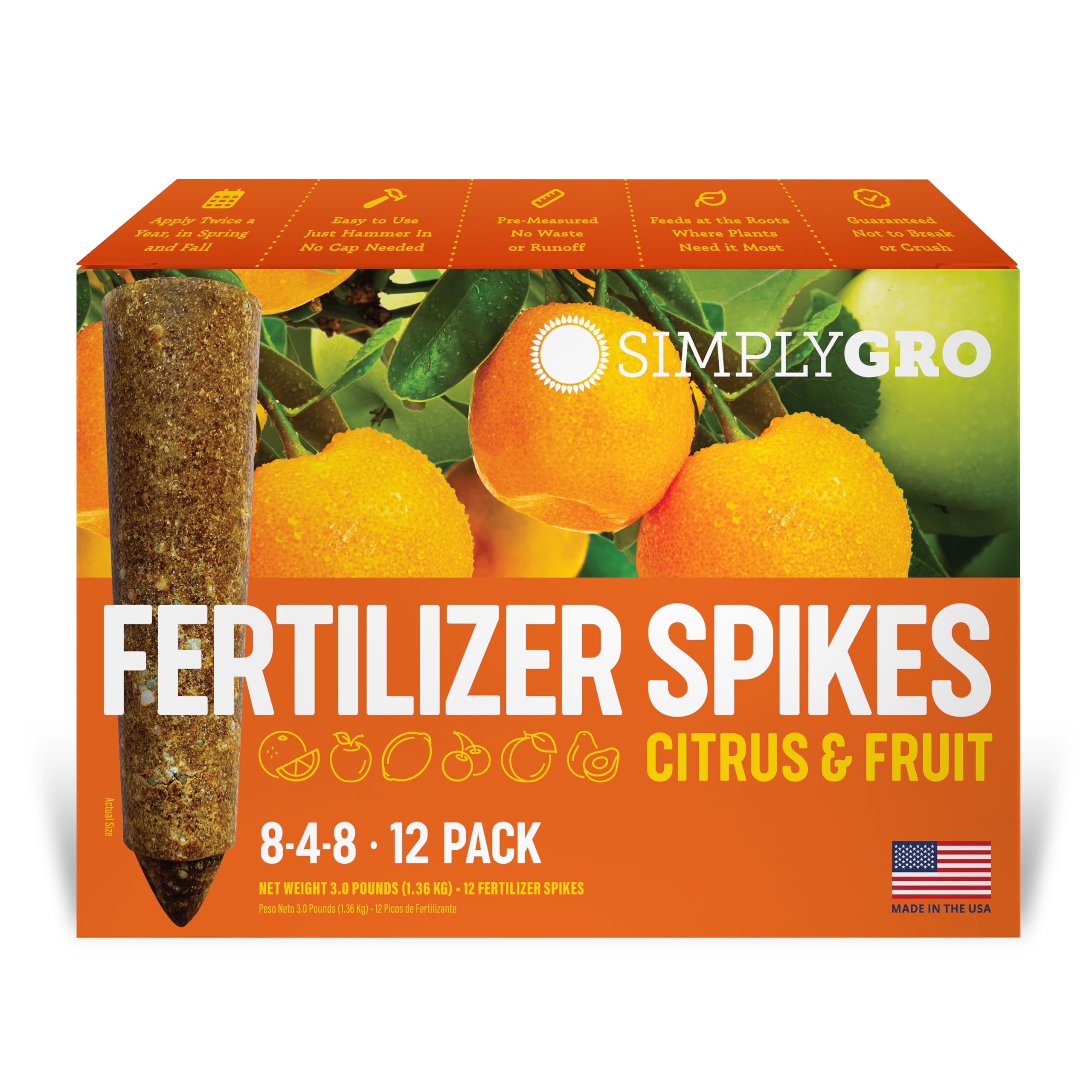
SimplyGro Citrus TruSpikes

SimplyGro Citrus TruSpikes

Hard-soil citrus

Our Score 9.0/10
Check Price

Worth Noting

  • Priciest per spike in this guide
NPK
8-4-8
Spike Count
12
Target Plants
Citrus and fruit trees
Release Period
Up to 3 months
Read the full review

Clay is where most citrus spikes fail, and not in the formula — at the point of installation. These are the dense TruSpike pegs in a twelve-count box, five inches long and rated for up to three months of feed, and they're in this guide because they go into firm ground whole where softer spikes come apart.

The 8-4-8 analysis is unusual in having more potassium than phosphorus, and it's aimed at citrus, fruit, berry, and nut trees rather than at shade trees. Twelve spikes covers a small collection of young or potted trees, and the labeled count per trunk is the thing to follow, since more is not better with a feed this concentrated.

The trade-off is straightforward. You pay the highest per-spike price in this guide for a formula aimed at one group of plants, and what you get back is a spike that survives the trip into the ground. If your citrus lives in a pot of soft potting mix on a patio, the cheaper Miracle-Gro box does the same job; if it's in the ground in heavy soil, this is the one that gets there in one piece.

Bottom line: The citrus spike for ground that fights back: dense enough to go in whole where softer spikes crumble, provided you're feeding trees in soil rather than pots on a patio.

How We Tested Fertilizer Spikes Over a Full Growing Season

We started by reading labels, which sounds dull until you notice how many boxes bury the nutrient analysis in small print. I filtered for a clearly stated nitrogen-phosphorus-potassium ratio, a dose sized for common containers rather than tree-only formulations, and a per-spike cost that made sense for someone feeding eight or ten pots. That cut a long list down to 11 products, which we used for roughly seven months, from the first spring watering through early fall.

Application happened where the plants actually live. I pushed spikes into tomato and basil containers on a sunny patio, into a potted ficus that had sulked indoors for a year without a new leaf, and along a row of boxwoods bordering the driveway. I timed how long it took to dose each pot and noted whether the spike slid in cleanly, needed a hammer, or snapped in half. I also checked the boxes after a few weeks in a humid garage to see which spikes had fused into a solid block.

Then we watched. Each week I counted new leaves and measured fresh shoots on the patio plants, checked whether the ficus finally pushed out growth, and looked for yellowing that reversed or leaf edges that crisped, which is what overfeeding looks like. I noted how long the response lasted before growth stalled and a second dose was needed, since a spike that feeds for six weeks and one that feeds for three months cost the same at the register but not per season.

How to Choose Fertilizer Spikes

Match the formula to the planting, not the label

Read the three numbers as a job description rather than a grade. Nitrogen leads in evergreen formulas such as 13-3-4, because it drives needle color and new growth. Phosphorus and potassium lead in fruit and citrus formulas such as 10-15-15 and 9-12-12, because they support blossom, fruit set, and root health. A general tree and shrub spike, whether 16-4-4 or 15-10-9, sits in the middle and handles a mixed yard.

For most of us, one all-round box is the right answer. The specialty formulas earn their price where the planting really is specialist: a conifer screen, an orchard, a row of patio citrus, a windowsill of pots.

Count spikes and place them at the drip line

The roots that actually feed a tree sit at the drip line, the circle the canopy makes on the ground, not against the trunk. A ring of spikes under the outer branches does more than a cluster at the base, and spacing matters as much as the count: Miracle-Gro's direction for its tree spikes, at least 3 ft between spikes with 12 spikes covering roughly three trees with a 4-ft drip-line diameter, is a good working rule for the whole category.

Scale the pack to the job, and remember the count is per feeding. Most of these products want two feedings a year, so a fifteen-spike box is a season's worth for a handful of young trees, not for a long hedge.

Plan for the soil, because the spikes will break

Breakage is the signature failure of this category, and it is almost always about the ground rather than the fertilizer. A dry spike meeting dry clay shatters, and the plastic caps in some boxes are there to spread the hammer blow.

Three things make the difference. Water the area the day before, or soak it while you work. Start the hole with a pick, a long screwdriver, or a bulb auger instead of letting the spike make its own. And tap rather than swing. If your whole yard is heavy clay, pay for the denser pegs: SimplyGro's TruSpikes and the Landscaper Pack spikes are the ones here that hold together best.

Read the release time as a feeding schedule

Spike boxes quote two different kinds of number, and confusing them is the most common planning mistake. Some give a schedule: feed twice a year, early spring and late fall. Others give a release period: up to two months for the indoor spikes, up to three months for the SimplyGro pegs. A three-month spike is not a feed-it-once product; it is roughly quarterly work if you want nutrition running all season.

For trees in the ground, the twice-a-year rhythm is easier to keep and lines up with spring and fall root growth. For pots and windowsills, the shorter, more frequent release suits the way container soil is watered and flushed.

Frequently Asked Questions

Final Verdict

Start with Jobe's Tree & Shrub Spikes. The 16-4-4 ratio covers shade, flowering, and acid-loving plants, the pre-measured spikes take the dosing guesswork out of the job, and two feedings a year is a schedule most people will actually keep.

Change the pick when your yard is one thing rather than a mix: Jobe's Evergreen for a conifer screen, Miracle-Gro Fruit & Citrus for an orchard or a row of patio citrus, and the Miracle-Gro indoor box for the windowsill. And if your soil is heavy clay that has shattered spikes before, go straight to SimplyGro's dense pegs, which go in whole where the softer ones crumble.