Homesteading & Harvest

Best Fermentation Crocks of 2026

A fermentation crock's whole trick is a ring of water: the lid rests in a moat molded into the rim, letting carbon dioxide burp out while oxygen, dust, and fruit flies stay out. Simple idea — but crocks fail on the details, like a lid that doesn't seat squarely or a glaze that crazes by the third batch. Get those right and the crock does the babysitting for you: no daily burping, no zip-top bag of brine, no skimming foam every morning, just a steady oxygen-poor environment that keeps cabbage tangy and still crunchy.

My first kimchi lived in a jar under a bag of salt water, and it went fine until the morning I lifted the lid and found pink fuzz and a smell that cleared the kitchen. Since then my team has fermented in 12 crocks over seven months, and the keepers were the ones that got the boring details right. The mistake nearly everyone makes is buying small: a crock wants to be filled about two-thirds, so a 5-liter vessel is really a 3-liter vessel once brine and weights go in. The picks below are the ones I'd hand to a friend.

1

e-jen Kimchi Container

Top Pick
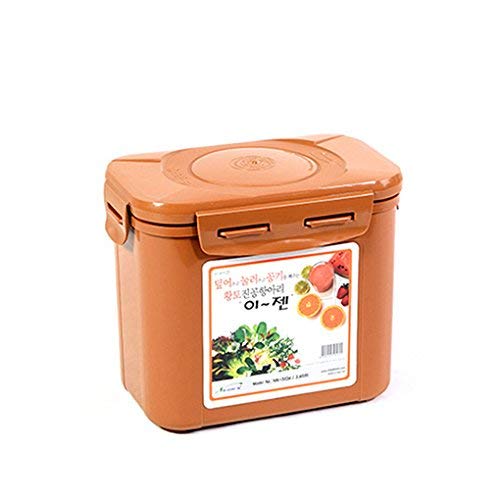
e-jen Kimchi Container

Kimchi storage

Our Score 9.4/10
Check Price

Worth Noting

  • Small: about one cabbage per batch
  • Outer lid is plastic, not ceramic
Lid
Double lid with inner vacuum lid
Weight
15.2 oz
Capacity
1.7 L (0.45 gal)
Material
Earthenware body, polypropylene lid
Read the full review

Kimchi announces itself from the far side of the kitchen. The e-jen's answer is two lids: an inner one that presses down onto the vegetables and pushes air out of the headspace, and an outer lid that locks over it. Closed, it keeps the smell where it belongs, which is why it earns a place here despite not being a water-seal crock at all.

The rhythm it is built for is a short ferment and a long fridge stay. A batch sits out for a day or two, then the whole container moves to a shelf, where the rectangular body stacks and the earthenware holds the cold. At 1.7 liters it takes one decent napa cabbage — roughly two to three pounds once the outer leaves and stems are off — so a big kimchi weekend means two containers, not one.

We liked the weight of it, too: just over fifteen ounces, so lifting it in and out of the fridge is nothing at all. What it cannot do is the long unattended kraut ferment. There is no channel of water doing the gas work here; the seal depends on that inner lid staying pressed down. For kimchi that is the right trade, and for six-week sauerkraut it is the wrong tool.

Bottom line: The one we point kimchi makers to: it holds the smell in, stacks in the fridge and takes a single cabbage at a time.

2

TOMO 7L Fermentation Crock

TOMO 7L Fermentation Crock

All-round kraut

Our Score 9.2/10
Check Price

Worth Noting

  • Collar traps brine when you tip it out
Seal
Extra-wide water-lock lid
Weight
10.3 lb
Weights
Two glazed ceramic weights
Capacity
7 L (about 2 gal)
Read the full review

Water channels are the part of a crock you live with. TOMO's is wider than most, so the seal keeps working through a fast ferment instead of drying to a damp ring you have to keep refilling. That one detail is why this sits at the top of our list: a 7-liter stoneware body, a lid that lets gas out and keeps air out, and two glazed weights that drop into the mouth without jamming sideways.

Seven liters is about two gallons, which means five to seven cabbages and roughly a dozen mason jars of finished kraut — enough that one weekend's work stocks the pantry. The inside is fully glazed, and we rate that higher than any exterior detail: a non-porous interior does not carry the smell of a garlic-heavy kimchi into the next batch, and it wipes clean with warm water instead of a scrub.

Plan where it lives before it arrives. Ten and a quarter pounds empty becomes a two-handed lift once it is full, so clear a counter corner or a low shelf and fill it there rather than carrying it loaded across the kitchen. And because this is a fired clay pot coming through the mail, open the box over a towel and run a thumb around the rim and across the inside base before the first cabbage goes in — a hairline you find then is a return, and one you find in week three is a mess.

Bottom line: Our pick for most people: two gallons of fully glazed stoneware, glazed weights and a wide water seal that mostly looks after itself.

3

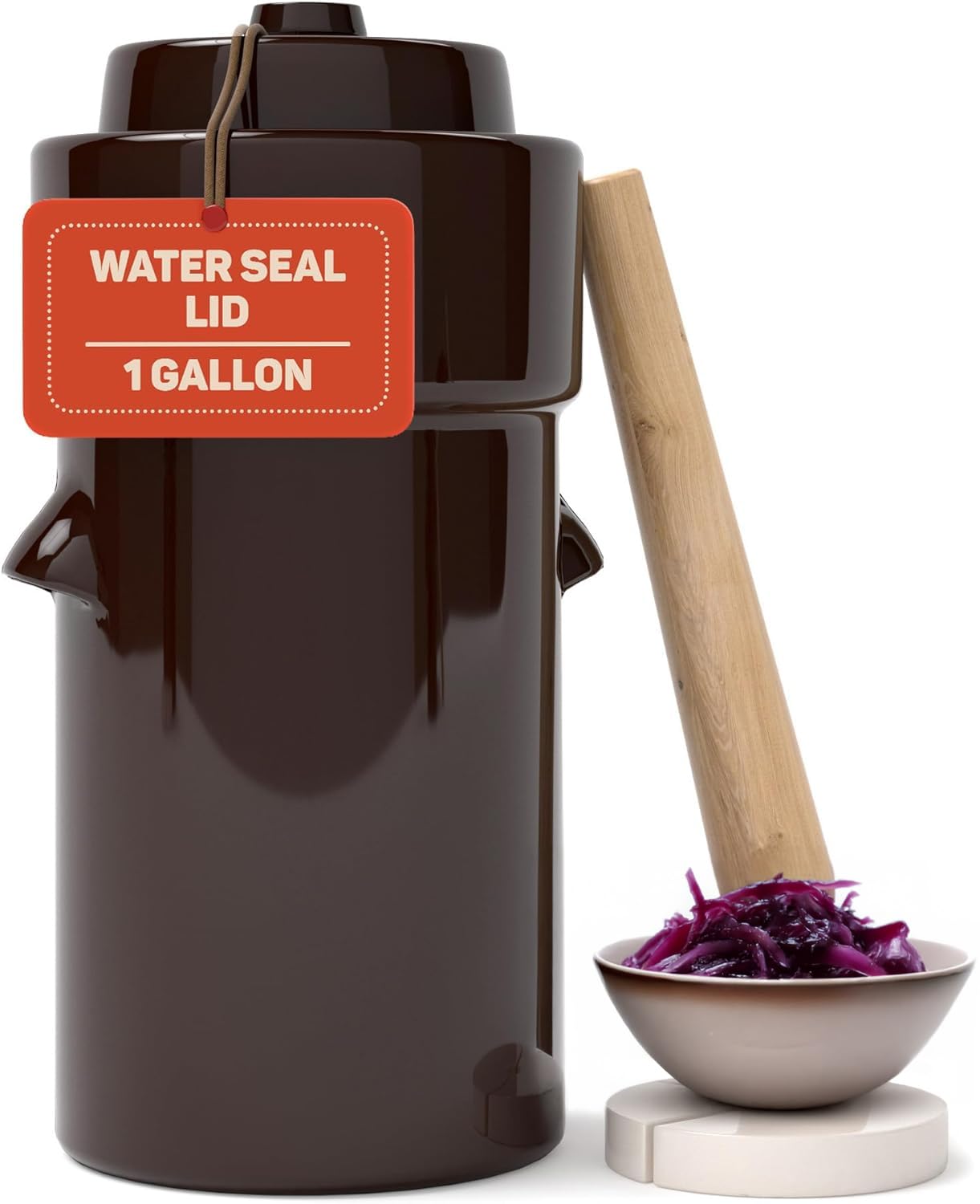
Kenley 1-Gallon Crock

Kenley 1-Gallon Crock

First batches

Our Score 9.2/10
Check Price

Worth Noting

Capacity
1 gallon
Included
Lid, two weights, beech pounder
Material
Glazed stoneware
Dimensions
6 x 6 x 12 in
Read the full review

Open the Kenley box and you have the whole method: the stoneware crock, a water-seal lid, two weighting stones and a beech pounder for packing cabbage down. Nobody has to hunt for a plate that fits or improvise a weight out of a freezer bag, and for a hobby most people back into with a mason jar, that completeness counts for a lot.

A gallon is the size we point beginners toward. It makes a few jars at a time, enough to learn the feel of a pack and a brine without committing a season's cabbage, and it does not demand a permanent slab of counter. Six inches across at the base and twelve tall, it tucks onto a shelf or into a corner, which is more than the big crocks here can say.

The trade is in the stones. They are unglazed, so they hold onto moisture, can discolor, and want a scrub and a boil between batches. Given that the lid, the stones and a pounder all arrive together, we think that is a fair swap on a first crock — and by the time it annoys you, you will know whether you want a two-gallon vessel anyway.

Bottom line: The starter crock we hand to anyone who has never fermented: everything you need in one box, at a size that will not overwhelm a first batch.

4

K&K Kerazo 7L Crock

K&K Kerazo 7L Crock

Buy once

Our Score 9.2/10
Check Price

Worth Noting

  • Weight stones small for the mouth
Weight
10.3 lb
Capacity
7 L (7.39 qt)
Dimensions
9.1 x 9.1 x 13.5 in
Base Thickness
0.6 in
Read the full review

The most expensive crock here is also the only one thrown by hand, in Germany, in a single piece. What the money buys is the pottery itself: a base around half an inch thick, fired at 1260 C, glazed in specks of earthen brown that shift toward copper as the light moves, and handles on both sides that make a heavy pot carryable.

We think it is worth the premium for one particular buyer: the person who wants a single crock sitting on the counter as an object, not a vessel that gets hidden in a cupboard between batches. The fermentation is no better than a well-sealed cheap crock — brine and cabbage do that work — but the glaze is free of lead and cadmium, the body is dense and non-porous, and the finish is the sort that makes you wipe it down for the pleasure of it.

The weakness is under the lid. The weight stones are small for a seven-liter mouth, and a loose pack of shredded cabbage will find its way around them; cut a couple of outer leaves to span the surface and they hold fine. Just over ten pounds empty is a relief after the American stoneware, and the side handles make it the one big crock here you can move without emptying first.

Bottom line: Buy it for how it looks and how it is made, not for better kraut; the premium pays for pottery, and the pottery is lovely.

5

Ohio Stoneware 3-Gallon Crock Set

Ohio Stoneware 3-Gallon Crock Set

Big kraut runs

Our Score 9.0/10
Check Price

Worth Noting

  • Shallow water channel needs topping up
  • Very heavy; decide its spot first
Weight
25 lb
Capacity
3 gallons
Included
Lid and two weight stones
Dimensions
13.75 x 13.75 x 15.5 in
Read the full review

The box is the first surprise. Fifteen and a half inches tall with the lid on and twenty-five pounds before anything goes into it, this is closer to furniture than to a kitchen gadget, and you want its spot decided before you unwrap it.

The body runs generous for a three-gallon crock. Eight heads of shredded cabbage is a realistic load, which is a winter's sauerkraut for a family that eats it weekly. The lid sits down in a water channel, two weight stones come in the box, and the stoneware carries the classic Bristol glaze and blue bands — the same shape your grandmother's crock had, because it never stopped being a good shape.

For a family putting up a season's kraut, this is the one we point to. The lead-free glaze covers everything the brine touches, the rounded handles take a real grip, and the mass works in your favor: a heavy crock full of cabbage stays exactly where you set it down. It is also the least fussy big vessel here — fill, weight, lid on, water in the channel.

Bottom line: Best for a family-sized kraut run: three generous gallons, a water-seal lid and two stones, in stoneware heavy enough to stay put.

6

Seeutek 1.3-Gallon Crock

Seeutek 1.3-Gallon Crock

Mid-size batches

Our Score 9.0/10
Check Price

Worth Noting

  • Weight stones undersized for the diameter
Weight
10.6 lb
Capacity
1.3 gallons
Included
Lid, weights, pickle tamper
Dimensions
10.63 x 10.63 x 11.82 in
Read the full review

One and three-tenths gallons is an odd figure that starts making sense after a few batches. It is a full market bag of cucumbers, or a big head of cabbage with room left over, without the two-gallon commitment — the size between the starter crocks and the family vessels, for people who already know they like this.

The mouth is the good part. It is wide enough to get a hand and a cloth inside for cleaning, which sounds trivial until you have tried to scrub a shoulder-heavy crock through a narrow neck. The water-seal lid, the weighting stones and a pickle tamper all come with it, and the glaze is lead- and cadmium-free.

Finish is where this one gives ground. In the middle of the price range you are buying capacity and a wide mouth, not fine pottery, so expect a chunkier, heavier body than the hand-thrown crocks and check the inside and the stones over when it arrives. The stones are also small for the diameter, so pack the cabbage tightly and lay a whole outer leaf over the top rather than trusting a loose pack to stay under the brine.

Bottom line: A solid middle choice: wide enough to clean by hand, big enough for a real batch, finished plainly enough to leave out on the counter.

7

Gardener's Supply 1-Gallon Kit

Gardener's Supply 1-Gallon Kit

Small kitchens

Our Score 9.0/10
Check Price

Worth Noting

  • Lid is a cover, not a water seal
Care
Hand wash
Capacity
1 gallon
Included
Lid and weights
Material
Lead-free stoneware
Read the full review

There is no water channel on this one. The lid is a stoneware bowl that settles down over the mouth of the crock, leaving a small gap at the rim rather than a sealed gully of water. That single fact decides who this crock is for.

What you get is a complete small-batch setup: a lead-free stoneware crock of about a gallon, a set of weights to hold the vegetables down, and a warm brown glaze in the style of an old farmhouse crock. It is a good-looking thing, the kind you leave on the counter rather than hide, and the weights mean you are not improvising with a plate on day one.

Without a water seal the routine changes. You look in every couple of days, skim whatever forms on the surface, and check that the brine still covers the cabbage. That is fine for pickles, short krauts and a quick turn of vegetables; for a six-week unattended ferment it is more attention than a channel-lidded crock asks for.

So it earns its place as the small, good-looking option in this group: a crock for the cook who wants something on the counter and a batch that is ready in two or three weeks. It is the least technical vessel here, and for a lot of kitchens that is exactly the point.

Bottom line: A handsome small-batch crock for pickles and short ferments, as long as you do not expect the lid to do an airlock's job.

8

Ohio Stoneware 5-Gallon Crock

Ohio Stoneware 5-Gallon Crock

Huge harvests

Our Score 9.0/10
Check Price

Worth Noting

  • Crock only; no lid or weights
Weight
26 lb
Capacity
5 gallons (18.7 L)
Material
Stoneware
Dimensions
13.3 x 12.3 x 14.3 in
Read the full review

Five gallons, eighteen and a half liters, twenty-six pounds of Bristol-glazed stoneware. This is the crock for the person who comes home from the farmers' market with a bushel of cucumbers and a plan, and who has somewhere cool to put it.

It arrives as the crock alone. The old method covers the brine with a plate or a food-grade bag of water and weights that with a clean stone or a filled jar. The top stays open to the air, so you skim the surface every few days and keep the vegetables under the liquid; there is no channel, no lid, no shortcut.

What it has going for it is scale and simplicity. Thick, non-porous stoneware, a finish that shrugs off a rinse, and dishwasher-safe care after a pickle run. The handles and the wide belly make it manageable when it is empty, which is the only time you should be moving it.

For a harvest that will not fit anything smaller, this is the answer: one big glazed vessel, no fuss, built to sit undisturbed in a cool room for a month. If you want a sealed ferment on the kitchen counter, look elsewhere — the water-seal crocks above are that job, and this one is not pretending to do it.

Bottom line: Buy it for volume: a bushel of cucumbers, a cool room and a plate on top; not for a sealed countertop ferment.

How We Tested 12 Fermentation Crocks

We built the shortlist by pulling every crock that shipped with weights and a lid designed to sit in water; open crocks sold without weights were out, and so were decorative pots with no replacement parts. From there we filtered by capacity, glaze, lid fit, and whether a spare lid or weight could be ordered separately, since a crock you can't buy parts for is a crock you use once.

All 12 crocks ran at least three batches over seven months: napa cabbage kimchi in the cool corner of my kitchen, sauerkraut in the warmer spot by the stove, and a round of dill pickles in August. We checked the water moat every other day and wrote down when it went dry, weighed each crock empty and full — a full 12-pound crock is a different object to carry to the sink than a 6-pound one — and noted how much brine pushed up over the shoulder when we packed in the cabbage and weights.

After each batch came the part nobody films: hand-washing in hot water, noting where brine had crept into the rim channel or under a lid lip and how much scrubbing it took to get the sour smell out. We held glazes under a bright light to check for crazing after repeated washings, set every lid on a flat counter to see whether it rocked, and left emptied crocks to air for a day before smelling them again. Batches were tasted at one, two, and four weeks, and we weighed how much usable ferment came out against the price — a wide mouth packs leaves faster and leaves less cabbage stranded on the shoulder of the pot.

How to Choose Fermentation Crocks

Start With the Batch, Not the Crock

Work backwards from how much you eat. A gallon crock is a learning size: a few jars at a time, a batch you can finish before it turns soft. Around two gallons, which is where the 7-liter crocks here sit, is the sweet spot for a household that goes through kraut weekly — roughly five to seven cabbages and about a dozen jars. Three gallons and up is a season's supply and a permanent piece of furniture.

Then check the footprint before you fall for the shape. A 25-pound crock standing 15 inches tall needs shelf clearance and a floor that can take it; the gallon crocks tuck into a corner of the counter. We put size first because it is the one thing you cannot change later.

Pick the Seal You'll Actually Maintain

A water-seal lid sits in a channel of water: gas bubbles out, air cannot get back in, and the brine largely looks after itself. The width of that channel is the difference between a crock you glance at weekly and one you top up every other day — wide gullies hold their water longer, and that is the single most useful thing to look at on a spec sheet.

A plain fitted lid or a bowl-style cover is not an airlock. It keeps dust and insects out while you skim and taste, which is fine for pickles and short ferments and more work for a six-week kraut. Never clamp a lid down hard on an active ferment; carbon dioxide needs somewhere to go, so if there is no channel, leave the lid loose.

Weights and Glaze Decide Whether the Batch Stays Clean

Vegetables have to stay under the brine, and the stones that do it best are sized to the mouth. Too small and they slide off the cabbage and leave a shoulder exposed to air — a common complaint on otherwise good crocks. Glazed stones wipe clean; unglazed ones need a scrub and a boil between batches because they hold moisture and can go musty.

Look hard at the interior glaze. Fully glazed and non-porous is what keeps last month's kimchi out of this month's kraut, and lead- and cadmium-free is the minimum for a vessel holding acidic brine for weeks at a time. A dull, rough or crazed interior is the thing to send back.

Weight, Cleaning and Where It Lives

Empty weight is the specification people forget. Ten pounds is a crock you can shift; twenty-five pounds is one you fill where it stands and empty before you move it. Decide the spot before the first batch — cool, steady, out of direct sun — because a full crock of brine is not something you relocate mid-ferment.

Cleaning is easy if you plan for it: smooth walls, a channel you rinse separately (hollow collars trap brine and dribble later), and stones that get boiled. Avoid thermal shock — hot water poured into a cold crock is the quickest way to crack one, and a cracked crock is finished.

Frequently Asked Questions

Final Verdict

The TOMO 7L is the crock we recommend to most people: two gallons of fully glazed stoneware, a water channel wide enough to leave alone for a week, and glazed weights in the box.

Smaller batches point to the Kenley gallon, which arrives with everything a first ferment needs, and kimchi that lives in the fridge points to the e-jen. Settle your batch size and your seal first; the rest of the choice follows from those two.