Tree & Forestry Care

Best Chainsaws for Carving of 2026

The first time I swapped a 16-inch bar for a dime tip, I stopped fighting the wood. A saw built for felling wants to bury itself in a cut; a saw built for carving has to pivot, plunge, and stop exactly where the line is. Get that wrong and your first carving turns into an hour of sanding. The right saw fixes that — light enough to hold in one hand for detail work, with an oiler that can be turned down far enough that it doesn't drown a short bar.

Over the past six months my team and I ran eight carving saws, gas and battery, through green cedar, dry basswood, and a stack of birch rounds. We weighed each one loaded with bar oil and battery, ran the cordless models flat mid-cut to see what a realistic session looks like, and watched how they held up — chain stretch, oil consumption, slop in the nose sprocket — after repeated plunge cuts. Control, not horsepower, is what separates these saws, and that's how the picks below were ranked.

1

Seesii M6 Lite

Top Pick
Seesii M6 Lite

All-around carving

Our Score 9.0/10
Check Price

Worth Noting

Motor
900W
Weight
2.2 lb
Batteries
Two 21V 2000mAh
Bar Length
6 inches
Read the full review

The first thing we noticed about the Seesii M6 Lite is how little saw there is to fight. The 6-inch bar and 1-kilogram body let us steer the nose around a small blank instead of wrestling the tool into place, and that control matters more for carving than a bigger motor does. We kept coming back to it for rough shaping because it is easy to reposition between cuts.

The 900W motor and 29 ft/s chain speed give it enough bite for hardwood offcuts, and the two 21V 2000mAh batteries mean a second pack is ready when the first runs down. The kit arrives assembled, which sounds minor until you are eager to make the first cut. We also liked the double safety lock: it takes a deliberate press to start, and the chain guard keeps chips out of your face.

It is not a fine-detail carving saw. The standard 6-inch bar is happiest blocking out ears, snouts, and other broad shapes, and you will want a dedicated carving bar and chain for whisker-level work. But as a first saw for small sculpture, or a second saw for roughing out, it is the one we reach for most. The light body makes a long shaping session feel less like a fight.

Bottom line: We recommend the Seesii M6 Lite as the best default for most carvers: it is light, controllable, and comes with two batteries for roughing out small blanks.
2

maXpeedingrods 6-Inch

maXpeedingrods 6-Inch

Spare-chain backup

Our Score 9.0/10
Check Price

Worth Noting

Motor
550W
Batteries
Two 21V 2000mAh
Bar Length
6 inches
Chain Speed
18.04 ft/s
Read the full review

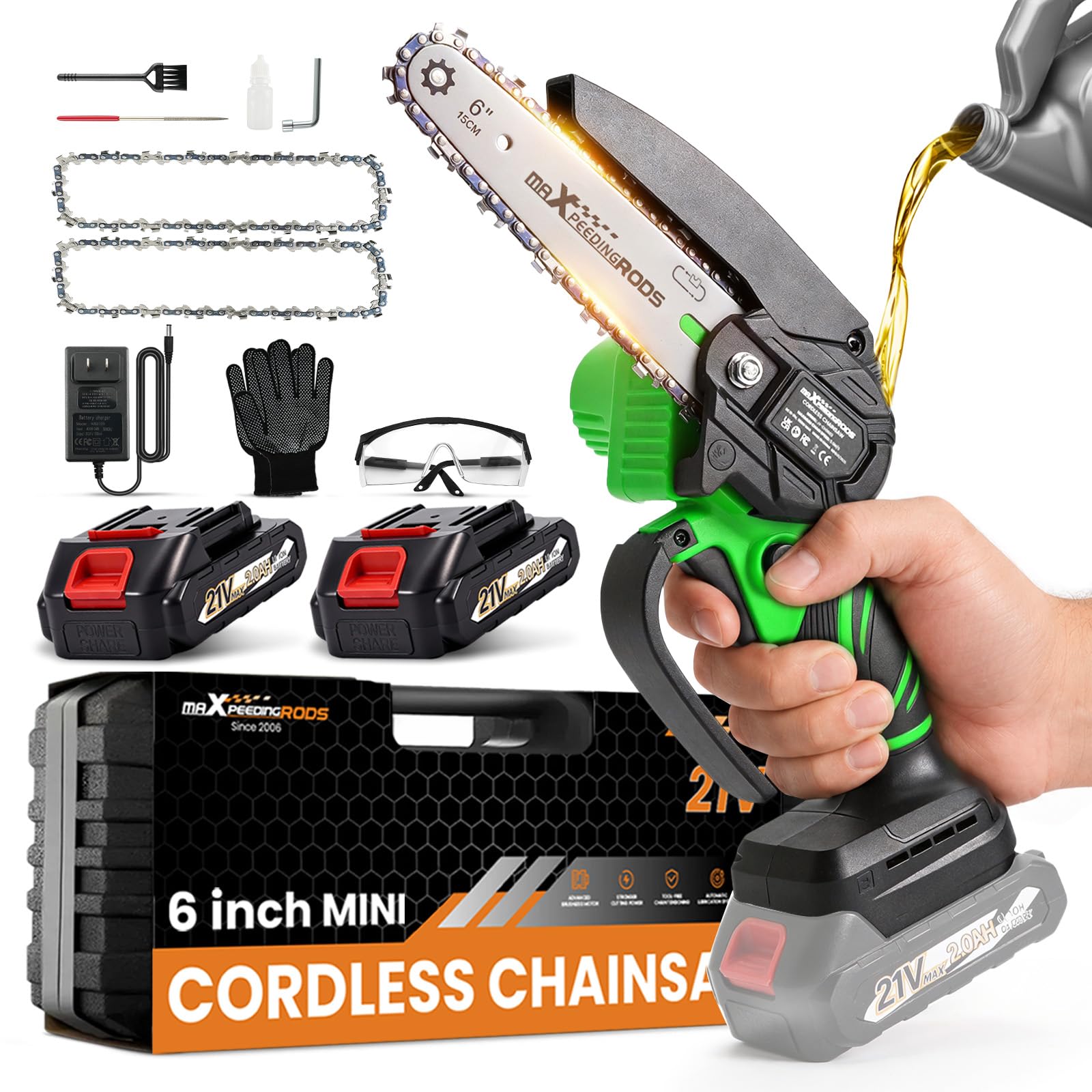
The maXpeedingrods kit leans on spares. You get a 6-inch bar, three chains, and two 21V 2000mAh batteries, which is a lot of backup for a saw at the lower end of this group. The 550W motor and 18.04 ft/s chain speed are the modest part, and they are worth understanding before you buy: this is a light-duty carver, not a saw that will churn through dense hardwood all afternoon.

For softwood blanks and small details, the package makes sense. The three chains mean you can keep a sharp one ready, and the two batteries let you rotate rather than wait. The 6-inch bar is easy to place, and the saw is light enough to move around a small workpiece. We think it works best as a backup or a second saw for roughing, especially if you already have a more powerful tool for the heavy removal.

What holds the maXpeedingrods back is the motor. In a group where 880W to 1200W saws are common, 550W asks for patience on anything dense, and the slower chain speed makes that patience non-negotiable. We do not treat it as the first choice for hardwood, but as a spare-chain kit for softer wood it has a clear job. If you want one saw to do everything, spend more on the Seesii or DocSmart.

Bottom line: We recommend the maXpeedingrods as a low-cost spare-chain kit for softwood carving and light shaping jobs.

3

Tietoc MNCS-118

Tietoc MNCS-118

Budget roughing

Our Score 8.8/10
Check Price

Worth Noting

  • Chain can loosen during use
Motor
880W
Weight
3.3 lb
Bar Length
6 inches
Chain Speed
28.6 ft/s
Read the full review

The Tietoc MNCS-118 is the value play in this group. You get a 6-inch bar, an 880W motor, and a 28.6 ft/s chain speed for less than the Seesii, and the saw is already assembled when it arrives. For a carver who wants to try a battery mini saw without spending much, that combination is hard to argue with.

We found the Tietoc easier to handle than its 3.3-pound weight suggests. The extra heft gives it a stable feel when you are making a straight blocking cut, and the auto oiler keeps the chain wet without a separate oil can. It is not as light as the Seesii, so long sessions of detail work will tire your wrist sooner; as a budget roughing saw, though, it earns its place. The 365-day warranty is a nice cushion, too.

The Tietoc is best treated as a first carving saw or a second saw for rough work. It has enough power for small hardwood blanks, and the low cost leaves room for a proper carving bar later. We do not treat it as a fine-detail tool; the 6-inch bar and standard chain are for shaping, not finishing.

Bottom line: We recommend the Tietoc as the budget pick for carvers who want a capable 6-inch saw with an auto oiler and a simple, stable feel.

4

CEEPUY 6-Inch Mini

CEEPUY 6-Inch Mini

Long sessions

Our Score 8.8/10
Check Price

Worth Noting

  • Battery life can fall short
Motor
880W
Chains
Three chains
Batteries
Two 21V 2000mAh
Bar Length
6 inches
Read the full review

The CEEPUY kit is built around the idea that a carving session should not stop because a chain dulled or a battery died. The case holds two 21V 2000mAh batteries and three chains, plus the small extras—oil bottle, goggles, gloves, cleaning brush—that usually become a separate shopping trip. We appreciated that the chain, bar, and battery all have a place in the box.

The 6-inch bar and 880W motor give it the same small-saw agility as the Tietoc and Seesii, and the 28.6 ft/s chain speed is quick enough for softwood and small hardwood blanks. The body is slim enough to hold close to your work, which is what you want when you are following a pencil line around a curve. The auto oiler is a press-and-go system, so you are not stopping to drip oil on the bar.

What keeps the CEEPUY out of the top spot is not a lack of capability; it is that the Seesii feels slightly more direct in the hand and comes with a simpler story. The CEEPUY rewards buyers who want a stocked case and do not mind a little more kit to keep track of. That is a fair trade for a long shaping session.

Bottom line: We recommend the CEEPUY for carvers who want a stocked kit with three chains and two batteries, and who value quick swaps over the simplest setup.

5

DEJUNPIOOL 6/8-Inch

DEJUNPIOOL 6/8-Inch

DeWalt battery users

Our Score 8.8/10
Check Price

Worth Noting

  • No battery or charger included
Motor
1200W
Weight
2.7 lb
Battery
DeWalt 20V, tool only
Bar Length
6 and 8 inches
Read the full review

The DEJUNPIOOL is the pick for anyone already carrying DeWalt 20V batteries. It runs on those packs, and the 2.7-pound body with a 6- or 8-inch bar is light enough to steer around a blank without feeling like a different battery platform is a tax on the purchase. We like that it fits the kit you already own; for a DeWalt user, that is the difference between trying carving and starting a new battery collection.

The 1200W brushless motor and 36 ft/s no-load chain speed are the strongest numbers in this group, and the tool-free chain tensioning is a real convenience when you are swapping between bars. The kit includes two 6-inch chains, two 8-inch chains, and both guide bars, so you can start with the short bar for control and move up when the blank gets bigger. We found the 6-inch setup the more natural carver; the 8-inch bar is there for blocking out larger sections.

For DeWalt owners, this is the most flexible saw here: two bar lengths, a light body, and a brushless motor that does not feel strained in small hardwood. The tool-free tensioning makes bar swaps quick enough to be useful rather than a chore. It is the one we reach for when we want the lightest possible body and already have the batteries charged.

Bottom line: We recommend the DEJUNPIOOL for DeWalt 20V users who want a light, brushless carving saw with both 6- and 8-inch bars.

6

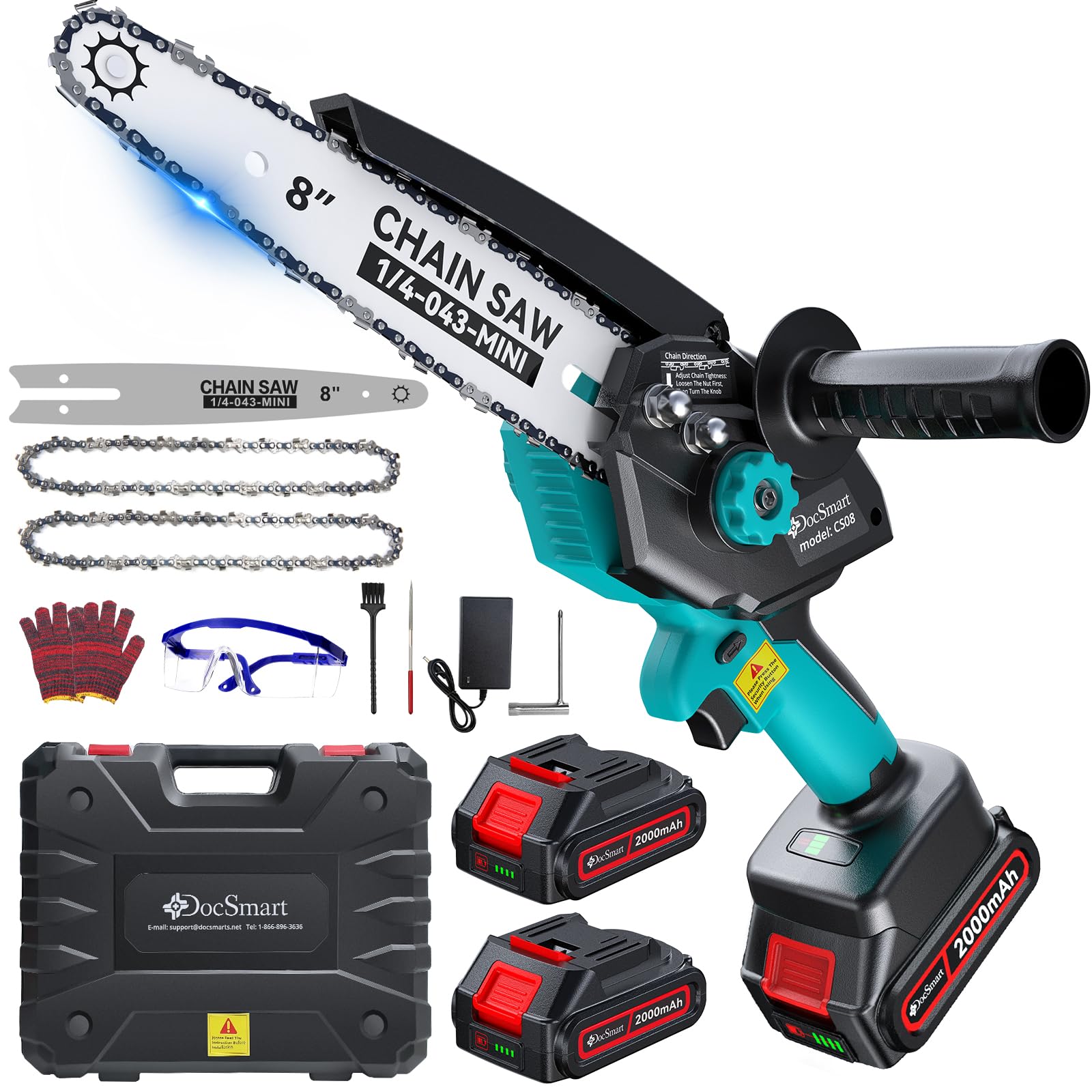
DocSmart 8-Inch

DocSmart 8-Inch

Larger blanks

Our Score 8.8/10
Check Price

Worth Noting

  • About 30 minutes per battery
Motor
1000W
Batteries
Two 2000mAh
Bar Length
8 inches
Chain Speed
26 ft/s
Read the full review

The DocSmart is the one to choose when the carving is bigger than a hand-sized blank. The 8-inch bar and 1000W brushless motor give it more reach and more sustained cut than the 6-inch saws here, and the 26 ft/s chain speed is quick enough to clear chips instead of packing them into the kerf. It arrives fully assembled, so the first session is about setting up your work, not the tool.

We noticed the size most when changing direction. The longer bar is stable in a straight blocking cut, but it is not as eager to turn a tight curve as the 6-inch Seesii or Tietoc; you feel the extra nose working against you. For large masks, chair parts, or roughing out a bigger animal shape, that reach is worth it. For eyes, ears, and small details, we still reach for the shorter saws. The two 2000mAh batteries are a sensible pairing for longer sessions.

The DocSmart earns its place as the larger-blank option rather than the all-rounder. It gives you more bar and more power without stepping up to a heavy 12-inch saw, and the fully assembled kit is friendly if you are new to battery saws. We kept it set up with the 8-inch bar and treated the 6-inch saws as the detail tools.

Bottom line: We recommend the DocSmart for carvers working on larger blanks who want an 8-inch bar and a 1000W brushless motor without a heavy 12-inch saw.

How We Tested Eight Carving Saws

We started with the saws carvers and arborists actually recommend to each other, then narrowed by spec: whether the powerhead would pull a small-pitch carving bar with a dime or quarter tip, whether the oiler could be dialed back far enough to keep a 12-inch bar from flooding, and whether the price made sense for the work the saw could do. Eight made the cut, a mix of gas and battery models from familiar names and smaller outfits.

Every saw spent six months going back and forth between a cedar stump in my driveway and a bench full of basswood blanks. We made the same three cuts on each one — a plunge, a nose-detail cut, and a stop cut across the grain — and noted where the tip wandered, how the saw handled one-handed, and how quickly the chain cleared chips. Cordless models were run until they cut out mid-cut so the battery numbers were honest, and the gas saws got cold-started and idled between cuts the way they do in a real session.

Durability was the long game. After every few sessions we checked chain tension, oil output, and play in the nose sprocket, so by the end we could tell which saws were still tight and which had gone sloppy. Price came last: we asked whether each saw earned its number against the one below it, because a simple saw that carves cleanly beats a fancy one you have to fight.

How to Choose Chainsaws for Carving

Start With Bar Length, Then Check the Bar Itself

A 6-inch bar is the most controllable choice for small blanks, an 8-inch bar gives you more reach for larger shapes, and a 12-inch saw is really a compact trimming saw rather than a detail carver. We prioritize 6-inch saws for most hand-sized work and move to 8 inches only when the blank demands it.

The trap is assuming every 6-inch mini saw is a carving saw. Most of the saws here are pruning tools with standard bars and chains, so they excel at blocking out and rough shaping, not dime-tip detail. If fine detail is the goal, budget for a dedicated carving bar and chain, or plan to finish with hand tools.

Weight and Balance Matter More Than Motor Size

Battery mini saws in this group run from about 2.2 to 3.3 pounds, and the difference shows up at the end of a session. A lighter body is easier to rotate around a curve and less tiring when you are working close to the blank. We look for a saw that feels balanced with the battery installed, because a nose-heavy tool fights your wrist.

Do not chase wattage alone. A 900W saw you can control will carve better than a 1200W saw you are wrestling. The exception is dense hardwood or a larger blank, where the extra power of a brushless 8-inch model earns its keep.

Battery Platform, Runtime, and Spares

Two batteries are the practical minimum for carving because you will run one down while shaping and want the second ready. Advertised runtimes are best-case; dense hardwood and long cuts shorten them, so treat a second pack as working time, not a luxury.

If you already own a battery platform, a tool-only saw can be the smartest buy, provided the total cost still makes sense. For everyone else, a kit with two batteries and a charger is the simpler start.

Chain Tension, Oiling, and Safety

Mini chainsaws are not maintenance-free. Check chain tension before each session and after the first few cuts, because a loose chain can jump the bar and stall your work. Fill the oil tank before you start; an auto oiler only helps if the reservoir has oil in it.

Wear the goggles and gloves that come with the kit, keep both hands on the saw, and use the safety lock as designed. A saw that feels loose or noisy is a signal to stop and check.

Frequently Asked Questions

Final Verdict

For most people, the Seesii M6 Lite is the right first carving saw. Its 6-inch bar and 1-kilogram body give you the control to rough out a blank, and the 900W motor with two batteries keeps you cutting instead of waiting. It is not a finish-detail tool, but it is the best default in this group.

If you already own DeWalt 20V batteries, the DEJUNPIOOL is the smarter buy because it adds a 1200W brushless motor and both 6- and 8-inch bars without another battery platform. Step up to the DocSmart only when most of your work needs an 8-inch bar; otherwise the smaller saws are easier to steer.