Garden Tools

Best Electric Pruning Shears of 2026

I resisted electric pruning shears for years. The bypass pruners I'd used since college felt honest, and a battery-powered pair seemed like a solution in search of a problem — until an afternoon cutting back overgrown spirea left my right hand too sore to grip a coffee mug. What changed my mind wasn't speed. It was how much less the work hurt: a good pair does the squeezing for you, so your forearm stops being the limiting factor and the battery takes over.

That shift is why this category is harder to sort than it looks. Two shears can list identical cutting capacity and feel completely different after an hour, because blade sharpness, weight, and trigger response matter more than the number on the box. We've spent the past eight months pruning with 10 models — through spring cleanup, summer deadheading, and a fall of cutting back woody shrubs — and the standouts share a few traits. The picks below are the ones I'd hand to a friend, sorted by who they actually suit.

1

SEESII CS510 Ultra Pruner

Top Pick
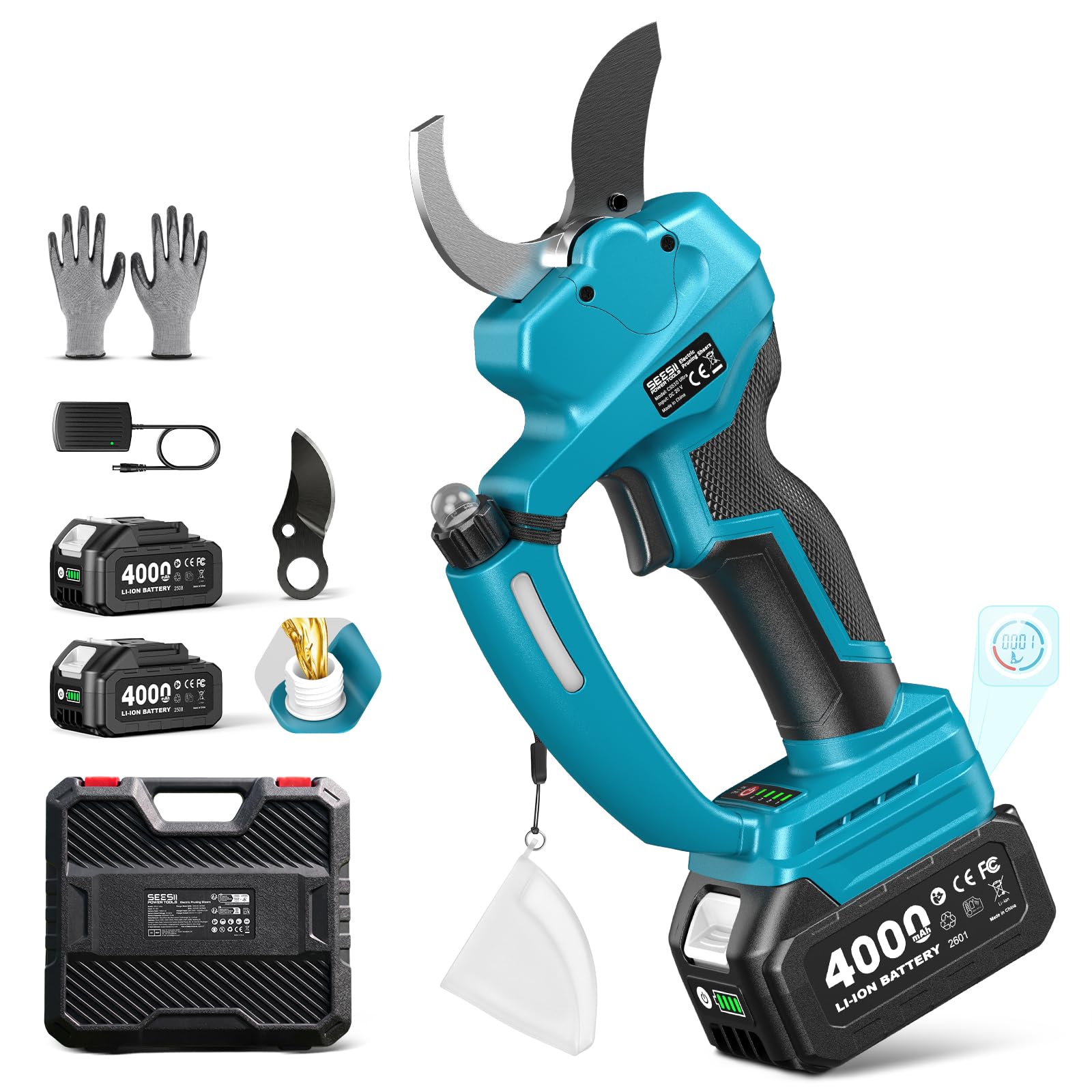
SEESII CS510 Ultra Pruner

Orchard-scale work

Our Score 9.8/10
Check Price

Worth Noting

  • Four pounds is heavy for one-handed work
Weight
4 lb
Batteries
2 x 4.0Ah
Blade Care
One-press lubrication
Cutting Capacity
2.2 inches
Read the full review

Every shear in this group eventually wants a drop of oil at the pivot, and the CS510 Ultra is the only one here with a button for it. Press it and the blade is oiled from a reservoir in the body — a small thing that says somebody thought about the second season rather than the first week.

The rest is built for volume. A 3.2-inch blade opening and a 2.2-inch cut, four modes starting at 0.67 inches, two 4.0Ah batteries rated at 4000-plus cuts, and a safety guard and blade cover that make it the most deliberately guarded tool here. For orchard rows, or a garden carrying a lot of fruit wood, this is the one we reach for when the wood is thick.

Four pounds is the cost. That is the heaviest shear in this group by a distance, and it is a two-handed tool for anything above waist height. If your pruning is a handful of branches at a time, the 1.8-inch SEESII does the same work with less weight in your hand.

Bottom line: The biggest jaw and the only built-in oiler in this group, made for orchard-scale cutting — provided four pounds in one hand all afternoon sounds like a fair trade.

2

DEWALT 20V MAX Pruner (Bare Tool)

DEWALT 20V MAX Pruner (Bare Tool)

DeWalt battery owners

Our Score 9.6/10
Check Price

Worth Noting

  • Battery and charger sold separately
Light
On-board LED
Weight
16 oz
Battery
Not included (bare tool)
Cutting Capacity
1.5 inches
Read the full review

Sixteen ounces and a 1.5-inch bite, with no battery in the box. That is the whole story of the DCPR320B, and it carries the lightest stated weight of any full-size shear in this group — which is the reason the bare-tool packaging is also the only thing keeping it out of the top spot.

The parts DeWalt got right are the ones you notice in a thicket. The non-stick blade coating sheds sap instead of dragging it, the blade change uses the supplied tool and takes about a minute, and the LED sits where it lights the cut rather than the shrub behind it. We worked through a bank of overgrown forsythia with it and never felt the tool straining.

If a 20V MAX pack is already on your shelf, this is the sharpest value here and the one we hand to anyone who prunes in short bursts, because the tool itself weighs so little. If it isn't, add a battery and charger to the arithmetic before comparing it with the kits, and look at the MODOFO instead.

Bottom line: Buy it if a 20V MAX pack is already in your garage; at 16 ounces it is the lightest shear here, and blade changes take about a minute.

3

MODOFO 1.4-Inch Cordless Pruner

MODOFO 1.4-Inch Cordless Pruner

Everyday garden pruning

Our Score 9.4/10
Check Price

Worth Noting

  • Capacity tops out at 1.4 inches
Motor
450W brushless
Display
LCD, charge and cut count
Batteries
2 x 2.0Ah
Cutting Capacity
1.4 inches
Read the full review

A 1.4-inch cut covers almost everything a home garden asks for, and that is where our recommendation starts. The MODOFO pairs a 450W brushless motor with an SK5 blade and ships with two 2.0Ah batteries, so a full afternoon among shrubs, roses and small fruit trees is a realistic session rather than an optimistic one. Nothing here is exotic; it is simply the right capacity in a complete kit.

The detail that won us over is smaller than the motor: a display that counts cuts alongside the charge level. After a session you know what a battery costs you in branches, which turns battery planning from guesswork into arithmetic. The same display explains the short pause between switching on and the blade responding — we read it as lag for the first minute and as good sense once we were reaching into a dense shrub.

In the hand it stays a one-handed tool, which matters more than any figure on the box once you are working at eye level with the other hand holding a branch out of the way. We came back to it for the fiddly jobs — the tangle of growth around a fence post, the dead stems inside a hydrangea — because it needs one squeeze rather than a wrestle.

Where it stops is 1.4 inches. If your work runs to wrist-thick sucker growth or storm-damaged limbs, the SEESII 1.8 and the Anttctig have the headroom, and stretching this one past its rating is how geared tools die young.

Bottom line: This is the pruning shear we point most gardeners to: two batteries, a 1.4-inch cut that handles real shrubs, and light handling that makes an afternoon feel routine.

4

CRAFTSMAN V20 Cordless Pruner

CRAFTSMAN V20 Cordless Pruner

Name-brand complete kit

Our Score 9.4/10
Check Price

Worth Noting

  • Cut capacity stops at 1.25 inches
Cut Speed
Up to 1 per second
In The Box
V20 battery, charger, spare blade set
Cuts Per Charge
Up to 900
Cutting Capacity
1.25 inches
Read the full review

Nine hundred cuts per charge and up to one cut per second sound like brochure numbers until you are three seasons behind on a hedge. This is the pruner that shortens the gap between the trigger pull and the branch being on the ground.

We like it best as an out-of-the-box answer: the V20 battery, the charger and a spare blade set all arrive together, and the 1.25-inch capacity is rated for wet wood as well as dry. That last part is the difference between cleaning up after a storm and waiting a season for the wood to dry.

Two things to know before you commit. The 1.25-inch ceiling is the real limit — past it the tool backs off and asks for a second bite — and this isn't the shear we grab for long stretches of overhead work, where the 16-ounce DeWalt is easier to hold. How the drive holds up across several seasons is the open question.

Bottom line: The most complete name-brand kit here — battery, charger and spare blade included — with a 1.25-inch cut and a one-cut-per-second rhythm that eats hedges.

5

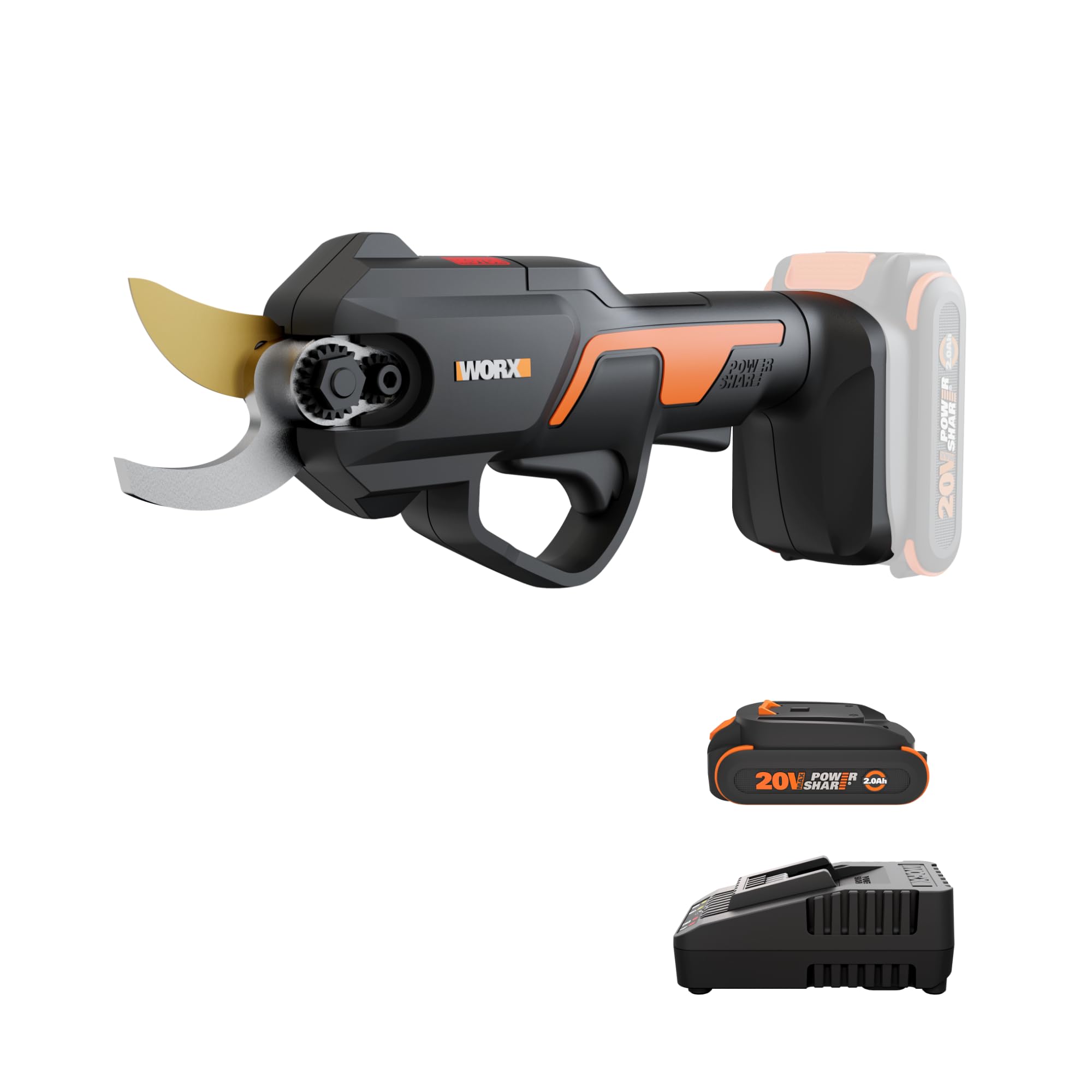
WORX WG330 Cordless Pruning Shear

WORX WG330 Cordless Pruning Shear

Small branches only

Our Score 9.4/10
Check Price

Worth Noting

  • One-inch capacity limits it to small branches
Weight
2.4 lb
Battery
20V 2.0Ah with charger
Warranty
5 years limited
Cutting Capacity
1 inch
Read the full review

One inch is the smallest capacity in this group, and for a great many gardens it is the entire job. Roses, buddleia, box hedges, the tangle of growth behind the shed — none of it needs more jaw than the WG330 has, and we are comfortable recommending it on exactly that basis.

What you get in return is the most polished small-branch tool here. The titanium-coated blade slices rather than crushes, the brushless motor is quiet enough for early on a Sunday, and the soft grip keeps the shape of your hand through a long session. The five-year limited warranty is the longest in this group by a wide margin, and the Power Share pack fits more than 75 other Worx tools.

The limit is the same one inch. Past that the jaw will not close around the branch, and no amount of technique fixes it — step up to the SEESII 1.8 or the Anttctig for anything thicker.

Bottom line: If your cutting stops at an inch, this is the shear to own: light, smooth in the cut, and backed by a five-year warranty plus a battery that runs dozens of other Worx tools.

6

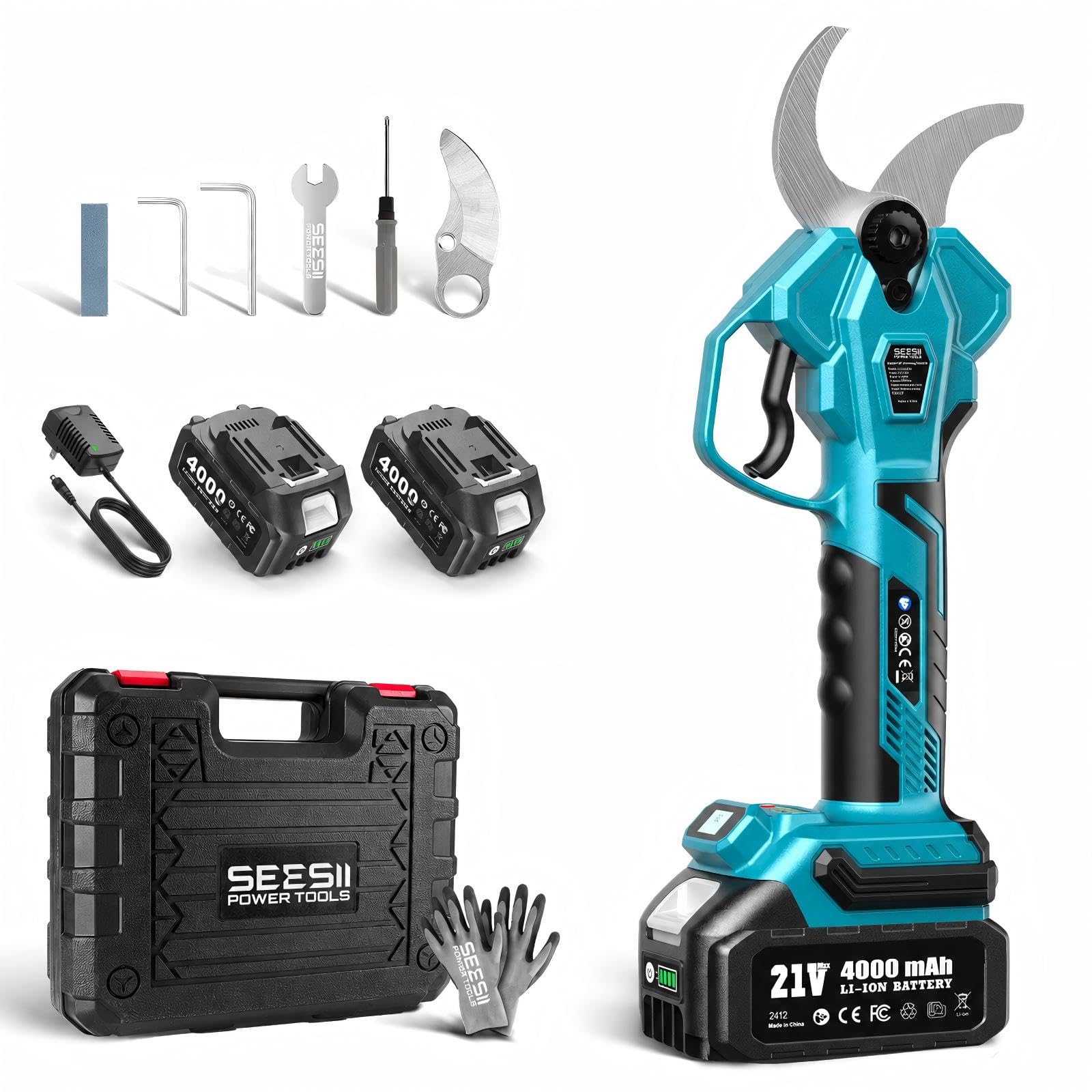
SEESII 1.8-Inch Cordless Pruner

SEESII 1.8-Inch Cordless Pruner

Heavier cutting jobs

Our Score 9.4/10
Check Price

Worth Noting

  • 2.8 pounds tires the arm overhead
Weight
2.8 lb
Batteries
2 x 4.0Ah
Cutting Modes
4 opening settings
Cutting Capacity
1.8 inches
Read the full review

Two 4.0Ah batteries is the sort of line you skim on a listing and then appreciate in November, when the leaves are down and there is still a border to cut back. Each pack is rated for 4000-plus cuts, and having the pair means one is always charged and waiting.

Open the case and the second thing you notice is that SEESII expects you to keep this tool running: a spare SK5 blade, a sharpening stone, hex drivers and a wrench, all in the same box. We were struck by the sharpening stone in particular, because it turns the blade from a disposable part into something you maintain. The 1.8-inch cut with four opening settings spans roses to fruit-tree limbs without changing tools.

It isn't the lightest way to do the job. At 2.8 pounds it wants two hands once you are above shoulder height, which is the trade for the bigger packs and the deeper cut. Against the 2.2-inch CS510 Ultra it gives up capacity and saves more than a pound; against the 1.4-inch MODOFO it gives up some easy one-handedness and gains real headroom.

Bottom line: The best balance of capacity and endurance in this group: a 1.8-inch cut, two 4.0Ah packs, and a case of spares that keeps it cutting season after season.

7

VOTREK Electric Pruning Shears

VOTREK Electric Pruning Shears

Tight budgets

Our Score 9.0/10
Check Price

Worth Noting

  • Single battery means a recharge break
Motor
600W brushless
In The Box
Battery, charger, gloves
Cutting Modes
0.71 and 1.6 inches
Cutting Capacity
1.6 inches
Read the full review

The least expensive way into a complete electric pruner here arrives with a battery, a charger and a pair of gloves, and cuts up to 1.6 inches. That combination is why it earns a place despite being a much smaller name than the tools above it.

Two cutting modes are the practical part. The narrow 0.71-inch setting lets you work through softer stems and spent flower heads without the blade slamming shut on nothing, and the wide setting takes the woody growth. The double-click arming sequence is the safety feature we want on a tool this sharp, and the display covers charge level and cut count.

What you accept at this end of the range is mostly about stamina: a single battery rather than a pair, so a long session has a pause built into it, and a wattage headline that says less about the tool than the 1.6-inch capacity does. Shop the capacity and the two modes, and this is a sensible first electric pruner.

Bottom line: The cheapest complete kit here: a genuine 1.6-inch cut, a fine mode for delicate work and a charger in the box — just plan around one battery.

8

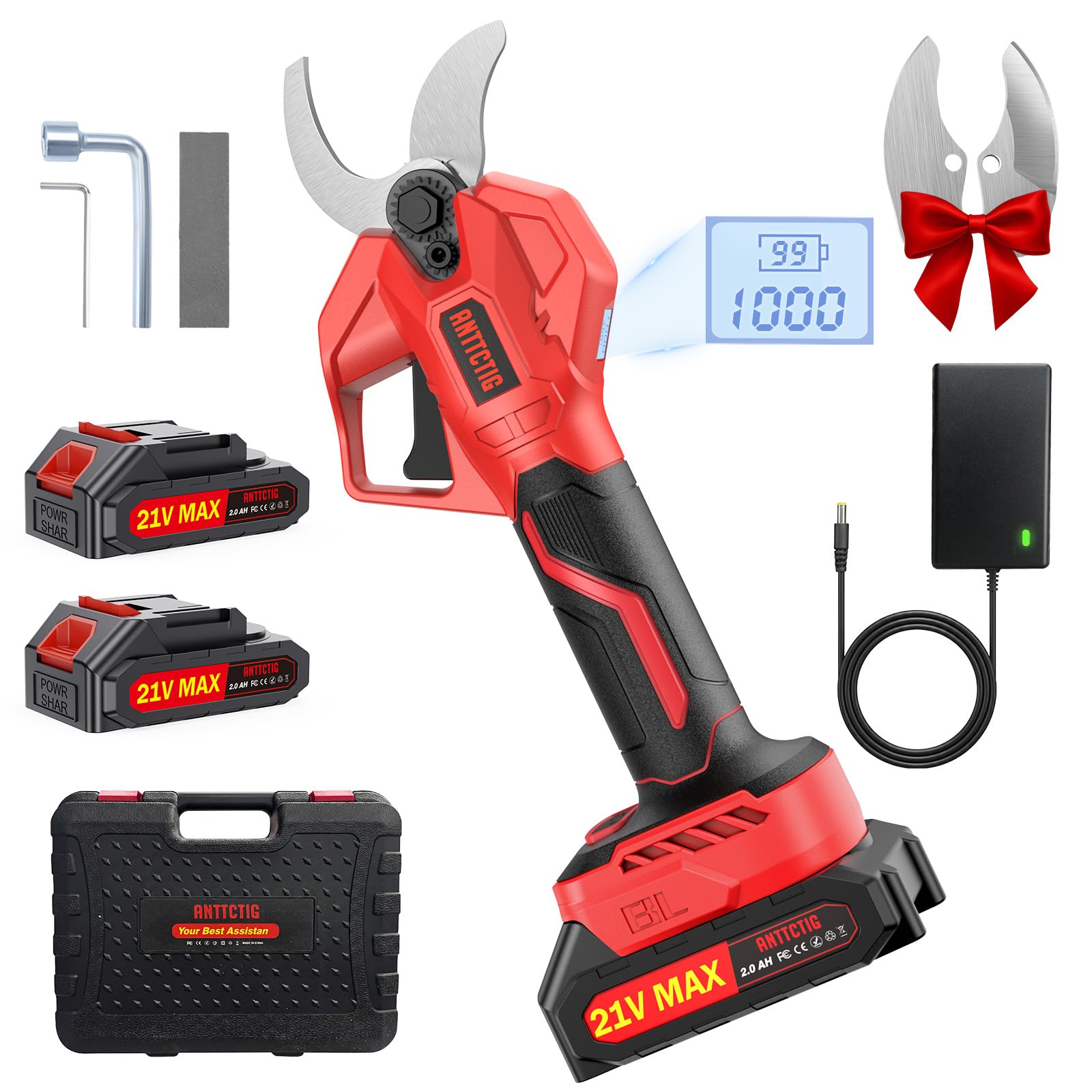
Anttctig 2.56-Inch Electric Pruner

Anttctig 2.56-Inch Electric Pruner

Thick, awkward limbs

Our Score 8.8/10
Check Price

Worth Noting

  • Drive gears are the risk in sustained heavy cutting
Blade
SK7 steel
Batteries
Two included
Max Opening
2.56 inches
Cutting Settings
1.97 and 2.56 inches
Read the full review

A 2.56-inch opening is the widest jaw in this group, and it is worth being precise about what that number buys. It is headroom — room to get the jaw around an awkward, angled limb that a narrower shear has to approach twice. It is not a promise that every branch that fits will come away in one clean bite, especially in dry hardwood.

The SK7 blade is the harder steel of the two commonly used here, and it shows in how the jaw finishes a cut rather than how it starts one. We are also fond of the silicone-wrapped handle, which damps the kick when the blade meets a knot; over a long afternoon that is the difference between sore hands and stopped work. The kit adds a second battery, a spare blade and a case.

The caveat is longevity. This is a tool that will take on bigger wood than most, and sustained heavy cutting is where the drive is most likely to let you down; the gear train is the part to listen to. Buy it for occasional thick limbs, not for a commercial clearing job.

Bottom line: The widest jaw here, with SK7 steel and a handle that soaks up the kick — a good choice for awkward, thick limbs as long as the work stays occasional.

How We Picked and Tested Electric Pruning Shears

We started with more than 30 models on paper, comparing cutting capacity, blade type, battery platform, and replacement-blade availability, then narrowed to 10 spanning the price range. Anything with a sealed battery that couldn't be swapped mid-job was out, and we favored shears built for homeowners rather than vineyard crews.

Those 10 went through eight months of real work: spring cleanup on a half acre of overgrown spirea and forsythia, deadheading perennials through the summer, cutting back raspberry canes, and clearing storm-downed branches in the fall. I counted cuts per charge until each battery quit and timed the recharge, then weighed every unit on a kitchen scale and ran a 30-minute session of overhead cuts to see how fast my wrist noticed the difference between a light shear and a heavy one.

Cutting performance was judged on the wood, not the label — I noted whether blades sliced cleanly through green growth or crushed and frayed the bark, and whether the jaw stalled on dry deadwood. For durability, each pair got dropped on concrete, left in an unheated shed through a cold snap, and checked for blade play after a few thousand cuts. Ease of use came down to whether I could open the jaw, swap a battery, and release the safety with gloves on, and value meant adding up what came in the box, what a spare blade costs, and whether the battery worked with other tools in that line.

How to Choose Electric Pruning Shears

Start with your thickest regular branch

Electric shears are rated by the largest branch they will take, and the tools here run from one inch to 2.56 inches. Measure the thickest thing you cut in a normal session rather than the biggest thing on the property, then add a quarter inch of headroom. That is the number that decides everything else.

The catch is wood type. Ratings are generous on green growth and conservative on seasoned hardwood, so a shear rated to 1.5 inches can strain on an old dry limb of the same diameter. Shrubs, roses and hedges are comfortable territory for a one-inch tool like the Worx; fruit trees and storm cleanup push you to the 1.8- to 2.2-inch models.

Decide whether you are buying a tool or a kit

A bare tool is the cheaper entry if you already own the battery. The DeWalt DCPR320B arrives without a pack or charger and runs on the 20V MAX batteries in your garage. If you don't have them, price a battery and charger into the comparison before you decide the bare tool is the bargain.

Kits trade that flexibility for something that works out of the box, and the better ones include two packs — the MODOFO and both SEESII models do. Two batteries matter more than one bigger battery, because a recharge stops work and a swap doesn't.

Weigh it in the hand you will actually use

Stated weights here run from 16 ounces to four pounds. That is a small difference at waist height and an enormous one above your head, where the tool is furthest from your shoulder. A 2.8-pound shear wants two hands once you are reaching up; a four-pound one wants two hands most of the time.

Test it before you commit to a long session: hold the shear out at arm's length and count slowly to thirty. If your wrist is complaining before you reach thirty, the weight or the balance is wrong for you, however good the specifications look.

Insist on a lockout and a slow start

Every tool in this group can take a finger, and the good ones are designed as if the maker knows it. Look for a lock or double-click arming sequence, a short delay between powering on and the blade responding, and a guard or blade cover for storage. That delay is not a flaw; it stops the shear firing while your hand is still moving into position.

Keep your spare hand behind the blade rather than under the branch, and take the battery off before you reach in to clear a jam. A branch wedged in a powered jaw is the most dangerous thing in this category.

Blades are the wear item, so plan for them

SK5 and SK7 are the two steels you will see, and SK7 holds an edge longer in the same design. What really determines how long a shear cuts well is whether you can replace the blade and keep sap off it. A spare blade, a sharpening stone and a case in the box, as on the SEESII 1.8-inch, are worth more than another feature.

Wipe the blade after every session, oil the pivot, and store the tool dry. Sticky sap is what turns a clean slice into a crushed stem, and it is far easier to remove fresh than a week later.

Frequently Asked Questions

Final Verdict

Capacity and weight decide this purchase, and the MODOFO answers both for a typical garden: a 1.4-inch cut, two batteries in the box, and a body you can hold one-handed for an afternoon. That is why it is the shear we point most people to.

If a 20V MAX pack is already sitting in your garage, the DeWalt is the better buy — lighter in the hand and just as capable on 1.5-inch wood. And if your pruning regularly runs past 1.8 inches, skip both and start with the SEESII 1.8 or the Anttctig, where the capacity is.