Garden Tools

Best Pruning Shears of 2026

Every pruning shear does the same fundamental thing — two blades close on a stem — but whether that stem gets sliced clean or crushed comes down to how the blades meet and how much play is in the pivot. A clean cut heals over; a crushed one invites rot and dies back halfway down the cane. That single distinction is why two shears that look nearly identical can behave so differently by midsummer.

I've cut back my own overgrown shrubs for years, and over the past six months my team and I worked through 11 pairs of shears, from plain bypass models to ratcheting ones. Sharpness out of the box and how long it lasted mattered most, along with the lock, which is the part that quits first on most shears. The ones below opened smoothly one-handed in gloves, cut clean through green and dead wood alike, and were still snapping shut securely in month six.

1

Felco F2

Top Pick
Felco F2

All-round pruning

Our Score 9.6/10
Check Price

Worth Noting

  • Premium outlay compared with the group
Item Weight
8.8 oz
Overall Length
9.25 inches
Cutting Capacity
1 inch
Replaceable Parts
Yes
Read the full review

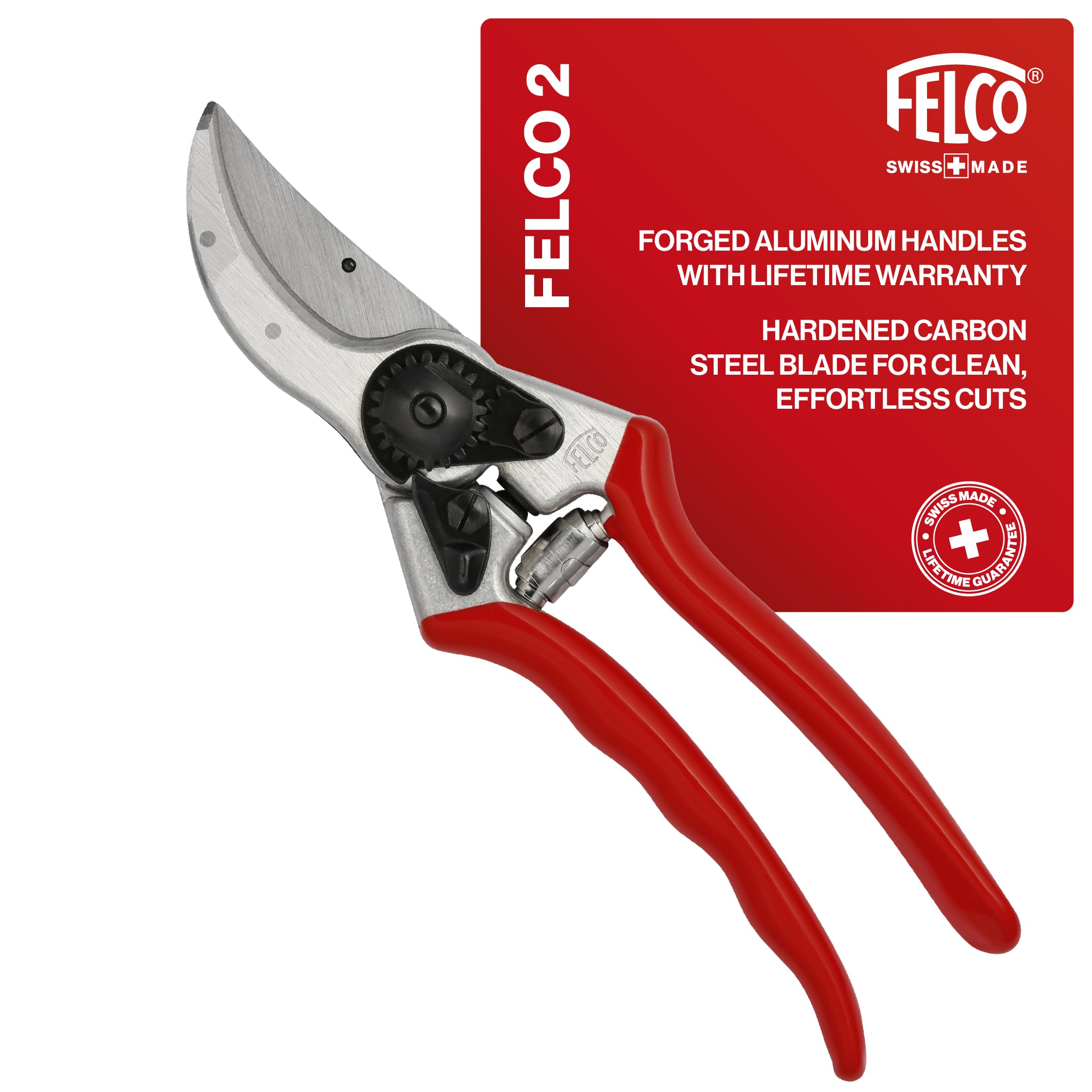
A full inch of cutting capacity is the first thing we look at on the F2, and it is why this is our top pick. The 9.25-inch body gives you enough reach for shrubs without crossing into lopper territory, while the 8.8-ounce weight keeps it manageable for a long pass through roses. The right-hand handle is the one fit check to make before buying: left-handed gardeners should look at an ambidextrous pick instead.

The hardened steel blade and 1-inch capacity are backed by an angled head and a non-slip coating, two details that matter more at the end of a pruning session than on the first cut. We like that the handles are forged aluminum rather than plastic; the tool feels solid without feeling heavy. The latch is stiff, though, and weak hands may need two hands to work it. That is a real annoyance on a pruner you will open and close constantly.

What makes the F2 easy to recommend over cheaper pruners is the parts support. The blade, spring, and handles are replaceable, so a damaged edge does not turn the whole tool into scrap. We also appreciate that the design has stayed familiar for years; there is nothing to learn before you start cutting. If you want a pruner that feels like a lifelong tool, this is the one we point to.

Bottom line: We recommend the F2 to anyone who wants one pruner to keep for years: it cuts a full inch, feels balanced, and every part can be replaced.

2

Kimura 8-Inch Pro

Kimura 8-Inch Pro

Value upgrade

Our Score 9.6/10
Check Price

Worth Noting

Item Weight
8.11 oz
Blade Material
Japanese SK5 steel
Handle Material
Aluminum with PVC
Cutting Capacity
1 inch
Read the full review

The lock on the Kimura does something we wish more pruners did: it clicks on as the handles come together, so the blade is secured before you set it down. That is a small convenience with a real payoff when you are moving between shrubs and do not want an open blade swinging at your leg. The release takes a deliberate squeeze, which is the trade-off for a lock that engages without a separate thumb movement.

That self-engaging lock is one of the reasons this is our value pick. The 1-inch capacity and Japanese SK5 steel blade put it in the same cutting class as pruners that cost more, and the 230-gram body feels substantial without dragging on your wrist. We like the 8-inch length for tight spots between branches; it is shorter than the Felco but still long enough for control. The PVC-coated aluminum handles are plain, but they stay put in a dry hand.

The blade is heat-treated to 60 HRC, and the PTFE coating is there to keep sap from gumming up the works. For rose canes, small shrubs, and the occasional woody stem, the Kimura has the sharpness and the lock to handle the job. It is the pruner we choose when the F2's price is more than the garden justifies.

Bottom line: The Kimura is the pruner we point to when someone wants most of the F2's cutting ability without the premium outlay.

3

Corona BP 3180D

Corona BP 3180D

Heavy branches

Our Score 9.4/10
Check Price

Worth Noting

  • Heavy at 13.6 ounces
Warranty
Limited lifetime
Item Weight
13.6 oz
Overall Length
8.5 inches
Cutting Capacity
1 inch
Read the full review

At 13.6 ounces, the Corona is the heaviest pruner we chose, and the first thing you notice is how much metal is in your hand. The forged steel body has a planted feel that lighter pruners lack; it does not chatter when you close it on a woody stem. That weight is also the reason it is not the pruner we hand to someone with a weak wrist or a long day of delicate deadheading.

For heavy cutting, that forged weight is exactly the point, and it is why we recommend the Corona as the heavy-duty value here. The 1-inch capacity and sharp bypass blade take thick stems and green wood without the flex you feel in cheaper tools. The contoured handles and spring-loaded action give you a secure grip, and the built-in lock is simple to operate. It is a no-frills pruner in the best sense: less to go wrong, more steel where it counts.

The maintenance bill is the trade-off. The steel is not stainless, and a damp shed will leave it looking old fast; dry it after use and put a drop of oil on the pivot. We also noticed that the pruner opens a little wider than most, which suits larger hands but can feel like a stretch for smaller ones. Neither issue cancels the recommendation for a gardener who cuts thick growth and wants a tool that can be kept going.

Bottom line: For thick stems and a tool that feels indestructible, we reach for the Corona; it is the heavy-duty value in this group.

4

Decerk 8.5-Inch Pruner

Decerk 8.5-Inch Pruner

Tired hands

Our Score 9.4/10
Check Price

Worth Noting

  • 3/4-inch capacity limits thick branches
Item Weight
8.82 oz
Blade Material
Titanium-coated SK5 steel
Overall Length
8.5 inches
Cutting Capacity
3/4 inch
Read the full review

The Decerk's lever-action handles are shaped to multiply your squeeze, and that is the kind of help that matters when your grip is tired before the hedge is finished. The 8.5-inch body is light in the hand, and the rubberized handles give you something to hold onto without a lot of padding. It does not feel like a professional forged pruner, but it does not ask you to muscle through every cut either.

The Japanese SK5 blade has a titanium coating, and the listed capacity is 3/4 inch. For rose canes, small shrubs, and light woody growth, that is enough; for thicker limbs, step up to a 1-inch pruner or loppers. The one-hand safety lock is a welcome detail, and the replacement spring in the box is a practical touch rather than a gimmick.

Where the Decerk earns its place is as the budget pruner for weaker hands. The lever action takes some of the sting out of a long session, and the light body is easier to carry around the garden than the forged alternatives. It is not the pruner for thick branches or a gardener who wants heirloom build quality, but it is a sensible choice for lighter work and tired hands.

Bottom line: We recommend the Decerk when hand strength is the limiting factor: its lever action and light body make three-quarter-inch stems feel less like a fight.

5

Okatsune 103

Okatsune 103

Light pruning

Our Score 9.4/10
Check Price

Worth Noting

  • Bare handles can feel slick
Origin
Japan
Item Weight
8.1 oz
Blade Material
High-grade steel
Overall Length
7.9 inches
Read the full review

At 8.1 ounces, the Okatsune feels closer to a pair of garden scissors than a heavy-duty pruner, and that is the first thing you notice when you pick it up. The 7.9-inch body is compact enough to slip into a pocket or a tool bag, and the high-grade steel blade is made in Japan. It is a pruner for quick passes through roses, herbs, and small shrubs rather than a day of clearing thick brush.

The latch is a simple metal piece that you can flick with a thumb, and it stays put when the blade is closed. We like that kind of directness; there is no plastic button to wiggle or spring-loaded gate to fight. The handles are bare steel, though, and they can feel slick when your hands are wet or you are wearing smooth gloves. That is the trade-off for a tool that feels so honest in the hand.

The blade takes a fine edge and cuts cleanly on green stems, but there is no published cut capacity to lean on here. Treat it as a pruner for stems and small branches, not a 1-inch brute. The compact handles also suit medium hands better than very large ones.

What keeps us coming back to the Okatsune is the feel: light, precise, and simple enough that you stop thinking about the tool. It is not the pruner for arthritic hands or heavy woody growth, but for a gardener who wants a sharp, traditional Japanese pruner for lighter work, it is a pleasure to use.

Bottom line: We keep the Okatsune for the pleasure of a light, simple pruner that cuts cleanly and locks with a thumb; it rewards gardeners who prefer feel over padding.

6

Kynup 2-Pack

Kynup 2-Pack

Two-garden kit

Our Score 9.4/10
Check Price

Worth Noting

  • Lock can be hard to engage
Pack Size
2 pruners
Blade Material
SK-5 steel
Overall Length
8.6 inches
Handle Material
Aluminum and silicone
Read the full review

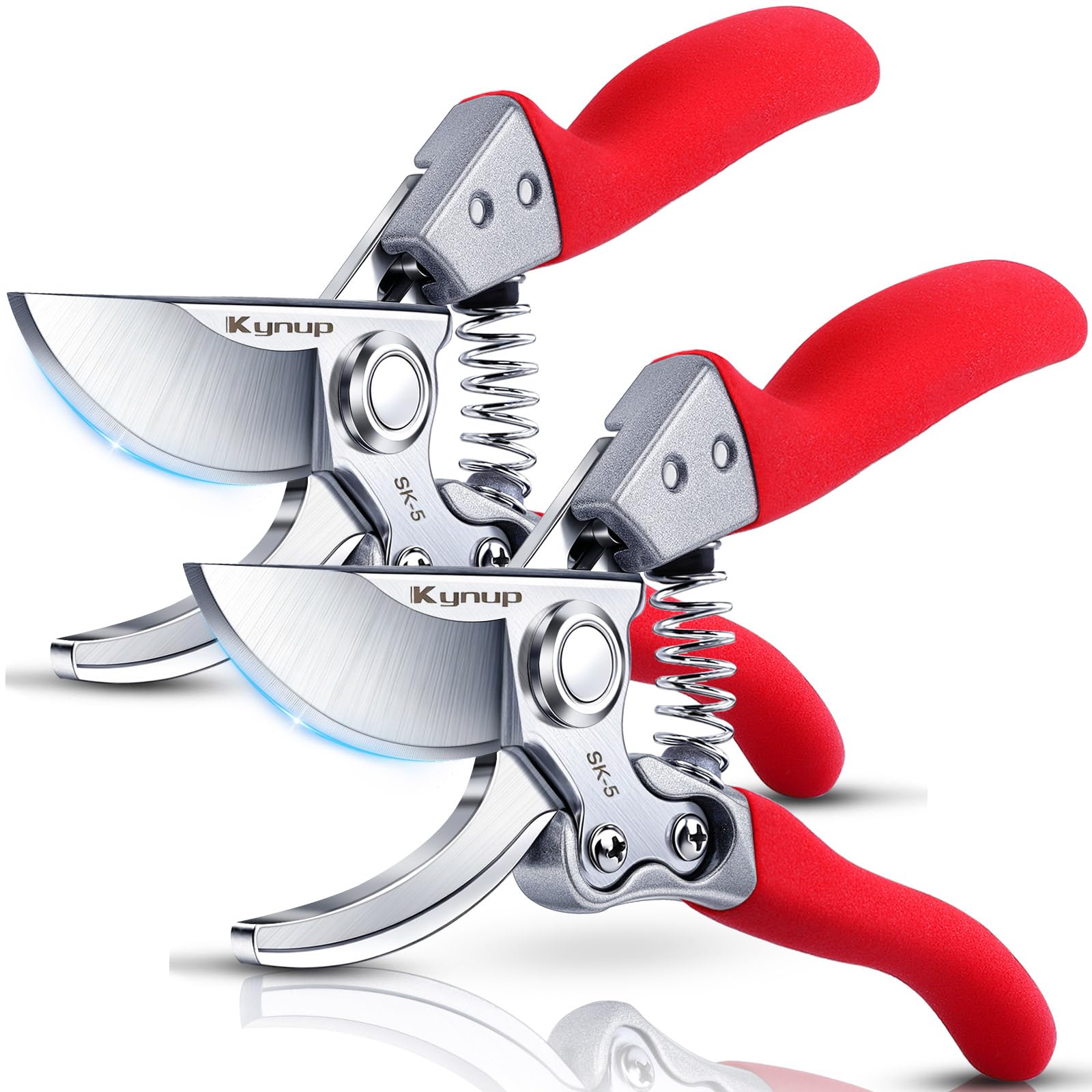
Two pruners for the price of one is the Kynup's appeal, and the pair makes practical sense if you garden in more than one spot. Keep one in the garage and one in the shed, and you stop carrying a pruner back and forth or hunting for it under a pile of gloves. The 8.6-inch body is a comfortable midsize, and the red handles are easy to spot when you set them down.

The SK-5 steel blades are sharp, and the aluminum handles have a silicone grip that feels secure in a dry hand. Each pruner comes with a spare spring, which is a nice bit of insurance because the spring is the part that usually gives out first on a budget pruner. The lock is a sliding button, and it is the detail that separates a good two-pack from a frustrating one.

The lock is where the Kynup loses ground to the better singles here. It can take more thumb pressure than it should, and on some pairs it does not stay engaged cleanly. That does not ruin the two-pack idea, but it does mean we recommend it for light pruning and for gardeners who want a spare rather than one heirloom tool. If you mostly cut thin stems and want a pruner in two places, the value is there; if you want the best lock in the group, spend it on the Kimura or the F2.

Bottom line: We like the Kynup two-pack for keeping a pruner by the back door and another in the shed, with sharp SK-5 blades in both.

7

Fiskars Bypass

Fiskars Bypass

Budget gardens

Our Score 9.2/10
Check Price

Worth Noting

  • 5/8-inch capacity limits thicker branches
  • ⚠️ Lock can stick or release on its own
Warranty
Lifetime
Blade Material
Alloy steel
Overall Length
9.07 inches
Cutting Capacity
5/8 inch
Read the full review

The Fiskars is the pruner we hand to someone who wants a dependable pair for flower stems and light shrubs without spending much. It has been around for years, and the formula is still sensible: a bypass blade, a low-friction coating, and a sap groove that helps keep the blade from gumming up. For a first pruner or a spare by the back door, that is a lot of usefulness in a plain package.

The 5/8-inch capacity is the honest limit. It handles green stems, deadheading, and small branches, but it is not the tool for thick rose canes or woody shrubs; forcing those cuts is how blades get nicked. The handles open wide, which is comfortable for larger hands and a stretch for smaller ones. The lifetime warranty is a genuine confidence booster on a budget pruner.

The lock is the part to check before you commit. It can stick or fail to stay closed, and that is more than a minor annoyance if you carry the pruner in a pocket or toss it in a bucket. Keep the pivot clean and the blade dry, and it behaves better, but the design is not as reassuring as the better locks here. The Fiskars still earns a place for light work and tight budgets; it just should not be your only pruner if you cut thick growth regularly.

Bottom line: The Fiskars is the cheapest way into a reliable bypass pruner, and we still recommend it for light garden jobs and first-time tool buyers.

8

gonicc 8-Inch Bypass

gonicc 8-Inch Bypass

Small hands

Our Score 9.2/10
Check Price

Worth Noting

  • Spring can pop off during use
  • Mixed durability for heavy work
Item Weight
5.29 oz
Blade Material
Titanium-coated SK-5 steel
Handle Material
Aluminum with PVC
Cutting Capacity
3/4 inch
Read the full review

At 150 grams, the gonicc is the lightest pruner in this group, and that is the first thing you notice when you pick it up. The 8-inch body and slim aluminum handles make it easy to carry in a pocket or a small tool bag, and the titanium-coated SK-5 blade is sharp enough for stems and light woody growth. It feels more like a precision tool than a heavy-duty lopper, which is exactly how it should be used.

The 3/4-inch capacity is enough for deadheading, herbs, and small shrubs, and the sap groove helps keep sticky growth from building up on the blade. The PVC-wrapped handles are comfortable in medium hands, and the non-slip texture is welcome when your hands are dry. A spare spring is included, which is a practical touch on a budget pruner.

The spring is also the part to watch. It can pop off during use, and the lightweight build does not have the forged solidity of the Corona or the F2. That does not make the gonicc a bad tool; it makes it a light-duty one. If you are cutting thick branches or pruning every day, the extra weight and cost of a stronger pruner buy you fewer interruptions and less worry.

We like the gonicc for what it is: a sharp, light, inexpensive pruner for small hands and light garden jobs. It is a good choice for a balcony garden, a few rose bushes, or a spare pair to keep in the car. It is not the pruner we reach for when the branches get thick or the session runs long, and that is the boundary we would keep in mind.

Bottom line: The gonicc is a light, sharp budget pruner we like for small hands and light pruning, but it is not the one we trust for years of hard use.

How We Put These Pruning Shears to Work

We started with the shears that working gardeners actually recommend — bypass and anvil designs, replaceable-blade models, ratcheting and geared options — and filtered out anything with a plastic pivot or a lock that couldn't be worked with gloves on. Eleven pairs made the cut, and we ran them for six months, from the first spring prune through the fall cleanup.

Each pair lived in a bucket by the back door and got used the way shears really get used: deadheading roses on a Saturday morning, cutting back leggy hydrangeas, working through a half-inch dead branch, snipping twine for stakes. We tracked somewhere around 300 cuts per pair, moving between green stems, dry deadwood, and the occasional woody perennial that should have gone to a lopper, and we noted after every session whether the blade still bit or started slipping.

Sharpness we judged by the cut itself — whether the stem came away clean or frayed at the edge — checked again at the one-, three-, and six-month marks. For the lock, we opened and closed it 50 times bare-handed and 50 times in thick gardening gloves, noting which models needed two hands, a thumbnail, or a hard squeeze. Durability meant watching for rust at the pivot after a pair got left on a damp bench, and checking for side-to-side wobble that would let the blades drift apart.

Ease of use came down to hand fatigue: we cut for an hour straight with each pair, in gloves, and paid attention to which ones left our palms sore and which we forgot we were holding. Value wasn't the cheapest pair — it was the one still cutting cleanly in month six without a blade swap or a warranty call.

How to Choose Pruning Shears

Match the blade and capacity to the cut

Bypass pruners slice green growth cleanly; anvil pruners crush and are better left for dry wood. For most gardens, a 5/8-inch bypass pruner handles flowers and small shrubs, 3/4 inch covers general pruning, and a 1-inch model is the choice for thicker canes and light woody branches. We prefer a 1-inch pruner for mixed shrubs because it leaves margin, but a 5/8-inch model is quicker in tight flower beds. The trap is treating the maximum cut as a challenge. A 5/8-inch pruner forced through a thick rose cane will nick its edge or twist the blade. Buy for the branches you cut most weeks, and keep a lopper for the occasional thick limb.

Test the lock before you trust it

The lock is the most common weak point in this category, and it matters more than the spec sheet suggests. A sliding thumb lock should engage and release without you changing your grip; an automatic lock should secure the blade as the handles close, then release with a deliberate squeeze. We like the Kimura's self-engaging lock for carrying safely between shrubs, but a stiff latch is a poor match for weak hands. Try the lock with gloves on. If it takes two hands or pops open in your pocket, the pruner will annoy you every time you use it.

Fit the handle to your hand and session

Weight is a useful clue but not the whole story. An 8- to 9-ounce pruner is easy to carry all afternoon; a 13-ounce forged model feels steadier on thick cuts but tires a weak wrist. Handle shape matters just as much: wide-opening handles suit larger hands, while compact handles can leave large palms cramped. Cushioned grips help arthritic hands, but a secure non-slip surface matters more than padding. We favor a handle you can hold without squeezing hard, because fatigue comes from grip as much as from cutting.

Decide whether you want to repair or replace

A forged pruner with replaceable parts is the better long-term buy if you garden often and hate throwing tools away. The Felco's blade, spring, and handles can be replaced, and the Corona's forged body carries a limited lifetime warranty. A budget pruner can still be the right call for light use or a spare. Whatever you buy, dry the blade after wet work and put a drop of oil on the pivot; rust and sap do more damage than most cutting jobs.

Frequently Asked Questions

Final Verdict

For most gardeners, the Felco F2 is the pruner to buy: a clean 1-inch cut, a balanced 8.8-ounce body, and replaceable parts that make the premium easier to justify. If the outlay is too much, the Kimura gives you a full 1-inch cut and Japanese steel for less. For thick, woody growth, the heavier Corona is the sturdier-feeling tool, while the Decerk is the one we point to when hand strength is the limiting factor. Choose by your branches and your hands, then keep the blade clean and the pivot oiled.