Garden Tools

Best Folding Pruning Saws of 2026

A folding pruning saw earns its keep when a limb drops across the path: it needs to be sharp, light, and unwilling to fold shut mid-cut. I've used pruning saws to clear storm damage, tidy shrubs, and cut kindling at camp, and a good one gets through green wood and dry deadwood without wearing out your arm. Then it disappears into a pocket until you need it again. That portability turns a messy cleanup into a ten-minute job instead of an afternoon of wrestling.

Over the past eight months, my team and I tested 14 folding pruning saws in gardens, on camping trips, and after storms, tracking cutting speed, sharpness, lock security, weight, folded size, durability, and value. The best shared a stiff blade, a lock that clicked into place without wobble, and enough heft to feel controlled without dragging down a pocket. A saw can feel sharp on day one and still disappoint if the blade flexes or the handle loosens; the picks below stayed tight, kept cutting, and made sense for the money.

1

Silky PocketBoy 170

Top Pick
Silky PocketBoy 170

Pack and pocket

Our Score 9.8/10
Check Price

Worth Noting

  • Heavy for its size at 10.4 ounces
Teeth
8.5 TPI (10 teeth per 30 mm)
Blade Length
6.75 inches (170 mm)
Cut Capacity
3.4 inches
Lock Positions
Two — in-line or flush cut
Read the full review

It arrives in a clear hard plastic case with a flip lock and a belt clip — the kind of packaging you keep, because it's the difference between a sharp saw in a daypack and a sharp saw loose in a daypack.

The blade is 6.75 inches of 1.4 mm hard-chrome-plated steel with 8.5 teeth per inch, taper-ground and impulse-hardened, and it makes the smoothest cut of the compact saws here — finer and slower in green wood than the 6 and 7 TPI blades, but clean enough to leave a face you'd show someone. Of the small saws, this is the one we trusted in a bag alongside a sleeping bag and a jacket.

Two locking positions are the detail we use most. Open it in line for a normal cut, or set it flush so the blade sits level with the handle — that second position lets you take a stub down close to a trunk or a graft union without the handle fighting the bark, which is exactly the cut a folding saw usually makes badly.

The fine tooth pattern is also why it's the one to reach for on dry, seasoned wood: it leaves a cleaner face than the aggressive blades, so the cuts you'll look at afterward look better.

Bottom line: The compact saw we trust in a pack: a rigid case, two locking positions, and a fine cut that belies its size.
2

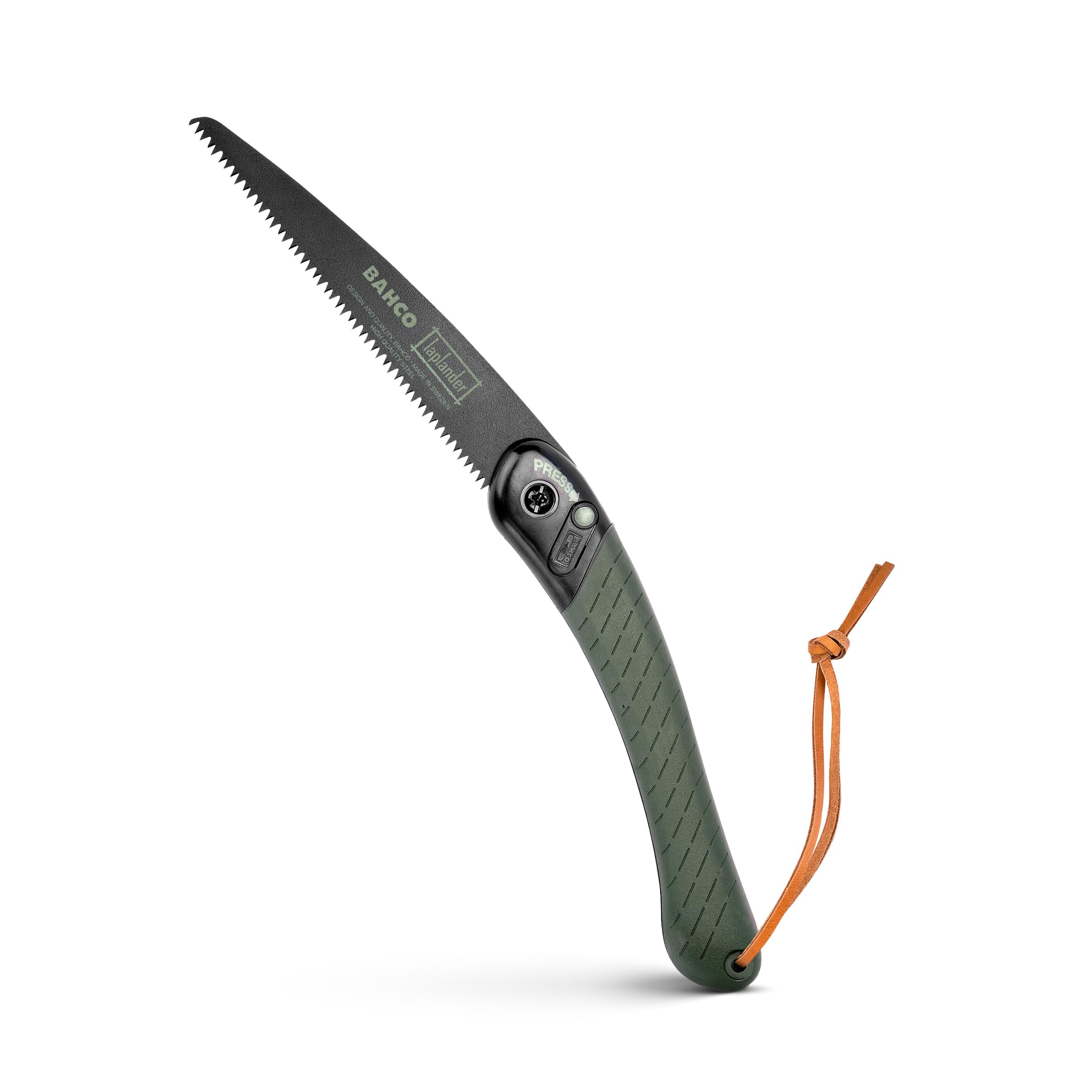
Bahco Laplander 396-LAP

Bahco Laplander 396-LAP

General pruning

Our Score 9.6/10
Check Price

Worth Noting

  • No case, just a leather strap
Teeth
7 TPI
Weight
7.52 oz
Blade Length
7-1/2 inches
Blade Material
Swedish steel
Read the full review

The detail that makes the Laplander our default isn't the blade — it's the lock. It clicks into place open and closed, so a saw dropped back into a pack or a truck box has no tooth waiting to find a finger or a stuff sack. Of everything here, this is the one we stopped thinking about, which is the best thing you can say about a folding tool.

The 7-1/2-inch blade with 7 TPI XT teeth is mid-length for this group, and we liked how little it cares about the condition of the wood: green limbs, dry deadfall, a bit of sappy pine, all of it comes off in fast, clean strokes. The blade is thick enough that it doesn't wander in a deep cut, and the low-friction coating keeps it moving once the kerf closes around it. The teeth take wood on both strokes, so a hesitant, badly angled push still removes material instead of polishing the bark.

The handle is a two-component plastic and rubber grip that stays put in wet weather, with a leather strap for hanging it off a belt. At 7.52 ounces it disappears in a daypack, yet there's enough handle to get a second hand on it for a stubborn cut — a combination the tiny saws here can't offer. It sits in the middle of the range on price, well under the Japanese blades and a step or two above the budget ones, which is the right place for a saw you'll use for years.

What it won't do is make a four-inch limb disappear in three strokes the way the GomBoy will. This is a saw for the branches a lopper can't reach, and for that job we never felt it come up short.

Bottom line: Our pick for most people: it locks open and closed, cuts green and dry wood without binding, and costs a good deal less than the premium saws here.

3

Silky GomBoy Professional 240

Silky GomBoy Professional 240

Large limbs

Our Score 9.6/10
Check Price

Worth Noting

  • Thin 1.5 mm blade can kink under force
Teeth
8.5 TPI (10 teeth per 30 mm)
Blade Length
9.5 inches (240 mm)
Cut Capacity
4.7 inches
Blade Thickness
1.5 mm
Read the full review

Nine and a half inches of 1.5 mm steel, a 4.7-inch cut capacity, and a taper-ground blade that only cuts on the pull — this is a different tool from the Laplander, not a longer version of it. Where the Bahco forgives a clumsy stroke, the GomBoy rewards a deliberate one: load the teeth, pull, and the saw does most of the work.

Impulse-hardened, non-set teeth leave a narrow kerf, which is why it moves through a four-inch limb so quickly, and the hard hinged plastic case means it can ride in a truck or a pack without the teeth finding something else to cut. We appreciated that the case is rigid; a soft sheath around a blade this sharp is an invitation to a sliced pack.

The trade-off is the blade itself. At 1.5 mm it's among the thinnest steel here, and thin steel punishes impatience — force a stroke, or lever the tip to free it from a pinched kerf, and the tip is what goes. Used as intended, with light pressure and the teeth tracking their own line, it's the fastest cutter in this set and the one we reach for first when a branch is too big for the others. At 250 g it's light for the reach.

The Japanese handle is the other thing we noticed: it's shaped to fill the palm, so a long session of limbing doesn't leave the web of your hand sore the way a skinny budget handle does.

Bottom line: Our fastest cutter: a 9.5-inch blade and 4.7-inch cut capacity make quicker work of big limbs than anything else here.

4

Corona RS 7245 Razor Tooth

Corona RS 7245 Razor Tooth

Garden pruning

Our Score 9.6/10
Check Price

Worth Noting

  • Seven-inch blade is short for bigger limbs
Weight
9.6 oz
Blade Shape
Curved
Blade Length
7 inches
Blade Material
High-carbon SK5 steel
Read the full review

The blade is curved, and that curve is the whole argument for this saw: it keeps the teeth loaded against the wood through the stroke instead of skating over bark, so a seven-inch blade cuts like something longer. We used it on shrubs, roses, and the mess of sucker growth along a fence line, and it's the one here that felt made for garden work rather than for camping.

Six razor teeth to the inch on a high-carbon SK5 blade, a push-button lock-back, and a cushioned handle that still works with gloves on. That button matters more than it sounds: it releases the blade easily, so you can fold the saw away with one hand while the other holds a branch out of the way. At 9.6 ounces it hangs on a belt all afternoon without you noticing.

Where it stops is size. A seven-inch blade is a pruning blade, and a six-inch limb will have you sawing long enough to reconsider the plan. Everything else about it is built to last: the steel is high-carbon SK5, the pivot feels tight rather than loose, and Corona backs it with a limited lifetime warranty.

Bottom line: We reach for this one in the shrub border: the curved blade keeps cutting where a straight blade skates, and the push-button lock frees a hand.

5

Mossy Oak 7-Inch Folding Saw

Mossy Oak 7-Inch Folding Saw

Budget starter saw

Our Score 9.4/10
Check Price

Worth Noting

  • Blade flexes on dry hardwood
Teeth
7 TPI
Packed Size
9.2 x 2 x 1 inches
Blade Length
7 inches
Blade Material
Bimetal (D6A and M2)
Read the full review

A belt pouch, an auto-lock that clicks over when the blade reaches full open, and no exposed teeth once it's folded — that's most of the way a folding saw should behave, and it's the budget one here that gets it right.

The blade is a D6A and M2 bimetal with a Teflon coating, 7 inches long with 7 TPI triple-ground teeth. The coating isn't decoration: sap and resin wipe off instead of setting, which matters if you cut much pine. Packed dimensions come in at 9.2 by 2 by 1 inches, small enough for a jacket pocket or the pouch, and the handle has a lanyard hole and a non-slip grip that stays usable in the wet.

What we liked most is how much capability comes with it. It cuts wet green wood cleanly and doesn't demand the delicate touch the thin Japanese blades do. What we didn't love is the flex. On dry hardwood the blade loads up and you can feel it give, so steady pressure beats muscling through — the saw will finish the cut, but it wants to be guided rather than forced.

The pouch has a belt loop and a snap, so this is the saw that stays on you instead of sinking to the bottom of a bag, which is the small thing that decides whether a folding saw gets carried.

Bottom line: Our best-value pick: a coated bimetal blade, an auto-lock, and a belt pouch for less than the saws it competes with.

6

Felco F 600 Folding Saw

Felco F 600 Folding Saw

Tight spaces

Our Score 9.4/10
Check Price

Worth Noting

  • Six-inch blade is limited to small limbs
Weight
6.4 oz
Cut Stroke
Pull
Blade Shape
Conical
Blade Length
6 inches
Read the full review

Felco grinds this blade conical — thinner along the top edge, thicker toward the teeth — so the kerf widens behind the cut and wet, sappy wood clears instead of packing in. We noticed it first on green growth, where other saws start to drag halfway through a cut and this one keeps its rhythm.

It's the shortest blade in this set at six inches with 6 TPI, and the pull-stroke action makes it feel sharper than the length suggests. What it's for is precision: taking out a crossed branch inside a shrub, cutting a stub back to a collar, working where a lopper won't fit and a longer saw won't turn. The handle is a slim TPE grip that stays put in wet weather, and at 6.4 ounces it folds down to something you can drop in a jacket pocket.

The blade is the delicate part. It's fine enough at the tip that levering it out of a tight kerf can snap it, so cut cleanly and don't use the point as a pry bar. Everything else carries Felco's usual build quality, and the saw is backed by a limited lifetime warranty.

Bottom line: We keep this one for detail work: a conical six-inch blade that gets into crowded shrubs and clears sappy wood as it cuts.

7

REXBETI 8-Inch Folding Saw

REXBETI 8-Inch Folding Saw

Thick branches

Our Score 9.2/10
Check Price

Worth Noting

  • Lock can slip when the saw is folded
Teeth
7 TPI
Weight
9.76 oz
Blade Length
8 inches
Blade Material
SK5 steel
Read the full review

Eight inches of SK5 steel with 7 TPI staggered teeth, and a stated appetite for branches four to five inches across. On paper this is the most blade for the money in the group, and it's the saw we kept for the rough jobs: sappy pine, dirty storm limbs, anything we didn't want near a premium edge.

The handle is the longest here, a rubber-coated polymer grip that leaves room for a second hand on a stubborn cut, and at 9.76 ounces it still packs down small. The teeth are aggressive and cut on both strokes, which makes short work of green wood and a slower job of dry hardwood.

Where it gives ground is stiffness: the blade is the flexiest here, and in a deep kerf you can feel it load up. Steer it through the cut instead of leaning on it and it tracks straight; force it and you'll spend the rest of the branch fighting the saw.

We think it earns a place anyway, because nothing else here gives you this much reach so cheaply. Go in knowing it's a workhorse rather than a lifer, and the money you save buys a saw you won't mind abusing.

Bottom line: Eight inches of blade for very little money, and the saw we keep for dirty, sappy jobs where a premium edge is wasted.

8

FLORA GUARD 7.7-Inch Folding Saw

FLORA GUARD 7.7-Inch Folding Saw

Cheap spare saw

Our Score 9.0/10
Check Price

Worth Noting

  • Edge holds up least well of the saws here
  • No case or sheath included
Teeth
7 TPI
Weight
8.48 oz
Blade Length
7.7 inches
Cut Capacity
Branches up to 4 inches
Read the full review

This is the least expensive saw in the group by a wide margin, and it doesn't pretend otherwise: a 7.7-inch high-carbon blade, 7 TPI staggered teeth, a rubber handle, a push-button lock. No case, no pouch, no extras.

The blade is actually longer than the top pick's, and on soft green wood it cuts like a saw costing more — the teeth are aggressive, the handle fits a gloved hand, and at 8.48 ounces it's light enough to live in a shed or a truck door pocket without anyone noticing. It claims branches up to four inches, which is about right on green wood and optimistic on dry hardwood.

The edge is where the money went missing. Its teeth are the least convincing in this group, and it's the saw we trust least to still be cutting cleanly after a hard season. That's a fair trade for something that gets used on shrubs and sappy volunteers, and a poor one if it's going to be your only saw.

Where it earns its place is as the second saw: one for the shed, one for the truck, one for the plot you only visit at weekends. We kept reaching for it for exactly the jobs where a nicer blade felt like a waste — a sappy stump, a branch dragged out of a hedge, a dirty limb off a fence line.

Bottom line: Our cheapest pick: sharp, light, and honest about the trade-off you're making on edge life.

How We Tested the Folding Pruning Saws

We built the shortlist by comparing blade length and tooth pattern, folded size, handle material, lock design, and price, then reading owner reviews for repeated complaints about loose hinges or blades that dulled quickly. We narrowed that list to 14 saws and used them for eight months. Each one lived in a garden bucket, a truck toolbox, or a camp kit, so it got carried, dropped, and put away damp rather than treated like a display piece.

We pruned dead branches from fruit trees, cleared storm-damaged limbs, trimmed shrubs, and cut kindling at camp. We counted strokes through a two-inch branch, noted whether green wood clogged the teeth, and checked whether edges still bit after repeated cuts in dry deadwood. We also timed how fast each saw opened and closed, weighed it, and slid it into a jacket pocket and a tool pouch to judge portability. To test the lock, we tried to force each blade closed mid-cut; any wobble or shift sent the saw to the reject pile.

Durability got its own round of abuse: we dropped each saw onto concrete, left them in a damp shed, and inspected hinges, handles, and teeth for rust, looseness, and rolled edges. Value was the final filter. We compared price with cutting speed, how long the blade held an edge, and whether the lock still felt solid after all that use.

How to Choose Folding Pruning Saws

Cut capacity, not blade length

Listings lead with blade length because it's the easy number to compare, but what limits you is cut capacity — roughly the distance from the teeth to the handle. The PocketBoy's 6.75-inch blade is rated for 3.4-inch wood; the GomBoy's 9.5-inch blade is rated for 4.7. Walk your garden and find the thickest limb you'd realistically take on, then buy for that number. If your cutting is finger-thick and wrist-thick growth, a 7-inch blade does everything you need and carries better.

Pull-stroke teeth or all-purpose teeth

Japanese-style blades — the two Silkys and the Felco — are taper-ground and impulse-hardened, cut on the pull stroke, and leave a narrow kerf, which is why they feel so quick. They also want a light hand: load the teeth, pull, and never lever. Western-pattern teeth, like the Bahco's XT or the Corona's razor teeth, take wood on both strokes and forgive an awkward angle up a ladder. Six or seven teeth per inch suits green wood; a finer pattern leaves a cleaner face on dry, seasoned limbs.

The lock has to work in both positions

A folding saw needs a lock that holds while you cut and, just as importantly, one that holds the blade shut. The Bahco and the Silky saws lock in both positions. Some budget saws lock only when open, which means a sharp blade can swing free inside a pack. If the saw will live in a bag rather than on a toolbelt, test the closed lock before you commit. A push-button release is worth having too, because it lets you fold the saw one-handed while the other hand holds a branch.

Treat the blade as a consumable

Impulse-hardened and hard-chrome-plated teeth aren't a maintenance item; there's no sensible way to touch them up with a file at home. Blade life is the life of the saw. Protect it: keep the teeth out of soil and grit, wipe sap off with an oily rag, store it dry, and never pry a pinched blade free with the tip. A saw that cuts clean wood and lives in a case will outlast one that's used to root out shrubs in stony ground.

Weight, carry, and the case question

The saws here run from 6.4 to 10.4 ounces, and the difference only matters if the saw rides in a daypack. A rigid case earns its place — it stops the teeth chewing through a pack and stops the pack chewing the teeth. For garden work, a belt pouch or a lanyard hole is more practical, because you'll set the saw down every few minutes and otherwise spend the afternoon hunting for it. Whichever you pick, a case makes the saw safe to store alongside other tools.

Frequently Asked Questions

Final Verdict

The Bahco Laplander is the saw we point most people to. It locks open and closed, cuts green and dry wood without binding, and sits well below the premium saws on price — for a gardener with a mix of shrubs and small trees, nothing else here makes the decision easier.

If your pruning regularly runs to limbs thicker than your wrist, step up to the Silky GomBoy; its 9.5-inch blade and 4.7-inch cut capacity make faster work of anything the Bahco has to chew through. And if the job is detail cutting inside crowded shrubs, the Corona's curved blade is the one that feels purpose-built.