Outdoor Power Equipment

Best Reel Mowers of 2026

A reel mower has a reputation problem: people picture a heavy, dull machine that skids over dandelions and leaves the lawn chewed. Fair worry — a reel with a badly set bed knife folds grass instead of snipping it. Set it up right and the payoff is immediate: no gas can, no pull cord, no 7 a.m. engine noise, and a cut that looks scissor-clean.

I've pushed my share of clunkers, so this spring my team and I gathered 12 reel mowers and spent the full growing season with them, from April's first muddy mow to October leaf cleanup. Weight surprised me — a 10-pound gap is invisible on the spec sheet and brutal on a slope — and stick resistance matters just as much: when a twig jams the reel, you stop, back up, clear it, and start over. Deck width, too: a narrow cut means more laps, which is where "this takes forever" comes from. Factor in assembly, since most ship with the handle in pieces, and every pick below earned its spot on cut quality first.

1

American 1204-14

Top Pick
American 1204-14

Small yards

Our Score 8.6/10
Check Price

Worth Noting

  • Sticks and twigs stop the reel
Blades
4
Weight
19 lb
Cutting Width
14 inches
Height Positions
3
Read the full review

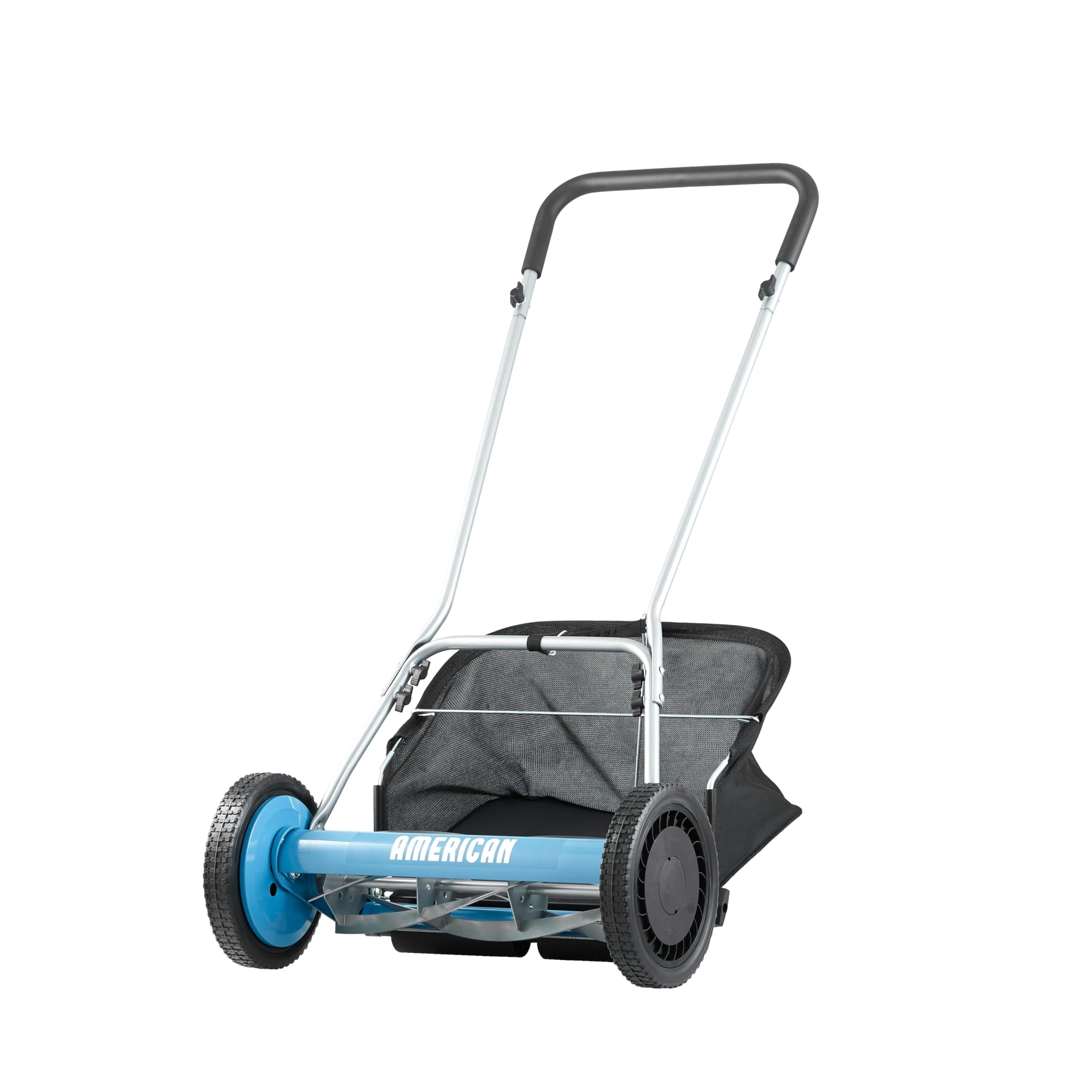
We found the 14-inch cut is an advantage on a small front lawn, not a compromise. The 1204-14 is narrow enough to weave around a stoop and light enough at 19 pounds to carry through a gate or hang on a wall hook. The 8.5-inch polymer wheels keep the deck low and the push simple, and the four-blade reel has a straightforward, mechanical feel that suits a first reel mower.

Assembly is one of the reasons we keep coming back to this one. The handle and reel go together with basic hardware, and the mower is ready to push without a fuel can, cord, or battery. On flat grass, the 19-pound body is easy to turn, and the four blades handle a weekly cut without much fuss. The deck is narrow enough to fit between a stoop and a fence, which is exactly where a 14-inch mower earns its keep.

The trade-off is a less polished finish than the seven-blade Earthwise and a deck that needs more passes if your lawn is wider than a small courtyard. That is the right exchange for a small yard, but not for an overgrown lot.

Bottom line: For a small, flat yard, we reach for the American 1204-14 first: it weighs just 19 pounds, assembles in minutes, and stores in a narrow slot.
2

Great States 815-18

Great States 815-18

Medium lawns

Our Score 8.4/10
Check Price

Worth Noting

  • Turns can feel heavy in tight borders
Blades
5
Weight
27 lb
Cutting Width
18 inches
Cutting Height
0.5–2.75 inches
Read the full review

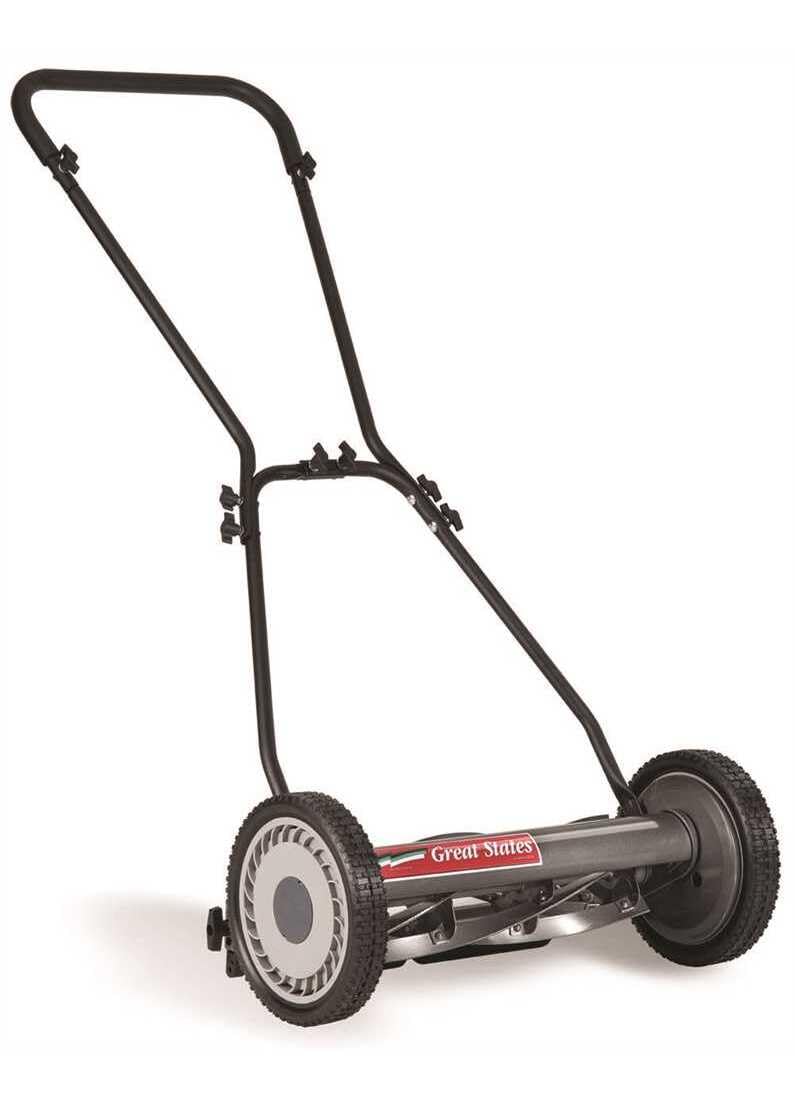
The 18-inch cutting width is the first thing we look at on a reel mower, because it decides how many passes a normal lawn takes. The Great States covers a useful strip without becoming a barge, and the five-blade reel leaves a clean scissor cut on grass you have kept up with. Its 0.5-to-2.75-inch height range is wider than most of the 14-inch models here, and the six positions give you room to raise the deck for the first cut of spring.

The 815-18 is the one we recommend as the default because it balances that width with a 27-pound body and a cushioned loop handle that does not fight you on flat ground. We noticed the 10-inch wheels roll over small dips better than the 8.5-inch wheels on the smallest mowers, and the five-blade reel is a sensible middle: more cuts per turn than a four-blade. On a lawn that is mowed regularly, that combination feels efficient rather than fussy.

The catch is the debris you leave down. Twigs, pinecones, and matted clumps stop the reel, so walk the lawn first and mow before the grass gets ahead of you. On a clean, level lawn, the width and height range make the extra prep worthwhile.

Bottom line: The Great States 815-18 earns our default recommendation for a typical suburban lawn: an 18-inch cut, a half-inch low setting, and a push that stays manageable.

3

Earthwise 1715-16EW

Earthwise 1715-16EW

Fine turf

Our Score 8.4/10
Check Price

Worth Noting

  • Height changes take extra work at low settings
  • Turns can feel heavy in tight borders
Blades
7
Weight
21.8 lb
Cutting Width
16 inches
Height Positions
7
Read the full review

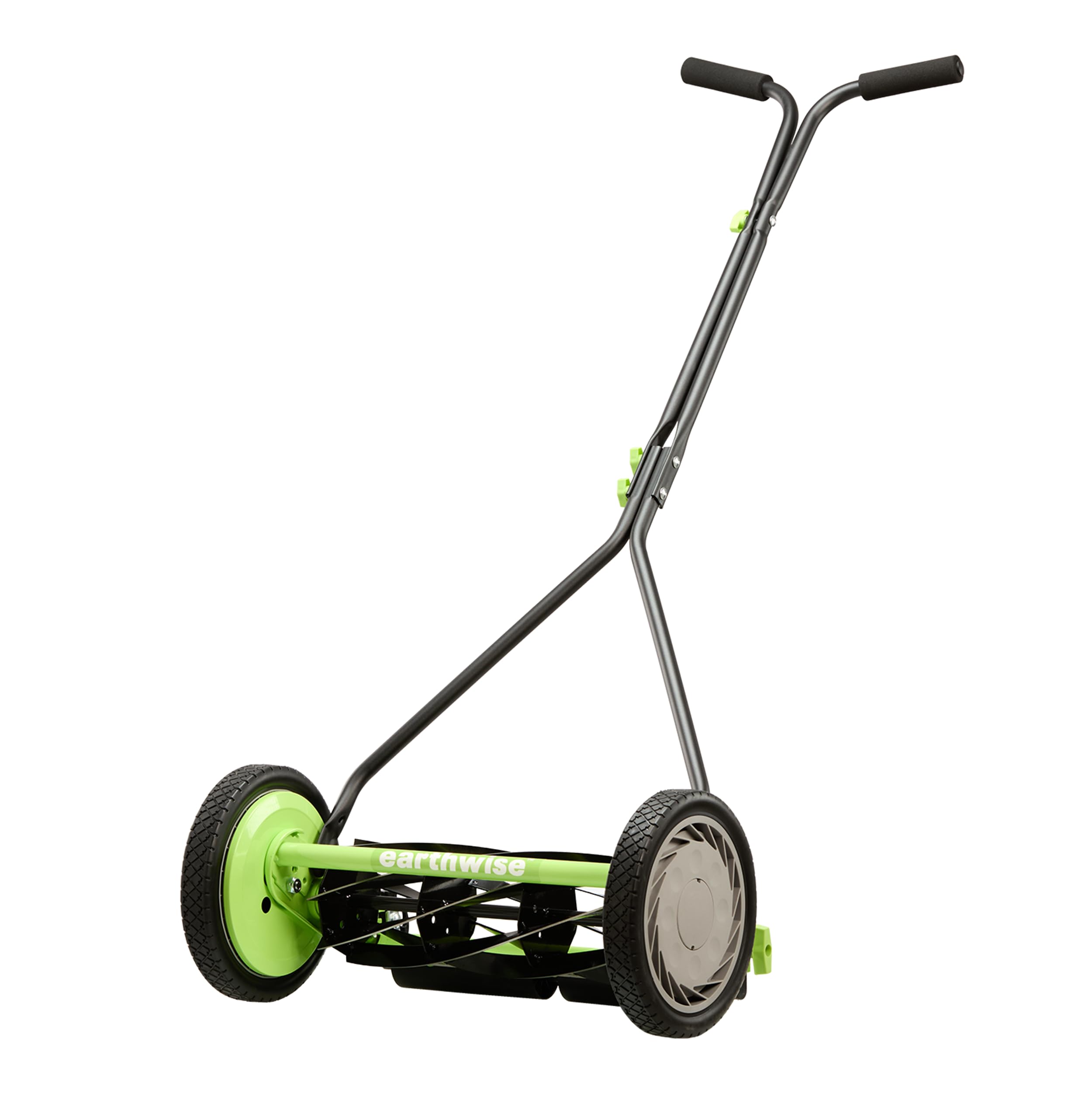
Seven blades is the detail that sets the Earthwise apart here. The 1715-16EW uses a 16-inch, seven-blade ball-bearing reel, and it is built for bent grass, Bermuda, Zoysia, Centipede, St. Augustine, and Seashore Paspalum. That is a specific brief, and it makes sense: a reel with more blades makes more cuts per turn, which is what fine turf wants.

At 21.8 pounds, it is light enough for one person to move around a small yard, and the 10-inch composite wheels roll smoothly on a flat lawn. We appreciate the quieter whir of a reel mower, and this one keeps that calm, mechanical sound. The steel side plates and seven-blade reel give it a more substantial feel than the 14-inch budget mowers.

The Earthwise is the pick when the lawn is already in good shape and you want a finer finish than the 14-inch American can give. The seven-blade reel is more demanding about grass height and debris, so it rewards weekly mowing. If your lawn is rough or you skip weeks, the extra blades are not the help you need.

Bottom line: We save the Earthwise 1715-16EW for fine-bladed lawns: its seven-blade reel and 16-inch cut leave Bermuda and Zoysia neat without a cord.

4

Scotts 2000-20S

Scotts 2000-20S

Large lawns

Our Score 8.2/10
Check Price

Worth Noting

  • 26.9 pounds is heavy to carry
Blades
5
Weight
26.9 lb
Cutting Width
20 inches
Cutting Height
1–3 inches
Read the full review

A 20-inch reel mower is a commitment. The Scotts 2000-20S cuts a wide swath, which is exactly what you want on a big open lawn, but it is a lot of mower to steer around beds, trees, and narrow gates. We found the width pays off in long straight runs and becomes a liability in a cramped yard.

The five-blade reel and nine cutting positions from 1 to 3 inches give you room to set the height for the season, and the cushioned handle is comfortable on a long pass. We appreciate how quiet it is; you can hear the reel working rather than an engine. The dual-tracking 10-inch wheels keep the deck steady on a flat lawn.

For a large, open lawn with few obstacles, the 2000-20S is the efficient choice, and the nine positions make it easy to drop the cut as the season changes. In a courtyard or a lawn broken up by beds, the width turns every corner into a three-point turn. Check the wheels and handle fittings when it arrives; a loose wheel is the one fault that undercuts the wide cut.

Bottom line: Our pick for a large, open lawn is the Scotts 2000-20S: the 20-inch cut covers ground fast, and the nine-position height adjustment spans the season.

5

LawnMaster LMRM1401

LawnMaster LMRM1401

Budget cutting

Our Score 8.2/10
Check Price

Worth Noting

  • Jams on weeds and small sticks
  • 14-inch deck needs more passes on larger lawns
Blades
5
Front Wheels
10 inches
Cutting Width
14 inches
Cutting Height
1–2.5 inches
Read the full review

The LawnMaster is the budget entry in this group, and it makes its case with a 14-inch five-blade reel and 10-inch front wheels. Those bigger front wheels are the practical detail: they roll over small bumps and make the mower feel less likely to dig in on a flat lawn. We like that the deck is narrow enough to fit between a stoop and a fence, which is where a 14-inch mower earns its keep.

We found the four-position height range from 1 to 2.5 inches easy to understand, and the mower is light enough to push without a running start. It is a simple machine, and that simplicity is the point: no gas, no cord, no battery, just a reel and a handle. The five-blade reel matches the 18-inch models here, even though the deck is the same 14-inch size as the American.

For a small, tidy lawn, that is a useful step up from the most basic reel without asking you to pay for an 18-inch deck. It is a simple, low-cost way to try the manual method, and the five-blade reel is the part that matters most.

Bottom line: We see the LawnMaster LMRM1401 as the low-cost way into reel mowing: a 14-inch five-blade deck, 10-inch front wheels, and a simple push.

6

American 1804-18

American 1804-18

Clipping collection

Our Score 8.0/10
Check Price

Worth Noting

  • 27.3 pounds is a two-handed lift
Blades
5
Catcher
Included
Cutting Width
18 inches
Cutting Height
0.5–2.75 inches
Read the full review

The 1804-18 is the only pick here with a grass catcher in the box, and that changes the daily routine more than the spec sheet suggests. Instead of leaving every clipping on the lawn, you can collect a portion of them and keep a tidier finish around a patio or walkway. The catcher is compact, so empty it often; it is not a bagging system in the rotary-mower sense.

We think the 1804-18 is the right catcher-equipped reel mower for a small-to-medium lawn: the 18-inch five-blade cut and seven height positions give it useful range, and the catcher is the practical bonus. The red finish is easy to spot in a shed, and the 10-inch wheels roll steadily on flat ground. The handle and controls are simple, with no engine, cord, or battery to manage.

For a lawn that needs a cleaner finish near the house, the catcher is the reason to choose this over the Great States. For open grass where clippings can stay, the catcher is simply not needed. The rest of the mower is a familiar 18-inch reel, so the choice comes down to whether collection matters enough to empty a small bag.

Bottom line: We recommend the American 1804-18 when you want the option of catching clippings: the 18-inch five-blade cut is solid, and the catcher is a useful extra, though it fills quickly.

How We Tested 12 Reel Mowers Over a Full Growing Season

We started with spec sheets and owner reviews and narrowed a long list to 12 reel mowers, spanning cutting widths from 14 to 20 inches and everything from budget models to ones that cost as much as a decent gas mower. We bought each at retail so nobody could send a hand-picked sample, then assembled every one at my dining table with only the tools in the box. I timed the job, checked whether the instructions matched the hardware bag, and noted which arrived with the reel already set and which needed the bed knife adjusted.

Out of the box, each mower got the newspaper test — a strip of newsprint slid between reel and bed knife, wheel turned by hand — to see whether it sheared cleanly across the full width or chewed at one end. Then they went to work: my quarter-acre lawn, which slopes more than I'd like; a neighbor's postage-stamp yard ringed by chain-link with three tight corners; and a shaggy patch of ryegrass I let get a week too long on purpose.

I ran each mower over that same overgrown strip and weighed the clippings, since a reel that leaves windrows of clumped grass is no bargain. Pushability got measured, not guessed: a spring scale clipped to the handle on flat grass, up the slope, and through the long stuff. I scattered twigs and pinecones in the path to count jams and time the clearing, and watched how each one turned around a flower bed and whether the wheels wobbled.

After each session I wiped the blades, looked for rust at the welds, and checked whether the height setting drifted. By October, every mower had been through at least eight cuts, and value had the final say: a model that cut beautifully but needed constant fiddling scored below a cheaper one that simply started and finished.

How to Choose Reel Mowers

Match the cutting width to the lawn

Cutting width is the first trade-off. A 14-inch deck, like the American 1204-14 or LawnMaster LMRM1401, fits narrow gates and small yards, but it asks for more passes on a wide lawn. An 18-inch model such as the Great States 815-18 covers more ground without becoming clumsy. The 20-inch Scotts 2000-20S is the efficient choice for a big, open lawn and the wrong one for a courtyard full of beds. We prioritize the widest deck you can comfortably turn, not the widest one in the catalog.

Plan for grass height and debris

Reel mowers cut best when you mow often and take no more than about a third of the blade at a time. Tall grass, weeds, and twigs are the enemy: the reel can push them down instead of cutting, or jam outright. Walk the lawn first and remove sticks and pinecones. If your lawn is regularly overgrown, a reel mower is the wrong tool, no matter how sharp the reel. We treat a weekly cut as part of the purchase, not an optional extra.

Choose a height range you will use

Height adjustment matters more than the number of blades for most buyers. A range from half an inch to 2.75 inches, as on the Great States 815-18 and American 1804-18, covers a low Bermuda cut and a taller spring cut. Check how the adjustment works, too: some mowers use wheel or roller positions that take more time at the low end. If you change height often, a quick, clearly marked system is worth more than an extra quarter inch of range.

Blade count, weight, and push effort

More blades mean more cuts per turn, which can mean a finer finish on fine turf; fewer blades make for an easier push. The four-blade American 1204-14 is the lightest here at 19 pounds, while the seven-blade Earthwise 1715-16EW weighs 21.8 pounds and suits Bermuda and Zoysia. The 20-inch Scotts is 26.9 pounds. On a lawn with lots of turns, weight and wheel size matter more than an extra blade. We choose the lightest mower that still gives the cut your grass needs.

Keep the reel sharp and the hardware tight

A reel mower cuts like scissors, so a dull reel tears grass and leaves a ragged tip. Budget for sharpening and learn the paper test: a clean cut across a sheet of paper tells you the reel and bed knife are meeting properly. Check wheel and handle hardware when the mower arrives, because those fittings take the abuse. Warranty terms vary across these mowers, so read them before you buy. A few minutes with a wrench at the start of the season is cheaper than a wobbly wheel in June.

Frequently Asked Questions

Final Verdict

Start with the Great States 815-18 if you want one reel mower for a typical lawn: the 18-inch cut, wide height range, and manageable push make it the least fussy default here. If your lawn is tiny or you need to carry the mower through a gate, the 19-pound American 1204-14 is the better fit. For fine turf, the seven-blade Earthwise earns the upgrade.