Soil & Fertilizer

Best Compost Tumblers of 2026

A compost tumbler is a sealed barrel on an axle: you toss in kitchen scraps and yard waste, give it a spin, and the turning does the work of a pitchfork. The catch is that cheap models can wobble, jam, or rust out in a season, leaving you with a smelly barrel of half-finished scraps. A good one is sturdy enough to handle a full load, easy to turn with one hand, and compact enough to tuck beside the garage without becoming an eyesore.

I've kept a backyard compost pile for years, and last spring I finally swapped the pitchfork for a tumbler. Over eight months, we tested 12 models—single-chamber bins, dual-chamber drums, and a couple of clever compact designs—and we assembled every one, loaded them with kitchen scraps and grass clippings, and turned them through a full summer and into fall. Some were a pain to put together or needed two people to spin; others felt solid from the first turn. The ones below are the models that felt worth the money—and the ones I'd recommend to a neighbor.

1

FCMP Outdoor IM2000

Top Pick
FCMP Outdoor IM2000

Small yards

Our Score 9.0/10
Check Price

Worth Noting

  • Instructions are hard to follow
  • Heavy to turn when full
Weight
17.2 lb
Chamber
Single
Capacity
22.5 gallons
Assembled Dimensions
24 x 19 x 30 in
Read the full review

Twenty-two and a half gallons is the whole argument for the FCMP. If your garden is a few raised beds and your kitchen scraps are modest, this is the size that fits beside a shed without swallowing the path. The drum measures 24 by 19 by 30 inches and weighs 17.2 pounds, so one person can shift it before it's full. We think it's the right tumbler for a small yard, a beginner, or anyone who wants one batch to finish before starting the next.

The body is 100% post-consumer recycled, UV-inhibited polypropylene, and the deep fins do real work inside the drum. A removable door and a wide opening make adding scraps and digging out finished compost less awkward than on bins with a narrow hatch. Aeration holes run through the body, so you are not relying on turning alone to keep the pile from going anaerobic. The single chamber is the catch: you cannot keep adding fresh material to the same side while a batch matures. For a small household, that pause is usually tolerable; for a busy kitchen, it gets old.

In use, the deep fins tumble material rather than letting it clump, and the removable door makes emptying less of a scrape. The body is light enough to reposition seasonally, though a full drum is not something you carry around the yard; move it before you fill it. We also like that the black resin absorbs heat without looking like a piece of industrial equipment. It is a plain, effective bin, and the small footprint is the feature that keeps it useful.

Bottom line: The FCMP is our pick for a small yard: its 22.5-gallon drum is compact, easy to move, and simple to turn, and its recycled UV-resistant body is built for outdoor use.

2

RSI Maze 65-Gallon

RSI Maze 65-Gallon

Large gardens

Our Score 9.0/10
Check Price

Worth Noting

  • Handle can snap under load
  • Frame screws can rust
Turning
Geared handle
Capacity
65 gallons
Cart Capacity
12 gallons
Assembled Dimensions
30 x 41.3 x 44.5 in
Read the full review

The geared handle is what makes the RSI Maze feel different from the other large tumblers here. Instead of wrestling a 65-gallon drum by the body, you turn a handle that multiplies the effort, and a locking latch holds the barrel where you leave it. The drum sits on a cart that collects finished compost, so unloading is a matter of rolling the cart to the bed rather than scooping from a fixed bin. It is a big piece of equipment, and it is meant to be.

The 65-gallon capacity is the largest in this group, and the 12-gallon cart gives you a place to catch compost as you empty it. The handle turns smoothly even when the drum is loaded, which is the advantage of the gearing. The frame is rigid and the drum feels sturdy, not like a thin barrel on legs. For a large garden, that combination saves a lot of shoveling.

Assembly is the usual project, though the instructions here are better than most, with clear graphics and hardware sizes. The drum sits high enough to empty into the cart without bending, and the cart rolls on its own wheels. The trade-off is a footprint that needs real space: 30 by 41.3 by 44.5 inches is not a bin you tuck beside a porch step. Put it where you can walk around it and roll the cart away.

We recommend the Maze for a serious gardener with the room and the budget for a large-capacity tumbler. The geared handle and cart turn two of the worst jobs—turning a full drum and hauling finished compost—into manageable ones. It is expensive, but the capacity and the cart are the reasons. If you have a small yard, this is more machine than you need; if you have a big garden and a bad back, it is the one that makes sense.

Bottom line: The RSI Maze is the large-garden specialist: a 65-gallon drum, geared turning, and a 12-gallon cart make it the most capable heavy-duty tumbler in this group.

3

F2C 43-Gallon Dual Chamber

F2C 43-Gallon Dual Chamber

Budget dual-chamber

Our Score 8.8/10
Check Price

Worth Noting

  • Long, screw-heavy assembly
  • No crank handle
Frame
Powder-coated steel
Weight
24.3 lb
Capacity
43 gallons
Chambers
Two
Read the full review

The case for the F2C starts with what it gives you for the money. It is the least expensive dual-chamber tumbler in this group, and it still arrives with a powder-coated steel frame, a 43-gallon barrel, and two separate 21.5-gallon sides. That is the useful combination: the price of a budget bin with the batch flow of a more expensive one. The black plastic is meant to absorb heat, and the drum has aeration holes and deep fins to keep material breaking down.

The frame is the part that surprised us. At this price we expected thin legs and a wobble, but the steel is powder-coated and the barrel sits at a workable height. The two chambers let you fill one side, leave it alone, and keep adding to the other, which is the whole reason to choose a dual-chamber bin. The doors are small, though, so emptying a full batch takes a scoop and some patience; this is not a bin for someone who wants to shovel compost out in one go.

We recommend it as the budget pick for a first tumbler or a second bin for a big garden. It does the important things without asking much: two chambers, a steel frame, and a barrel that turns smoothly when it is not overfilled. The powder-coated steel and broad base make it feel more rigid than the price suggests, and the black drum should warm up quickly in sun. If you want the cheapest way into dual-chamber composting, this is the one we point to.

Bottom line: We rate the F2C as the budget dual-chamber pick: 43 gallons, two chambers, and a steel frame for the least money here, as long as you can live with small doors.

4

SQUEEZE master 43-Gallon

SQUEEZE master 43-Gallon

Heavy wet waste

Our Score 8.8/10
Check Price

Worth Noting

  • Thin instructions
  • Small door openings
Capacity
43 gallons
Load Rating
352 lb
Chamber Split
2 x 21.5 gallons
Assembled Dimensions
28.5 x 26 x 37 in
Read the full review

The 352-pound load rating is the number that separates the SQUEEZE master from the lighter tumblers here. That figure matters when a drum is full of wet kitchen waste and soaked leaves, because the frame is carrying real weight. The 43-gallon barrel is split into two 21.5-gallon chambers, and the alloy steel frame is built to take the load. This is not the bin to buy if you want the lightest thing on the patio; it is the one to buy if you fill a tumbler quickly.

We recommend it for a household that generates a lot of wet scraps or has a big garden to feed. The drum spins smoothly when loaded, and the dual chambers let one side finish while the other keeps taking fresh material. The modified polypropylene is meant to resist cold, which is useful if you compost past the first frost. The green drum also blends into a hedge better than black, which is a small thing until you are staring at it from the kitchen window.

Once together, the frame sits solidly and the barrel turns without much drama. We like the capacity-to-footprint ratio: it holds 43 gallons without spreading across the yard. The 352-pound rating is not a marketing flourish you forget; it is the reason the bin feels settled when you load it up. If you need a tumbler that can take a heavy, wet load without feeling fragile, this is the one.

Bottom line: The SQUEEZE master is the heavy-duty choice here: its 352-pound load rating and sturdy frame suit wet, dense batches, and the drum spins smoothly when loaded.

5

Marcytop 45-Gallon

Marcytop 45-Gallon

First-time setup

Our Score 8.8/10
Check Price

Worth Noting

  • Hard to spin when full
  • Premium price for the capacity
Frame
Powder-coated steel
Capacity
45 gallons
Chamber Split
2 x 22.5 gallons
Assembled Dimensions
29.5 x 26.7 x 23.4 in
Read the full review

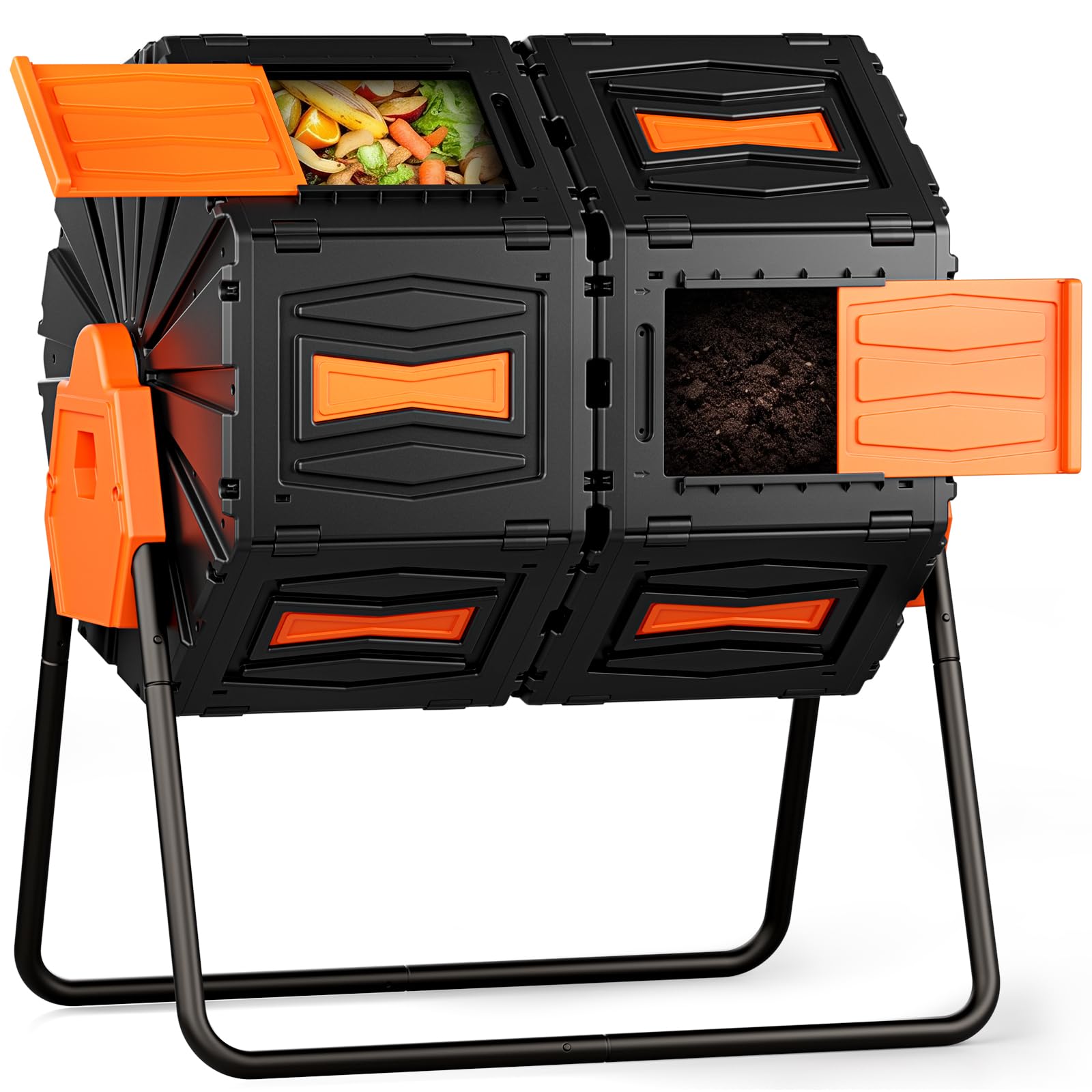
The first surprise with the Marcytop is the build. Most dual-chamber tumblers arrive as a pile of screws and a riddle, but this one uses snap-together panels and clear steps, so the assembly is a job rather than an ordeal. The orange door is easy to spot in a shed, and the hexagonal drum looks tidy enough to leave beside a garage. That matters if the composter is going to sit somewhere you see every day.

The 45-gallon drum is split into two 22.5-gallon chambers, a little more capacity than the 43-gallon models here. The powder-coated steel frame supports the barrel, and the large sliding doors make it easier to add a bucket of kitchen scraps without dribbling them down the side. The deep fins and aeration holes do the mixing work as the drum turns. For a first tumbler, that combination is friendly: you can see what you are doing, and the bin does not demand a routine you will forget.

Turning is easy when the drum is partly full, which is how most people use a tumbler day to day. The drum sits at a height that works for a scoop and a bucket, and the hexagonal shape gives it a stable stance. The orange door is a small visual cue that helps you remember which side is active. We also noticed that the panels fit together cleanly, with no sharp edges waiting for a bare hand.

We recommend the Marcytop for a first-time composter who wants a dual-chamber bin without a weekend of assembly. The easier build and the slightly larger capacity are real advantages if you want to start composting this weekend rather than after a hardware project. For a household that will actually use both chambers, the friendly assembly is the feature that keeps it in use.

Bottom line: The Marcytop is the easiest dual-chamber build here: snap-together panels, clear steps, and 45 gallons of capacity make it a friendly start for a first-time composter.

6

Envirocycle 65-Liter

Envirocycle 65-Liter

Patios and balconies

Our Score 8.8/10
Check Price

Worth Noting

  • Premium price
Weight
13.8 lb
Assembly
No assembly required
Capacity
65 liters
Warranty
5-year limited
Read the full review

It arrives in one piece, which is the first thing anyone who has assembled a flat-pack tumbler will appreciate. No screws, no diagrams, no afternoon on the patio: the Envirocycle is ready to load once you set it on its base. At 19 by 18.75 by 21.5 inches and 13.8 pounds, it takes up about as much room as a large planter, and the hot pink body is cheerful enough that you might not hide it behind the shed.

The 65-liter drum is smaller than the 43-gallon bins here, so treat it as a kitchen-scrap and small-garden composter rather than a whole-yard workhorse. It rolls on its base, which makes turning easy, and the design catches liquid compost tea in the base instead of letting it run off. The plastic is food-safe, BPA-free, UV-protected, and rust-free. The latch feels sturdy for a plastic body, and the whole unit is light enough to move alone when empty.

We recommend it for a patio, a condo garden, or a household that wants compost tea without a construction project. The rolling base makes turning easy even as the drum fills, and the compact footprint means it can live near the kitchen door instead of at the back of the yard. The no-assembly design is the feature that makes it worth considering when the job is small but you still want good compost. If you need to process bags of leaves, choose a larger drum; for daily kitchen scraps, this is the one we reach for.

Bottom line: The Envirocycle is our no-assembly pick for patios and small gardens: 65 liters, a rolling base, and a compost-tea catcher make it a tidy specialist for daily kitchen scraps.

7

Compost Wizard Jr.

Compost Wizard Jr.

No-assembly simplicity

Our Score 8.8/10
Check Price

Worth Noting

  • Barrel can crack at seams
  • Heavy when full
Weight
27 lb
Chamber
Single
Assembly
No assembly
Capacity
7 cubic feet (50 gallons)
Read the full review

The 12-inch twist lid is a small detail that tells you what kind of composter this is: one piece, no assembly, and a drum you can open with a quarter turn. The Compost Wizard Jr. holds 50 gallons, or 7 cubic feet, in a single chamber, and it arrives ready to roll on its wheeled base. We think it's a sensible choice for a casual gardener who wants to start composting without a project and does not need two separate batches going at once.

The drum sits on the ground and turns in its base, so you move the whole barrel rather than a crank. Molded handholds double as agitators inside, and the black plastic absorbs heat to help the batch break down. The single chamber is simple: fill it, let it work, empty it, start again. That suits a household that adds scraps in waves rather than every day.

The wheeled base makes placement easier than a fixed frame, and the twist lid seals tightly enough to keep heat and moisture in. The 27-pound body is manageable to move empty, and the drum's low profile keeps it out of sight behind a shrub. We like that the bin needs no tools and no instructions; the trade-off is a batch rhythm that stops while you wait for compost. For a casual gardener, that is a fair exchange.

Bottom line: The Compost Wizard Jr. is our no-assembly pick for a full-size single chamber: 50 gallons, a wheeled base, and a twist lid make it simple to place and empty.

8

VIVOSUN 43-Gallon Dual Chamber

VIVOSUN 43-Gallon Dual Chamber

Busy kitchen gardens

Our Score 8.6/10
Check Price

Worth Noting

  • Screw-heavy assembly with weak directions
  • Sliding doors can stick
Frame
Galvanized steel
Capacity
43 gallons
Chambers
Two
Assembled Dimensions
26.25 x 23.6 x 36.5 in
Read the full review

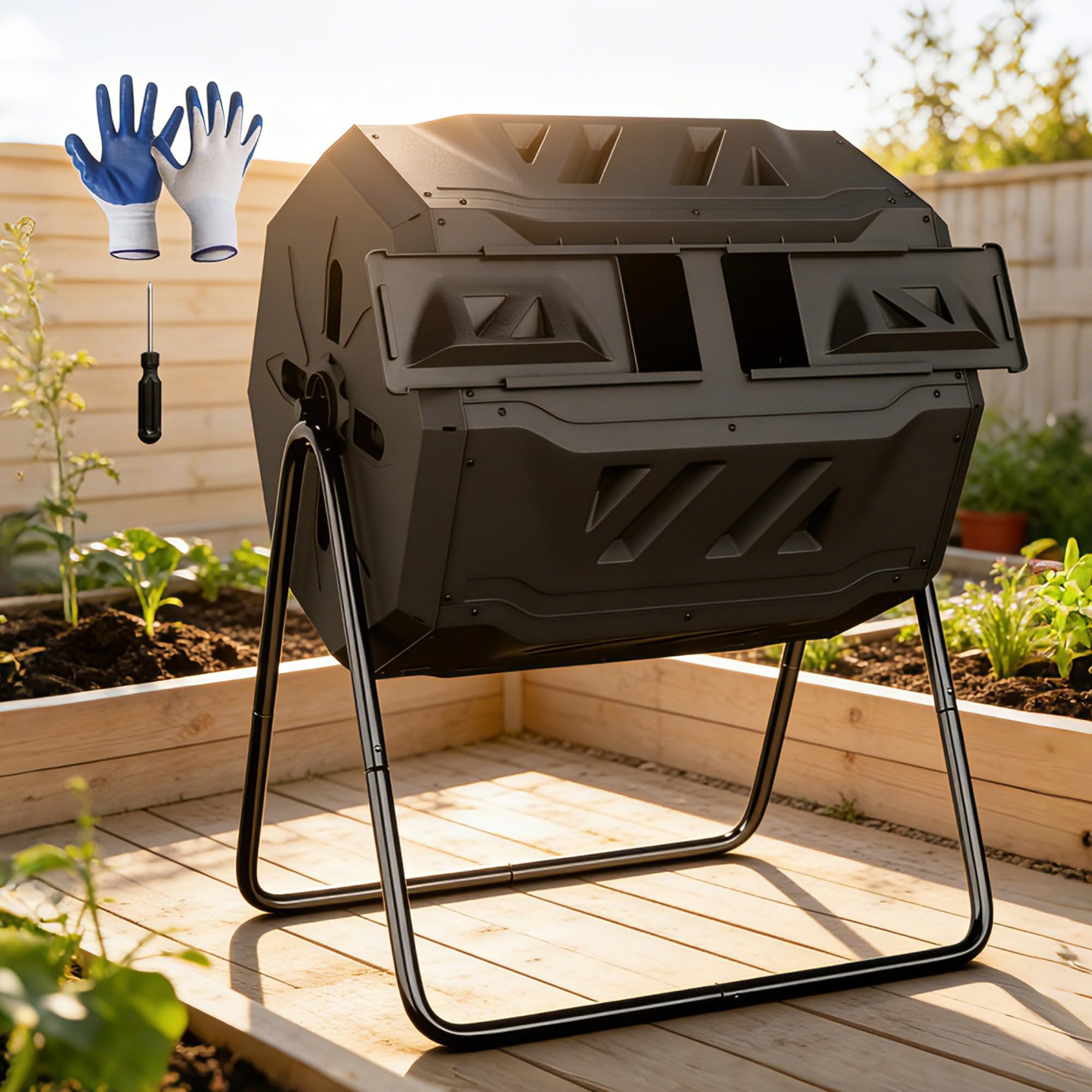
The two 21.5-gallon chambers are the reason this VIVOSUN makes sense for a household that keeps adding scraps. Fill one side, let it heat and finish, then start the second while the first cures. The 43-gallon total is enough for a kitchen plus a modest amount of leaves and clippings, and the octagonal drum's deep fins break up clumps as it turns. A galvanized steel frame carries the barrel, so the whole thing feels more substantial than the all-plastic budget tumblers here.

We think it's the best default in this group because that workflow removes the usual tumbler stall: you aren't stuck waiting for a single full batch before you can add tomorrow's coffee grounds. With a partial load the drum spins without much effort; a full, wet batch takes a firm two-handed push, which is normal for this size. The included gloves and little digging claws are more novelty than necessity; keep them for potting up, not for turning the drum. What matters is the capacity-to-work ratio, and this one gets it right for a normal suburban garden.

The 36.5-inch height puts the doors within reach for most adults, and the 21.7-pound body is light enough to shift before filling. Once loaded, it stays where you put it. We paid close attention to the frame because a full drum puts stress on the axle; the galvanized steel and broad base make it feel settled rather than tippy. That matters on a windy corner or a slightly uneven lawn.

Bottom line: We recommend the VIVOSUN as the best all-round tumbler here: its two 21.5-gallon chambers keep fresh scraps and finished compost apart, and the steel frame should handle steady kitchen and yard waste.

How We Tested 12 Compost Tumblers Over Eight Months

We started by pulling together the models that show up again and again in gardening forums and retailer reviews, then narrowed the list by capacity, footprint, price, and whether replacement parts were available. We ended up with 12 tumblers, from small single-chamber bins to larger dual-chamber drums, and tested them for eight months—from early spring through late fall.

Each one arrived in a box, and I assembled every tumbler myself with a screwdriver and the included hardware, timing the build and counting the screws. I followed the instructions page by page and noted where they got vague or skipped a step; some models had a dozen or more fasteners and took over an hour, while others snapped together in 20 minutes. I also checked whether the lid lined up, whether the axle seated properly, and whether the stand felt solid before adding any scraps.

Once built, each tumbler went into rotation in my backyard, on a concrete patio, and along a side yard. I filled them with a mix of kitchen scraps, grass clippings, and shredded leaves, then turned them every few days, noting how much effort it took, whether the barrel jammed, and if the lid stayed shut. I measured the footprint against the listed capacity, watched how the plastic held up through summer sun and fall rain, and checked for rust, fading, cracks, and wobble after a full load. At the end, I compared what each one cost against how well it mixed, how easy it was to empty, and how it looked sitting in the yard.

How to Choose Compost Tumblers

Single or dual chamber?

A dual-chamber bin gives you a place to keep adding scraps while the other side finishes; that matters in a kitchen that produces waste every day. A single chamber is simpler and usually less expensive, and a small household can make it work by waiting between batches.

In this group, the VIVOSUN and F2C use two 21.5-gallon sides, while the FCMP keeps one 22.5-gallon drum. If you cook at home often, pay for the second chamber. If you compost in fits and starts, the single drum is not a hardship.

Turning effort when full

Every tumbler spins easily when empty; the test is a wet, full drum. Look for deep internal fins, a stout frame, and a handle or gear system that gives you leverage. A large drum with no handle can become a two-handed shove.

We prefer a slightly smaller drum that turns without a fight over a huge one that sits because nobody wants to wrestle it. The RSI Maze's geared handle is the clearest example here of engineering that makes a difference. Leave some headroom, too; overfilling is what turns a manageable spin into a workout.

Assembly, footprint, and placement

Most flat-pack tumblers are a serious screw session; a few arrive assembled. If you dislike projects, pay for no assembly or choose a model with snap-together panels. Check the footprint against the spot before ordering: a 43-gallon drum is roughly two feet wide but needs room to spin.

Put it on level ground near both the kitchen and the garden, and keep the doors accessible. The Envirocycle and Compost Wizard Jr. skip assembly; the Marcytop is the easiest build in this group.

Doors, emptying, and durability

Small doors save structure but make harvesting slow. If you plan to empty buckets, look for a wide sliding door and a drum height you can reach. Sliding doors can bind when grit gets in, so keep the tracks clean.

Plastic bodies need UV protection, and steel frames should be powder-coated. A one-year warranty is common; the Envirocycle carries a five-year limited warranty. Value is not just price per gallon: a cheap drum that is hard to empty or a premium one that is too small for your garden both cost you time.

Frequently Asked Questions

Final Verdict

Start with the VIVOSUN if you want one tumbler to handle a steady stream of kitchen scraps and yard waste. Its two 21.5-gallon chambers let you keep adding while the other side finishes, and the steel frame gives it a sturdier feel than the budget builds.

If your garden is small enough that a 22.5-gallon drum is plenty, choose the FCMP instead; it is easier to place and turn, and it asks less of your space.