Poultry & Livestock

Best Chicken Run of 2026

A chicken run has one job: keep your hens in and everything else out. That sounds simple until a flimsy frame bows in the wind or you find a gap wide enough for a raccoon to reach through. I have kept a small backyard flock long enough to know that the wrong run turns morning chores into a negotiation and gives you a fresh reason to count heads at dusk. The right one gives your birds room to scratch and dust-bathe without turning your garden into a buffet.

Over the past eight months, my team and I assembled nine runs in a windy backyard, from compact covered pens to walk-in styles. We tracked how long solo assembly took, whether the wire felt sturdy or flexed under a push, how many zip ties the frame leaned on, and whether the footprint actually suited a small flock. We also weighed price against predator resistance and durability, because a cheap run that fails in a season is no bargain. The picks below are the ones we would trust with our own hens.

1

ANC POP Pop-Up Run

Top Pick
ANC POP Pop-Up Run

Chicks and daytime

Our Score 8.8/10
Check Price

Worth Noting

  • Refolding it into the bag takes practice
  • Fabric and mesh will not last like metal
Doors
Three, with double zippers
Frame
16 mm steel poles
Packed
Folds into a zippered bag
Footprint
78.7 x 39.4 x 45.3 in
Read the full review

This is the run you carry to the grass rather than build on it. ANC POP's pen pops open out of a bag, stakes down through six holes in the base, and folds away when the afternoon is over — three doors, double zippers, and a mesh body that lets the birds scratch at something new every day.

We think it is at its best on the jobs a big run is bad at: chicks moving from the brooder to real ground, a hen separated for a week, a vegetable bed you want scratched and fertilized before you plant. Because it is light it moves to fresh grass, and because the walls are mesh you can watch the birds from the kitchen window. What it is not is a predator barrier — fabric and zippers stop chickens, not raccoons — so it is daytime housing with someone around, never an overnight pen.

The materials are honest for the money: 16 mm steel poles, a mesh body, and a rainfly that has kept the inside dry. It is the least expensive way here to give birds fresh ground, and the one we grab for a broody hen or a batch of chicks that has outgrown the brooder. Just do not ask it to be a permanent structure.

Bottom line: For chicks, a separated hen or a fresh patch of grass, this is the run we reach for — cheap, quick, and strictly for daytime.

2

NUGRIART 83-Inch Low Pen

NUGRIART 83-Inch Low Pen

Small movable pens

Our Score 8.6/10
Check Price

Worth Noting

  • Latches need a clip to stay shut
  • 22 square feet is a two- or three-bird pen
Cover
PE roof panel
Doors
Four, around the pen
Latch
Gravity lock
Footprint
83 x 38 x 34 in
Read the full review

Thirty-four inches is the number that decides this one. NUGRIART's pen runs 83 inches long and 38 wide, and at 34 inches tall it is high enough for chickens to stand and dust-bathe but too low to walk into — you open one of the four doors and reach in.

What that buys you is something a walk-in run cannot do: it moves. Two people can pick it up and set it down on fresh grass, which makes it a tractor in the old sense — the flock works one patch, you shift the pen, the patch recovers. The epoxy-coated frame, the PE roof panel and the four doors are all sensible for that job, and the gravity latches close with a nudge, though a clip at each door is cheap insurance.

NUGRIART rates it for six to eight hens. At roughly 22 square feet we call it a pen for two or three, or a short-term one for a broody hen and her chicks. For that job, and for anyone who wants a movable pen without spending much, it is a good buy — just go in knowing you are buying a small pen, not a walk-in run.

Bottom line: Buy this if you want a movable pen for a couple of birds rather than a walk-in: cheap, quick to set up, and easy to shift onto fresh ground.

3

HEYTOWN 9.8x6.5 Metal Coop

HEYTOWN 9.8x6.5 Metal Coop

Budget walk-in

Our Score 8.6/10
Check Price

Worth Noting

  • Cover catches wind on an exposed site
  • One door limits access for cleaning
Door
One front door
Cover
Waterproof PE roof
Frame
Galvanized steel pipe
Footprint
78 x 117.6 x 78 in
Read the full review

Standing up inside a chicken run is the luxury item, and this is the least expensive route to it: 6.5 feet of headroom over a 9.8 by 6.5 footprint, on a galvanized pipe frame with a waterproof PE cover.

For a small flock in a sheltered spot, that is most of what you need. The 9.8 by 6.5 floor works out to roughly 64 square feet, so four or five hens have room to move and you have room to rake, and the covered roof gives shade in summer and a dry corner in rain. It suits a suburban backyard and someone with no ambition to build a permanent structure.

Where you spend the difference is the finish. The mesh is thin and the ties in the box are few, so a roll of hardware cloth on the lower walls and a bag of your own ties is part of the project, not an optional upgrade. Do that in the first weekend and you have a stand-up run for very little money; skip it and you have a shade structure with chickens in it.

For a first flock, a rented yard or a run you might take down and move, the trade makes sense: standing height and a roof for the price of a small pen, with the mesh work you would do on a fancier run anyway. What we would not do is put a dozen birds in it, or leave it unsheltered on a ridge with the cover on.

Bottom line: If standing up inside a run is the goal and money is tight, this is the cheapest way there — just plan on better mesh and a box of ties.

4

Betterhood 19.5x9 Metal Coop

Betterhood 19.5x9 Metal Coop

Budget big flock

Our Score 8.4/10
Check Price

Worth Noting

  • Thin coated mesh is the weak link
  • Poles bend under heavy snow
Door
Single door with latch
Mesh
Coated hexagonal wire
Cover
240D Oxford cloth
Footprint
19.5 x 9 x 6.5 ft
Read the full review

The first thing to know about this run is that the door latch is the cheapest part of it. The second is that everything else is a lot of pen for the money: 19.5 by 9 feet, 6.5 feet of headroom, a steel tube frame and a 240D Oxford cover that shrugs off rain.

Space is the whole argument. This is the least expensive route here to a run that runs nearly twenty feet, and the frame goes together quickly with two people — assembly is not where this one frustrates. Line it up against a coop door, or stand a small hen house inside, and you have a setup that suits a dozen birds without crowding.

Fix the door before the birds go in. A clip or a carabiner through the latch tab takes a moment and closes the one gap we would not leave open overnight, and it is the kind of two-minute job that makes the difference between a run you trust and one you check twice. Do that and this is a lot of shelter for the money.

Bottom line: Our pick when floor space matters more than fittings: it is the cheapest way here to get a run that is nearly twenty feet long.

5

NUGRIART 9.8x6.6 Walk-In

NUGRIART 9.8x6.6 Walk-In

First flocks

Our Score 8.4/10
Check Price

Worth Noting

  • Can collapse under heavy snow if left covered
  • Ties in the box fall short of the mesh
Door
Lockable metal latch
Cover
Waterproof PE, anti-UV
Frame
1 in galvanized steel
Footprint
9.8 x 6.6 x 6.6 ft
Read the full review

Nine and a half feet by six and a half of floor, 6.6 feet of headroom, one lockable door: this is the size and shape most backyard flocks actually need, and it fits a suburban lot without eating the whole garden.

The build is the part that stands out. The frame is 1-inch galvanized tube that clips together, and the instructions are clear enough that the frame is up quickly; the slow half is wrapping the PVC-coated mesh and tying it off. Two people, one day, and the rest of the weekend is yours — which is a much easier sell than the bigger runs, where the mesh alone is an afternoon.

At roughly 65 square feet it is a six-bird run, or four if you want them comfortable through winter, and the 6.6-foot walls mean feeders, waterers and cleanup do not require crawling. For a first flock, a rented yard or a run to bolt onto an existing coop, this is the value pick: midrange money for a pen you can stand up in.

The mesh is the compromise. PVC-coated hex netting keeps chickens in and costs almost nothing to include; it does not stop a raccoon and it will not stop a dog. If your yard has either, run hardware cloth around the lower walls and across the door seam before the birds move in, and this becomes a genuinely secure little run.

Bottom line: A quick build, a small footprint and midrange money: this is the walk-in we suggest for a first flock of about six birds.

6

Quictent Advanced 18x9

Quictent Advanced 18x9

Predator pressure

Our Score 8.2/10
Check Price

Worth Noting

  • Door hinge is the lightest hardware on the run
  • Costs more than the other walk-in runs here
Frame
1 in poles, 8 support bars
Footprint
18 x 9 x 6.6 ft
Side Mesh
1" x 1" (20 gauge) square welded hardware cloth
Parts Support
365 days frame, 180 days mesh and cover
Read the full review

The mesh is why this run is our top pick. Quictent lines the walls with 1" x 1" (20 gauge) square welded hardware cloth, where nearly every other run here uses hexagonal chicken wire, and that single difference decides what the pen is for: a one-inch square is too small for a raccoon to work a paw through, and welded joints hold when something pulls at them. Chicken wire is a fence. Hardware cloth is a barrier.

The frame earns its place too. One-inch galvanized poles, eight reinforcement bars and triangular corner plates keep the run square, and the cable ties are 0.2 inch wide instead of the hair-thin ones most of these kits include. There is a climbing perch with wooden crossbars along one side, which gives a flock somewhere to get off wet ground — a small thing we were glad to see.

Eighteen by nine feet with 6.6 feet of headroom is enough to walk in upright, rake the litter and still leave the birds room to get away from each other. Call it comfortable for eight to ten hens, with space for a small coop inside if you want everything under one roof. Two people raise the frame quickly; wrapping and tying the mesh takes the bulk of the day.

The hardware cloth is light gauge, so it stops a paw but not a determined jaw — if dogs or coyotes work your yard, overclad the lower walls with heavier cloth. The roof is the softer half of the build, too: the tarp is waterproof and UV-resistant, but the wire above it is hexagonal, so the top is not the equal of the sides.

Bottom line: We recommend this one first: it is the only run here whose walls are welded hardware cloth, and that is the part that decides whether your flock is safe after dark.

7

VEVOR 19.6x9.8 Metal Coop

VEVOR 19.6x9.8 Metal Coop

Large flocks

Our Score 8.0/10
Check Price

Worth Noting

  • Needs two people and most of a day to build
  • Light frame wants staking before wind
Roof
Dome roof with waterproof tarp
Frame
1 in galvanized steel tubes
Weight
93 lb
Footprint
19.6 x 9.8 x 6.5 ft
Read the full review

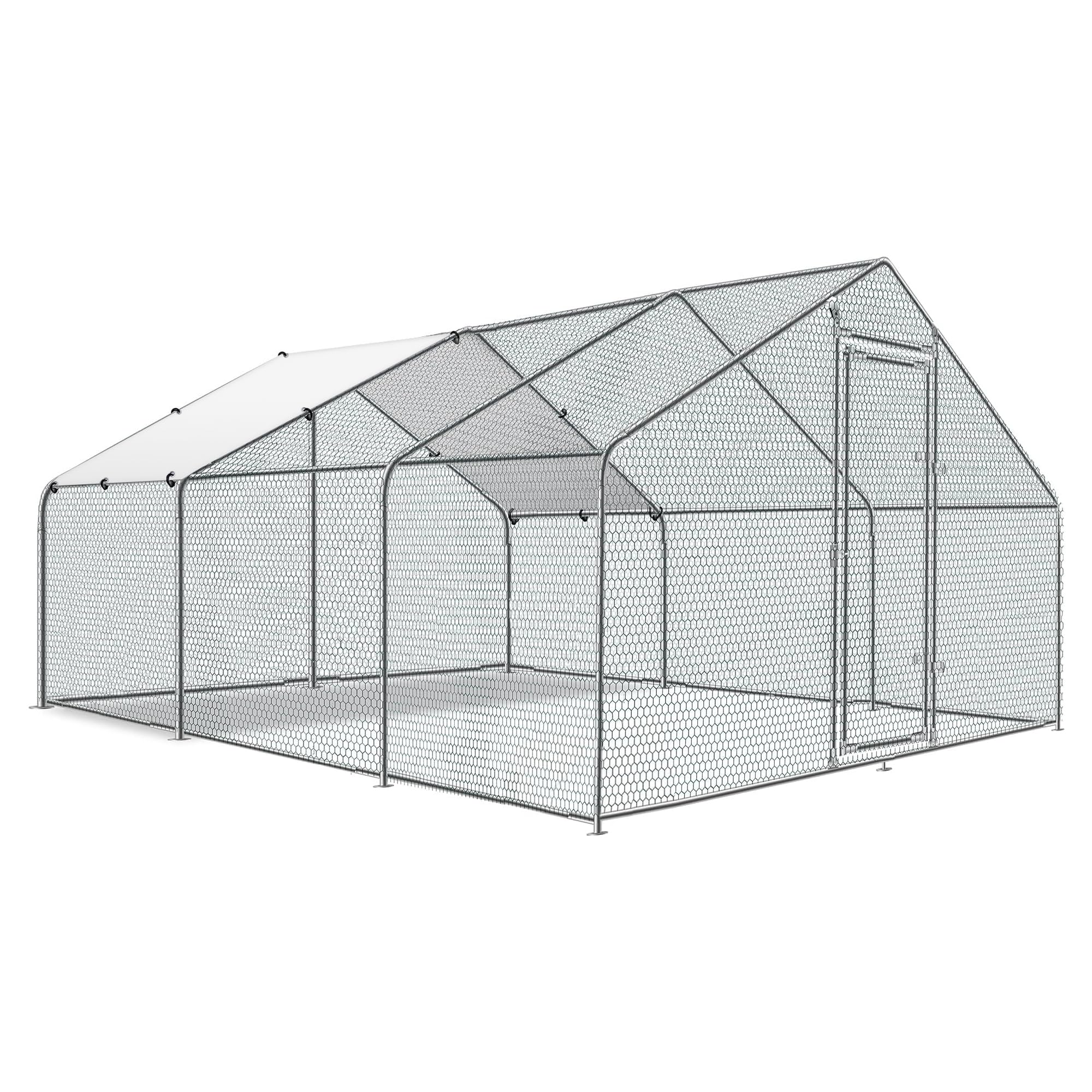
Nineteen and a half feet of run is a different category of thing. VEVOR's 19.6 by 9.8 footprint gives a flock room to actually move — a dozen birds can spread out, dust-bathe, and still leave a dry strip under the tarp for feeders — and 6.5-foot walls mean you clean it standing up.

This is the pick for anyone whose flock has outgrown a small pen. The dome roof sheds rain instead of pooling it the way a flat tarp does, the door has a lock rather than a hook, and the whole thing weighs 93 pounds, which two people can shift around the yard before the mesh goes on. That last part matters more than it sounds: you want the position right before you spend a day tying wire.

Plan for the finish work. The frame, roof and door are the product; the included netting and ties are a starter kit. A roll of hardware cloth along the lower walls and a bag of UV-stable ties is the difference between a pen that keeps birds in and one that keeps predators out, and it is work you want finished before the flock moves in, not after.

Bottom line: For a dozen birds or more, this is the run we point to: the longest footprint here, with a roof that sheds rain and a door that locks.

How We Tested the Best Chicken Runs

We started with a shortlist of two dozen chicken runs from brands we could verify, then filtered by wire gauge, footprint, frame material, and whether the run could realistically be assembled by one person. That left nine runs, which we set up in a windy backyard over eight months. Each one stayed through rain, gusty afternoons, and a summer of dust baths; we moved a few across the lawn to see how they handled being repositioned.

Assembly was timed solo with a stopwatch, and we counted every zip tie a frame depended on, then checked whether the panels stood square without them. We pushed on frames, tugged wire at seams, and ran a hand along the bottom edge to see whether a predator could pry or dig under. After storms, we looked for bent tubing, loose ties, and rust at the joints.

For size and suitability, we measured interior footprint and door height, then put four to six hens inside to see whether feeders and waterers fit without crowding. We opened and closed doors daily, watched whether latches lined up, and noted whether each run was easy to clean or move. Value came down to wire quality and hardware versus price: a run that needed extra ties or replacement panels by month three did not score well.

How to Choose the Right Chicken Run

Start with the mesh, not the frame

The single most useful thing to know: hexagonal chicken wire is a containment fence, not a predator barrier. A raccoon reaches through a one-inch hex and works at it until there is a hole. Welded 1-inch by 1-inch hardware cloth is a different material — square, rigid, much harder to open — and it is the reason the Quictent run leads this list.

If you buy a run with hex netting, plan to overclad the lower walls with hardware cloth and tie it every few inches. One trap worth naming: a title that calls a run predator-resistant is usually describing the frame, not the netting inside the box.

Size it to the flock and to your back

Plan on roughly 10 square feet of run per bird, then add space for feeders and a dust bath. A 9.8 by 6.6 run works out to about 65 square feet, which is six hens rather than the eight or nine some listings claim, and an 18 by 9 run gets you comfortably past a dozen.

The other half of sizing is height. A 6.5-foot walk-in lets you rake, refill and catch a bird without crawling; a 34-inch pen means reaching over a panel. Headroom is worth paying for on anything that stays in one place, and it is the first thing to give up if the pen moves every week.

Wind, snow and the ground line

These are light frames under a big sheet of fabric, and wind is what destroys them — a tarped run in an exposed yard behaves like a sail. Stake every corner, put a fence or wall between the run and the prevailing wind if you can, and pull the cover before a serious blow or heavy snow.

The ground line matters just as much. Predators dig, so bury an apron of hardware cloth along the base or ring the run with pavers. A run that is anchored and skirted comes through weather that flattens one that is not.

Doors, latches and the small parts

The latch is the cheapest component on every run here and the one that decides whether the pen is shut. Plan on adding a clip or a carabiner to the door, and check the latch tab for play as you assemble.

The zip ties in the box are thin and short. A bag of UV-stable ties costs little and is the difference between mesh that stays tight for years and mesh that flaps loose by autumn. Buy them before you start, not after the flock is already inside.

Portable, movable or permanent

Three shapes, three jobs. A fabric pop-up is for supervised daytime grass, chicks and a hen that needs separating: it goes up in a minute and protects against nothing with teeth. A pen around 34 inches tall is a tractor, moved weekly by two people so the grass recovers.

A walk-in metal run is a structure, and once it is staked and skirted it stays put. Decide which of the three you actually want before you compare footprints, because they do not substitute for one another.

Frequently Asked Questions

Final Verdict

One recommendation covers most buyers: the Quictent Advanced Series. It is the only run here that ships with welded hardware cloth on the walls, and the mesh is what decides whether a run is a fence or a defense. The perch, the corner plates and the parts support are bonuses on top of that.

Past a dozen birds, VEVOR's 19.6-foot run gives you the room and a roof that sheds, provided you budget for hardware cloth and ties. Starting with six hens in an ordinary backyard, the NUGRIART walk-in is the simpler build and the easier footprint to live with.