Lawn Care

Best Broadcast Spreaders of 2026

A lawn doesn't stripe itself. Run a spreader that dumps too much in one pass and you get dark green ribbons beside yellow ones, or a burned patch that takes until fall to forgive you. A broadcast spreader is meant to fix exactly that: fill the hopper, set the rate, walk, and let the spinning plate throw granules in an even fan. The catch is that the fan is only as even as the machine turning it, and two spreaders that look identical on the shelf can behave nothing alike on a Saturday morning.

I've laid down enough fertilizer by hand — and raked up the evidence — to be picky about this. Over one full growing season, my team and I ran 11 broadcast spreaders across lawns, slopes, and bare patches that needed overseeding. What separates them isn't hopper size or the number of clicks on the dial. It's whether the wheels track straight when the hopper is loaded, whether the agitator keeps clumps moving, and whether the instructions get you calibrated before your first bag is gone. The picks below are the ones that held up.

1

Scotts Whirl Hand Spreader

Top Pick
Scotts Whirl Hand Spreader

Spot seeding jobs

Our Score 9.4/10
Check Price

Worth Noting

  • Fine seed like clover can bind the crank
  • Handle can work loose on the shaft
Size
13 x 8.7 x 8.5 in
Type
Hand-powered broadcast
Arm Support
Adjustable
Coverage Per Load
1,500 sq ft
Read the full review

The arm support is the detail that separates the Whirl from a bucket with a crank. The hopper's weight rides on your forearm instead of hanging from your wrist, and after a full hopper across a slope your hand is still steady enough to work the dial.

We keep coming back to it for spot work: bare patches under a tree, the strip along a fence, a quick pass of ice melt on the walk. The dial covers 1,500 square feet of Scotts product per fill, settings 2 and 3 handle grass seed at a walking pace, and small seed goes on evenly rather than in clumps.

Its limit is size. On anything bigger than a town lot you are refilling constantly, and a quarter acre of fertilizer becomes an afternoon of dipping the hopper into a bag. For seeding bare spots, edging a bed, and winter salt on the front path, none of that matters.

Bottom line: For spot seeding, bare patches, and a quick pass over the walk, this is the handheld we recommend: light, even with small seed, and comfortable for a full hopper.

2

Scotts EdgeGuard Mini

Scotts EdgeGuard Mini

Small suburban lawns

Our Score 9.2/10
Check Price

Worth Noting

  • Plastic wheels drag on soft ground
Setup
Pre-calibrated, no assembly
Folded Size
21.5 x 16 x 18 in
Edge Control
EdgeGuard side shield
Coverage Per Load
5,000 sq ft
Read the full review

The EdgeGuard shield is the detail that sold us, and it is a small thing: a flap you drop on whichever side faces the driveway, sidewalk, or flower bed. Fertilizer stops at the lawn edge instead of staining the concrete. We walked a full hopper along a driveway edge to see whether it held, and it did.

The rest is built for people who want to spend an afternoon on the lawn rather than a weekend on the spreader. It arrives calibrated, so there is no bolt bag and no half-finished assembly in the garage. The hopper holds 5,000 square feet of Scotts product, which is one fill for a typical suburban lot, and the agitator keeps material funneling instead of bridging over the gate.

The pattern runs a little heavier on one side, so an overlap pass at half the spread width is worth the ten extra minutes. Walk the same stripes for a few seasons and you will see where it lays down heavy.

Come November it folds down and hangs on a wall hook, which is more than the bigger spreaders here can say. For a lawn that is more pavement-edged than pasture, that combination of coverage, edge control, and a small footprint in the garage is why it is the one we hand to most people.

Bottom line: For a typical quarter- to half-acre lawn, this is the spreader we recommend first: no assembly, a full 5,000-square-foot fill, and an edge shield that saves your driveway.

3

SOLO 421 Chest Spreader

SOLO 421 Chest Spreader

Food plots, slopes

Our Score 9.2/10
Check Price

Worth Noting

  • Gearbox can strip after a few seasons
  • 20 lb hopper means refills on big jobs
Size
11.2 x 10.5 x 19.4 in
Mount
Chest, cross-shoulder strap
Controls
Adjustable flow and direction fan
Hopper Capacity
20 lb
Read the full review

A 20-pound hopper hanging off your chest sounds like punishment. The SOLO's wide cross-shoulder strap spreads that weight across your back rather than pulling on one shoulder, and the crank falls naturally to hand, so a long pass on a slope does not leave your arm done in.

The controls are what separate it from cheaper hand spreaders: a flow gate you can work while cranking, and a direction fan you swing to throw material left, right, or straight ahead. Seed lands where you aim it instead of in a circle around your feet. Metal gears and a rot-proof hopper are the other half of that; it is built like a tool rather than a toy.

We think it earns its keep on ground a wheeled spreader cannot reach: food plots, steep banks, tight beds, the strip between a fence and a hedge. A big seeding job from a chest spreader is slow work, and your arm knows about it the next day, but the seed goes on evenly and you never fight a wheel.

The catches are specific ones. Large seed such as corn or soybeans jams if you stop cranking mid-pass, so keep the handle turning until the gate is closed. And the strap needs careful adjustment before the weight sits on your back rather than your neck.

Bottom line: This is the spreader we reach for on slopes and food plots, where wheels are useless: 20 pounds on your chest and a fan you can aim.

4

Chapin 8400C SureSpread

Chapin 8400C SureSpread

Heavy seasonal use

Our Score 8.4/10
Check Price

Worth Noting

  • Assembly directions leave gaps
  • Bulky to store between seasons
Frame
Stainless steel
Tires
14 in pneumatic
Gearbox
Enclosed, grease fitting
Hopper Capacity
100 lb
Read the full review

A grease fitting on the gearbox is the detail that tells you who this spreader is for: someone who plans to service it rather than replace it. Add a stainless steel frame, an enclosed gearbox, and 14-inch pneumatic tires, and you have the most substantial walk-behind of this group.

The 100-pound hopper and rotary gate with steel linkage handle everything from fine seed to coarse fertilizer, and the gate closes down far enough for light applications. The T-handle with rubber grips stays comfortable over a long pass, and the big tires roll over uneven ground without the hopper wanting to tip.

The trade-off is scale. It is a lot of spreader for a single suburban lot, and the money goes into stainless and a serviceable gearbox rather than features you will use twice a year. On a large property, a ball field, or a handful of rental lawns, it is the one here that should still be working in a decade.

Bottom line: We choose this one for a large property and a long horizon: stainless frame, greaseable gearbox, and 100 pounds of capacity.

5

EarthWay 2150

EarthWay 2150

Large rough lawns

Our Score 8.2/10
Check Price

Worth Noting

  • 25 lb to lift and store
Tires
13 in pneumatic studded
Weight
25 lb
Spread Control
3-hole drop, side-spread
Hopper Capacity
50 lb
Read the full review

Thirteen-inch studded pneumatic tires are the first thing you notice, and they are why this spreader does not care about the rough patch behind the shed. On ruts, a slope, or the transition from turf to gravel it keeps rolling where small plastic wheels bog down. The handle runs high, too, which tall users will appreciate about a hundred feet in.

What earns it the price: 50 pounds in the hopper, a three-hole drop system with side-spread control, and an enclosed gearbox that keeps damp fertilizer from seizing the works. The side control feathers the edge so you are not throwing product into the bed on every pass. Of the walk-behinds here, this is the most accurate on rough ground and the most solidly built short of the Chapin.

Assembly is the tax. The directions are the weakest part of the package, with diagrams that do not match the hardware, and the job goes faster if you lay every part out first and work backwards from the finished shape. Once it is together, it is the spreader for a large, uneven lawn and for anyone tired of replacing a cheap one every couple of seasons.

Bottom line: If your lawn is big, rough, or hilly, this is the walk-behind we point you to: studded pneumatic tires, a 50-pound hopper, and a sealed gearbox.

6

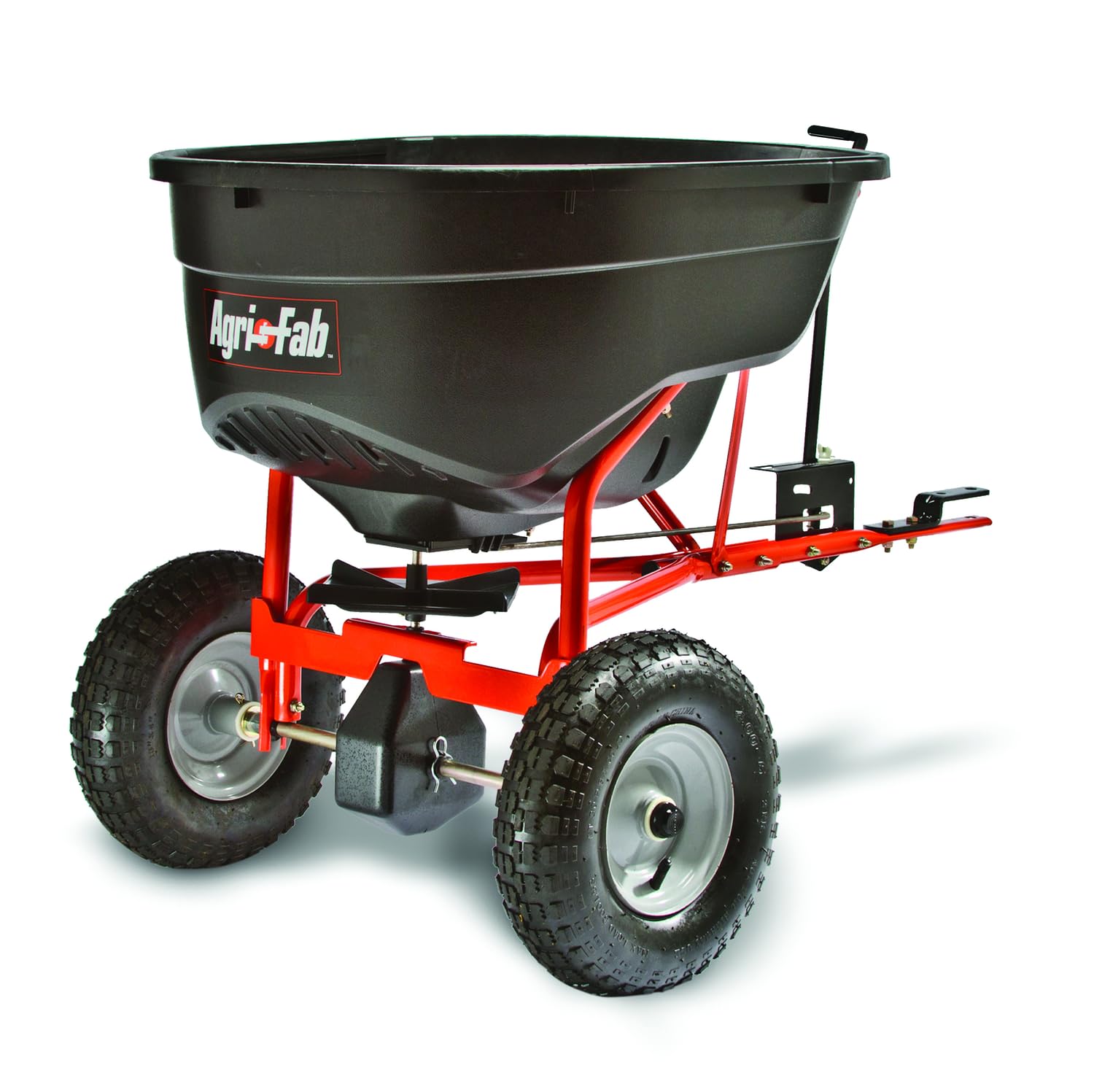
Agri-Fab 130 lb Tow-Behind

Agri-Fab 130 lb Tow-Behind

Half-acre properties

Our Score 8.2/10
Check Price

Worth Noting

  • Gearbox failures show up within a few seasons
  • Instructions make assembly a long afternoon
Tires
13 x 4 in pneumatic
Spread Width
10 to 12 ft
Hopper Capacity
130 lb
Coverage Per Load
25,000 sq ft (1/2 acre)
Read the full review

A half acre goes by quickly behind a riding mower: 130 pounds in the hopper, a 10- to 12-foot pass, and no walking. For anyone cutting more than an acre that math is the whole argument. You trade the walk for a hitch pin, and each fill covers roughly five times what a walk-behind hopper does.

The hitch fits the usual riders, Craftsman and Husqvarna and Cub Cadet among them, and the inch steel tubing, poly hopper, and 13-inch pneumatic tires handle a lawn that is not a golf course. It tracks straight on open ground and throws a wide, even pattern when the ground is level.

Two boundaries to know. The hopper will not quite take 130 pounds of dense fertilizer, so weigh the product rather than counting bags. And on slopes or tight turns it can tip and throws material forward, so it suits open, mostly flat ground, which is exactly where a tow-behind makes sense anyway.

Bottom line: For a half acre or more behind a riding mower, this tow-behind earns its place: 130 pounds in the hopper, a 12-foot pass, and a fraction of the walking.

7

Amazon Basics Walk-Behind

Amazon Basics Walk-Behind

First spreader

Our Score 8.0/10
Check Price

Worth Noting

  • Gate can stick open and dump a pile
  • Thin steel and plastic bin limit its life
Frame
Steel with plastic bin
Settings
Multi-gear gate
Hopper Capacity
33 lb, 0.53 cu ft
Coverage Per Load
5,000 sq ft
Read the full review

The release cable arrives pre-installed and the frame goes together with ordinary tools. We had it standing before the coffee went cold, which is the right first impression for a budget spreader.

On paper it is a full-size walk-behind: 5,000 square feet per load, a multi-gear gate, a steel frame with a plastic bin, and a footprint that fits a garage corner. For a first spreader or a lawn you feed twice a year, coverage per fill is the number that matters, and it matches the coverage of our top pick.

Where it gives ground is consistency and feel. The spinning disc stumbles rather than turning steadily, which shows up as a light stripe, and the whole frame flexes if the bolts are not snug. Tightening every one properly at assembly is what keeps it from feeling flimsy.

The honest framing: it does the job of a walk-behind spreader for a fraction of what the good ones cost, and the build makes it a few seasons of tool rather than a decade's. Twice a year on a small lawn, that math works. If you want to hand it down, spend more.

Bottom line: It is the budget walk-behind we recommend for a first spreader: 5,000 square feet per fill and a steel frame, for a lawn you feed twice a year.

8

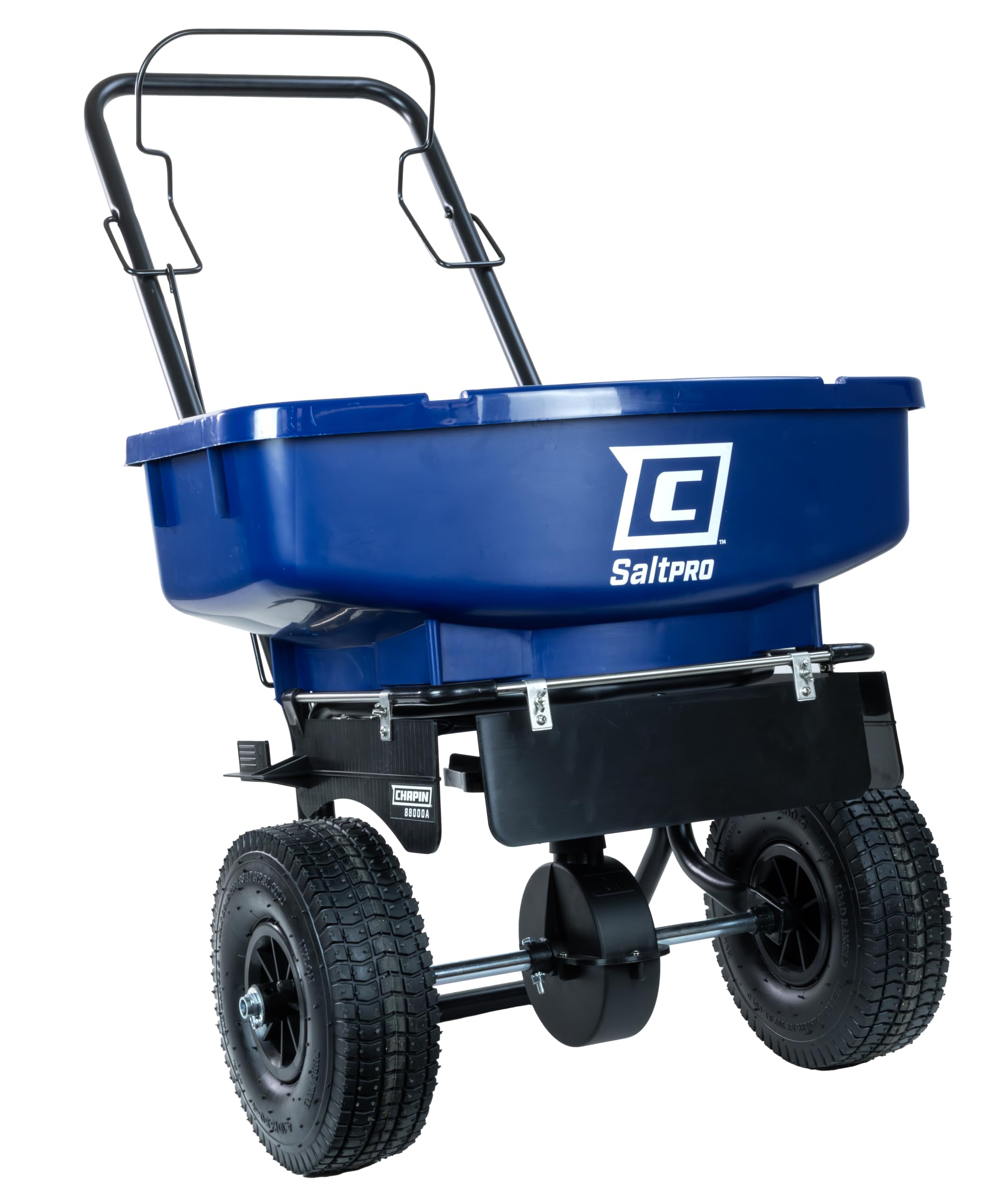
Chapin SaltPro 88000A

Chapin SaltPro 88000A

Ice melt duty

Our Score 8.0/10
Check Price

Worth Noting

  • Gate scale is a paper decal that wears off
  • 26.8 lb to haul up steps
Frame
Powder-coated steel
Tires
10 in pneumatic
Baffles
Fixed front, adjustable side
Hopper Capacity
80 lb
Read the full review

Salt is what kills most spreaders. It eats painted steel, seizes linkages, and leaves a hopper full of grit by February. The SaltPro is built around that: a poly hopper, a powder-coated steel frame, and enclosed acetal gears instead of an exposed drive.

The 80-pound hopper is sized for a driveway and a couple of walkways, and the fixed front baffle plus adjustable side baffles keep salt off the lawn edge and out of the garage door track. The 10-inch pneumatic tires find traction on packed snow.

We liked the flip handle immediately: the full-width gate lever works with gloves on, which is the difference between salting the drive and fighting with it. Chapin builds this one for residential ice melt and salt, so treat it as a winter tool. For grass seed and fertilizer through the growing season, the turf spreaders above are the better fit.

For a driveway-first buyer in a snowy climate it is the most sensible thing here: the one spreader in this group whose hopper, frame, and gate were chosen for salt rather than adapted to it.

Bottom line: If the spreader's real job is a January driveway, we recommend this one: a rust-resistant hopper, salt-tuned baffles, and a gate lever you can work with gloves.

How We Tested Broadcast Spreaders, From Assembly to the Last Bag

We started by rounding up every broadcast spreader we could find from the brands that actually turn up in lawn-care aisles, then filtered by the things that matter before you ever touch one: hopper capacity, tire size, whether the rate lever is reachable from the handle, and how the price sits against the build. That left 11 spreaders, which we used through one full growing season — spring feeding, summer touch-ups, and a fall overseeding.

Each one got assembled solo with a stopwatch running, and I noted whether the hardware bag matched the diagram and whether the instructions explained how to calibrate or just pointed at a chart. Then we calibrated: a measured 10-by-10-foot patch, fertilizer weighed before and after, and a walk at normal pace to see whether the rate held. Spreadability was judged by stripes — we ran overlapping passes on a thin lawn and looked for the dark bands and skips that mean the pattern is uneven, plus how far the fan threw and whether it clipped the edge of a flower bed.

Stability and durability got rougher treatment. We loaded hoppers to capacity and pushed them across a side slope to see if they wanted to tip, then dragged them over driveway seams and curbs. After roughly eight months outdoors, including a few weeks parked in a hot garage, we checked wheels, axles, and agitators for wobble and cracks. Ease of use came down to small things: how heavy a full hopper felt turning at the end of a row, whether the lever stayed where we set it, and how easily the hopper rinsed out afterward.

How to Choose Broadcast Spreaders

Coverage per load is the number that matters

Square footage per fill tells you how many times you will stop to refill, and that is the figure worth comparing. Pound ratings depend on what goes in the hopper, because a hopper of dense fertilizer weighs far more than the same volume of grass seed. As a rough map, a handheld covers around 1,500 square feet, a typical walk-behind around 5,000, and a tow-behind behind a riding mower around 25,000, or half an acre. Multiply your lawn's length by its width and divide by the coverage figure to see whether you are in for one fill or six.

The trap is buying capacity you never use. A 130-pound tow-behind on a quarter-acre lot is a machine you have to store and maintain for a job a walk-behind finishes in twenty minutes.

Spread width, overlap, and edge control

Broadcast spreaders throw material in an arc — heaviest in the middle, thinner at the edges — so an even result comes from overlapping passes at about half the spread width. A 10- to 12-foot tow-behind and a 6-foot walk-behind can both produce a smooth lawn; the wider one just needs fewer passes and more discipline about the overlap.

What separates a good spreader from a frustrating one is edge control: a side shield, a side-spread gate, or adjustable baffles that keep product on the lawn instead of the driveway. If your turf borders a bed or a paved drive you care about, that feature is worth more than another pound of capacity.

Walk, tow, or carry

Up to about half an acre, a walk-behind is the right tool: it turns tightly, stores upright, and lets you see the pattern as you go. Past that, or on long straight runs, a tow-behind behind a riding mower saves hours — but only with room to turn and mostly open ground, since a towed spreader can tip and throws material forward on slopes.

For banks, beds, fence lines, and food plots, a handheld or chest-mounted spreader reaches where wheels cannot. Tire size is the other tell: 10- to 14-inch pneumatic tires roll over ruts and soft turf, while small plastic wheels drag and bog down.

Gears, materials, and what actually lasts

The failure point on most spreaders is the drive, not the hopper. Metal gears in an enclosed gearbox, a grease fitting, and stainless or powder-coated steel are what keep a spreader working past its third season; plastic gears and exposed linkages are what turn a cheap one into a disposable one. A poly hopper genuinely beats steel for salt and fertilizer because it cannot rust.

If you spread ice melt, pay for the corrosion-resistant build rather than rinsing harder every spring. A seized gate is what a neglected salt spreader looks like by March.

Frequently Asked Questions

Final Verdict

The Scotts EdgeGuard Mini is the spreader we recommend to most people: it is ready to use out of the box, holds a full 5,000-square-foot dose, and keeps fertilizer off the driveway. If your lawn is big, rough, or hilly and you want a walk-behind that lasts, the EarthWay 2150 is the step up; if you are covering half an acre or more from a riding mower, hitch the Agri-Fab instead.

For the jobs a wheeled spreader cannot reach, the Whirl handles spot seeding and the SaltPro handles a January driveway.