Lawn Care

Best Handheld Spreaders of 2026

A handheld spreader looks like a bucket with a crank until you're the one cranking it across a wet lawn. Then the differences show up: an uneven edge, a clogged opening, a lid that won't budge when your hands are covered in fertilizer. The right model fixes all three—it meters product evenly, empties cleanly, and lets you refill without wrestling the lid—so the job takes one pass instead of three.

I've spread enough fertilizer with a scoop and a bucket to know that size—the hopper and the handhold—matters more than the spec sheet suggests. Over six months, my team and I tested 14 handheld spreaders on lawns, garden beds, and icy walkways, judging ease of use by filling, carrying, and cranking; quality by the crank feel and lid seal; value by whether cheap models skipped anything essential; and spreading by whether the granules landed where we aimed. The lid got its own test: could we open, fill, and close it one-handed without spilling? The picks below are the ones that made that easy.

1

Scotts Whirl Hand-Powered Spreader

Top Pick
Scotts Whirl Hand-Powered Spreader

Small-yard all-rounder

Our Score 9.2/10
Check Price

Worth Noting

  • Hopper covers up to 1,500 sq ft per fill
Power
Hand crank
Weight
1.2 lb
Arm Support
Adjustable
Rated Coverage
Up to 1,500 sq. ft.
Read the full review

Fifteen hundred square feet is the number that defines this spreader: it is how much seed, fertilizer, or ice melt the hopper holds in one fill, which lands right on the front-and-side-yard job most people actually have. Load it, tuck the arm support against your forearm, and turn the crank as you walk. A broadcast fan throws material in an arc ahead of you, so a small lawn takes a few passes rather than an afternoon of flinging fertilizer by hand and wondering why the grass comes up patchy.

What we appreciated on the first pass is how much the forearm brace does. The spreader hangs off one arm, and the brace takes the wobble out of the crank, which is what keeps the fan throwing the same pattern from the first pass to the last. There is a flow gate as well, and backing it off is how you keep a light overseeding pass from dumping a season of seed into one strip.

Fit is the thing to check before you commit. The brace sits best against a smaller forearm; on a long arm it rides high and the grip gets cramped, so slide it into position with the hopper empty. Beyond that there is very little to it: 1.2 pounds of plastic, nothing that rusts, and no battery to remember in March.

As a default for a yard at or under that 1,500-square-foot mark, this is the one we reach for. Seed, fertilizer, and ice melt all go through it, the spread stays even, and one hand runs the whole job. Past that size the refills become the story, and the chest-mounted SOLO below is the tool that fixes it.

Bottom line: Our pick for most small lawns: it broadcasts seed, fertilizer, and ice melt evenly, and the forearm brace keeps the crank steady enough to avoid streaks.

2

SOLO 421 Chest-Mount Spreader

SOLO 421 Chest-Mount Spreader

Large plots

Our Score 9.2/10
Check Price

Worth Noting

  • Bulky 19-inch body needs shelf space
Mount
Chest, cross-shoulder strap
Body Height
19.4 inches
Flow Control
Adjustable flow and direction fan
Hopper Capacity
20 lb
Read the full review

Twenty pounds is what earns this one its place. That is the hopper, and it is why the SOLO is the pick for ground measured in acres: a food plot, a long fence line, or a steep bank gets done without a dozen trips back to the bag. The chest mount is the other half of the idea. The strap crosses your shoulders, the hopper rides against your sternum, and both hands stay free to crank and steer.

Steering is the part we appreciate most. Flow control and the direction fan are both within reach while you walk, so the pattern narrows along a bed edge and opens up across open ground without breaking stride. Metal gears in a chemical-resistant hopper is the combination that makes it feel like equipment rather than a plastic toy, and there is real weight in the crank.

Chunky seed is where it gets fussy. Corn, soybeans, and anything that size jam the moment you stop turning the handle, so keep the crank moving through the turn at the end of a row. It is also a 19-inch body that does not collapse, which means a shelf rather than a hook. Set the strap once, before you fill it, and it stays where you put it.

Bottom line: Worth the premium when the ground is measured in acres: the 20-pound chest-mounted hopper cuts refill trips and frees both hands to crank.

3

Yhtpouqe Hand Spreader

Yhtpouqe Hand Spreader

Salt and seed

Our Score 9.2/10
Check Price

Worth Noting

  • Heavy to lift when filled to the top
Weight
1.17 lb
Capacity
80 oz
Included
Scoop and gloves
Opening Sizes
Three, twist-select
Read the full review

A scoop and a pair of gloves come in the box, and that tells you who this is for: someone filling a canister out of a big bag in the garage, not someone doling out a cupful at a time. The scoop gets material from bag to hopper without a funnel, and the gloves keep fertilizer dust off your hands.

Eighty ounces and three opening sizes put it alongside the other big shakers here, and the twist lid seats down and locks. We checked that specifically, because a lid that walks loose is the failure mode on this kind of tool. The plastic has enough thickness that it does not flex when you shake it hard.

Salt, sand, fertilizer, grass seed: small holes for a light overseed along a fence line, wide ones for a salting pass. It will not throw a pattern across open ground, since that is crank work, but for fill, shake, and put away it does everything you ask of a canister.

Bottom line: A big shaker that arrives ready to use, with the scoop and gloves in the box and a lid that locks down.

4

Spot Spreader Hand Shaker

Spot Spreader Hand Shaker

Overseeding and salt

Our Score 9.0/10
Check Price

Worth Noting

  • Lid is stiff to twist off and reseat
Weight
1.04 lb
Capacity
Up to 80 ounces
Opening Sizes
Multiple adjustable
Read the full review

Eighty ounces is close to the ceiling of what one arm wants to shake. Fill this canister to the top with rock salt and your shoulder knows about it by the end of a driveway, which is why three-quarters is the practical load and why the size still counts as an advantage: fewer walks back to the bag, without turning a walkway into a workout.

Nothing on it moves, and that is the quiet appeal. No crank, no gear, no battery, just a screw top with several opening sizes and a body you shake. Salt, pelletized fertilizer, grass seed, and grit each find a setting, and there is nothing to seize up in February or charge the night before a storm. This is the one we pick up for a sidewalk, a set of steps, and the strip of lawn between them.

Cleanup is a rinse and a dry, and the screw top means it can sit on a shelf with material still inside. What it does not do is throw a pattern across open ground the way a crank spreader does: shake it and the material lands in a band roughly as wide as your swing. Treat it as a spot tool and leave the broadcast work to the Whirl.

Bottom line: The shaker we reach for on salt, edges, and bare patches: 80 ounces, three opening sizes, and nothing mechanical to fail.

5

Chapin 8740A Hand Shaker

Chapin 8740A Hand Shaker

Spot treatments

Our Score 9.0/10
Check Price

Worth Noting

  • More refills than an 80-ounce canister
Weight
11.2 oz
Capacity
64 oz
Fill Opening
Wide screw top
Opening Sizes
Three, twist-select
Read the full review

The Chapin is the least expensive pick here, and it is the one to own for small, irritating jobs: the strip along the driveway, the bare patch under the maple, the steps and walk in January. Sixty-four ounces is a good deal less to carry than the 80-ounce canisters, which matters when you are shaking one-handed into a corner, and the wide mouth makes filling from a bag or a scoop quick work.

Three openings in the lid, small, large, and wide, do the work of matching material to job, and the logic is easy to remember: ice melt and grit out of the wide one, fertilizer and grass seed out of the small. The screw top is the part we keep an eye on, because it can work loose if it is not seated square; give it a full turn past snug and check it once mid-job with salt. At this price, nothing else about it gets in the way.

Bottom line: Buy this one for tight, annoying jobs: it is the least expensive here and light enough to shake one-handed into a corner.

6

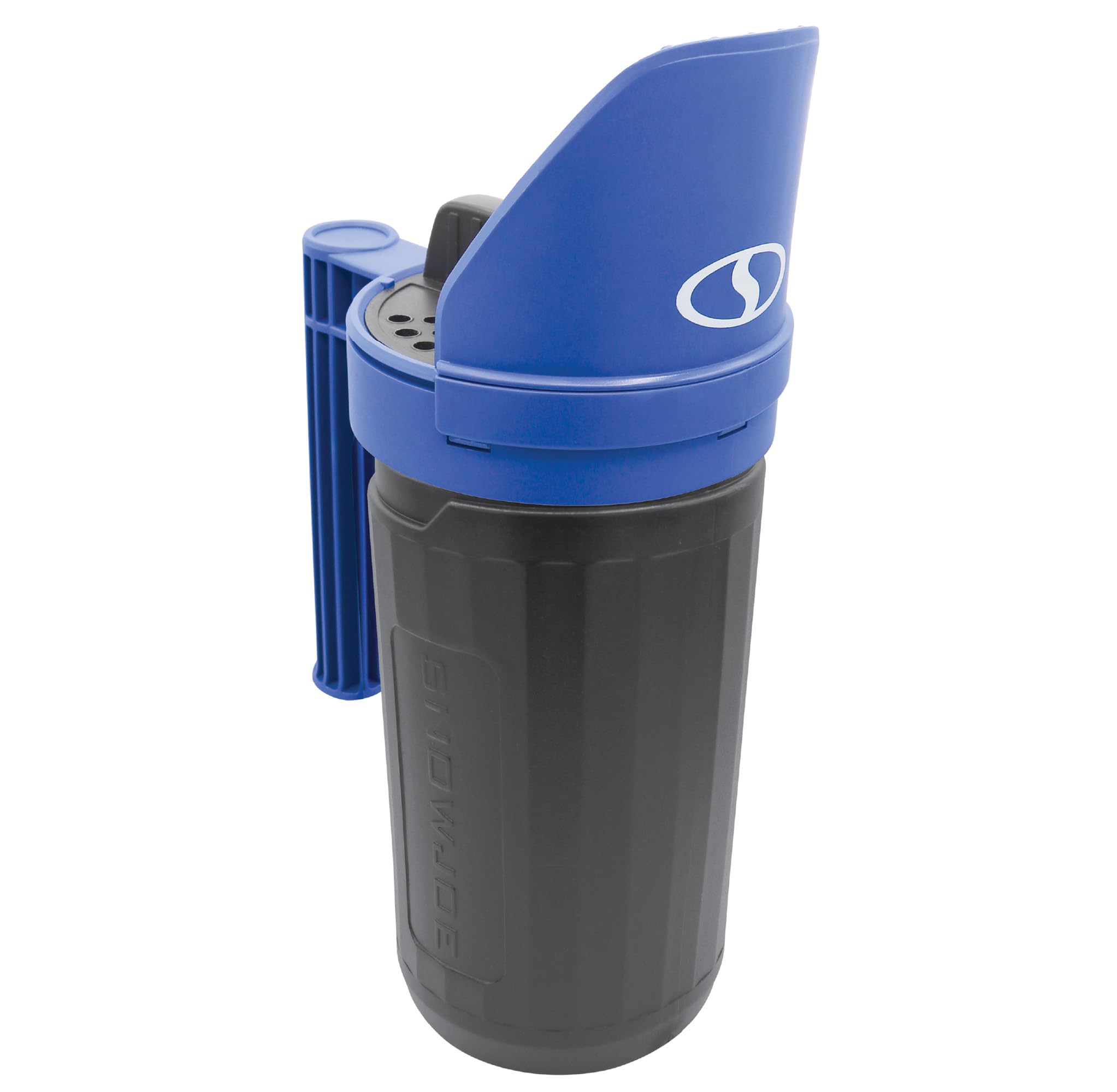
Snow Joe SJSPD1 Handheld Spreader

Snow Joe SJSPD1 Handheld Spreader

Ice melt duty

Our Score 9.0/10
Check Price

Worth Noting

  • Dial offers only coarse and fine openings
Lid
Doubles as a scoop
Weight
1.48 lb
Capacity
5 pounds (84.5 oz)
Flow Control
Adjustable dial
Read the full review

The lid comes off and turns into a scoop, which sounds like a gimmick until you are standing over a bag of ice melt in the cold. Dig, fill, twist it back on. No separate scoop to lose in the garage, and no wrestling a heavy bag over a small opening with gloves on.

Five pounds goes in, more than most shakers here carry, and the dial flips between a coarse and a fine opening as you work. On a long driveway that capacity is the difference between one lap and three. Coverage is even, with a steady shake laying a band down the width of your stride, and the ridged handle gives a gloved hand something to hold.

Ice melt is clearly what this was designed around, and it is the one we hand to someone who wants the winter job done with less bending. For seed and fertilizer it works, but a crank spreader covers a lawn faster, so keep this for hard surfaces and the transition strips the mower cannot reach.

Bottom line: The winter pick: a five-pound hopper and a lid that scoops, so gloved refills on a frozen driveway take seconds.

7

Uniqwamo Battery Handheld Spreader

Uniqwamo Battery Handheld Spreader

DeWalt battery owners

Our Score 8.6/10
Check Price

Worth Noting

  • Battery and charger not included
  • Heavier than the plastic shakers
Weight
2.81 lb
Battery
DeWalt 20V/60V, not included
Settings
6 spread speeds, 8 volume settings
Hopper Capacity
3 liters
Read the full review

The battery is the whole pitch. If there is a DeWalt 20V or 60V pack in the garage already, this spreader clips onto it and does the cranking for you, with no fresh AAs to feed it and no sore forearm at the end of the lawn. Three liters of hopper and six spread speeds with eight volume settings give you more adjustment than any crank model here.

The adjustment matters more than the motor. Widening the throw and opening the gate are separate settings, so an edge or a bed line gets a narrow pass and the middle of the lawn gets everything the spreader has, both without changing pace. Weight sits close to the handle, so a full hopper does not drag your wrist down the way a nose-heavy canister does.

What we cannot promise is years of service. These battery handhelds have the shortest lives in this group, with a season or two where they tend to stop, and that is the trade for not cranking. Buy it because the battery is already on your shelf and the cranking hurts, not because it will outlast a crank model.

Bottom line: If a DeWalt pack is already in your garage, this is the easiest way to spread: no cranking, six speeds, and a three-liter hopper.

How We Tested Handheld Spreaders

We built the shortlist from the handheld spreaders that show up in lawn-and-garden aisles and on hardware store shelves, then filtered by hopper size, crank design, lid type, and price. We ruled out anything with a fill opening smaller than a cup—if you can't fill it from a standard bag without a funnel, it's not worth testing. That left 14 models, which we put through six months of real use.

Testing happened where spreaders actually live: on a half-acre lawn, in raised garden beds, and on a sloped driveway that ices over every winter. We filled each hopper with fertilizer, grass seed, and ice melt, noting how easy it was to open the lid one-handed, pour from a bag, and close it without spilling—and whether the lid stayed sealed when we shook a full hopper. We timed how long a full hopper took to empty and whether the crank turned smoothly with one hand or demanded two.

To check spreading, we laid tarps in a measured grid and walked straight lines at a normal pace, then looked for stripes, gaps, and overspill at the edges. We also tested functionality: does the shut-off gate close completely, does the opening clog with damp fertilizer, and does the spreader stand upright when set down? For size, we carried each one loaded across the lawn and noted whether the hopper cut into a hip or the handle fit a smaller hand. Value came last—we compared what the cheapest models skipped against what the midrange ones added, and asked whether the extra money bought smoother cranking or just a bigger logo.

How to Choose Handheld Spreaders

Crank, shaker, or battery

A crank broadcast spreader throws a fan of material ahead of you, which is what you want for grass seed and fertilizer across a lawn: the pattern covers ground quickly and a gate sets the rate. A shaker canister drops material in a band, so it suits salt, grit, and granules you are placing along an edge, a step, or a bare patch. Battery handhelds do the cranking for you and are worth it mainly if you already own the battery platform.

Our advice is not to buy one tool and ask it to do all three jobs badly. Most households with a lawn and a driveway end up with a crank for the grass and a canister for the salt, and the canister is the one that lives by the door all winter.

Capacity is really a weight decision

Coverage is quoted in square feet, pounds, or ounces, and every version answers the same question: how far do you walk before a refill. The Scotts Whirl carries enough product for about 1,500 square feet, the SOLO takes 20 pounds, and the big canisters hold 80 ounces or, in the Snow Joe's case, 5 pounds.

Bigger is not automatically better in your hand. A full 80-ounce canister is roughly where one arm stops enjoying the job, so fill to about three-quarters and top up when you pass the bag again. A hopper you cannot comfortably lift ends up underfilled anyway.

Opening size beats hopper size with coarse salt

The most common mismatch is a roomy canister with holes too small for the material inside it. Rock salt and coarse ice melt need a wide opening; fine grass seed and dust-fine granules need the small one, or you dump a season's worth into a square yard. Twist lids with three settings cover both ends, while a single fixed opening locks you to one kind of material.

Look at how the openings change before you buy. A rotating collar you can work with gloves on is worth more in January than a clever design that needs bare hands.

Lids, gloves, and cold hands

The lid decides whether a canister is pleasant or infuriating, and it is the first thing to test once the box is open. Screw tops that demand a hard twist are miserable with gloves on; a wide mouth, and a lid that doubles as a scoop the way the Snow Joe's does, keep refills quick when your hands are cold.

Seat the lid firmly before you shake and check it once mid-job. A lid that works loose empties onto your driveway instead of onto the ice.

Even coverage is technique as much as hardware

Whatever you buy, spread at half the recommended rate in one direction, then cross it at half rate again. Two light passes at right angles hide the streaks a single heavy pass leaves, and they use no more material. Walk at a steady pace, keep the crank turning at the same speed, and resist stopping mid-pass to talk to a neighbor.

Wind is the other variable. On a breezy day, keep the wind at your side rather than behind you and hold the pattern closer to the ground.

Frequently Asked Questions

Final Verdict

Most people should buy the Scotts Whirl. It broadcasts seed, fertilizer, and ice melt evenly, the forearm brace keeps the crank steady, and there is no battery to be flat when the bag is already open. If your planting is measured in acres rather than square feet, the SOLO's 20-pound chest-mounted hopper earns its premium in refill trips you never make.

And if the job is really a sidewalk and a set of steps, skip the cranking entirely: the Snow Joe holds five pounds of ice melt with a scoop built into the lid, and the Chapin handles the same small jobs for the least money here.