Ponds & Water Gardens

Best Aquatic Plant Fertilizers of 2026

Aquatic plants pull nitrogen, potassium, iron, and a long list of trace minerals straight out of the water, and fish food and fish waste only cover part of that bill. A good fertilizer tops up the rest, which is often the difference between a tank that fills in and one where leaves yellow, stems stretch, and everything stalls out. The trouble is that the same nutrients that push new growth will feed algae, tint the water, or stress fish and shrimp if the dose is off.

I've kept planted tanks for years, and the lesson I keep relearning is that the bottle's maximum dose is a ceiling, not a target — how much you need depends on how densely planted the tank is and how much light it gets. My team and I spent five months dosing 14 fertilizers, liquids and root tabs alike, in tanks from a 5-gallon shrimp cube to a 40-gallon community setup, and the differences showed up in leaf color, water clarity, and glass algae well before they showed up on a test kit. A few were worth the money; a couple were basically expensive water. The picks below are the ones we'd buy again.

1

Seachem Flourish

Top Pick
Seachem Flourish

Stocked community tanks

Our Score 9.4/10
Check Price

Worth Noting

  • No nitrogen or phosphorus, so not a standalone high-tech feed
Form
Liquid
Bottle Size
500 ml
Nutrient Coverage
Micro and trace elements
Nitrogen And Phosphorus
Not significant
Read the full review

A stocked tank is already a fertilizer factory. Fish food and fish waste supply the nitrogen and phosphorus plants need, so what usually runs short is the trace side, and that is the gap Seachem Flourish fills. It is a micronutrient and trace supplement with no significant nitrogen or phosphorus of its own. We think that makes it the right first bottle for most freshwater tanks: you feed the plants without pushing the nitrate and phosphate numbers that algae live on.

Plants that have stalled usually green up and start putting on size within a few weeks of regular dosing. The bottle is 500 ml and the formula is concentrated, which is the one thing to respect here — a little goes a long way, and a careless pour into a small tank wastes product and feeds algae. Measure it rather than estimating. The bottle itself is worth a look on arrival, too: these can turn up with a loose cap and product already in the packaging, so check the seal while the return window is still open.

Where it stops being enough is a tank of demanding plants under strong light. Flourish is the trace half of a dosing routine, not the whole of one, and a high-tech setup full of fast-growing stems will want a complete formula instead or on top. For everything else — a low-tech community tank, a shrimp colony, a betta tank with anubias and java fern — it is the simplest way to keep plants fed without disturbing the water. That is why it stays our default.

Bottom line: For a stocked freshwater tank, this is the bottle we recommend first: broad trace coverage, nothing to spike your nitrates, and months of dosing from one container.
2

NilocG ThriveS

NilocG ThriveS

Shrimp tanks

Our Score 9.4/10
Check Price

Worth Noting

  • Premium-priced next to the budget liquids
Form
Liquid
Coverage
2,500 gallons
Application
Pump
Bottle Size
500 ml
Read the full review

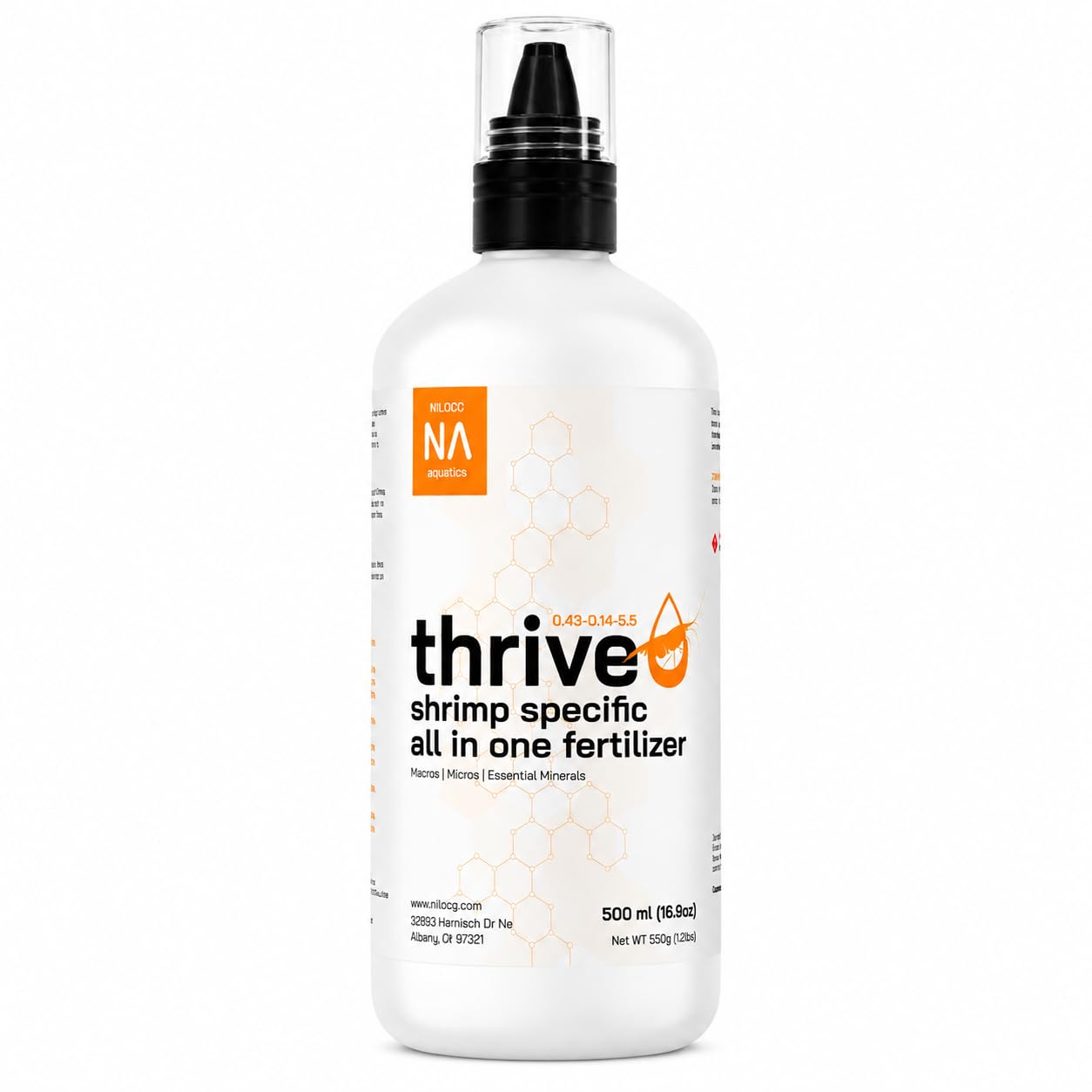
Shrimp tanks are the easiest tanks in the hobby to over-fertilize. A colony of neocaridina in a ten-gallon with a light bioload barely produces the waste that a full-strength all-in-one is designed to feed on, and the surplus goes straight to the algae. ThriveS is NilocG's answer to that mismatch: an all-in-one built specifically for shrimp tanks with live plants, in a pump bottle that treats 2,500 gallons.

The blend follows the same idea as the standard Thrive — macros, micros and minerals — but the target changes what the dosing is for. In a shrimp tank you want steady, modest nutrition that keeps plants lush and colored without loading the water. That is the balance this bottle aims at, and it is the difference between a shrimp tank that stays clear and one that grows a green fuzz on the glass.

The pump is genuinely convenient. A milliliter per five gallons, one to three times a week, with no measuring cup to rinse and no powder to dissolve. Where we slow down is the starting dose: a shrimp colony is not the place to begin at the label rate. Start low, watch the animals for a week, and build up only if the plants are asking for more and the water is staying clear.

As a fertilizer for a shrimp tank, this is the one from this group we recommend: formulated for the job rather than adapted to it, with a pump that makes a small dose realistic in a nano. If you keep sensitive fish alongside the shrimp, dose low and watch them too — the nutrients that feed plants feed everything else in the water.

Bottom line: We recommend it for shrimp tanks specifically: a formula built for them, a pump that makes small doses easy, and no guesswork about which bottle to buy.

3

2HR Aquarist APT 3

2HR Aquarist APT 3

Aquascapes

Our Score 9.4/10
Check Price

Worth Noting

  • Premium price among the complete formulas here
  • Adds nitrate and phosphate a low-tech tank cannot use
Form
Liquid
Nutrients
NPK plus iron, magnesium, traces
Bottle Size
600 ml
Read the full review

APT 3 is the aquascaper's bottle. It is a complete formula — NPK plus iron, magnesium and trace minerals — sold in 600 ml, and aimed at the tank where the plants are the display and everything else is supporting cast.

Magnesium is the detail worth noticing. It is the nutrient that so often ends up as a separate bottle on the shelf, and it sits at the center of chlorophyll, so a shortage shows as pale tissue between green veins. Having it in the same pour as the macros and the iron means one pump instead of a lineup of bottles and a dosing spreadsheet.

We rate it highly on formulation and on how a tank looks after a few weeks of steady dosing: richer color, and plants pushing new growth at a rate you notice. What holds it back is the price per bottle against the other complete formula here. If you want the fullest nutrient set in one container and no mixing, it is worth the premium; if you are watching the budget, Thrive does the same job for less.

Where it does not fit is a low-tech tank with a light fish load. Complete formulas add nitrate and phosphate deliberately, and in a slow-growing tank those go unused until a water change takes them out. This is a product for a tank already pushing growth, not for the one you are trying to coax into it.

Bottom line: We rate this the best-formulated complete here, with a caveat: one bottle, no mixing, full nutrient coverage, and a price to match.

4

NilocG Thrive

NilocG Thrive

CO2 high-light tanks

Our Score 9.2/10
Check Price

Worth Noting

  • Adds nitrate and phosphate, so lightly planted tanks need bigger water changes
Dose
1 ml per 5 gallons
Form
Liquid
Coverage
2,500 gallons
Bottle Size
500 ml
Read the full review

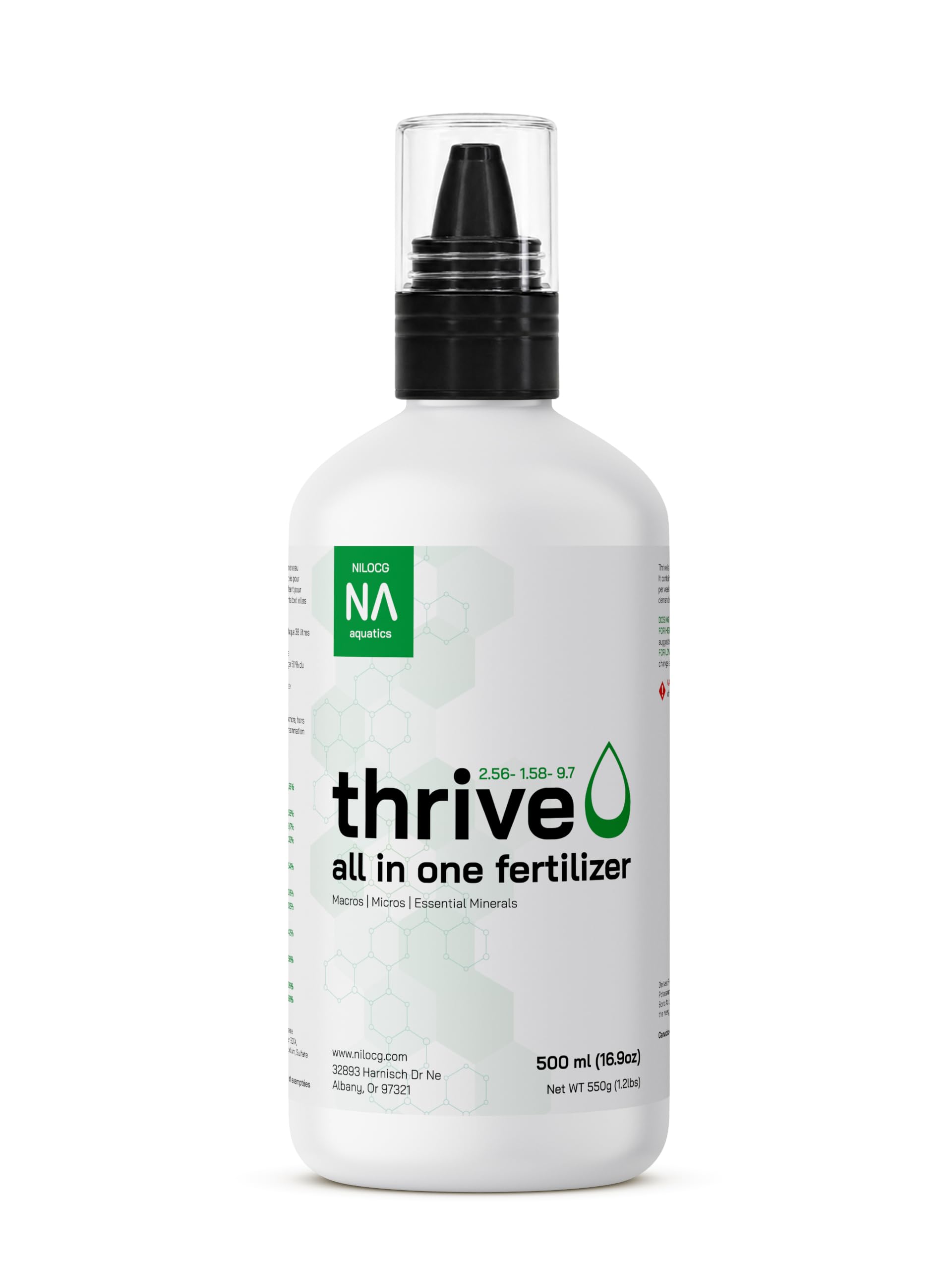
Where Flourish covers the trace side, Thrive covers the whole job: macronutrients, micronutrients and minerals blended into one 500 ml bottle with a pump top. That makes it the formula for a tank where the plants are the main event — CO2 injection, strong light, fast-growing stems that pull nitrate and phosphate out of the water faster than fish food puts them back.

We rate it as the complete formula to reach for first in that kind of tank, and the pump is a large part of why. One milliliter per five gallons, one to three times a week, no syringes and no powder to dissolve — a routine you can repeat in ten seconds before you feed the fish. A single bottle treats 2,500 gallons, so a nano tank is set for a very long time.

The flip side of a complete formula is that you are adding nitrate and phosphate deliberately. In a heavily planted, fast-growing tank that is exactly the point; in a lightly planted low-light tank the plants cannot use it, and the surplus feeds algae and shows up on a nitrate test. Start below the label rate anywhere the tank isn't obviously hungry, and expect to increase the size of your water changes. In a tank holding sensitive fish or shrimp, dose gently for the first week and watch.

Bottom line: The complete formula we point CO2-injected, high-light tanks toward: one pump, everything the plants need, and months of dosing per bottle.

5

Seachem Flourish Tabs

Seachem Flourish Tabs

Heavy root feeders

Our Score 9.2/10
Check Price

Worth Noting

  • Does nothing for plants that feed from the water column
  • A 40-tab box goes fast in a large footprint
Form
Tablets
Count
40 tabs
pH Effect
Will not alter pH
Refresh Interval
Every 3 to 4 months
Read the full review

Amazon swords, cryptocorynes and water lilies feed through their roots, and in a tank running inert gravel or sand there is nothing down there to feed on. Liquid fertilizer poured into the water column drifts past those roots without doing much for them. That is the case for a root tab, and Flourish Tabs are the ones we reach for.

Each tab goes into the substrate near the base of a plant, where it sits and breaks down over months instead of dissolving into the water. The label schedule is one round every three to four months, which makes this about the lowest-effort feeding in the whole article. They also will not alter pH — worth knowing if you keep soft-water species — and they sink and stay put rather than bobbing up to the surface.

For heavy root feeders this is the best option in the group, and duration is the reason: 40 tabs covers a small-to-mid planted tank for most of a year, because a plant only needs a couple under it. In a large tank with a wide footprint the arithmetic turns, and you work through a box quickly enough that the value argument weakens.

The tabs are also the natural partner to a liquid. Run both and you cover the plants feeding through leaves and the ones feeding through roots; run tabs alone and your anubias, java fern and floaters get nothing, because their roots sit in the water rather than the gravel. Push each one deep, too — a tab that works loose is a nutrient release where you didn't plan one.

Bottom line: When swords and crypts sulk in bare gravel, these are the fix: root feeding that liquids cannot do, four times a year.

6

API Leaf Zone

API Leaf Zone

Budget yellowing fix

Our Score 9.2/10
Check Price

Worth Noting

  • Narrow formula built around iron and potassium
  • Iron can tint the water yellow briefly
Dose
5 ml per 10 gallons weekly
Form
Liquid
Nutrients
Chelated iron and potassium
Bottle Size
473 ml
Read the full review

Leaf Zone does two things and does them without fuss: chelated iron and potassium, the two nutrients most likely to run short in a tank that already gets nitrogen and phosphorus from fish food. If your plants are yellowing and you want one bottle rather than a three-part system, this is the simplest route in. It is the budget liquid of this group, and it earns the spot rather than just filling it.

The dose is easy to remember and repeat: five milliliters per ten US gallons, once a week. At 473 ml, a 20-gallon tank is looking at months of dosing, and there is nothing to mix or weigh. The iron is also why some tanks go yellow for a day or so after dosing — that is the product working, not spoiling, and it clears on its own.

What it is not is complete. The formula is built around iron and potassium rather than a full trace range, so a tank of demanding plants will outgrow what it can supply. It is also the wrong purchase if you have not worked out what your plants are short of: dose it because your tank needs iron and potassium, not because a bottle is easier than reading the symptoms.

Bottom line: We reach for this when a stocked tank shows yellowing leaves: iron and potassium, one weekly dose, no three-bottle system to buy.

7

Pondtabbs 60ct

Pondtabbs 60ct

Pond blooms

Our Score 9.0/10
Check Price

Worth Noting

  • Pond and soil-push use only
  • Big ponds go through 60 tablets quickly
Form
Tablets
Count
60 tablets
NPK Ratio
10-14-8
Application
Push into soil
Read the full review

10-14-8 is the whole story with Pondtabbs. That is the NPK ratio on the pack — nitrogen, phosphorus, potassium — and it is a flowering ratio, tilted hard toward phosphorus, which is what pushes a water lily from pads to buds. A general pond feed keeps a plant alive; this one is compounded for bloom.

The tablets go into the soil at the base of each pot, one push of a finger, and break down slowly from there. No measuring, no mixing, no dosing cup to lose in the shed — for a pond with a dozen pots, that is the difference between feeding the plants and meaning to. Each tablet keeps working for weeks, so a spring round and a midsummer round carry a plant through the season.

Sixty tablets is a generous count for a small water garden, and it is where one box beats buying a smaller pack twice. Scale up to a big koi pond with a lot of pots and you work through them faster than expected, which is the main thing to check before ordering.

For the pond where flowers are the goal, this is the box we reach for: the bloom ratio is aimed at exactly that, and 60 tablets suit a collection rather than a single lily. For two or three pots and a smaller outlay, the API tablets do the same job in a smaller box.

Bottom line: For pond lilies you want flowering rather than merely surviving, this is the box we reach for — a bloom ratio and enough tablets for a real collection.

8

API PondCare Tablets

API PondCare Tablets

Small garden ponds

Our Score 8.8/10
Check Price

Worth Noting

  • Pond and pot use only, not submerged aquariums
Use
Potted pond plants
Form
Tablets
Count
25 tablets
Nutrients
Iron and boron
Read the full review

A pond is not an aquarium with the lid off. Plants sit in pots of soil, the water volume is enormous, and the nutrient question changes: you are feeding for leaves and flowers rather than for a carpet. API's PondCare tablets are made for that arrangement — pressed tablets you push into the soil of a potted lily or bog plant, where they break down and feed the roots.

This is the pond tablet we reach for with a handful of pots, and boron is the detail that earns it. Boron supports flower formation, which is the whole reason most people fertilize a water lily in the first place, and it sits alongside iron for leaf color. Between the two you get the parts you actually look at from the bank: pads that fill in green and buds that open. Change usually shows within two to three weeks.

Twenty-five tablets go further than the count suggests, because you are feeding pots rather than gallons, and a single push keeps working for weeks. Where it does not help is glass: this is a soil fertilizer for outdoor pots, and it is the wrong product for a submerged gravel bed. If your lilies have gone quiet with small, pale pads, this is the simplest way to find out whether feeding was the problem.

Bottom line: For potted lilies and bog plants, this is what we buy: iron and boron in a push-in tablet, aimed at flowers rather than just leaves.

How We Tested the Aquatic Plant Fertilizers

We started by reading guaranteed analyses instead of marketing copy: which nutrients a bottle actually delivers, whether the iron is chelated, whether a complete formula leaves out nitrogen on purpose, and whether the label gives a dose per gallon or just vague instructions. Anything that didn't disclose copper content got set aside, since even small amounts are hard on shrimp and snails. That left 14 products — liquids, root tabs, and one dry mix — which we dosed for five months.

Testing happened in our own tanks during ordinary maintenance, not on a bench. Every Sunday after a 25 percent water change we dosed each tank per its label, then counted new leaves, measured stem length against a ruler taped to the glass, and photographed the same anubias leaf weekly under the same light. We also checked the glass and the slow growers for green spot and black beard algae, ran nitrate, phosphate, and iron tests before and after dosing, and held a cup of tank water against a white card to catch any tint. Root tabs went under cryptocoryne and swords, where we dug around a month later to see whether the roots had taken them up or the leaves had melted back.

Fish and shrimp were watched closely for the first two days after every dose — gasping at the surface, listlessness, or any deaths got logged, along with how the snails behaved. At the end we tallied how many doses a bottle actually delivered in a 20-gallon tank, since cost per week varied far more than the sticker price suggested.

How to Choose Aquatic Plant Fertilizers

Start With What Your Tank Is Already Producing

Fish food is fertilizer. Every feeding adds nitrogen and phosphorus, and in a stocked tank under moderate light those two are rarely what limits growth — trace elements usually are. That is why a trace-only liquid like Seachem Flourish is the right first bottle for most community tanks, and why a complete formula can hand a slow-growing tank more than it can use. Run a nitrate test before you buy. If it reads high, your tank is already making what a complete fertilizer would add, and the trace side is what you actually want.

Liquid or Root Tab: Match the Delivery to the Plant

Most plants feed through both leaves and roots, but the balance varies. Stem plants, floaters, java fern and anubias take nutrients from the water column, which is what a liquid supplies. Heavy root feeders — Amazon swords, cryptocorynes, water lilies — feed through their roots, and in inert gravel or sand there is nothing down there until you put it there. The trap is buying a liquid and expecting it to rescue a sword in bare gravel. It won't. Put root tabs under the heavy feeders and dose the water for everything else.

Match the Formula to the Setup

Low-tech tanks with ordinary light and a normal fish load run well on traces plus the occasional root tab. Add CO2 and strong light and consumption climbs: plants start pulling nitrate and phosphate out of the water fast enough that a complete formula becomes the simpler choice. Shrimp tanks sit at the other end of the scale — tiny bioload, sensitive animals — so dose below the label and build up slowly. Ponds are their own case: potted, seasonal, and fed through the soil rather than the water.

Read the Dose, Not the Bottle Size

Two bottles of the same size can be very different value, because one doses at a milliliter per five gallons and another at five milliliters per ten. Concentration is what you are paying for, and it is worth more than a slightly higher sticker price when the dose is small and repeatable. The other half of this is restraint: unused nutrients don't vanish, they feed algae and show up on a nitrate test. Buy a bottle you can measure accurately — a pump top or a marked cap beats a free pour every time.

Frequently Asked Questions

Final Verdict

For a stocked freshwater tank, the bottle that earns its shelf space is Seachem Flourish. It covers the trace side that tap water and fish food leave short, it won't push nitrate or phosphate up, and one container lasts a small tank for months.

When the plan gets more ambitious — CO2, strong light, fast-growing stems — move to a complete formula, and Thrive is the one we recommend first. If the plants in question are swords and lilies in gravel, add Flourish Tabs. If the water is in a pond, start with the API tablets for a few pots and move to Pondtabbs once the collection grows.