Outdoor Power Equipment

Best 2 Stroke Oil for Chainsaw of 2026

Two-stroke oil never sits in a crankcase. It goes into the gas can, through the carburetor, and whatever survives combustion leaves a film on the piston skirt — either what keeps a chainsaw alive or what glues the rings into their grooves. The right mix also burns clean enough that you're not smoking out the neighbors and pours without running down the side of the jug.

I've mixed fuel in a one-gallon can for years, and I've learned the number on the label matters less than the rating behind it. Over six months we ran 14 oils through three saws — a 40cc homeowner saw, a 55cc farm saw, and a 60cc pro saw — and the differences showed up in the exhaust port long before they showed up on the plug. The one mistake first-timers make is dribbling in extra oil for insurance; a clean-burning mix protects better than a heavy one. The picks below run from a cheap jug for storm cleanup to full synthetic for a saw that earns its keep.

1

Echo Power Blend Gold 50:1

Top Pick
Echo Power Blend Gold 50:1

Modern 50:1 saws

Our Score 9.6/10
Check Price

Worth Noting

  • 50:1 mixing only, so 40:1 and 32:1 saws need another oil
Mix Ratio
50:1
Standards
ISO-L-EGD, JASO FD
Bottle Size
2.6 fl oz (6 pack)
Fuel Stabilizer
Included
Read the full review

Echo names two standards most oils in this group don't: ISO-L-EGD and JASO FD, the ratings that describe how an air-cooled two-stroke oil resists deposits and keeps lubricating at the temperatures a saw reaches in a long cut. That's what put it first for us. A chainsaw engine is air-cooled, spends its working life near full throttle, and gets shut off hot, and a named rating is the closest thing on a bottle to evidence that an oil was built for it.

The format is just as sensible. Each 2.6 oz bottle is dosed for one gallon of gas at 50:1, and Echo asks for 89 octane or better, so the whole job is emptying a bottle into a can and filling it at the pump. There's a fuel stabilizer and a detergent in the blend as well, which matters for a saw that spends two weeks in the shed between wood days.

Mixing a gallon at a time through a stretch of cutting, we never had to think about the ratio, which is the entire point of a pre-dosed bottle. What we watched for was start-up smoke and a saw that kept idling between cuts; the exhaust stayed light and the saw settled into a steady idle after the first tank. The bottles are small enough that a six-pack disappears into a toolbox drawer.

One gap worth knowing: this is a semi-synthetic blend, so a saw that works hard and runs hot is better served by the full-synthetic Stihl Ultra. And six bottles is six gallons of mix — about a season for a firewood saw, considerably longer for someone who cuts storm limbs twice a year. Buy a pack, keep the caps tight, and date the box.

Bottom line: For a modern saw run at 50:1, this is the oil we recommend: a named JASO FD and ISO-L-EGD rating, a stabilizer in the mix, and no measuring.

2

Husqvarna XP+ 2-Stroke Oil

Husqvarna XP+ 2-Stroke Oil

Regular firewood cutting

Our Score 9.6/10
Check Price

Worth Noting

  • No published JASO or ISO rating
Mix Ratio
50:1
Bottle Size
2.6 fl oz
Total Volume
15.6 fl oz
Bottles Per Pack
6
Read the full review

Six bottles for the lowest cost per gallon of any six-pack in this group is the short version of why the Husqvarna XP+ is here. Each 2.6 oz bottle makes a gallon at 50:1, so a box is six gallons of mix and there's no cup to wash afterwards. For a saw that gets used most weekends, that arithmetic is the whole argument.

In use it is deliberately unremarkable, which is what we want from two-stroke oil: it mixes without persuasion, the saw starts on the usual pull, and the exhaust stays light. We ran it alongside oils that cost noticeably more per bottle and came away with no reason to pay the difference for ordinary firewood cutting. That's the value case, and it holds up.

Where it thins out is storage. There's no stabilizer in the oil, so a can mixed in October is a can you want to burn by December; add a stabilizer yourself if that isn't realistic, or keep a bottle of STA-BIL for the fuel that sits. For a saw that runs every couple of weeks, that's a non-issue.

Bottom line: The value pick: the cheapest six-pack per gallon here, pre-dosed for one gallon at 50:1, and it runs clean in saws that see regular work.

3

STIHL HP Ultra 2-Cycle Oil

STIHL HP Ultra 2-Cycle Oil

Hard-working pro saws

Our Score 9.6/10
Check Price

Worth Noting

  • Highest price of the six-packs here
Oil Type
Fully synthetic, biodegradable
Bottle Size
2.6 fl oz
Bottles Per Pack
6
Read the full review

Fully synthetic, specified for high-performance saws, and the only oil in this group the listing calls biodegradable — that's the Ultra's case, and it's the one we keep on the shelf for a saw that's going to be in wood all day. Stihl builds it for professional chainsaws, and it behaves like it.

The mechanism is straightforward. A full-synthetic base holds its film at higher temperatures and leaves less carbon behind, which matters in a saw that runs hot for hours rather than minutes. Stihl also lists outstanding engine cleaning. What we noticed in use was an absence of the things you don't want: barely any smoke at start-up, no oily reek on your gloves, and a plug that stayed clean.

So the Ultra is a working-saw oil. A homeowner running two tanks a season won't get the benefit back, and the Husqvarna covers the same ground for a lot less. If the saw cuts firewood for a living, or you're working near water where a biodegradable formula is a real consideration rather than a line on the label, the extra cost buys something real.

Bottom line: For a saw that works hard, this is the one: a full-synthetic, biodegradable oil that burns cleanly and keeps the exhaust light.

4

STA-BIL Full Synthetic 2-Cycle

STA-BIL Full Synthetic 2-Cycle

Long fuel storage

Our Score 9.6/10
Check Price

Worth Noting

  • Doses five gallons at a time, so small cans need a measure
Treats
5 gallons
Mix Ratios
50:1 or 40:1
Bottle Size
13 fl oz
Fuel Stabilizer
Up to 12 months
Read the full review

A chainsaw is a seasonal tool for most of us: a few weekends of firewood in the fall, then a corner of the shed until spring. STA-BIL's 13 oz bottle is built for exactly that pattern. One shot treats five gallons, and the stabilizer in it is rated to keep fuel fresh for up to twelve months.

What won us over is that it solves two problems with one bottle. The base is full synthetic with a low-smoke formula, so the saw runs clean, and the stabilizer means the can you mix in October is still good in April. Multi-mix covers 50:1 and 40:1 equipment, so the same bottle serves an older trimmer and a modern saw without a second purchase.

Ethanol protection is part of the formula too, which matters if the pump near you sells E10 and the saw sits. Between that and the stabilizer, this is the bottle that assumes your fuel will be in the can longer than it is in the saw — which is true of most chainsaws we know.

Bottom line: For fuel that sits between seasons, this is the pick: a full-synthetic, low-smoke oil with a stabilizer rated to keep five gallons fresh for a year.

5

Power Performance 2-Cycle Oil

Power Performance 2-Cycle Oil

Mixed-ratio equipment

Our Score 9.4/10
Check Price

Worth Noting

  • One bottle per order, so a season's supply means reordering
Standards
JASO FD
Mix Ratios
50:1 and 40:1
Bottle Size
16 fl oz
Graduations
oz and mL
Read the full review

The graduations are the reason this bottle is on the list. There's a 2.6 oz mark for a 50:1 gallon and a 3.2 oz mark for 40:1, plus 80 and 100 mL, and ounce and milliliter scales up the side for bigger batches. Pouring becomes a glance instead of a calculation.

The oil itself is JASO FD, one of the two ratings worth looking for on an air-cooled two-stroke, and it's one of only two oils here that names a standard at all. A 16 oz bottle makes several gallons at 50:1, so it covers a saw and a trimmer without a shelf full of little bottles.

Where it earns its place is a shed with mixed equipment. When we're filling a 50:1 can for the saw and a 40:1 can for an older trimmer on the same afternoon, this is the bottle that comes off the shelf, because the marks do the thinking and one container serves both. The oil is good; the bottle is why we keep buying it.

Bottom line: The one to buy when a shed runs more than one ratio: JASO FD oil graded for 50:1, 40:1, and milliliters, with no cup needed.

6

Arnold 2-Cycle Engine Oil

Arnold 2-Cycle Engine Oil

Older 32:1 machines

Our Score 9.4/10
Check Price

Worth Noting

  • You measure each batch rather than pouring a pre-dosed bottle
Dispenser
Tip N Measure cap
Mix Ratios
32:1, 40:1, 50:1
Bottle Size
16 fl oz
Fuel Stabilizer
Included
Read the full review

Plenty of older saws still call for 32:1, and the Arnold bottle is the only one here that names it — 32:1, 40:1, and 50:1 all covered. That single fact is why it's in the guide. If your saw is an older model that wants 32:1, most of the pre-dosed bottles in this group can't help you at all.

The dispenser is the other half of the story. The cap has a measuring well built into it: you squeeze the body, oil rises into the well, and you pour from there. After one batch you stop hunting for a measuring cup, and there's no separate cup to keep track of in the shed.

It carries a fuel stabilizer as well, which the cheaper pre-dosed packs don't, and at 16 oz it's the least expensive bottle of that size in this group. We mixed it for a saw and a trimmer running different ratios and both ran clean, with no smoke worth mentioning.

That makes it our pick for a shed with older equipment in it. If everything you own is a modern 50:1 saw, pre-dosed bottles are quicker and tidier. If you're feeding three machines on three different ratios, one Arnold bottle covers all of them, and that's the reason it stays on the shelf.

Bottom line: The one to buy if something in your shed wants 32:1: three ratios covered, a built-in measuring well, and a stabilizer in the cheapest 16 oz bottle here.

7

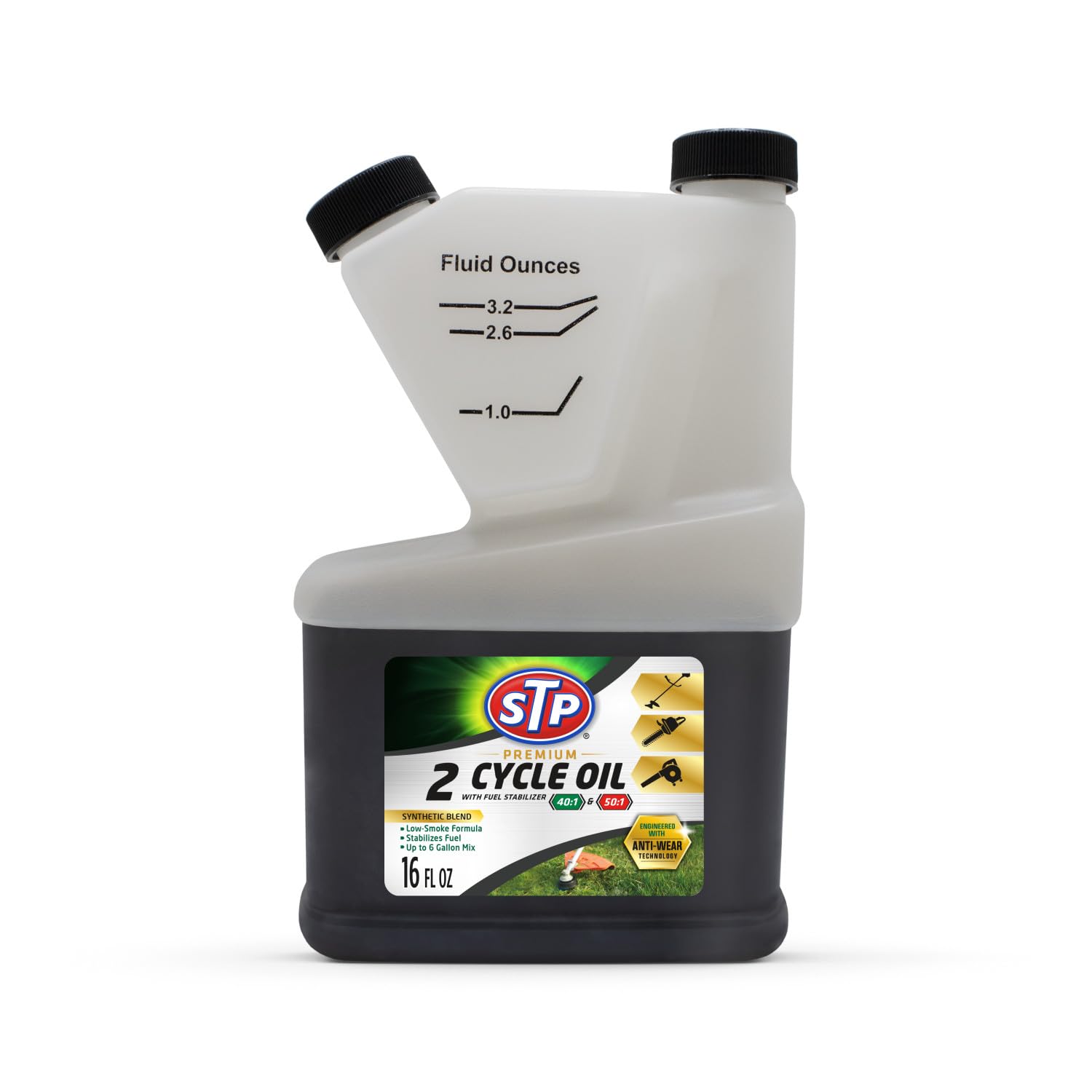
STP Premium 2-Cycle Oil

STP Premium 2-Cycle Oil

Weekend saw duty

Our Score 9.4/10
Check Price

Worth Noting

  • Synthetic blend rather than a full synthetic
Oil Type
Synthetic blend
Bottle Size
16 fl oz
Fuel Stabilizer
Included
Read the full review

STP sells this on the automotive shelf rather than with the lawn equipment, but it's a two-cycle oil for air-cooled engines and the formula reads well: a synthetic blend with a fuel stabilizer, detergents for carbon control, and anti-wear and corrosion additives. That's a fuller additive package than several bottles in this guide can claim.

The 16 oz can is enough for several gallons at 50:1, and the stabilizer means a can of mix can stand for months rather than weeks. The detergents are aimed at the carbon that eventually sticks a ring, which is the slow failure mode on a hard-worked two-stroke rather than the thing that stops one on a Saturday.

Where it fits is someone who wants a stabilizer and a decent additive package without committing to a six-pack of brand-name bottles. Being a blend rather than a full synthetic, it gives away something to the Stihl Ultra on a saw that runs hot for hours. For a saw and a trimmer on 50:1 that get used most weekends, we came away with no complaints and no strong reason to pay more.

Bottom line: Worth buying when you want stabilizer and detergents in one can without a six-pack commitment, though the blend stops short of full synthetic.

How We Tested 14 Two-Stroke Oils

We started with roughly 40 oils sold in everything from 2.6-ounce one-gallon doses to full gallons, then narrowed the field on the certification printed on the label — JASO FD and ISO EGD claims carried more weight than vague "low smoke" language — plus how easy the bottle is to find in a store and what a gallon of mixed fuel actually costs rather than what the bottle costs. That left 14 for hands-on testing.

Each oil was mixed at 50:1 with ethanol-free 91 octane, measured in a graduated ratio cup instead of the sight window molded into the bottle, since those windows are consistently off by enough to matter. The saws bucked oak and pine in the yard, limbed storm-downed branches after a nor'easter, and ran wide open through a long afternoon of clearing fence line.

Smoke got judged at two moments: the cold start with the saw idling on the tailgate, and right after a full-throttle cut in green oak. Every ten tanks we pulled the muffler and inspected the piston skirt and exhaust port for carbon buildup and scoring, then checked the fuel line and carburetor diaphragm for softening.

Bottles spent a night on their side in a truck bed to see whether the cap or spout wept. We also handed each one to someone who had never mixed fuel to find out whether the printed instructions were enough without a phone call, and scored bottle size on whether a dose made exactly one gallon without a second guess.

How to Choose the Right 2 Stroke Oil for Chainsaw

Start with the ratio in your manual

Most modern saws run 50:1, which is 2.6 oz of oil to a gallon of gas. Older saws, and some saws worked hard in heat, specify 40:1 or 32:1. A pre-dosed 50:1 bottle can't get you there, and the trap is buying a six-pack of them for a saw that wants 40:1 — you end up running the saw lean or doing arithmetic at the fuel can every time.

Check the fuel cap or the manual before you order. If the number isn't 50:1, buy a bottle with graduations that cover your ratio instead of a pre-dosed pack.

Pre-dosed bottles versus a bottle you measure from

Two formats cover almost everything: small 2.6 oz bottles dosed for exactly one gallon, and 13 or 16 oz bottles you measure from. The small bottles win on speed and on the mess you don't make. The big ones win on flexibility, on shelf space, and on serving more than one machine.

We reach for a pre-dosed bottle when we're filling a single can, and a graduated one when the shelf holds a saw, a trimmer, and a blower on different ratios.

Read the specification line

JASO FD and ISO-L-EGD are the ratings worth finding on a label. Both describe how an air-cooled two-stroke oil resists deposits and keeps lubricating at the temperatures a saw reaches in a long cut. Plenty of bottles skip them and lean on brand reputation instead, which is fine until you're deciding between two similar prices.

Semi-synthetic is the sensible middle for a homeowner. Full synthetic earns its extra cost on a saw that runs hot for hours, and it usually burns cleaner.

Stabilizer, storage, and the fuel you don't burn

A chainsaw is a seasonal tool for most people, and a can of mix left in the shed goes stale. Oils with a built-in stabilizer claim to keep fuel usable for months, and that's worth real money when you mix five gallons at a time and finish two.

If your oil doesn't bring a stabilizer, add one or mix batches small enough to burn through. A hard-starting saw in spring is usually last fall's fuel, not a worn carburetor.

Compare cost per gallon, not cost per bottle

Divide what a pack costs by the gallons of mix it makes and the ranking changes. A six-pack of 2.6 oz bottles is six gallons at 50:1. A 16 oz bottle with graduations makes roughly six gallons too, with a little left over, and it usually costs less than the six bottles.

Buy for the season, not for the decade. Oil has a shelf life once opened, so a bargain on a huge pack only pays off if you'll actually mix that much.

Frequently Asked Questions

Final Verdict

Echo's Power Blend Gold is what we recommend for most chainsaw owners: it names both ISO-L-EGD and JASO FD where most of the field names nothing, it carries a stabilizer, and one bottle makes a gallon at 50:1 with no measuring cup to rinse.

Buy the Husqvarna XP+ instead if the saw only sees a few tanks a year and you want the cheapest six-pack per gallon here. Buy STA-BIL if you mix five gallons and leave it standing, or STIHL's Ultra if the saw works every week and you want a full synthetic. If something in the shed still wants 32:1, the Arnold bottle is the only one here that covers it.