Outdoor Power Equipment

Best Brush Cutter Blades of 2026

The worry with a brush cutter blade is simple: you bolt it on, hit the throttle, and find out it is unbalanced, dull, or not meant for your machine. The right blade turns a miserable afternoon of blackberry canes and saplings into a manageable job, and it is still intact when you are done. It fits your arbor, cuts fast without excessive vibration, holds an edge, comes with the hardware to mount it safely, and does not cost more than the work justifies.

Over six months, my team and I ran 14 blades through fence-line clearing, pasture edges, and sapling patrol—not one tidy test patch. The pattern was clear: a blade that feels sharp out of the box can lose its bite in dry grass, and one that mounts with a loose washer will chatter before it reaches a log. We noted how quickly each dulled, how easily a file restored the edge, and whether the included hardware matched our machines. The picks below are the ones that made the work feel less like a fight.

1

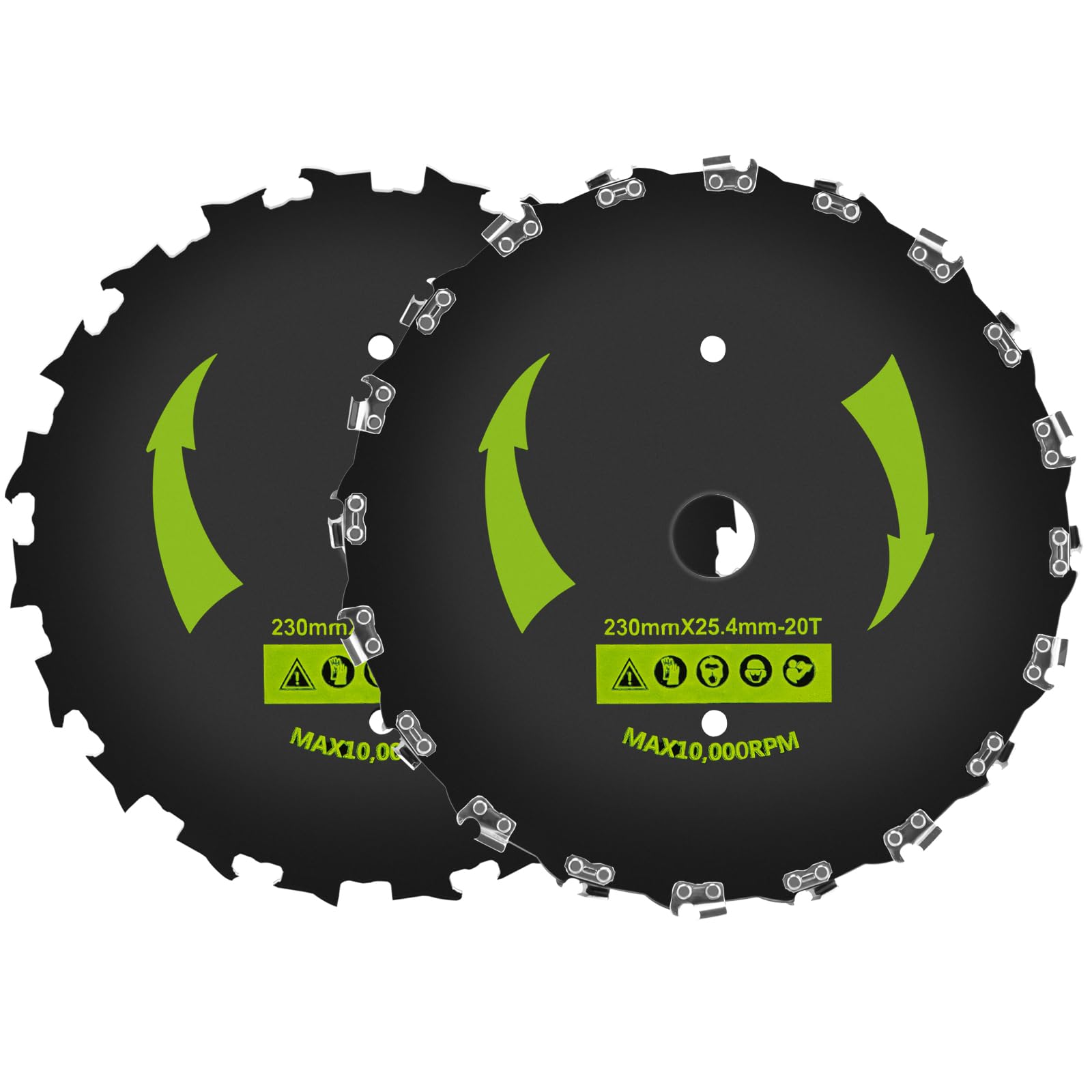
KAKO 2-Pack 9 in 20T Blade

Top Pick
KAKO 2-Pack 9 in 20T Blade

Budget two-pack

Our Score 9.2/10
Check Price

Worth Noting

  • Edge is only average out of the box
  • 20 teeth are coarse in grass and fine stems
Arbor
1 in (25.4 mm)
Teeth
20
Diameter
9 in
Max Speed
10,000 rpm
Read the full review

The parts of a brush blade that fail first are the rivets holding the teeth and the plate they sit in. This pair is built on a heavy manganese-steel body with the teeth riveted rather than stamped, and that is the construction that survives the cutting that kills cheaper blades: saplings with real wood in them, not just weeds.

We rate it the value pick of the set, and not only because it is inexpensive. A stated 1-inch arbor, a 10,000 rpm ceiling, and a sharpening file in the pack make it a complete spare-blade purchase. The edge is not as sharp out of the box as the FORESTER pair, so give each blade a few strokes with the included file before its first cut. Twenty teeth are also coarse in grass and fine stems, which makes this a blade for woody growth rather than a lawn.

Bottom line: The pair we recommend to anyone clearing fence lines a couple of times a year: two riveted 20-tooth blades, a file in the pack, and a common 1-inch arbor.

2

Renegade 10 in 80T Carbide Blade

Renegade 10 in 80T Carbide Blade

Aggressive clearing

Our Score 9.2/10
Check Price

Worth Noting

  • Blade mounting kit sold separately
  • Single blade in the pack
Teeth
80 carbide teeth
Blades
1
Diameter
10 in (254 mm)
Mounting
Blade kit sold separately
Read the full review

The most aggressive blade in this set is also the most demanding to buy: a single 10-inch, 80-tooth carbide disc that arrives on its own, with the blade-kit parts for your particular trimmer bought separately. What the money buys is bite. Two-inch saplings go down without the blade slowing, and it will score through bigger stems if you work around them instead of forcing straight through.

It is a blade for clean ground. Catch rock, wire, or a steel post and the carbide can let go, a risk every carbide blade here carries and a more expensive one to carry on a single blade with no spare in the pack. Where the ground is clear and the trimmer already has its mounting parts, it is a serious cutter; where either of those is not true, the kits are better value.

Bottom line: A serious single blade for clean ground and heavy saplings: budget for the mounting kit your trimmer needs and keep it out of the rocks.

3

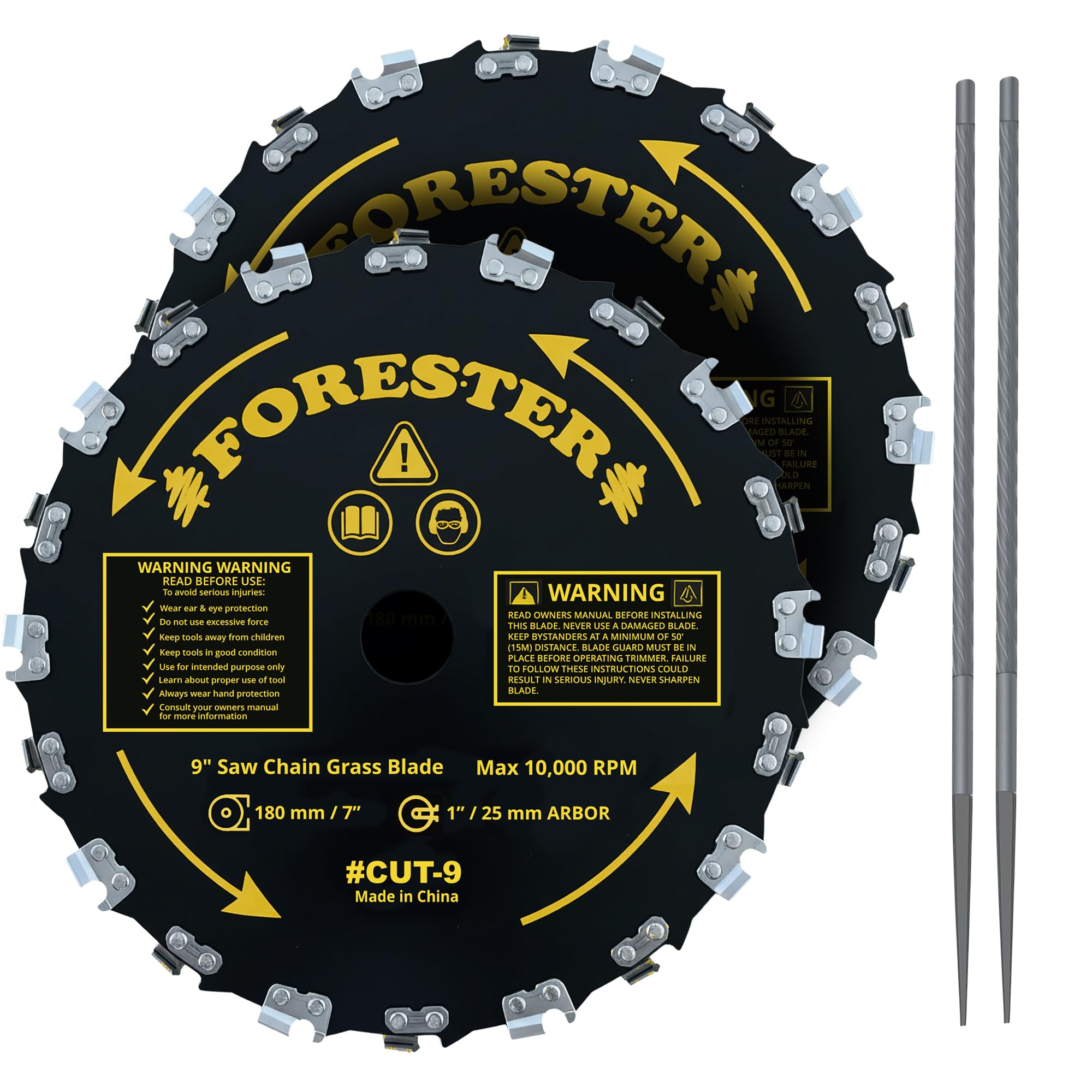
FORESTER 2-Pack 9 in 20T Blade

FORESTER 2-Pack 9 in 20T Blade

Heavy brush clearing

Our Score 9.0/10
Check Price

Worth Noting

  • Sharpening file is not always in the box
Teeth
20 chainsaw teeth
Max Cut
2.5 in
Diameter
9 in
Sharpening
13/64 in file included
Read the full review

A 20-tooth chainsaw blade on a straight shaft turns clearing back into trimming. Of everything we mounted, this is the one that stayed on the machine: it takes saplings up to about two and a half inches without dragging the engine down, and it does it at a pace that makes a choked fence line feel like an afternoon rather than a lost weekend.

The design is a chainsaw chain brazed into a circle: 20 teeth on a 9-inch steel disc, 3/8 pitch, rated to 10,000 rpm, and sharpened with the 13/64-inch file that comes in the pack. That file matters more than it sounds. A chainsaw-tooth blade is meant to be touched up, not thrown away, and a few strokes every tank keeps it biting instead of tearing.

Mounting is the part to sort before you order. FORESTER sells its conversion kit separately, so a trimmer that has only ever run string needs that kit as well as the blades, while a machine already set up as a brush cutter has the hardware. Fit is also machine-specific in a way that catches people out: an Echo SRM 225 takes this blade, the bigger SRM 2620T does not, and Honda string trimmers are out.

What we liked most was the arithmetic of two blades. A chainsaw tooth dulls the moment it touches dirt, gravel, or fence wire, so having a second blade sharpened and waiting means you swap at the truck instead of finishing the job with an edge that is tearing. Treat the pair as a consumable set rather than a lifetime purchase and the value holds up.

Bottom line: Our default pick: a 20-tooth chainsaw blade that clears saplings to 2.5 inches, ships with its sharpening file, and fits most straight-shaft machines once the mounting hardware is sorted.

4

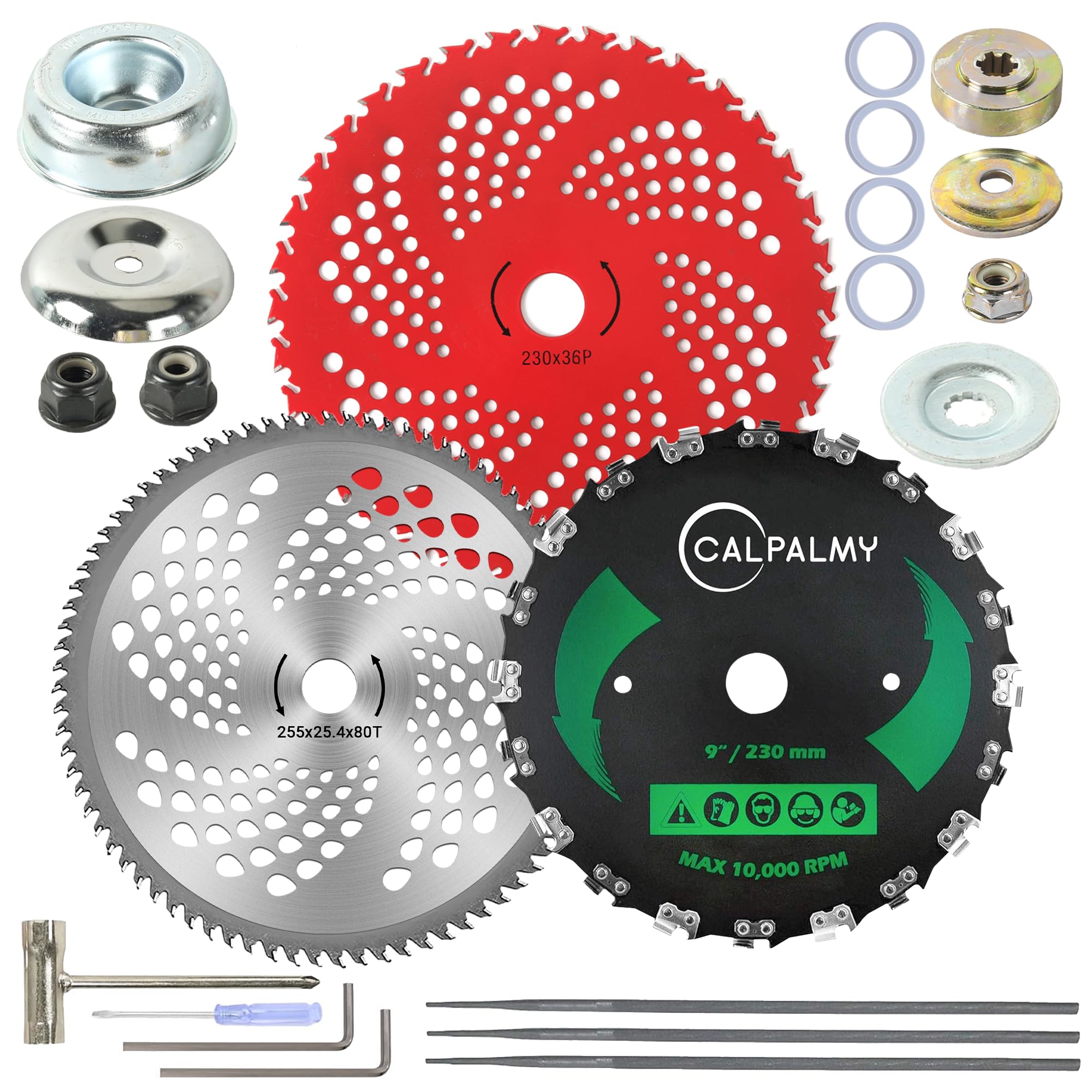
CalPalmy 3-Blade Kit

CalPalmy 3-Blade Kit

First blade setup

Our Score 8.8/10
Check Price

Worth Noting

  • Not for Echo SRM series or other arbor sizes
Arbor
1 in
Sizes
9 in x 20T, 9 in x 36T, 10 in x 80T
Blades
3
Hardware
Two adapter kits included
Read the full review

Open the box and you get three blades and two full adapter kits: a 9-inch 20-tooth chainsaw blade, a 9-inch 36-tooth, a 10-inch 80-tooth carbide disc, plus thrust washers, collar nuts, a rider plate, and wrenches. For a trimmer that has never run anything but string, that hardware is the reason to start here rather than with a bare blade.

For a first blade, this is the kit we point people to, because it answers the question no product page can: which tooth count suits your ground. Run the 20-tooth on saplings, the 36 on briars and vines, the 80 on grass and thin stems, and one afternoon tells you what to buy twice next time.

The blades themselves are manganese steel with brazed carbide tips, which makes them tough rather than magical. They dull, a tooth can let go on rock, and the 1-inch arbor is the only size the kit covers. What earns the kit its place is the middle blade: a 36-tooth in the box handles blackberry canes and finger-thick regrowth in a way a single 20-tooth pack cannot, and you find that out without buying it separately.

Bottom line: Start here if you have never run a metal blade: three tooth counts and the mounting hardware in one box, so you can find out what your ground needs without a second order.

5

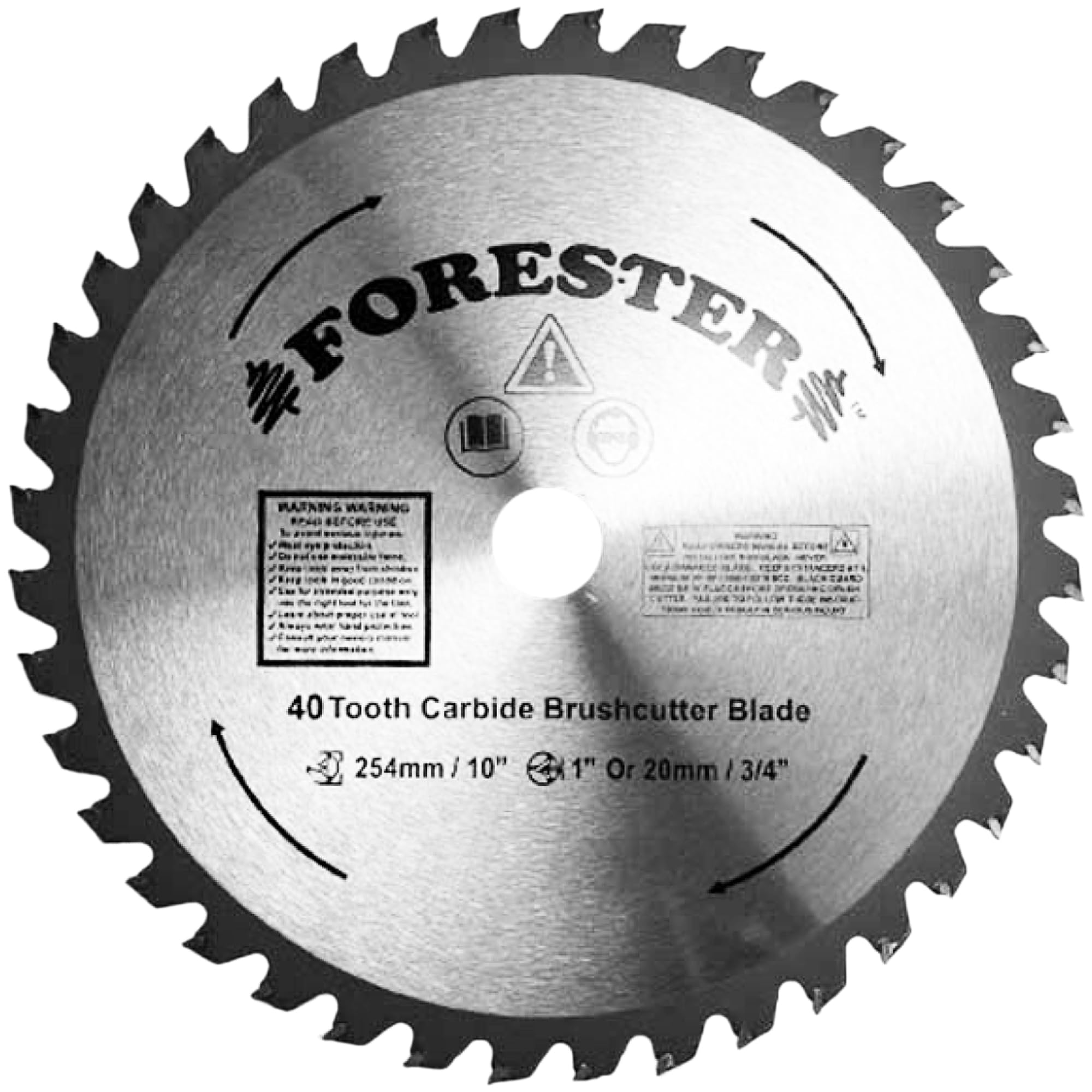
FORESTER 10 in 40T Carbide Blade

FORESTER 10 in 40T Carbide Blade

Clean carbide cuts

Our Score 8.8/10
Check Price

Worth Noting

  • Conversion kit and hardware sold separately
  • Thin plate can need a shim to tighten
Teeth
40 carbide teeth
Diameter
10 in
Mounting
Conversion kit sold separately
Max Speed
10,000 rpm
Read the full review

Forty carbide teeth on a 10-inch disc behave nothing like a 20-tooth chainsaw blade. Each tooth takes a smaller bite, the cut comes out cleaner instead of torn, and there are twice as many edges still working once the first few have dulled. In mixed growth such as grass, weeds, vines, and saplings under a couple of inches, we found it the more pleasant blade to run.

The 10-inch diameter covers more ground with each pass, which is why it wants a mid-size engine behind it. FORESTER's own guidance pairs the 8- and 9-inch discs with 25 to 30cc machines and compact guards and leaves the 10-inch for more muscle, and nothing about our time with it argued otherwise. It is rated to 10,000 rpm, and the carbide holds an edge longer between sharpenings than plain steel teeth.

Where this blade earns its place is a Stihl straight shaft: the FS-91 and FS56RC are the machines it lines up with most cleanly, and it suits ground where you want one tidy pass rather than the biggest possible bite. It is the carbide blade we rate highest in this set, with two things to know going in. The conversion kit and mounting hardware are sold separately, and the plate is thinner than some original blades, so it can need a shim to tighten down properly.

Bottom line: Our carbide pick: a 10-inch, 40-tooth blade that leaves a cleaner cut and keeps its edge, best on a mid-size Stihl straight shaft once the mounting kit is sorted.

6

ATIE 8 in 80T Carbide Blade

ATIE 8 in 80T Carbide Blade

Small trimmers

Our Score 8.8/10
Check Price

Worth Noting

  • 8-inch size gives up on the biggest stems
Arbor
1 in or 20 mm
Teeth
80 carbide teeth
Blades
2
Diameter
8 in
Read the full review

Eight inches is the size to look at if your trimmer is on the small side. A smaller disc takes less torque to spin, so the machine keeps throttle in reserve instead of bogging in tall grass, and it clears a compact guard in a way a 10-inch blade will not.

The disc carries 80 brazed carbide teeth, and the arbor takes either a 1-inch or a 20 mm bore. That 20 mm option is the unusual part, and it is what makes this blade work on Stihl's FS-56 and similar machines that do not accept a straight 1-inch mount. Two blades and a washer come in the pack.

In use it is a clean cutter: 2-inch saplings, blackberry canes, and 3-inch stems all go down without drama, and it leaves a tidier finish than a 20-tooth blade. Fine teeth dull quickly in soil or gravel, though, because an 80-tooth disc has more edges but each one is smaller. It also has to sit flat on its washer, and a blade that jumps or wobbles is usually a mounting problem rather than a bent disc.

If you own one trimmer under 30cc, this is the blade we fit to it. The 8-inch reach is the compromise: less ground covered per pass and less appetite for the biggest stems. For the brush most yards actually produce, it keeps a small machine useful instead of overworked.

Bottom line: For a trimmer under 30cc, this is the blade we fit: 80 carbide teeth, an arbor that takes 20 mm machines, and two blades in the pack.

7

HK 2-Pack 9 in 36T Blade

HK 2-Pack 9 in 36T Blade

Briars and vines

Our Score 8.6/10
Check Price

Worth Noting

  • No installation instructions in the box
Arbor
1 in (25.4 mm)
Teeth
36
Diameter
9 in
Gear Case Fit
1 in or 0.79 in
Read the full review

Thirty-six teeth is the layout to pick when the growth you are fighting is springy rather than solid. Finer, closer teeth slice through briars, vines, and finger-thick stems instead of hooking them, and the blade keeps its speed in grass that a 20-tooth disc grabs at.

The pack is generous for the money: two 9-inch carbide-tipped blades, a 1-inch arbor, and two sets of mounting hardware, enough for the standard mount and for the smaller 0.79-inch gear cases some compact straight shafts use. Nothing in the box tells you how to stack the washers, rider plate, and nut, and the order is easy to get wrong the first time.

Edge life is the compromise. These teeth hold a sharp edge for a shorter stretch than the 20-tooth blades here, especially in dense, dusty going, so plan on touching them up with a file more often and rotating to the second blade when the first stops slicing cleanly. For occasional work that is a fair trade; for all-day clearing it is not.

Where this pair earns its keep is the tangle at the back of a property, where finer teeth beat a bigger bite and the blade is not grabbing and stalling every few feet. Take the 20-tooth FORESTER when the stems have real wood in them.

Bottom line: Take this pair for springy, tangled growth such as briars, vines, and bamboo, where 36 finer teeth beat a 20-tooth blade's bigger bite.

8

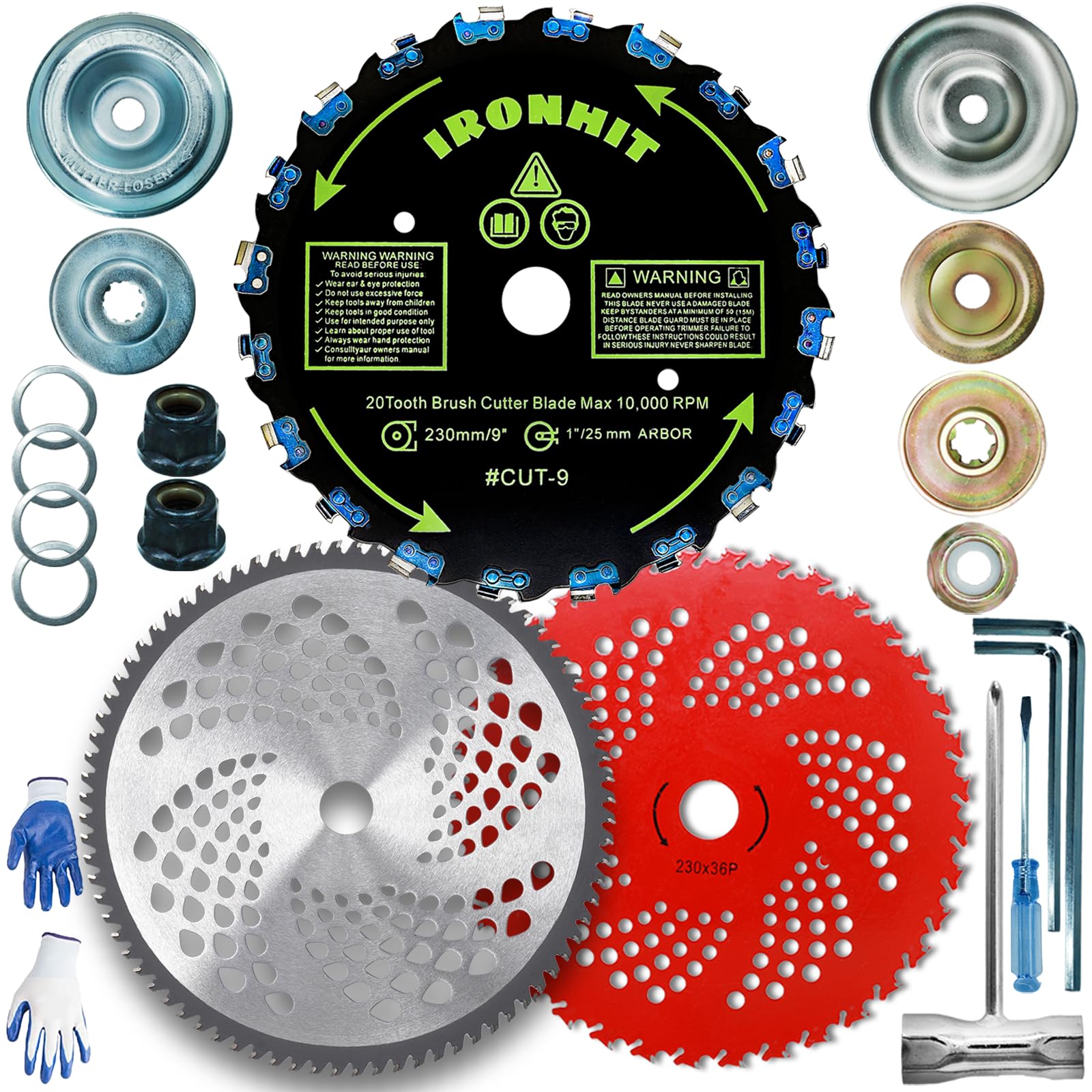
IRONHIT 3-Blade Set

IRONHIT 3-Blade Set

Three-size kit

Our Score 8.6/10
Check Price

Worth Noting

  • Not for Echo SRM or Ryobi machines
  • Hardware does not fit every trimmer
Arbor
1 in
Sizes
9 in x 20T, 9 in x 36T, 10 in x 80T
Blades
3
Hardware
Two adapter kits included
Read the full review

Most multi-blade kits leave the 36-tooth out. IRONHIT includes it, alongside a 9-inch 20-tooth chainsaw blade and a 10-inch 80-tooth carbide disc, and that middle blade is the reason to look at this set: it handles briars and finger-thick regrowth without the grabbing a 20-tooth disc gives you in springy growth.

The box is complete, with three manganese-steel blades on a 1-inch arbor plus two adapter kits carrying thrust washers, a rider plate, lock nuts, and wrenches. The 10-inch disc does the heavy work, taking blackberry vines an inch thick and shrubs to about two and a half inches without much fuss.

We rank it behind the CalPalmy kit, and the reason is fit. CalPalmy covers the same three geometries with hardware that suits a wider spread of machines for about the same money, while IRONHIT's compatibility list is shorter than its box suggests. It earns its place when your trimmer is one of the machines the listing names, or when a 36-tooth blade in the kit is exactly what you are after.

Bottom line: The three-blade kit to buy if you want a 36-tooth blade alongside the 20 and the 80, and your trimmer takes standard 1-inch hardware.

How We Tested Brush Cutter Blades

We built the shortlist from blades sold for straight-shaft brush cutters, then filtered by stated arbor size, tooth geometry, and whether the listing made the included hardware clear. We ruled out anything with vague fitment or a cutting edge that looked uneven in the product photos, and we favored blades that came with the washers or adapters needed for common machines. That left 14 blades, which we used over six months on blackberry, tall grass, saplings, and gravel-edged fence lines.

Installation was the first test. I mounted each blade on two different brush cutters, timed the swap, and checked whether it sat flat, centered, and spun without wobble at full throttle. A blade that needed extra washers or grinding to fit got marked down, and I noted exactly what came in the box—adapter, washer, nut, or nothing. In the field, we timed how long each blade took to clear a measured stretch of blackberry and saplings, watched for vibration and kickback in tall grass, and stopped to check the edge after every session. We also ran each blade through a rocky patch to see whether the teeth chipped, bent, or cracked.

Sharpening told us a lot about long-term value. Using a flat file with the blade clamped in a vise, I timed how long it took to bring a dulled edge back and noted whether the tooth shape made that easy or awkward. Then we tracked how many sessions each blade lasted before it needed another pass, and whether it kept cutting cleanly or started tearing at grass. The blades that rose to the top were not the cheapest or the most aggressive—they were the ones that stayed stable, held an edge, and came with hardware that actually fit.

How to Choose Brush Cutter Blades

Fit first: arbor, hardware, and the machines that are excluded

Nearly every blade here is built around a 1-inch (25.4 mm) arbor, and that is the number to check against your gear case before anything else. The exceptions matter: ATIE's 8-inch disc also takes a 20 mm bore, and HK's adapter set covers 0.79-inch gear cases as well as the standard inch.

If your trimmer has only ever run string, you also need the conversion hardware. CalPalmy and IRONHIT include it, while FORESTER sells its kit separately. Read the exclusion list as well: Echo SRM and Ryobi machines are named as incompatible on several of these listings, whatever the photos suggest.

What tooth count actually changes

Twenty chainsaw teeth take the biggest bite and clear saplings fastest, which makes them the right choice when most of your work is woody and an inch or more across. Thirty-six teeth cut finer and handle briars, vines, and springy regrowth without hooking, at the cost of a shorter sharp life. Eighty small carbide teeth give the cleanest finish in grass, weeds, and thin stems, and the least tolerance for grit.

Pick by what is actually on your ground rather than by which number looks more serious. A 20-tooth blade in a briar patch grabs and stalls; an 80-tooth disc on hardwood saplings takes three times as long.

Match the disc to the engine

A 10-inch blade on a 25cc trimmer is a lot of steel to spin, and the machine tells you so in tall grass. FORESTER's own guidance pairs the 8- and 9-inch discs with low-to-mid-range engines and compact guards and reserves the 10-inch for more muscle, and our time with these blades agreed.

If you own one small straight shaft, an 8-inch blade keeps throttle in reserve and clears the guard. If you have a 40cc brush cutter, the 10-inch disc covers more ground per pass and cuts down on repositioning.

Ground contact is what costs you the edge

Wood does not dull a brush blade; soil does. A chainsaw-tooth blade that touches dirt, gravel, or fence wire loses its edge in a single pass, and carbide teeth can chip or let go on the same contact.

So cut a couple of inches above the ground and let the teeth work rather than using the blade as a scraper. On banks, work downhill so the disc swings away from the soil, and cut anything flush with a saw. Keeping the blade out of the dirt is worth more than any tooth specification on the box.

Frequently Asked Questions

Final Verdict

Most people should buy the FORESTER 20-tooth pair. It clears saplings at a walking pace, comes with the file that keeps it working, and the second blade means a dull edge costs you ten minutes rather than an afternoon.

Two situations change that. A trimmer under 30cc is happier with the 8-inch ATIE, and if you want the cleanest cut and already own a Stihl straight shaft, the 40-tooth carbide FORESTER is the better blade. Sort the arbor and the mounting hardware first; everything else follows from that.