Pest & Weed Control

Best Tree Root Killer of 2026

A tree root doesn’t need an invitation. It follows moisture into a cracked pipe or loose joint, and the first sign is often a slow drain that turns into a gurgling sink and then a backup you can’t ignore. The right root killer reaches the cluster of roots, kills it, and keeps water draining long enough to avoid an emergency call. A good one also loosens the root mass so it can be flushed out, and it gives you instructions you can actually follow.

My first surprise was that the strongest-looking label didn’t win. Over six months, my team and I tested 14 root-killer products in older sewer lines and on cut root clusters, and the differences showed up fast: some foamed up the pipe wall and reached roots a liquid missed, while others barely wet the joint. Granules sink and sit; foams climb; liquids can wash past a dense root mass if the line isn’t pre-wet. The picks below are the ones that killed roots, kept drains open, and didn’t leave us guessing about dosage.

1

RootX Foaming Root Control

Top Pick
RootX Foaming Root Control

Long sewer runs

Our Score 9.2/10
Check Price

Worth Noting

  • Premium price
Form
Foaming
Coverage
50 ft of 4-inch pipe
Application
Toilet with funnel
Package Size
2 lb jar
Read the full review

RootX is the pick for a sewer line where roots have had years to find the top of the pipe. The foaming formula is designed to cling to the upper surfaces, and the jar comes with a funnel and applicator that help you get it into the toilet and down the line. One 2-pound jar is labeled to treat 50 feet of 4-inch pipe, which is a useful number for a typical residential run.

We like the professional-style approach: the funnel does most of the aiming, and the foam is meant to work where a granular product can sink past the problem. It is EPA accepted, and the funnel makes the dose easier to place than a loose powder. If your line is longer than 50 feet, buy two jars rather than stretching one.

The trade-off is price: this is the premium pick here, and you are paying for the foaming action and the 50-foot coverage. The foam itself can be inconsistent, so follow the label closely and do not expect a thick head every time. For a long run or roots at the top of the pipe, the coverage is worth the premium; for a short, simple line, a granular product does the job for less.

Bottom line: We reach for RootX when roots sit high in the pipe or the run is long; the foam treats up to 50 feet and the funnel helps place the dose.

2

Zep Root Kill

Zep Root Kill

Bulk maintenance

Our Score 9.2/10
Check Price

Worth Noting

  • Not for sink or tub drains
Form
Copper sulfate crystals
Pack Size
Case of 4
Use Limit
No more than 2 per year
Time To Results
3–4 weeks
Read the full review

Buying root killer by the case sounds like overkill until you have priced a plumber's call. Zep Root Kill comes as four containers, and the copper sulfate crystals are meant for scheduled maintenance rather than a one-off rescue. We like the value story: the per-treatment cost is easier to justify when the next dose is already in the basement, not a hurried trip to the store.

We think the label is the most useful thing about it. Roots take about 3 to 4 weeks to take up enough copper sulfate, die, and begin to decay; only then should flow improve. Zep also caps use at no more than two applications a year, which keeps a case pack from becoming an excuse to over-treat. That makes it a good fit for a sewer line or septic system with proper access, not for a quick drain-clearing emergency.

The crystals are odorless and easy to measure, and the case format is the main catch: four containers are a commitment if you are new to root maintenance, and they take up shelf space. For a household already on a spring-and-fall schedule, though, Zep is a sensible bulk buy that keeps the next treatment within reach.

Bottom line: We see Zep's case pack as the practical buy for scheduled treatment: four containers keep repeat doses on hand, and the copper sulfate routine is easy to follow.

3

Roebic K-77 Root Killer

Roebic K-77 Root Killer

Overall value

Our Score 8.8/10
Check Price

Worth Noting

  • Can take weeks to improve flow
Form
Granules
Plumbing
All types
Package Size
32 oz
Use Interval
Every 6–12 months
Read the full review

A 32-ounce tub of granules that goes into the toilet and gets flushed is about as uncomplicated as root control gets. We think that simplicity is the reason to start here: no mixing ritual, no special applicator, and a label that points to sewer and septic lines rather than a stump. The copper-based formula is designed to kill roots at the point where they enter the pipe and then keep them from regrowing.

What we appreciate most is the maintenance rhythm. The label directs use every 6 to 12 months, which fits a spring-and-fall check better than a frantic emergency purchase. The tub is small enough to store on a shelf, and the granules are unscented. It is labeled non-corrosive and safe for all plumbing types, so it is a reasonable first choice if you have a mix of pipe materials and do not want to sort out compatibility product by product.

This is a maintenance product, not an emergency cure: if the line is already backing up, clear it mechanically first. We also noted that copper sulfate can be tough on shallow plants if it gets outside the line, so apply it through the toilet as directed and keep it off the lawn. For a sewer or septic line that still has some flow, it is the one we reach for first.

Bottom line: Roebic K-77 is our default root killer: a low-cost granular treatment that goes in the toilet and fits a twice-yearly maintenance routine.

4

Root Destroyer

Root Destroyer

Septic tanks

Our Score 8.8/10
Check Price

Worth Noting

  • Only roots inside the leach line are killed
Dose
2 lb per 300 gal tank
Form
Copper sulfate crystals
Application
Septic and leach lines
Use Interval
Twice a year
Read the full review

Root Destroyer is a copper sulfate crystal product built for septic systems and leach lines. The label directs it into the tank rather than a sink or tub, and the dose is based on tank volume. That is a more specific job than flushing a maintenance product down a building drain.

The dosing is the reason to choose it. The label calls for 2 pounds in an active 300-gallon septic tank, twice a year or whenever flow slows. That is a more deliberate process than flushing granules and hoping, and it suits a household that knows the tank size and can treat on schedule. It also temporarily reduces bacterial action, with a return to normal in about 15 days.

For a septic owner, that specificity is a feature: you know what you are treating and how much to use. It is not the fastest-acting product here, and it will not rescue a line that is already blocked, but it gives a maintenance-minded household a clear schedule. If your roots are in a building drain, this is the wrong shape of product.

Bottom line: Our pick for a septic tank or leach line is Root Destroyer, where the measured copper sulfate dose and twice-yearly schedule suit a deliberate routine.

5

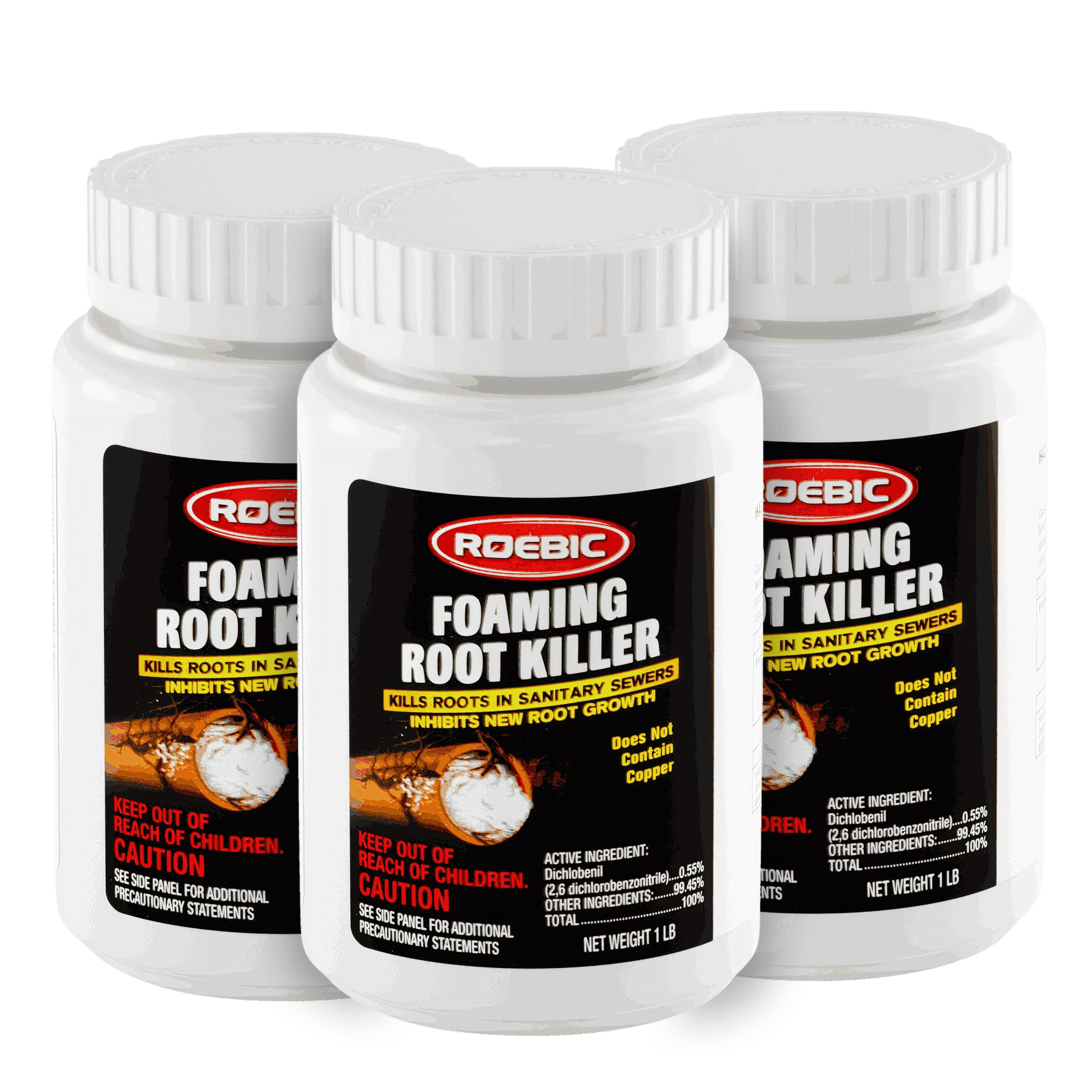
Roebic FRK Foaming Root Killer

Roebic FRK Foaming Root Killer

Copper-free foaming

Our Score 8.8/10
Check Price

Worth Noting

  • Foam action can be inconsistent
Form
Foaming powder
Pack Size
Three 1 lb containers
Water Hold
4–6 hours
Active Ingredient
Dichlobenil
Read the full review

Three separate 1-pound containers instead of one big bag is the appealing part of Roebic's foaming root killer. Each container is its own dose, so you can keep one for spring and one for fall without opening a larger package. The active ingredient is dichlobenil rather than copper, which matters if you want a foaming treatment without adding copper to the system.

Application is simple in theory: pour the contents into the toilet and flush, then restrict water use for 4 to 6 hours and flush two or three times. We like the no-copper angle and the individual containers, but the powder is the weak point. It can arrive clumped and hard to get out, so open the containers before you need them and break up any solid chunks before measuring.

The three-dose pack is a reasonable way to try foaming without committing to a large jar, but it is not the cheapest way to treat a long line. If your line is short and you want to avoid copper, it earns a place; if you need coverage across a long run, RootX is the stronger choice.

Bottom line: We keep Roebic FRK as a copper-free foaming option in three separate doses; it suits a short line where convenience matters.

How We Tested Tree Root Killers in Real Drains

We started with a shortlist of 28 root-killer products sold for sewer, drain, and stump use, then narrowed it by labeled dose, active ingredient, and whether the instructions were clear enough to follow without a call to the manufacturer. Fourteen made the final test. Over six months, I used them in two older homes with clay sewer lines and on cut root clusters from a storm-damaged tree, timing how long each treatment took to measure and pour and noting whether the bottle or scoop stayed easy to handle when wet.

At each cleanout, I checked drainage before treatment by running a utility sink and watching for gurgling, slow water, or backup. After dosing, I noted whether foaming products clung to the pipe walls or thinned out before reaching the root cluster, and whether granules dissolved evenly or clumped in the cup. I logged root kill by inspecting cut root sections for softening and color change, then checked whether the loosened mass flushed away or needed a snake. A small camera helped me see roots at joints without guessing.

We tracked each line for six weeks after the final dose to see whether roots stayed dead or water started slowing again, which is where durability and value separated the field. We figured cost per treatment from the labeled dose, not the shelf price, and noted any product that required extra tools or a second application. We also watched for backups during the test and read the instructions cold before every first use, because a root killer is only useful if you can apply it correctly the first time.

How to Choose the Right Tree Root Killer

Start With the Pipe, Not the Tree

Roots get into a sewer line at joints and cracks, often from the top of the pipe, so the product has to reach that part of the line. We start with the access point: foaming treatments are designed to coat the upper surfaces, while granular and crystal copper sulfate products mix into the water and travel with the flow. Neither is automatically better. A foaming product makes sense when the roots are high in the pipe and you can apply through a toilet; a crystal product is simpler for scheduled maintenance in a septic tank or leach line. Check the label's access point before you buy, because some copper sulfate products specifically warn against sink and tub drains.

Dose by Tank Size and Pipe Run

The package size is not the dose. Root Destroyer calls for 2 pounds in an active 300-gallon septic tank, while RootX says one 2-pound jar treats 50 feet of 4-inch pipe. Those are different jobs, and using a whole container because it is convenient is how people over-treat a system. Measure the run or know the tank volume first. If your line is longer than the stated coverage, buy another container rather than stretching one. We also pay attention to annual limits: several labels cap use at twice a year.

Expect Weeks, Not Minutes

A root killer is not a drain snake. The chemical has to be taken up by the roots, and the dead roots then decay before flow improves. Zep puts the usual wait at 3 to 4 weeks, and we treat that timing as a useful expectation for any of these products. Do not judge the treatment after one flush, and do not repeat it early because the drain still looks slow. If water is backing up, clear the line mechanically first; a root killer needs flow to reach the problem.

Keep the Treatment Inside the Pipe

Copper sulfate is effective because it is non-selective, which is also why it needs careful handling. Several labels note a temporary dip in septic-tank bacterial action, returning to normal in about 15 days. We keep the product out of wells, streams, storm drains, and garden beds, and we do not pour it down a sink or tub if the label warns against it. The products claim surrounding trees are safe when used as directed, but roots and plants that contact the chemical can still be damaged. Apply only through the access point named on the label.

Frequently Asked Questions

Final Verdict

For most households, Roebic K-77 is the root killer we point to first. It is the budget pick here, it goes in through the toilet with no special applicator, and the copper formula is labeled for both sewer and septic lines. The compromise is patience: it is maintenance, not an emergency clearing.

If your line is long or the roots sit high in the pipe, RootX's foaming action and 50-foot coverage justify the premium. For a septic tank with a measured schedule, Root Destroyer is the more specific tool.