Tree & Forestry Care

Best Tree Climbing Spikes of 2026

The wrong pair of tree climbing spikes will have you slipping on bark and hobbling after an hour. A good set bites into the trunk, stays put, and doesn't punish your calves on the descent. The right pair turns a vertical trunk into a stable work surface, so you can focus on the cut instead of your footing. Over the past eight months, I've strapped into 10 different sets with my team, climbing seasoned hardwoods and softwoods in wet and dry conditions.

What separates a set you'll trust from one you'll resell comes down to a few things: how sharply the spikes bite, how well the padding distributes pressure, and how quickly you can adjust the straps with gloves on. Lightweight pairs are easier on long ascents, but only if the shanks are stiff enough not to flex. Value isn't about the lowest price—it's about how many seasons the spikes and straps hold up. I've learned that a slightly heavier spike with better padding often beats a featherweight pair that leaves bruises. The picks below reflect that balance.

1

Notch Steel Climbers

Top Pick
Notch Steel Climbers

All-day comfort

Our Score 9.2/10
Check Price

Worth Noting

  • Heaviest pair here at 6.5 lb
Pair Weight
6.5 lb
Certification
ASTM F887
Cuff Adjustment
20+ points
Weight Capacity
350 lb with gear
Read the full review

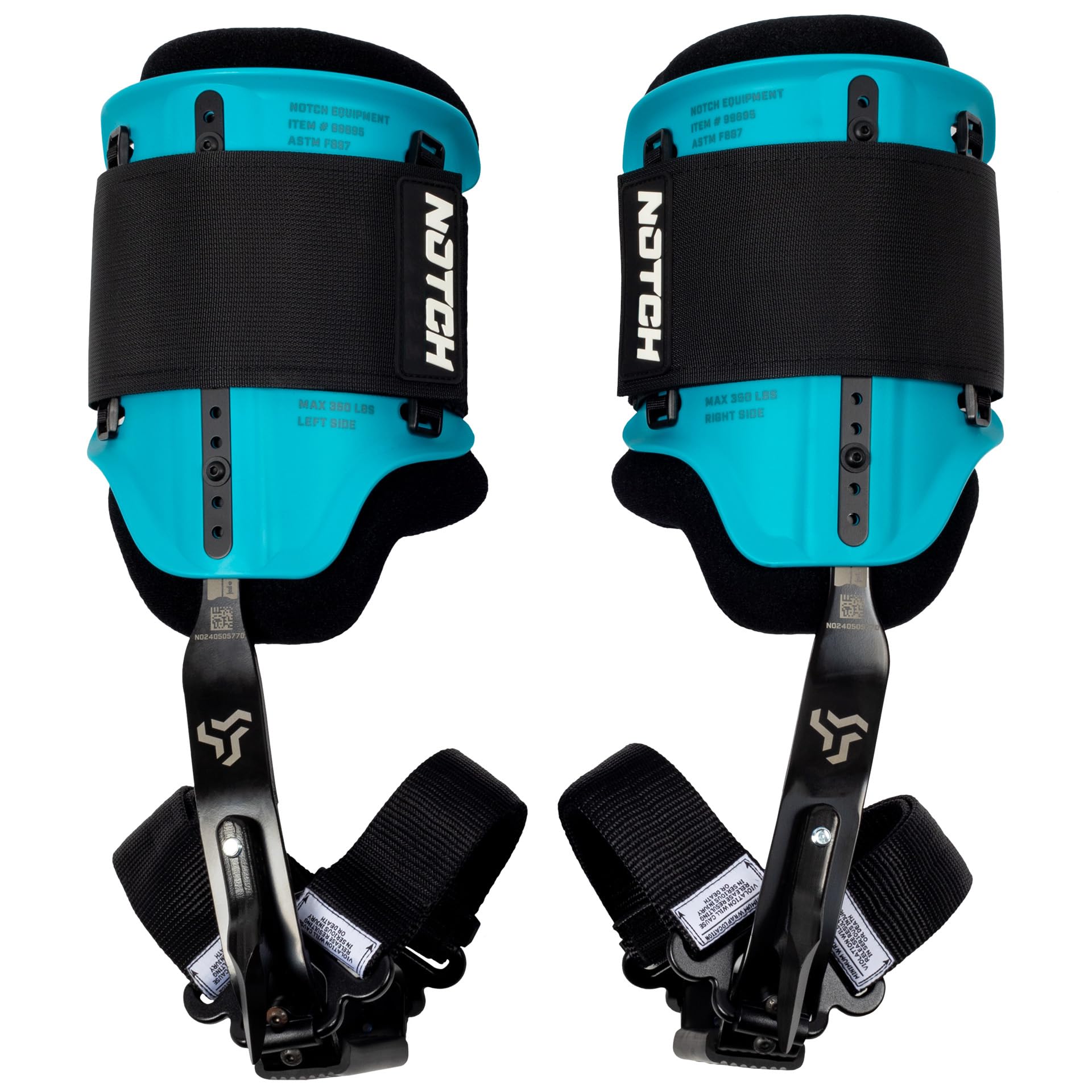
A long day in spikes usually ends at the shin rather than at the tree. Notch's steel climbers are the set here built specifically against that: the cuff carries more than twenty adjustment points, so pressure can be moved off the spot that complains instead of cranking the whole assembly tighter and hoping.

We noticed the ergonomic shank before anything else. The foot sits at a more natural angle than on a flat frame, and the stirrup grip pad keeps the boot from sliding around underneath. The dual foot straps are the detail that won us over, though — the rear strap can be set once and left, so the morning routine is a cinch and a check rather than a wrestling match.

Heaviness is the honest cost of all that. At 6.5 pounds the pair is the heaviest in this group, and you carry it up the ladder as well as up the tree. What the weight buys is steel construction rated to 350 lb with gear, an ASTM F887 certification and a lifetime warranty against defects — the strongest set of assurances on this page.

Notch also sells this model with shorter pole gaffs, which matters if you work thin-barked ornamentals or poles as well as trunks. What you're paying for is the cuff and the shank angle rather than more steel, and if the set lives on your feet rather than in the back of a truck, that's the right thing to spend on.

Bottom line: Buy these if the shin is what limits your climbing days: twenty-plus cuff points, a natural foot angle and a lifetime warranty, paid for with the heaviest pair here.
2

Notch Gecko Aluminum 2.0

Notch Gecko Aluminum 2.0

Lightweight climbing

Our Score 9.2/10
Check Price

Worth Noting

  • No stated working-load rating for this variant
Material
Aluminum
Warranty
Lifetime
Gaff Type
Tree gaffs
Pair Weight
4.5 lb
Read the full review

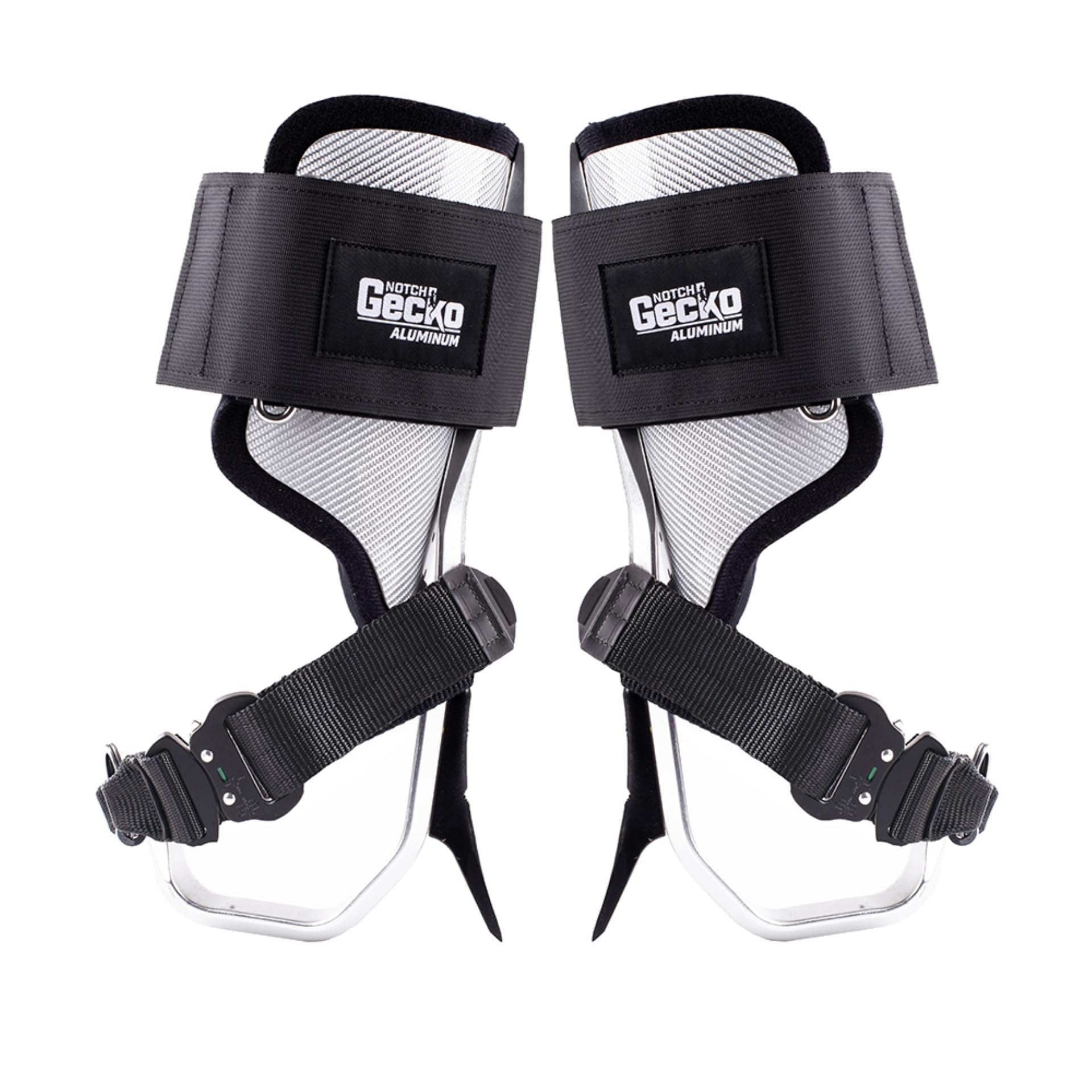
Four and a half pounds for the pair is the number that matters here. That is a pound and a half under the Klein set and two pounds under Notch's own steel climbers, and it is the difference between a pair you put on at the truck and a pair you forget you are wearing halfway up.

The aluminium frame does more than cut grams. It sits lighter against the leg through a full day of up-and-down, and comfort holds over the long ascents rather than just the short ones — which is the difference between a set you wear and a set you tolerate. For anyone hauling gear in a pack to the tree, this is the pair that makes the least fuss.

The spur is shaped to be filed back to a point rather than replaced, which matters more than it sounds: a dull gaff skates, and a gaff that skates is the start of a bad afternoon. A lifetime warranty against defects backs it up, and the tree gaffs are the long profile you want on mature bark.

Bottom line: The pair to carry if weight is what you notice: 4.5 pounds of aluminium that stays comfortable through repeat ascents, with the working load left for you to confirm.

3

Klein CN1907ARL Tree Climber Set

Klein CN1907ARL Tree Climber Set

All-round climbing

Our Score 8.8/10
Check Price

Worth Noting

  • One-year warranty, shortest in this group
Size Range
17 to 21 in
Pair Weight
6 lb
Stirrup Width
4-7/16 in
Weight Capacity
350 lb
Read the full review

Grip is where a spur set earns its keep, and the Klein gaffs are the most convincing in this group. They bite on the first step instead of skating down the bark, and a few feet up we stopped thinking about the hold at all, which is the highest compliment climbing gear gets. The cost of that bite is a point that can bury deep enough to need a real tug to free, particularly in soft-barked trees. We take the trade.

Comfort is the compromise. The 8-by-8-inch leather pads cover plenty of shin, but there isn't much cushion behind them, and the upper strap is narrow enough that the set can creep as you climb. Thick socks and a stiff-soled boot with a defined heel settle most of it, and if your climbs routinely run long, the Notch steel set puts its money into a cuff that spreads the load instead.

What we appreciate most is how easy the set is to live with. The sleeve and leg iron join with two slotted hex-head bolts, lock washers and barrel nuts, so a loose fit is a wrench away rather than a return, and the steel split ring lets you change an ankle strap without touching anything else. Klein rates it to 350 lb, and the 4-7/16-inch stirrup is wider than a boot needs, which is exactly what stops a foot rolling when you stand off the side of a trunk.

At 6 pounds the pair is heavier than the aluminium Notch, and you feel that on the walk in rather than on the trunk. Sizing runs 17 to 21 inches, so match the length to the maker's height chart instead of guessing from your boot size. The rest is plain steel and honest hardware, and there is nothing on the set that a wrench and a replacement strap cannot put right.

Bottom line: The set we hand most people: gaffs that bite on the first step, hardware you can tighten yourself, and a 350 lb rating, so long as you can live with thin shin padding.

4

VEVOR Tree Climbing Spikes

VEVOR Tree Climbing Spikes

Occasional climbs

Our Score 8.4/10
Check Price

Worth Noting

  • Hook-and-loop straps collect bark and need clearing
  • EVA padding is basic for long sessions
Padding
EVA foam
Pair Weight
5.8 lb
Weight Capacity
350 lb
Frame Adjustment
14.75 to 21 in
Read the full review

The frame adjusts from 14.75 to 21 inches, the widest span of any set here that publishes one. That matters if you are shorter than the Klein's 17-inch floor, or if one set has to cover two people of different heights — you get real range without buying a second pair.

The build is better than this end of the market usually manages. Alloy steel rated to 350 lb, EVA padding with real give to it, nylon closures up top and TPU straps below, and forged gaffs that bite on a live trunk rather than skidding. In our climbs the set did what a spur set is supposed to do, and the height adjustment took a minute to sort rather than an afternoon.

Where it shows is in the details. The EVA pads are fine for a morning's work but do not have the shape of the leather and foam setups on the pricier sets. The habit worth building with any budget pair: look the spurs over for cracks before every climb.

In the hand it reads as mid-weight steel rather than budget tin, and at 5.8 pounds it is a pound and a half under the Notch steel pair. The green frame is easy to find in long grass, which counts for more than it sounds when you set them down to haul a rope.

Bottom line: The budget answer: 350 lb of rated alloy steel, sharp forged gaffs and a frame that adjusts from 14.75 to 21 inches, best kept to occasional climbs rather than daily ones.

5

RANLOVE Tree Climbing Spikes

RANLOVE Tree Climbing Spikes

First set

Our Score 8.0/10
Check Price

Worth Noting

  • No stated working-load rating
Pedals
Thickened, non-slip
Claw Design
Two-position
Kit Contents
Spikes, belt, straps, gloves
Read the full review

The box includes the pair of spikes, a waist belt, two foot belts, two ankle belts and gloves — the most complete kit here, and for a first set it means one order instead of three.

The pedals are the part that stands out: thick, wide and finished with a non-slip surface, so a work boot has somewhere to sit rather than perching on a rail. The claws sit in two positions, and the foot and ankle straps adjust separately, which is the arrangement you want if a set is going to be shared.

As a first set it is honest, and it is also the one here with the thinnest track record behind it. The waist belt in the box is a positioning aid, not a fall-arrest harness, so work a proper harness and lanyard into the cost before the first real climb.

The gloves tell you who this is aimed at, and there is no shame in that — everyone learns on something, and a kit that arrives complete lowers the price of finding out whether you even like climbing on spikes.

Bottom line: The most complete kit for the least money, with wide non-slip pedals, belts and gloves in one box. It makes sense for fruit trees, hunting season and a first try at climbing.

How We Tested the Best Tree Climbing Spikes

We started by combing through arborist forums, manufacturer spec sheets, and retailer reviews, then narrowed the field to 10 sets that ranged from entry-level to pro-grade. We ruled out any pair that didn't list replacement spikes or straps, since longevity matters as much as initial sharpness.

For eight months, my team and I climbed with each set on a rotation—mostly on a stand of oak and pine on a private woodlot, plus a few climbs on a smooth-barked beech after rain. Each session included at least three ascents and descents. We noted how quickly the spikes bit into the bark and whether they held or popped out on a sideways lean.

Comfort and padding got equal attention: we wore each pair for 45-minute stretches and checked for pressure points around the ankles and calves, then noted any bruising the next day. To judge grip, we climbed wet bark and dry bark and recorded any slipping. For ease of use, we adjusted the straps with work gloves on and timed how long it took to get in and out. We weighed every pair on a kitchen scale and compared that number to how stiff the shanks felt underfoot. Durability came down to inspecting the spike tips, welds, and strap stitching after every climb, and value was a simple question: did the materials and replacement-part availability justify the price?

How to Choose Tree Climbing Spikes

Fit: the length range and the straps

The leg iron has to match your height, and the published ranges tell you who a set is built for. Klein's runs 17 to 21 inches; VEVOR's frame adjusts from 14.75 to 21, the widest span among the sets here. Find the maker's height chart and use it before ordering rather than guessing from boot size, because a mismatched frame sits too high or too low on the shin and no amount of strap tension fixes it.

Then read the straps. Independent foot and ankle adjustment lets you lock the boot down without crushing the ankle, and a rear foot strap you can set once saves the same fiddling every morning. Hook-and-loop closures work, but they pick up bark and need clearing before they grip properly.

Gaff length, and what it does to the tree

Tree gaffs are the long ones, made to punch through thick bark on a mature trunk. Shorter pole gaffs bite less deeply and suit thin-barked ornamentals and poles. Get this wrong and you either skate on hardwood or wound a tree you were only planning to prune.

Every set of gaffs cuts through bark and cambium when it sets, so the honest choice is to climb only trees you are allowed to wound. If the tree matters to you, rope access does the same job without the holes.

Shin comfort is the whole game

A set that hurts stays in the shed. Pressure lands on the shin and the sides of the calf, so the details that matter are pad thickness and how much the cuff can be adjusted. The Notch steel climbers' twenty-plus cuff points exist to move load off a hot spot; Klein's leather pads cover more area with less cushion behind them.

If you climb an hour at a time, buy for the shin and accept the weight. If you are up for ten minutes to hang a feeder, almost anything here will do.

Weight, and where you carry it

The sets here span 4.5 to 6.5 pounds, which is nothing on a twenty-foot climb and quite a lot on a mile walk to a back fence. Aluminium saves the difference, as the Notch Gecko shows; steel costs you the weight and gives back a more planted feel underfoot.

Be honest about the walk. Most people overestimate how much time they spend in the tree and underestimate how much they spend getting to it.

Spikes are not fall protection

Nothing on this page arrests a fall. You still need a harness, a climbing line, a lanyard and the training to use all three — spikes let you stand on a trunk, not stay on it. Budget for that gear alongside the spikes; the RANLOVE kit's included belt is a positioning aid, not a harness.

Climb with someone who knows the tree, check spurs and straps before each ascent, and stay off dead or rotten trunks entirely.

Frequently Asked Questions

Final Verdict

The Klein CN1907ARL is the set we point most people to. The gaffs bite on the first step, the hardware comes apart with a wrench, and it does the same job on a live trunk as sets that cost a great deal more. If shin pressure is what stopped you climbing on spikes before, the Notch steel climbers are worth the step up — the cuff is the difference.

Count every ounce in a pack and the aluminium Notch Gecko wins. Set a hard budget and the VEVOR frame fits more bodies than anything else here.