Tree & Forestry Care

Best Manual Pole Saws of 2026

There’s a dead branch over the driveway you’ve been pretending not to see. A manual pole saw is how you deal with it from the ground—no ladder, no rope, no balancing act—provided the pole doesn’t flex like a fishing rod the moment you start cutting. I learned the hard way: a wobbly pole turns a ten-minute pruning job into a shoulder workout, and a dull blade makes you wonder if you’d be better off with a lopper taped to a broomstick.

The best manual pole saws solve that with a stiff spine, a blade that bites instead of skips, and a weight that doesn’t wear you out after three overhead cuts. You don’t have to spend a fortune, but the cheapest models tend to remind you why they’re cheap—sloppy locking joints, teeth that dull by midsummer, handles that twist mid-cut. Over the past eight months, my team and I have put 12 pole saws through their paces, and the ones worth keeping share a few traits. The picks below made yard work feel less like a gamble.

1

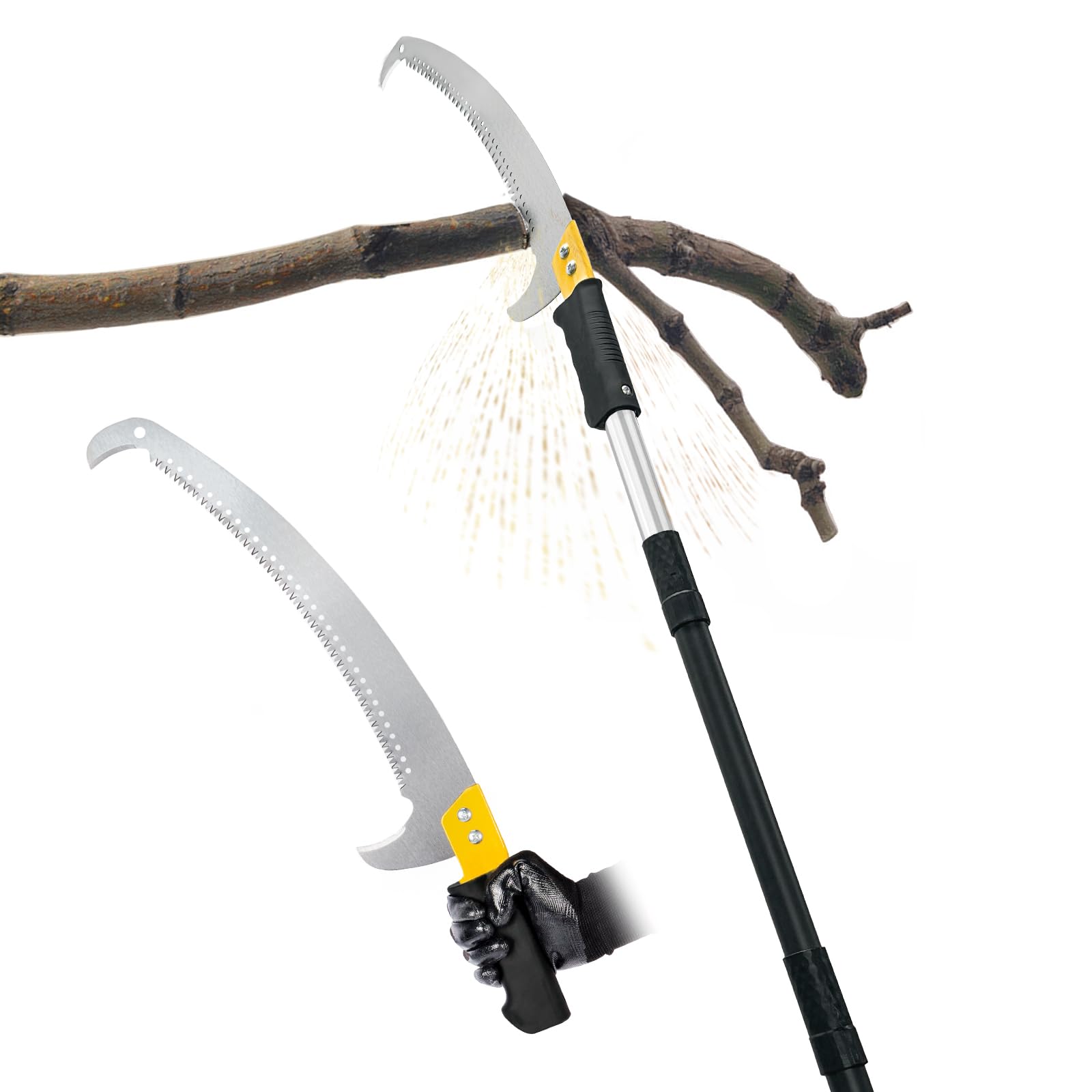
Notch 18 Ft Pole Saw Set

Top Pick
Notch 18 Ft Pole Saw Set

Tall trees

Our Score 9.4/10
Check Price

Worth Noting

  • Eight pounds gets heavy when reaching horizontally
Reach
18 ft, three 6 ft poles
Weight
8 lb
Saw Blade
15 in double-thick
Cut Capacity
8 in
Read the full review

Three six-foot fiberglass sections make the 18 feet, and the joints come apart so you can leave one section in the truck when the job is lower. That's how tree crews carry a pole, and it's the right way: no telescoping collar to slip, no plastic head to crack. The 15-inch double-thick blade and the hook at its tip are the other half of the design, with the hook grabbing a limb and holding it steady while the teeth work.

Eight pounds is what that buys, near the top of this set on weight, and it's a trade we make every time. At full extension the pole stays straight where lighter ones bow and wander, and the blade tracks through a cut instead of skating off the bark. On a tall pine or a palm, that stiffness is the difference between a clean cut and five minutes of sawing at air.

Impulse-hardened teeth hold their edge through a lot of limbs, and the chrome plating shrugs off a damp shed. The 8-inch cut capacity is the figure to note: this is a saw for limbs, not twigs.

Bottom line: For branches above 14 feet, this is the saw we hand over: 18 feet of interlocking fiberglass and a blade thick enough to stay in the cut.
2

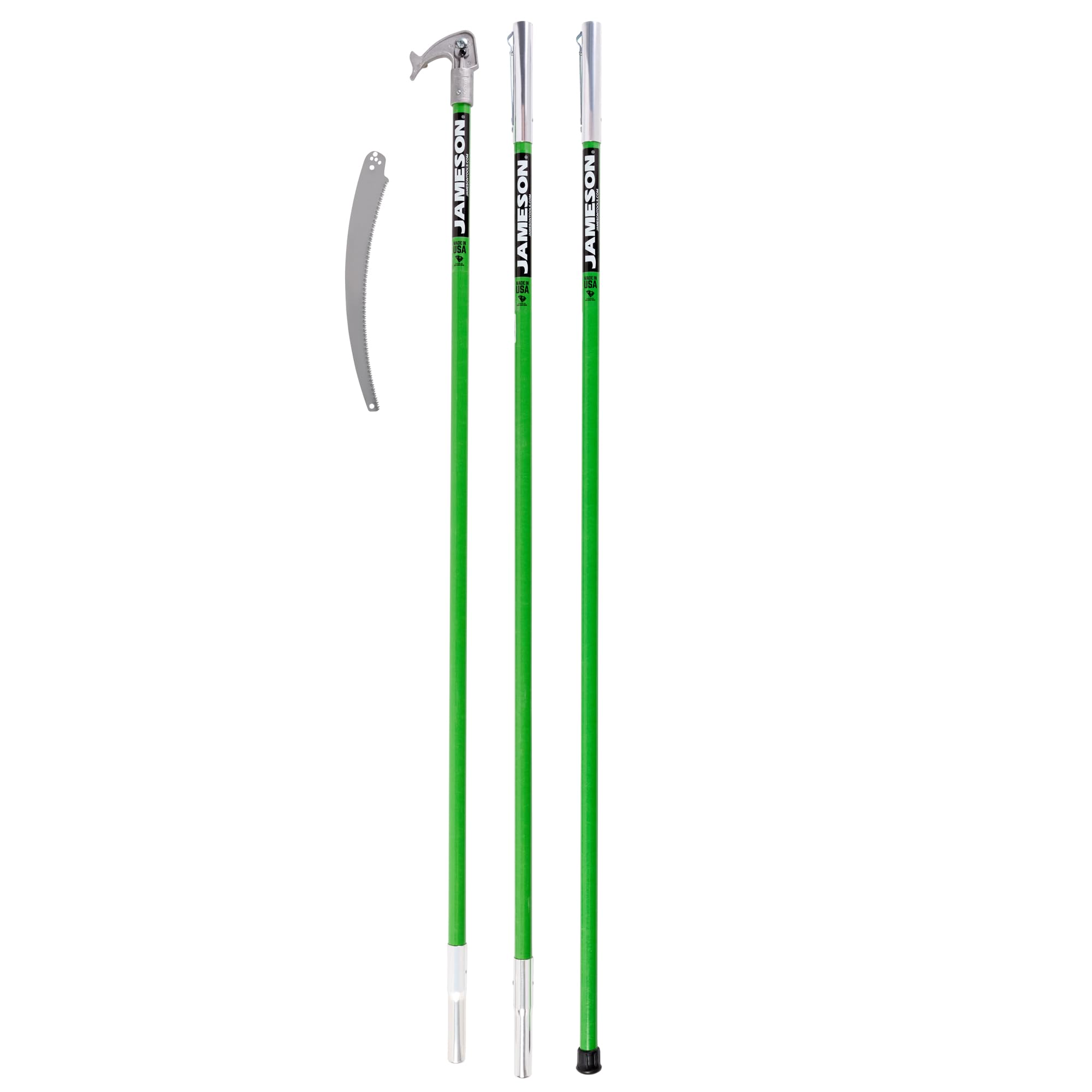
Jameson LS 18 Ft Tree Trimming Kit

Jameson LS 18 Ft Tree Trimming Kit

Light long reach

Our Score 9.4/10
Check Price

Worth Noting

  • Poles bow at the full 18 feet
Reach
18 ft, three 6 ft poles
Weight
7.4 lb
Saw Blade
16 in tri-cut
Pole Locks
Leaf-spring buttons
Read the full review

A 16-inch tri-cut blade on a low-profile head is why this kit slips through a crowded canopy. The Barracuda blade cuts cleanly on the pull stroke, and the narrow head passes between branches where a wider saw head hangs up; on palms and dense ornamentals that matters more than another inch of blade.

The poles are hollow-core fiberglass with aluminum ferrules and external leaf-spring buttons. We rate the buttons above twist collars, particularly with gloves on: press, slide, listen for the click, and you know the joint is seated. All three sections plus the blade weigh 7.4 pounds, which is what lets one person hold 18 feet of pole at an angle long enough to finish a cut without handing off.

Of the long-reach kits here, this is the one we pass to a friend who wants height without a workout. Eighteen feet is a lot of pole, and the advantage shows up in the last ten minutes of a session, when you can still lift the saw for one more branch. Seat each button fully when you add a section; a half-clicked joint is where the wobble starts.

Bottom line: The long-reach kit we reach for first: 18 feet of light fiberglass, a 16-inch tri-cut blade, and locking buttons you can work with gloves on.

3

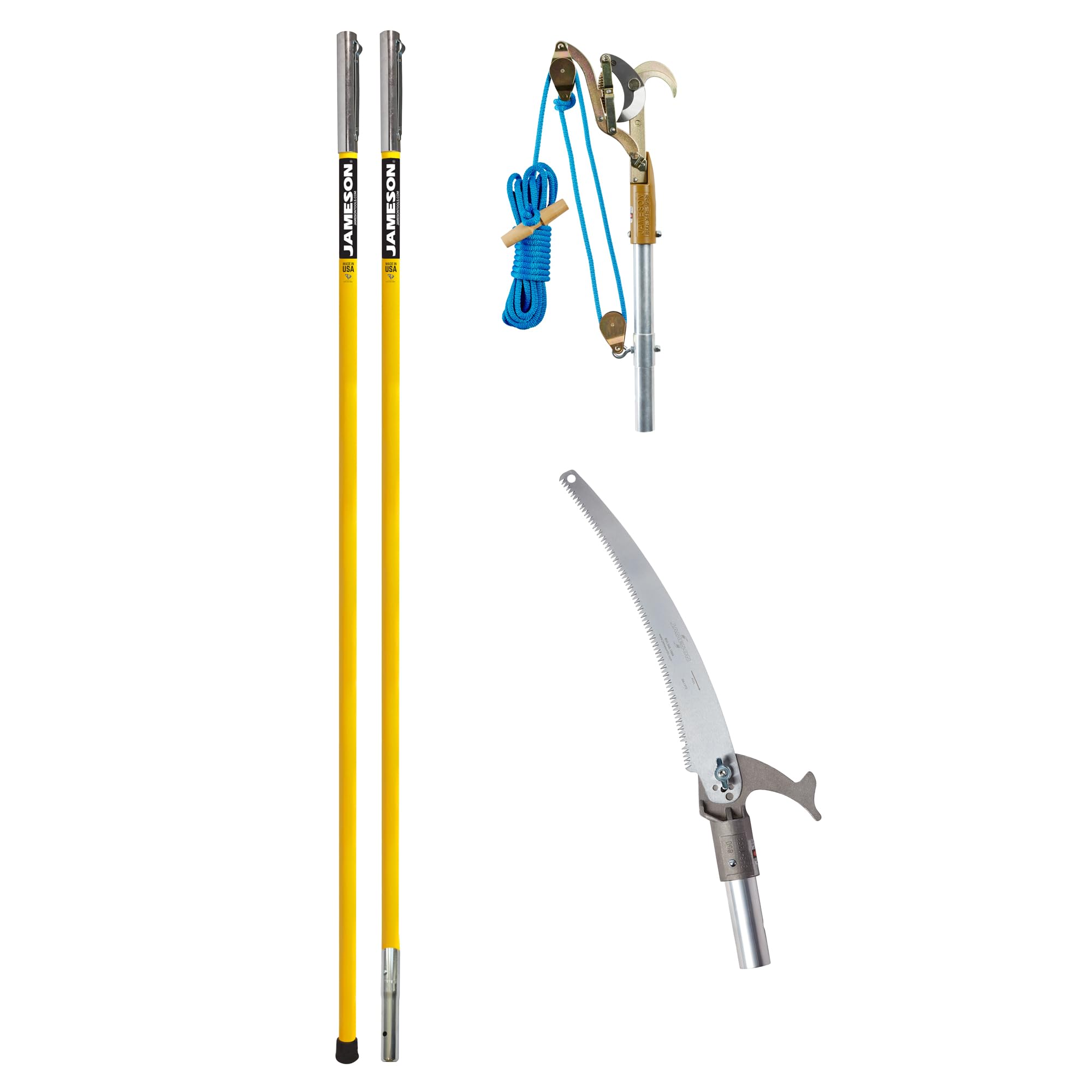
Jameson FG 12 Ft Pruner and Saw Kit

Jameson FG 12 Ft Pruner and Saw Kit

Heavy pruning

Our Score 9.4/10
Check Price

Worth Noting

  • Ten pounds with only 12 feet of reach
Reach
6 to 12 ft
Pruner
Double-pulley Big Mouth
Weight
10 lb
Saw Blade
16 in tri-cut
Read the full review

A double-pulley pruner changes the arithmetic of cutting overhead. Two pulleys mean less pull on the 20-foot rope for the same bite, and the bypass blade releases cleanly instead of hanging on the limb. Pair it with the 16-inch Barracuda tri-cut saw on the same pole and you can take small limbs with the pruner and heavier ones with the saw without changing anything but your grip.

It's the heaviest tool in this group at 10 pounds and it costs more than anything else here, and both are deliberate. The fiberglass poles are batch tested to 100 kV per foot for five minutes to meet OSHA requirements, this is a kit sold to people who prune for a living, and the build shows in joints that don't rattle and a pruner head that returns to open with an easy pull.

Twelve feet is the working limit: a 6-foot base pole and one 6-foot extension. That's less reach than the sectional kits, and in exchange you get a pole heavy enough not to wander, plus adapters that let the saw head and the pruner share the same two sections, so it's one system to load rather than two tools.

Bottom line: For anyone pruning every season, this is the kit we keep coming back to: a double-pulley pruner, a tri-cut saw, and poles built for daily work.

4

Fiskars 8-12 Ft Extendable 2-in-1

Fiskars 8-12 Ft Extendable 2-in-1

All-around yard use

Our Score 9.0/10
Check Price

Worth Noting

  • Plastic head assembly is the weak point under heavy loads
Head
Pruner and rotating saw
Reach
7.9 to 12 ft
Weight
4.8 lb
Saw Blade
15 in double-grind
Read the full review

Under five pounds is the number that decides this one. Plenty of pole saws will reach 15 or 18 feet; far fewer stay pointed where you aimed them once they get there, and the Fiskars stays manageable because there is less mass swinging around at the end of the pole. Between the 7.9- and 12-foot extension, that covers the first scaffold of a young maple, a crape myrtle, or the dogwood leaning over a driveway.

The head earns its keep twice over. A 15-inch double-grind blade handles limbs that need real saw work, and a chain-drive pruner takes the small stuff without ropes to tangle or a second head to swap. We were skeptical of the rotating head and came around to it: angling the blade to a branch that grows back toward the trunk beats wrestling a fixed head into position.

The locking collars want a firm twist and a re-check after the first few cuts, which is true of every twist-lock pole here, and at 12 feet the pole bows a little when you lean into a stroke. Neither surprised us at this weight.

What we did not expect to care about was the blade coating. The low-friction finish keeps pine pitch from welding itself to the teeth, so a pine doesn't turn a sharp blade into a sticky one by lunchtime. Fully collapsed the saw is still about eight feet of pole, so plan on wall brackets or rafter hooks in the garage rather than a shelf.

Bottom line: For most yards we point to this one: under five pounds, 12 feet of reach, and a pruner and saw sharing one rotating head.

5

BlumeTrec 11 Ft Pole Saw

BlumeTrec 11 Ft Pole Saw

Quick yard work

Our Score 9.0/10
Check Price

Worth Noting

  • Thin blade can bend in a stubborn cut
Poles
Stainless steel
Reach
11 ft, eight sections
Weight
4.1 lb
Saw Blade
16.7 in manganese steel
Read the full review

The line comes in three pole counts, 8.5, 11, and 14.5 feet, and the 11-foot version uses eight stainless sections. That's more joints than the Notch or the Jameson, and each section is short enough to pack in a car trunk or stand in a closet corner, the kind of detail we notice when a tool has to live in a garage.

The blade is the interesting part. A 16.7-inch manganese steel saw with a three-sided edge and barbs on both faces cuts on the push and the pull, so a branch leaning toward a fence doesn't force you into a stroke the pole can't make.

Assembly is screw-together, with a wrench in the box and a powder-coated finish on the stainless. At 4.1 pounds the pole is light enough to hold at 11 feet with one hand while the other steadies a branch, and the sections break down without tools when you're done.

Where it makes sense is a yard with mixed heights and a homeowner who wants one tool to cover most of it: short enough for a hedge, long enough for the low limbs on a mature tree. Wipe the sections down before they go back in the garage, since the powder coating is what keeps the stainless underneath from rusting.

Bottom line: We like this for a yard with mixed heights: a light 11-footer that packs small, as long as you treat its thin blade gently.

6

HOSKO 14 Ft Pole Saw

HOSKO 14 Ft Pole Saw

Budget mid-reach

Our Score 8.8/10
Check Price

Worth Noting

  • Screw joints work loose while sawing
Poles
Stainless steel
Reach
14 ft
Sections
Screw-together, detachable
Blade Edge
Three-sided, double barb
Read the full review

Fourteen feet of stainless pole with a three-sided, double-barbed blade, for less than most of the saws here. The barbs let the blade bite on the push as well as the pull, which helps in a canopy where you can't always get a clean pull stroke, and the hook at the tip does the same job as the expensive saws: catch the limb, steady it, cut.

Sections screw together and come apart again, and the whole saw breaks down to something that fits on a shelf. We found it light at the end of the pole for a 14-footer, easy to aim at ten or twelve feet, and quick to shorten when the work drops lower.

Fourteen feet is the sweet spot for a suburban lot: tall enough for fruit trees and crape myrtles, short enough that one person can hold it steady with two hands. What it doesn't have is the fit and finish of the Fiskars or the Jameson, since the tube is plain stainless and the grip is basic, and none of that stops the blade from cutting.

Bottom line: Our budget pick: a sharp 14-footer that reaches the fruit trees, feels light at the end of the pole, and costs less than most saws here.

7

Walensee 7.7 Ft Pole Saw

Walensee 7.7 Ft Pole Saw

Small yards

Our Score 8.8/10
Check Price

Worth Noting

  • Pole flexes under a hard cut
Poles
Stainless steel
Reach
7.7 ft
Weight
3 lb
Second Use
Converts to hand saw
Read the full review

Take the blade off the pole and you have a hand saw; leave it on and you have 7.7 feet of reach for the hedge, the fruit trees, and the low limbs you can already see from the ground. That's the whole tool, and for a small yard it's enough. We found the dual-hook blade bites quickly in green wood, and the powder-coated stainless sections don't mind a wet afternoon.

Seven and a half feet is short by the standards of this group, but the arithmetic changes when the trees are small: it tops a young apple tree and reaches the far side of a hedge without the weight of a long pole. The wrench in the box tells you what the saw expects, which is occasional use, stored indoors, with the blade checked and tightened when it needs it.

Bottom line: For a small yard and a short list of branches, this is the one we suggest: a light pole saw that turns into a hand saw when you're done reaching.

8

VEVOR 27 Ft Extendable Pole Pruner

VEVOR 27 Ft Extendable Pole Pruner

Extreme reach

Our Score 8.6/10
Check Price

Worth Noting

  • Sections can unscrew as you work
Reach
3.87 to 27 ft
Blades
Two 65Mn dual-hook
Weight
8.2 lb
Recommended Length
20 ft
Read the full review

Twenty-seven feet is the headline, and VEVOR's own instructions tell you to stop at 20 for trimming, which is the most sensible thing about this kit. Eight fiberglass sections screw together with metal threads, and you add them as you go: lean the first one against the trunk, add the next, work upward, rather than trying to raise 20 feet of pole in one motion.

Two dual-hook blades come in the box, both 65Mn steel, plus a handled blade for ground-level work. The hooks pull a limb toward you and hold it while the teeth cut, which matters more at 20 feet than at 8. A second blade means one can stay sharp for clean cuts while the other takes the gritty, dirty limbs.

Weight is what you pay for the reach. The kit is 8.2 pounds, and at 20 feet it's a two-handed, brace-it-on-the-branch proposition; we did most of our cutting with the pole leaned into the limb rather than held free. Saw in short strokes, let the hook carry some of the load, and come down a section or two for anything that doesn't need the height.

Treat the 27 feet as a ceiling for special jobs like a dead palm frond or a limb over a roof, and work at 15 or 20 for everything else. The carrying bag looks like an afterthought until you've tried to store eight loose sections in a garage; it's the difference between a kit and a pile of poles.

Bottom line: When a branch sits beyond everything else here, this is the kit we take: 27 feet of sections, two blades, and a bag to keep them together.

How We Chose and Tested Manual Pole Saws

We started by pulling together the manual pole saws that kept showing up in owner reviews and garden-center recommendations, then narrowed the list by reach length, blade style, weight, and price. We ruled out anything with a reputation for snapped poles or blades that arrived dull, and we made sure the final group included a mix of telescoping and fixed-length designs. That left 12 saws, which we used over eight months.

Testing happened where pole saws actually live: my backyard, on green limbs, dry deadwood, and storm-downed branches that were too high or too tangled to reach with a lopper. For each saw, I timed setup and, on telescoping models, extension, then shook the fully extended pole to see if the locking joints slipped. I made a series of overhead cuts while watching whether the blade bit cleanly or bounced out of the kerf, weighed each saw, and ran 15-minute overhead sessions to see where fatigue set in—some handles dug into my palm, others balanced well enough that I forgot I was holding a pole.

Cutting performance came down to how the teeth entered the wood and how much downward pressure I had to add; the best saws cleared chips instead of clogging and left a clean kerf on both green and dry wood. Stability showed up when the pole was fully extended and a branch pinched the blade—the saws that twisted in my hands got set aside. After eight months, I checked every locking collar, blade, and handle for wobble, rust, or stripped threads, and compared what each saw delivered against its price bracket.

How to Choose Manual Pole Saws

Buy the reach you can still aim

Working height is the pole plus your own height and arm reach, and only when the pole is vertical. Angle it toward a branch across the yard and you lose a couple of feet. Twelve feet covers most suburban trees below the roofline and is the length one person can hold steady; 18 feet is for mature trees and palms. Anything longer is a special-case ceiling: VEVOR's own instructions recommend working at 20 feet with its eight-section kit, not the 27 it advertises.

Measure the branch before you buy the pole. Stand under it, check where it sits against the height of your house, and buy a foot or two more than you think you need.

Weight decides whether you finish the job

Held out at an angle, a pole becomes a lever, so a couple of extra pounds feels like a lot more by the fourth cut. A light pole flexes more; a heavy one tracks straighter through a thick limb. Choose light if your pruning is a handful of branches a year, and pay the weight only when you're regularly taking limbs off a mature tree. The Notch at 8 pounds stays straight where the 4.8-pound Fiskars bows; the Jameson LS splits the difference at 7.4 pounds over 18 feet.

Screw sections, locking buttons, or a telescoping pole

Screw-together sections are the cheapest way to build a long pole and the fussiest to live with: fine threads, more joints, and a tendency to loosen while you saw. Leaf-spring buttons on the Jameson LS poles and the interlocking ferrules on the Notch seat with a click you can hear through gloves, which is what you want at the base of a tree in January.

Fewer, longer sections also flex less than many short ones, so an eight-section pole feels springier than a three-section pole of similar length. If you change length often, buttons win; if you set one length for the season, screws are fine.

Blades, teeth, and whether you want a pruner

Fifteen or 16 inches of blade is the useful range: long enough to get through a limb a lopper won't touch, short enough to control. Tri-cut and triple-ground teeth cut on the pull stroke, and a hook at the tip catches the limb so it doesn't whip while you finish the cut. The Notch's 8-inch cut capacity is the widest in this group.

A pruner head takes small limbs with one pull and no sawdust, which is why the 2-in-1 Fiskars and the double-pulley Jameson FG exist. It also adds a mechanism and a few pounds. If your limbs are big, buy the saw alone and skip the extra hardware.

Frequently Asked Questions

Final Verdict

For most yards, the Fiskars is the pole saw to buy. Twelve feet is the reach one person can still aim, the pruner saves you a second tool, and under five pounds means you finish the job instead of leaning the pole against a tree.

If your branches start above 14 feet, go to the Notch, which trades weight for 18 feet of straight fiberglass and a blade thick enough to stay in the cut. On a tighter budget and a smaller lot, the HOSKO covers 14 feet for very little money.