Tree & Forestry Care

Best Chainsaw Chains of 2026

The cut that teaches you about chainsaw chains is always the same one: the saw is buried in a log, the revs are up, and the bar does nothing but make dust. Almost always the powerhead is fine — the chain is dull, stretched, or simply the wrong one for the bar. It's the least expensive part of the saw and the only part actually touching wood, which makes it the cheapest performance upgrade most people will ever make. Over the past four months, we've run 15 chains through firewood, storm cleanup, and a season's worth of overgrown fence lines.

Here's what nobody tells a first-time buyer: fit beats brand every single time. Pitch, gauge, and drive-link count have to match your bar exactly, and a chain that fits and holds an edge will outcut a fancier one that's half a link off. We compared them on out-of-box sharpness, how much they stretched over the first few tanks of fuel, how well they kept cutting after a filing, and whether a two-pack was actually two of the same chain. The ones below are the loops that were still pulling chips when the others were making dust.

1

DEWALT DWO1DT612 12-Inch

Top Pick
DEWALT DWO1DT612 12-Inch

12-inch DeWalt saws

Our Score 9.6/10
Check Price

Worth Noting

  • Single loop, no multi-pack option
Bar Length
12 in
Chain Type
Semi-chisel
Drive Links
45
Kickback Standard
ANSI low-kickback
Read the full review

Every drive link on this DEWALT loop has a small channel cut into it — Centri-Lube, in DEWALT's language — that picks oil off the bar and carries it along to the rivets. On a 12-inch bar with 45 links there is not much oiling surface to begin with, so a chain engineered to move lubricant along itself is a sensible piece of design rather than a line on the box.

The rest of it is aimed at a small, fast-spinning saw: ramped depth gauges, a stated ANSI low-kickback rating, and a semi-chisel cutter that holds its edge longer than a square full-chisel corner would on a light saw. Semi-chisel also cuts smoothly rather than aggressively, which is what you want when the saw is light enough that you are working at arm's length all afternoon.

Twelve inches and 45 links is a narrow fitment, and that is the whole decision for us. If you own a 12-inch DeWalt saw, this is the loop that matches the bar, the nose sprocket and the oiling design together, and you cannot stretch a longer loop onto a shorter bar to save the trouble.

Bottom line: Built for the 12-inch DeWalt battery saw: a semi-chisel, low-kickback loop whose drive links carry oil to the rivets.

2

Husqvarna C83 X-Cut 24-Inch (3-Pack)

Husqvarna C83 X-Cut 24-Inch (3-Pack)

Professional 24-inch saws

Our Score 9.6/10
Check Price

Worth Noting

  • Only the .050-gauge, 84-link fitment
Pack Size
3 chains
Bar Length
24 in
Drive Links
84
Pitch And Gauge
3/8 in, .050 in
Read the full review

This is the chain you buy when the saw is a 562 XP or a 592 XP and the weekend is a truckload rather than a few limbs. Three 24-inch loops, 3/8-inch pitch, .050 gauge, 84 drive links, full chisel — the professional end of the Husqvarna range, for the 555, 562 XP, 390 XP, 585 and 592 XP saws.

Pre-stretching is the detail that earns its money on a long bar. A 24-inch loop that stretches during its first tank means stopping to tension it, and a chain running loose on a long bar is the one that jumps the sprocket. These arrive pre-stretched, so you spend less of the first tank bent over the saw.

The golden tie strap is a small thing we appreciated: it marks where to start and stop filing, which matters when you are running a file down 84 cutters and lose your place halfway. Full chisel gives the aggressive cut these saws are built to deliver, and the trade is the usual one — clean timber only, and a stroke or two of the file before the chain is properly dull rather than after.

Three loops at this level is the right quantity for anyone cutting for a living or heating with wood: one on the saw, one sharp, one at the shop. It is the biggest outlay on this list and the cheapest way to run a professional saw through a season without ever facing a dull chain.

Bottom line: Three pre-stretched full-chisel loops for professional Husqvarna saws: the sensible quantity for anyone cutting firewood at scale.

3

Husqvarna X-Cut SP33G 20-Inch

Husqvarna X-Cut SP33G 20-Inch

Husqvarna 450 Rancher

Our Score 9.4/10
Check Price

Worth Noting

  • One loop per pack at OEM pricing
Bar Length
20 in
Drive Links
80
Fits Models
450 Rancher, 445(E), 450(E), 545(MII), 550XP(MII)
Pitch And Gauge
.325 in, .050 in
Read the full review

Five chainsaws, and no others: the 450 Rancher, 445(E), 450(E), 545(MII) and 550XP(MII). That short list is the first thing to know about the X-Cut SP33G, because it is factory chain built for one family of Husqvarna bars — 20 inches, .325-inch pitch, .050-inch gauge, 80 drive links.

For a 450 Rancher owner this is the loop we keep on the saw. X-Cut chains are pre-stretched at the factory, so you spend less of the first tank with a wrench in your hand taking up slack, and the semi-chisel cutter touches up with a round file between refuels without any fuss. Husqvarna builds and tests these beside the saws themselves, and the semi-chisel profile is a deliberate choice for people cutting felled timber rather than clean dimensional stock.

If your saw is a 450-class Husqvarna, the money is well spent: you get the cutter geometry the saw was set up around instead of a drawer of loops you will never wear out. A .058-gauge bar or a 3/8-pitch sprocket takes a completely different chain, and no amount of clever ordering changes that.

Bottom line: The OEM chain for a 450-class Husqvarna: pre-stretched, easy to file, and worth single-loop money if you want the fit the saw was built around.

4

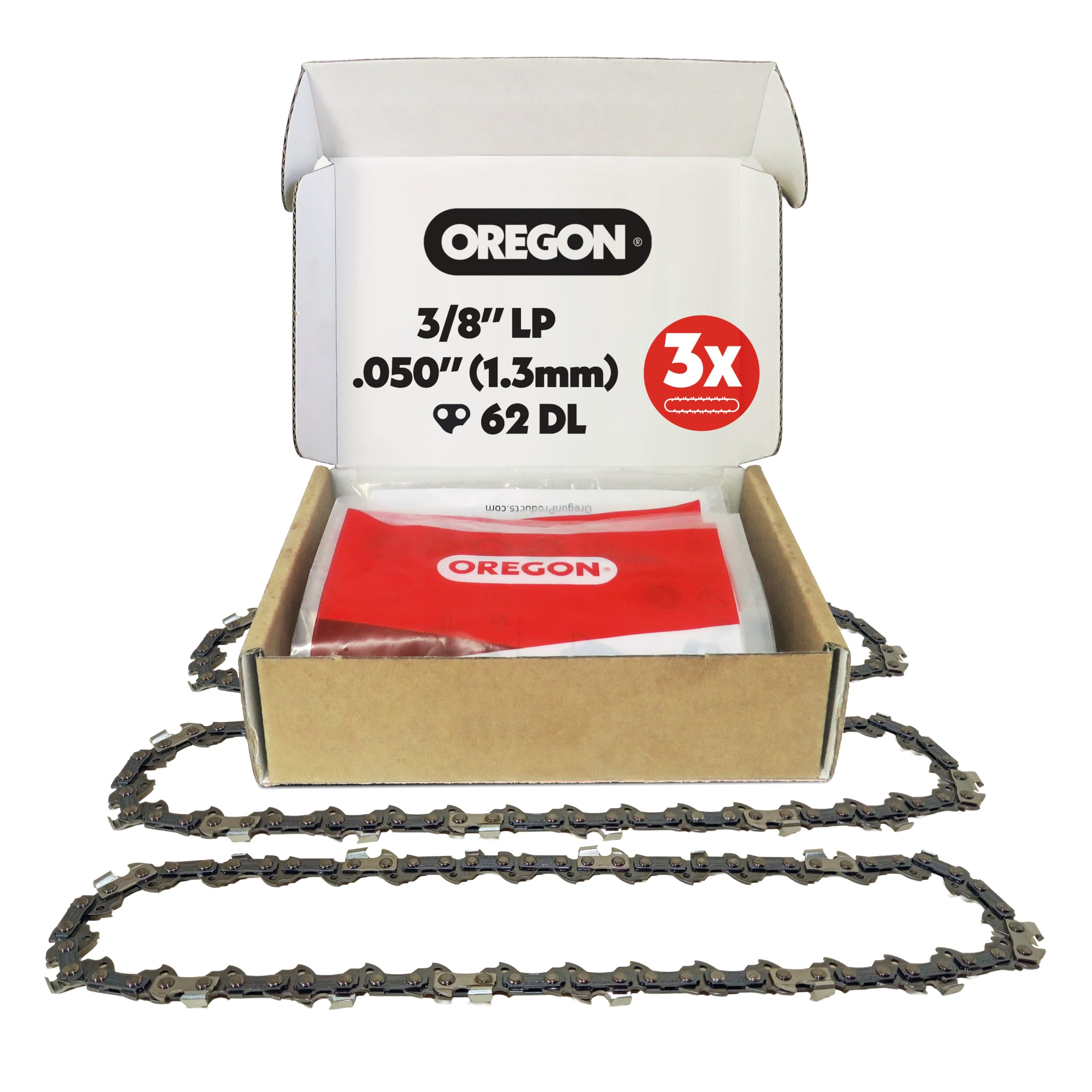
Oregon 18-Inch 3/8 LP Chain (3-Pack)

Oregon 18-Inch 3/8 LP Chain (3-Pack)

18-inch homeowner saws

Our Score 9.2/10
Check Price

Worth Noting

  • Covers only the 62-link, .050-gauge 18-inch fitment
Pack Size
3 chains
Bar Length
18 in
Drive Links
62
Pitch And Gauge
3/8 in LP, .050 in
Read the full review

Eighteen inches, 3/8-inch low-profile pitch, .050-inch gauge, 62 drive links. Those four numbers decide whether a chain is a fit or a return, and they are why this Oregon loop is our default pick: that combination covers a long stretch of the small gas and battery saws people actually own. Oregon names them, too — Husqvarna 240 and 120 Mark II, Ego CS1800 and CS1804, Ryobi RY3818 and RY40580, Poulan PR4218, Echo CS310, Greenworks GCS80420, plus Craftsman, Homelite, Remington and Sun Joe models. Being able to run your eye down a list before you order beats finding out at the drive sprocket.

Three loops come in the box, which changes how you work. When one starts throwing dust instead of chips, you hang it on a nail, fit the next, and file the dull ones in a batch on a wet afternoon. The cutters are semi-chisel, with the rounded corner that shrugs off grit — the stuff you meet cutting storm limbs off the ground or a stump near the driveway. It gives up a little speed in clean timber; it keeps cutting when a square corner would be grinding its edge away on dirt.

The bumper drive links and depth gauges are the low-kickback part, and we think that matters on an 18-inch saw that gets handed to whoever in the family is willing. It will not turn a small saw into a big one, and it is not meant to.

It is also not the loop for a pro saw or a 20-inch bar, and it will not satisfy anyone chasing full-chisel speed through clean softwood. For the 18-inch saw that comes out for storm cleanup and a winter's firewood, it is the one we hand people first.

Bottom line: Our pick for the widest range of 18-inch homeowner saws: a low-kickback semi-chisel three-pack with a fit list you can actually check before ordering.

5

STIHL Rapid Super 33RS-72 20-Inch

STIHL Rapid Super 33RS-72 20-Inch

Genuine Stihl 20-inch

Our Score 9.2/10
Check Price

Worth Noting

  • One loop per box at genuine-part pricing
Bar Length
20 in
Chain Type
Full chisel
Drive Links
72
Pitch And Gauge
3/8 in, .050 in
Read the full review

Two 20-inch Stihl bars can take different chains, and the difference is the gauge — .050 inch here, .063 on others. This is the 33RS-72: 3/8-inch pitch, .050 gauge, 72 drive links, one loop, Rapid Super full chisel. Order it by that part number against the stamp on your bar, not by the bar length alone.

Rapid Super is Stihl's full-chisel cutter, and we understand why people pay for it: a square corner that takes a proper bite, long chips instead of dust, and an edge that comes back with a few strokes of a round file. On a mid-size saw with a 20-inch bar it pulls hard and cuts straight.

What you do not get is margin. One gauge and one link count means a mistake in the order costs you a return rather than a spare. Keep the protective oil that comes on the chain, and wipe a used loop down and re-oil it before it goes back on the shelf.

For a Stihl owner who wants the factory cutter geometry and does not mind buying one loop at a time, this is the right chain. If your bar is stamped .063, or your saw runs .325 pitch, it is the wrong one however good it is.

Bottom line: The genuine full-chisel Rapid Super loop for a .050-gauge 20-inch Stihl bar: factory cutter geometry, ordered by part number.

6

KAKEI 16-Inch 56-Link Chain (3-Pack)

KAKEI 16-Inch 56-Link Chain (3-Pack)

16-inch electric saws

Our Score 9.0/10
Check Price

Worth Noting

  • Semi-chisel is slower than full chisel in clean softwood
Bar Length
16 in
Chain Type
Semi-chisel
Drive Links
56
Pitch And Gauge
3/8 in LP, .050 in
Read the full review

The cutter on this KAKEI loop has a rounded corner, and that is the whole reason we keep a set for the 16-inch electric saw. Semi-chisel holds its edge through the material a small saw actually meets: a limb that has been lying in the yard, a stump with grit in the bark, the bottom foot of a trunk where the chain picks up soil.

Fifty-six drive links in 3/8-inch low profile and .050 gauge is the fitment a lot of 16-inch saws take, and these go on without a fight — three loops, oiled from the packet, tensioned and running in a couple of minutes. We were glad to see the listing state that the chain meets the ANSI B175.1-2012 kickback performance requirements, because a 16-inch saw is often the one a first-time user picks up.

What you are buying is a working set rather than a forever chain. German steel, chrome-plated cutters, and they file up fine, but the point of a three-pack is that you never cut with a dull loop because you did not get around to sharpening it. If you want one chain that holds an edge through a full day of clean hardwood, the OEM loop further down this list is the better buy.

Bottom line: A three-pack for 16-inch low-profile saws that keeps you cutting through dirty, ground-level wood without stopping to file.

7

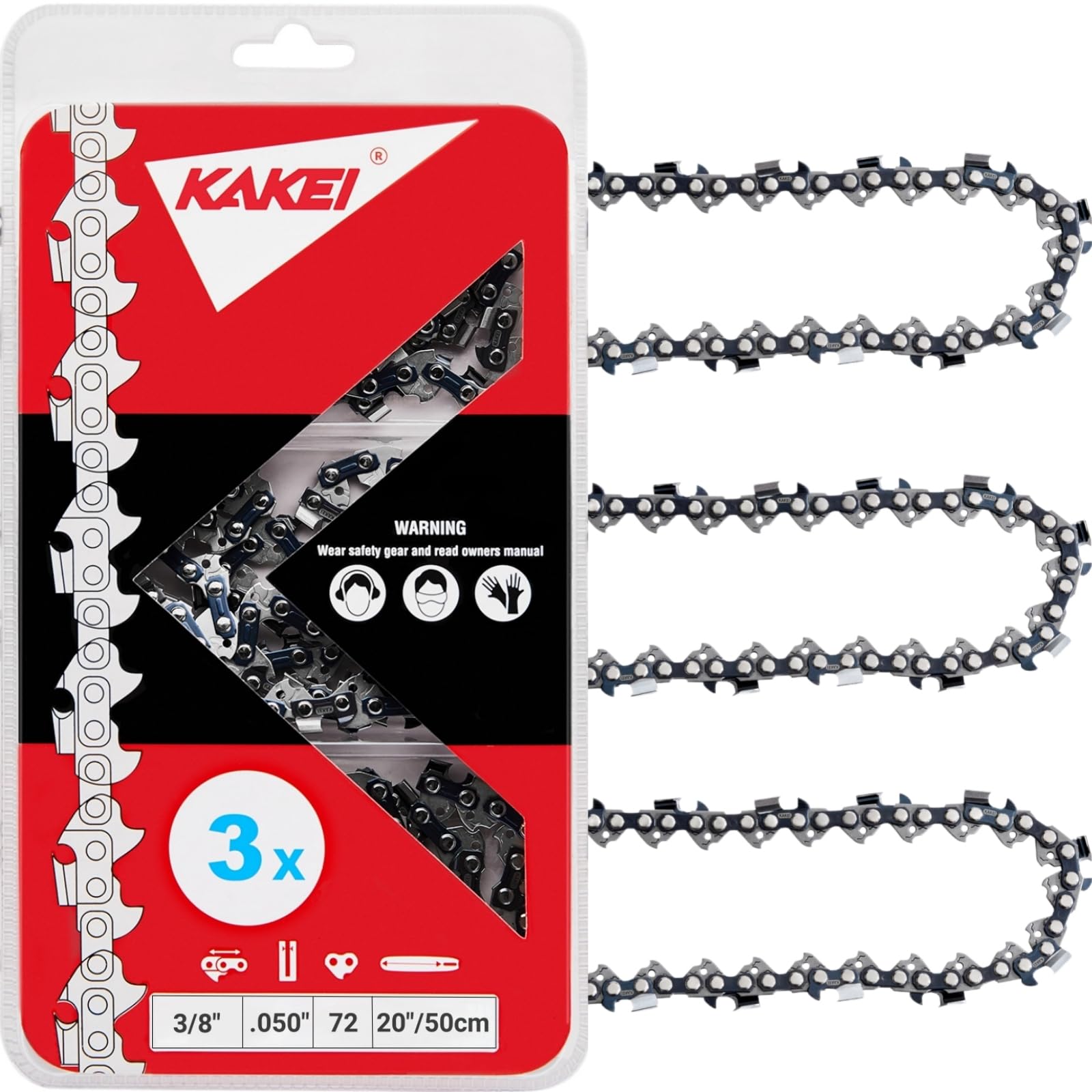
KAKEI 20-Inch 72-Link Chain (3-Pack)

KAKEI 20-Inch 72-Link Chain (3-Pack)

Big gas saws

Our Score 9.0/10
Check Price

Worth Noting

  • Only fits 72-link, .050-gauge 20-inch bars
Bar Length
20 in
Chain Type
Full chisel
Drive Links
72
Pitch And Gauge
3/8 in, .050 in
Read the full review

Full chisel is the fast cutter: a square corner that takes a bigger bite and throws real chips instead of sawdust. This KAKEI pack puts three of them on a 20-inch bar in 3/8-inch pitch, .050-inch gauge and 72 drive links — the fitment behind saws like the Stihl MS311 and MS391 and the Husqvarna 455 and 460 Rancher.

Seventy-two links is a lot of cutter to keep sharp, which is why the three-pack matters more here than it does on a small saw. Run one until it stops pulling, swap it, and file the pair on the bench with a cold drink. The cutters are German steel with a chrome plate, packed in protective oil, and they arrive sharp enough to go straight to work.

We rate this as the value play for anyone feeding a wood stove: full-chisel speed on a 20-inch bar for the price of a couple of shop sharpenings. Full chisel is also the cutter that dulls fastest in dirty wood — if your logs come off a skidder with sand in the bark, a semi-chisel loop keeps cutting longer even though it is slower.

Bottom line: Full-chisel speed for a 20-inch bar without dealer money per loop: three sharp 72-link chains, provided your wood is reasonably clean.

8

GSSHBR 18-Inch 62-Link Chain (5-Pack)

GSSHBR 18-Inch 62-Link Chain (5-Pack)

Bulk swap-and-toss

Our Score 9.0/10
Check Price

Worth Noting

  • Shorter edge life than the name-brand loops here
Pack Size
5 chains
Bar Length
18 in
Drive Links
62
Pitch And Gauge
3/8 in LP, .050 in
Read the full review

Five loops in one box changes how you own a chain. Instead of one loop you baby, you get a stack to burn through: fit a fresh one when the cut starts to wander, drop the dull one in a can, and deal with all of them at once at the end of the season. That is exactly how we treat this pack — as a consumable, not as five chains to be preserved.

The cutters come sharp out of the wrapper and cut fast while they last, and the hard chrome outer layer and hardened rivets are there to slow the wear that follows. The fitment is the common one: 18-inch bar, 3/8-inch low profile, .050 gauge, 62 links, which covers Echo, Poulan, Homelite, Ryobi, Kobalt, McCulloch, Remington and Greenworks saws built for that size.

Where the pack stops is edge life, and that is the trade you are making for a stack of loops at this money. For storm cleanup, a brush pile, or a saw that comes out four weekends a year, a box of loops you can swap without thinking is the right way to spend. For a firewood business, one loop that holds a fine edge matters more than five that do not.

Bottom line: The lowest cost per loop here: five sharp 18-inch chains you can swap and throw away without flinching.

How We Tested the Best Chainsaw Chains

We started with the saws people actually own — a 50cc gas saw, a smaller homeowner gas model, and a 60V battery saw — then cross-referenced pitch, gauge, and drive-link count against each bar before ordering anything. Chains whose listings were vague about gauge or whose packaging specs didn't match what we measured with a caliper got flagged, because a chain that's described inaccurately is a chain that costs you a bar. From there we narrowed by price, loops per pack, and whether a replacement was easy to reorder, landing on 15 chains.

Every chain was mounted and tensioned to its manual, then run through the same rotation: bucking 10-inch ash rounds at the woodpile, limbing a storm-downed maple, and cutting up fence-line logs that had been seasoning for two years. We re-checked tension after the first tank to see how far each one had stretched, and again at the end of a full cutting day — the ones that needed constant re-tensioning got written down. Fit was judged at the moment of mounting, too: whether the loop sat down in the bar groove without slack or needed coaxing.

For cutting performance, we timed cuts through matched rounds and watched what came off the bar, since chips mean a chain is working and dust means it isn't. We ran each chain until it stopped pulling itself through the wood, filed it, and kept going, which is where the real durability differences surfaced. Value came down to cuts per dollar rather than sticker price, because a cheap chain that quits after a cord was never cheap.

How to Choose Chainsaw Chains

Read the stamp on the bar first

Pitch, gauge, drive-link count and bar length decide fit, and all four are usually stamped on the side of the guide bar near the mount. Gauge is the thickness of the drive link where it runs in the bar groove — .050, .058 and .063 inch are the common ones and they look nearly identical on a shelf. Pitch is the rivet spacing, and low-profile 3/8 is a different chain from standard 3/8 even though both get called 3/8.

The trap is assuming length settles it. Two 16-inch bars from different makers can want different drive-link counts, and an 18-inch bar can take 62, 68 or 72 links depending on the nose sprocket. Photograph the stamp before you order and match every number. The Oregon pack here lists its fitments model by model, which is the standard to hold any listing to.

Full chisel or semi-chisel

Full chisel has a square corner that bites hard and cuts fast in clean timber; it is what the KAKEI 20-inch pack, the Husqvarna C83 and the Stihl Rapid Super are built around. Semi-chisel has a rounded corner that gives up a little speed but holds an edge far longer in gritty, ground-level wood, which is why our 16- and 18-inch picks use it.

Choose by the wood you actually cut. Clean logs off a pile: full chisel. Limbs dragged through sand, stumps, fence-line growth, anything with dirt in the bark: semi-chisel. Both come in low-kickback versions with bumper drive links and ramped depth gauges, and on a small saw that is worth having.

How many loops to keep on hand

Chains dull in the cut, not on the shelf, and stopping to file mid-job is how a morning disappears. Two or three loops let you swap and keep cutting, then sharpen in a batch. Five, as in the GSSHBR pack, turns the chain into a consumable — a reasonable way to run a saw that only comes out a few times a year.

Decide which of those you are buying. A cheap multi-pack buys time and convenience; a single OEM loop buys edge retention. Three loops per saw is the number we settle on: one cutting, one sharp, one waiting.

Watch for gauge and model-year changes

Saw models change spec without changing their name. The Stihl MS250 is the classic case: earlier saws ran a .063-gauge bar while later ones may carry .050, so the same model name wants two different chains. The Husqvarna X-Cut SP33G fits five specific models and nothing else, which is normal for factory chain.

That makes the manual the second-best source and the bar in front of you the first. If you are replacing a bar at the same time, buy the chain to the new bar's stamp, not to the one coming off.

Frequently Asked Questions

Final Verdict

The Oregon three-pack is the chain we point most people to. Eighteen inches, 3/8 low-profile, .050 gauge and 62 links covers a long list of the saws sitting in garages and sheds right now, and three low-kickback semi-chisel loops mean you swap instead of stopping to file.

If your bar reads something else, the rule does not change: match the stamp, then pick the cutter and the pack size that fit how you cut. Husqvarna owners with a 450-class saw should go straight to the X-Cut SP33G and skip the arithmetic.