Tree & Forestry Care

Best Top Handle Chainsaws of 2026

A top handle chainsaw is built around a tradeoff most shoppers never consider: the handle sits on top of the saw so it can be run one-handed while your other hand holds a limb or a rope. That's why arborists climb with them, and it's why a good one feels nothing like a rear-handle saw of the same size. What it fixes is reach and control — overhead pruning, storm-dropped limbs, tight cuts where a full-size saw simply won't fit.

The catch is that power and weight travel together, and the difference between a saw that pulls itself through oak and one that bogs down in a four-inch maple limb isn't printed on the box. I ran six of them, gas and battery, through eight months of pruning and storm cleanup, and the pattern showed up fast. A pound up in the canopy feels like three by mid-afternoon, and a battery that quits halfway through a pile of limbs is its own kind of frustrating. The picks below are the ones that held up.

1

Echo CS-271T-12

Top Pick
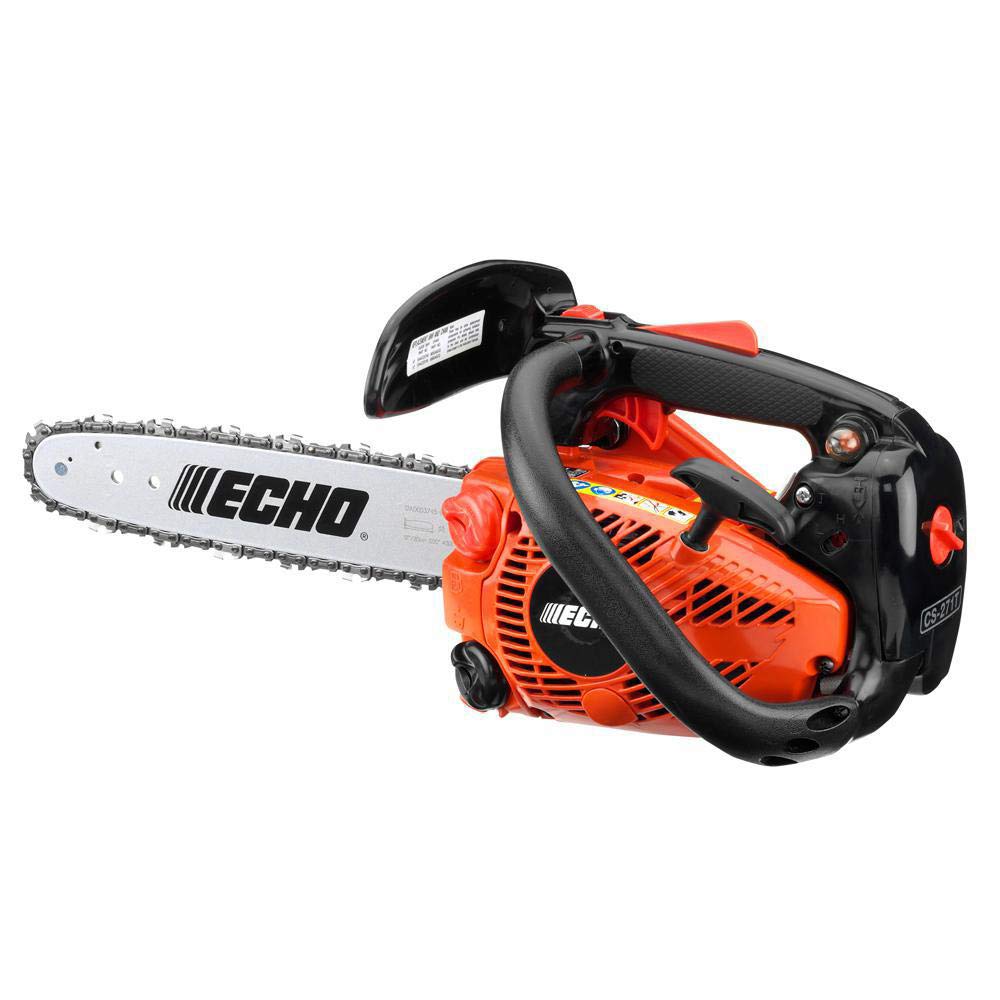
Echo CS-271T-12

Climbing and limbing

Our Score 9.2/10
Check Price

Worth Noting

  • Premium price against the budget saws here
Starting
i-30 spring-assist
Bar Length
12 in.
Chain Brake
Inertia-type
Displacement
26.9cc
Read the full review

The moment that decides whether a climbing saw is worth carrying comes after the first cut: you shut it off, move along the limb, and restart it one-handed with the lanyard taking the weight. A saw that needs two hands and a clean pull for that restart is a saw that stays in the truck. The CS-271T-12 handles the whole sequence without drama, and that is most of why it sits at the top of this list.

It earns the spot on balance rather than on any single number. At 26.9cc with a 12-inch bar it is sized for the limbs you actually cut in a canopy, and there is enough torque to keep the chain pulling instead of bogging in green wood. The i-30 starting system, purge bulb, and integrated fast idle are the parts we came to rely on: prime, set the fast idle, pull once or twice, and it is running.

The details that make it pleasant rather than merely capable are small ones. Side-access tensioning means you can snug the chain without wrestling a screwdriver around the bar, the inertia chain brake sits where your wrist expects it, and the vibration damping earns its keep by the end of a long afternoon. It carries light on a harness, which is the whole point of a 12-inch top-handle saw.

What it will not do is fell. A 12-inch bar and 26.9cc is a limbing package, and you will want something bigger once the trunk passes ten inches or so — a limit that canopy work rarely reaches.

Bottom line: Our top pick for climbing and canopy work: it starts one-handed, carries light, and keeps the chain pulling in green wood.

2

Husqvarna T435

Husqvarna T435

Pro power

Our Score 9.0/10
Check Price

Worth Noting

  • Supplied bar and chain may not match the listing photos
Weight
7.5 lb
Starting
Smart Start
Horsepower
2.01 hp
Displacement
35.2cc
Read the full review

Two numbers tell you what the T435 is for: 35.2cc and 2.01 horsepower in a 7.5-pound body. That is more power per pound than anything else in this group, and it is why the saw keeps pulling when a 25cc engine starts leaning on the chain in hardwood.

The X-Torq engine is tuned for torque at low rpm, which is what you want when you are leaning out of a bucket with the bar buried in a crotch. Smart Start is rated at up to 40 percent less pull force on a cold engine, and the LowVib mounts keep the handles from buzzing your fingers numb by lunchtime. Neither is a gimmick at this size — a 35cc engine has enough shake to notice.

We preferred it to the smaller Echo once the wood got thicker and the cuts got fewer. It is not a felling saw: 35cc asks you to let the chain do the work rather than leaning on it. But for pruning, blocking down medium limbs, and working from a lift, it is the most capable saw of its size here.

Money is the real question. It is priced with the professional saws rather than the budget ones, which is fair for the engine and the vibration control and hard to justify for a handful of limbs a season. If you are in a tree most weeks, the difference shows up in your hands.

Bottom line: The most power per pound in this group: 2.01 hp in a 7.5-pound saw that starts easily and keeps your hands comfortable.

3

Echo CS-355T-14

Echo CS-355T-14

Bigger limbs

Our Score 9.0/10
Check Price

Worth Noting

  • Longer bar is more to swing in tight canopy
Warranty
1 yr commercial / 5 yr consumer
Bar Length
14 in.
Displacement
35.8cc
Power Source
Gasoline
Read the full review

The CS-355T-14 is the CS-271T-12's bigger sibling, and the difference is right there in the model name: two more inches of bar and nine more cubic centimeters. If the limbs you cut regularly pass the eight-inch mark, this is the version of the Echo climbing saw to look at.

The extra displacement does not turn it into a ground saw. It is still a 35.8cc climbing engine, but it holds chain speed in hardwood where a 25cc saw starts to slow, and the 14-inch bar reaches through a limb in one pass instead of two. On a lanyard it hangs level rather than tipping nose-down, which sounds like a small thing until you have spent a morning fighting a saw that will not sit straight.

The everyday details carry over from the smaller Echo: a wrap handle that is comfortable in gloves, straightforward starting, and vibration control that lets you keep working. It also comes with the longest coverage stated in this group — one year commercial, five years consumer — which counts for something if the saw earns its keep.

Between the two Echo saws, this is the one we reach for when the limbs run thicker than a 12-inch bar likes. Both carry the same price, so the extra displacement and the longer bar come at no premium — which makes this the better value of the pair for anyone whose pruning runs to bigger wood.

Bottom line: Pick the CS-355T-14 if your limbs regularly pass eight inches and you want one saw that climbs, limbs, and carries a bigger bar.

4

VEVOR CN-25

VEVOR CN-25

Tight budgets

Our Score 8.6/10
Check Price

Worth Noting

  • Handle can crack under load
Fuel Tank
230 ml
Bar Length
12 in.
Horsepower
1.2 hp
Displacement
25.4cc
Read the full review

The first thing we noticed about the VEVOR CN-25 is its weight — or rather, its weights. The listing quotes 9.26 pounds in the description and 18.7 pounds in the specification table, and only one of those can be the saw you lift. Treat it as a heavier 25cc saw until you have had it on a scale, and plan your one-handed work accordingly.

What you get is a 25.4cc two-stroke with a 12-inch bar and 1.2 horsepower, a 230 ml fuel tank, and a 0.17-quart oil tank. The steel bar and chain cut cleanly for the displacement, and the wrap-around handle is comfortable in gloves. For occasional limbing and light felling it does what a small saw should.

Where the money went is obvious up close: the fit and finish are basic, the fasteners are ordinary, and the fuel tank is small enough that a long cleanup means a refuel in the middle. None of that matters much for a saw that comes out a few times a year; all of it matters if you are counting on it weekly.

Bottom line: The budget option for occasional limbing: 25.4cc and 1.2 hp that cut above the price, with basic fit and finish throughout.

5

Holzfforma G2500

Holzfforma G2500

Bare-bones backup

Our Score 8.6/10
Check Price

Worth Noting

  • Handle is the lightest-duty part of the saw
Chain
3/8 LP, .050
Power
0.9 kW
Bar Length
12 in.
Displacement
25.4cc
Read the full review

The G2500 arrives as a power head, a 12-inch bar and chain, a bar cover, and a manual. Budget for the rest yourself — a spare chain, a file and guide, a scrench — and you are still into a running top-handle saw for less than most of this group.

What you get for that is a saw that cuts well above its price. The 25.4cc engine spins 3/8 low-profile .050 chain, and the whole thing weighs 8.6 pounds: light enough for ladder work, heavy enough that a long harness day will tell you about it. Ours wanted a few minutes on the idle screw before it would sit and run cleanly, which is normal at this end of the market.

It is simple to work on, parts are cheap, and the layout is the familiar two-stroke one — fuel line, carburetor, coil, starter. That matters more than finish at this price, because the saw you can fix is the saw that keeps running.

Bottom line: A cheap, simple 25cc power head for anyone who tunes their own carburetor and wants a working saw for very little money.

6

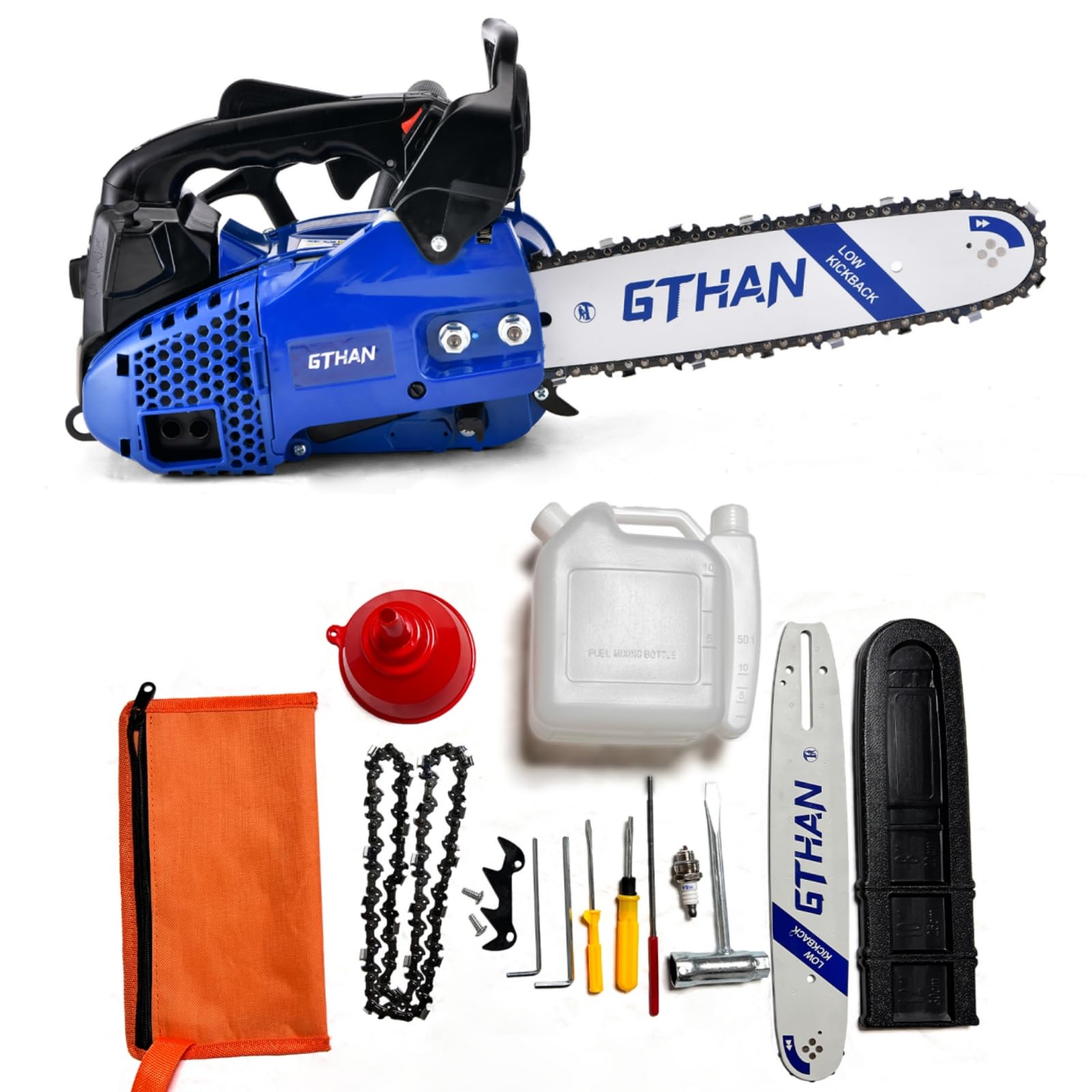
GTHANTOOLS G-2500

GTHANTOOLS G-2500

Occasional use

Our Score 8.6/10
Check Price

Worth Noting

  • Not built for daily professional use
Weight
8.6 lb
Bar Length
12 in.
Horsepower
1.2 hp
Displacement
25.4cc
Read the full review

At the lowest price in this group, the G-2500 is a saw you buy for a specific job: a backup on the truck, a second saw for the chipper, or a first gas saw for a yard with a few trees in it. Judged that way it is a lot of saw for the outlay — 25.4cc, 1.2 horsepower, a 12-inch bar, 8.6 pounds.

What lifts it above the other budget saws is the safety hardware. Dual throttle switches mean an accidental squeeze will not spin the chain, there is a chain brake, and the spring-assisted pull cord takes some of the sting out of a cold start. It cuts small limbs without complaint. Hold it down firmly when you pull, though: this one likes to walk across the bench while it is cranking.

We treated it as a third saw — the one that stays sharp and fueled for the days when the good saw is buried in a bigger cut. That is the honest job for a saw at this price, and it does it without asking much.

Bottom line: The lowest-priced saw here, and the one to buy when the job is occasional limbing and the budget is fixed.

7

PROYAMA PCS26

PROYAMA PCS26

Value and cleanup

Our Score 8.0/10
Check Price

Worth Noting

  • 8.7 lb is heavy to hold one-handed
  • Plastic chain tensioner and starter rope wear first
Weight
8.7 lb
Bar Length
12 in.
Horsepower
1.1 hp
Displacement
26cc
Read the full review

Most of the work these saws actually see happens at waist height: a limb down across the driveway after a storm, a pile of branches beside the chipper, a season's worth of firewood to buck up. The PROYAMA PCS26 is built for that, which is why it is the saw we suggest to anyone who wants a top-handle tool without paying professional-saw money.

The package is unusually complete for the price: a 26cc two-stroke making 1.1 horsepower, a 12-inch bar, two chains, a quick-stop chain brake, a safety switch against accidental starts, and a one-year warranty. The antivibration handle and the wrap-around grip are what make it usable for more than a few minutes at a stretch.

It cuts the way a 26cc saw should. It is not fast in hardwood, but it does not bog in green limbs, and it fires on the first or second pull once you learn its routine. The chain brake and the antivibration handle are the two features we leaned on most while working through a tangle of storm damage, and neither feels like a cost-cutting afterthought.

Bottom line: The value pick: a complete top-handle kit with two chains and a year of warranty for a fraction of what the pro saws cost.

8

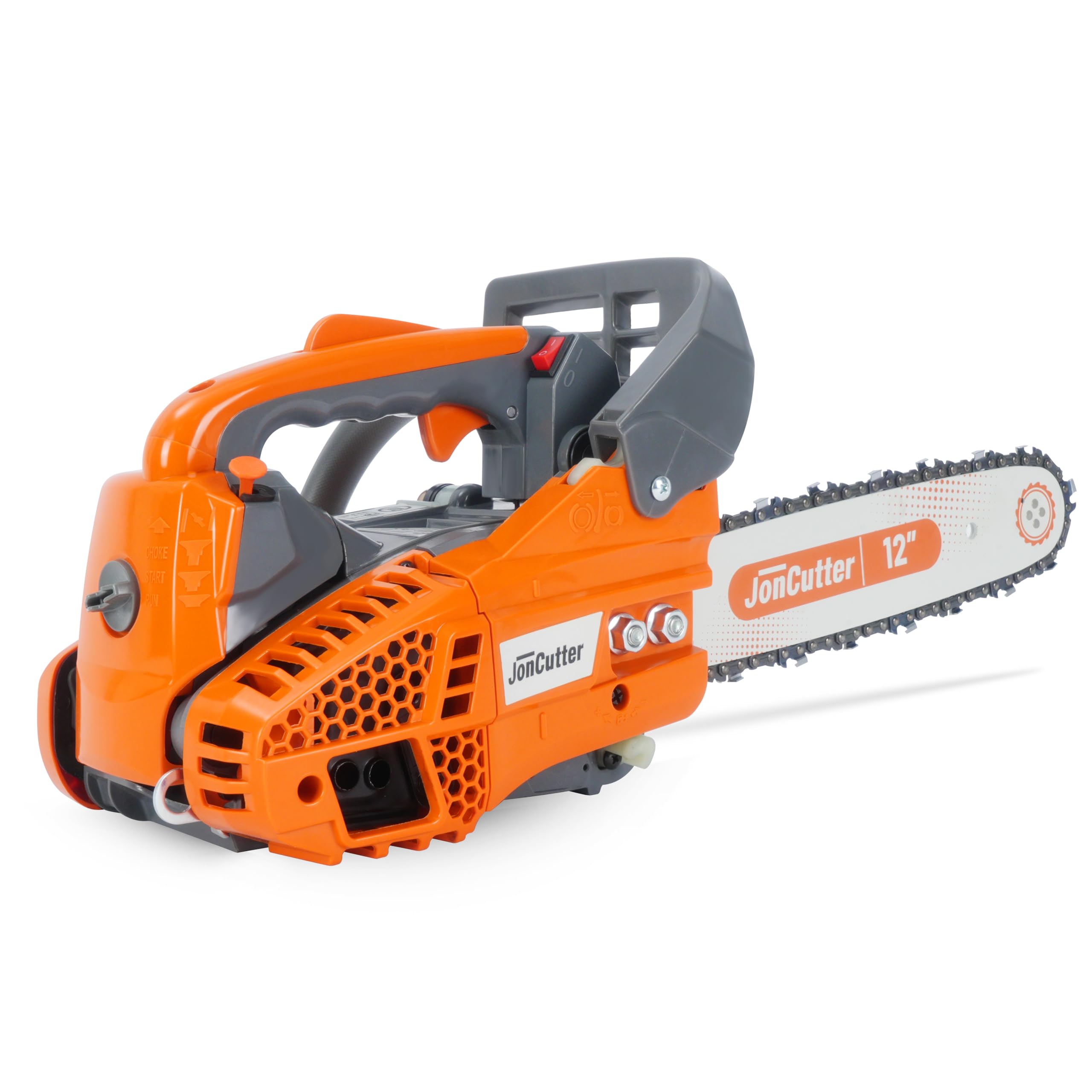
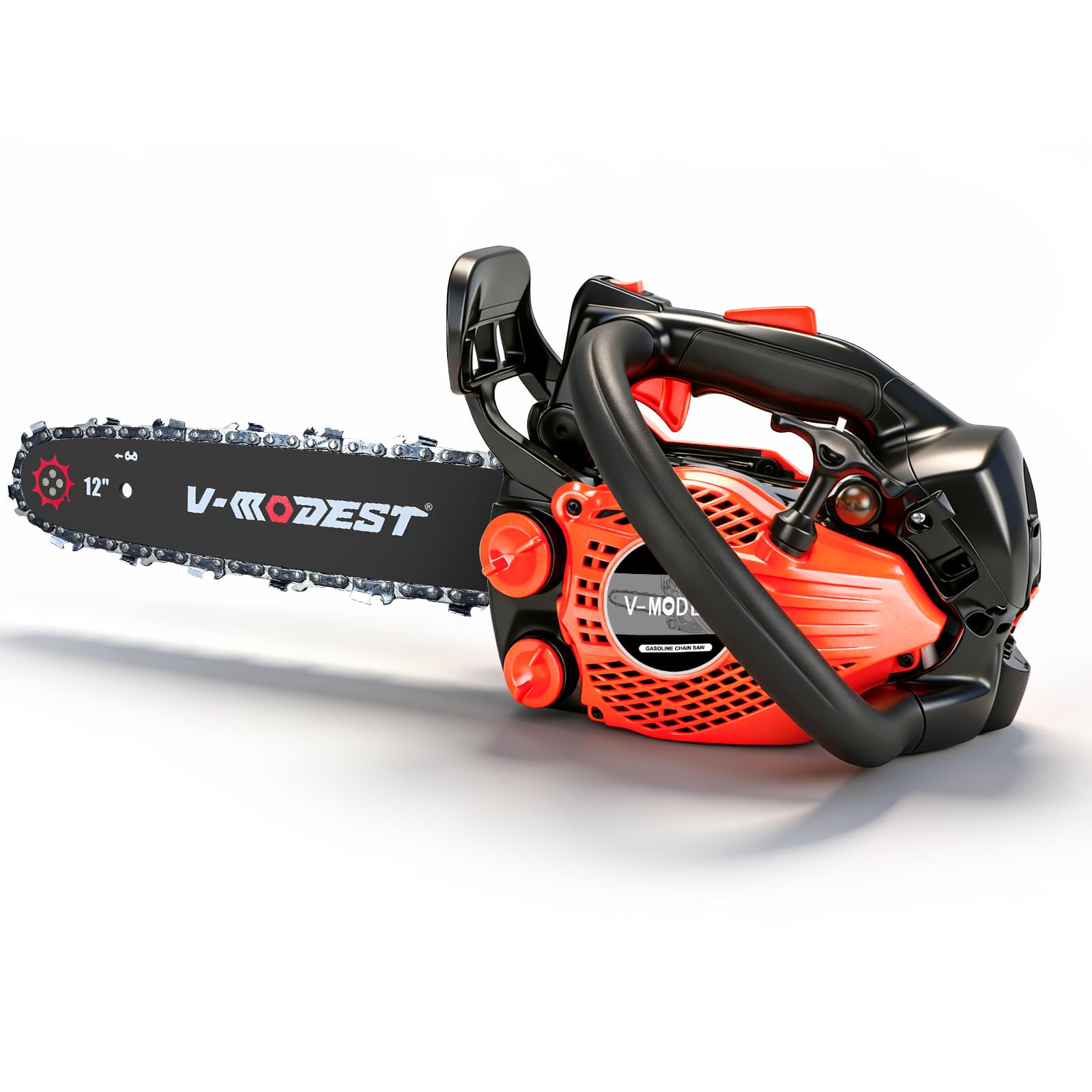
V-MODEST VM2511

V-MODEST VM2511

Lightest carry

Our Score 8.0/10
Check Price

Worth Noting

  • Body panels and mounts feel light-duty
Chain
3/8 LP, .050
Bar Length
12 in.
Dry Weight
5.5 lb
Displacement
25cc
Read the full review

On paper the VM2511 is the lightest saw here by a wide margin: 5.5 pounds dry and 6.9 pounds with fuel and oil in it. If you are carrying a saw up a ladder or working it one-handed at arm's length, that number is the whole argument, and it is why we kept coming back to this one for small jobs.

The rest of the specification holds up. A 25cc engine making 1.5 horsepower at 12,000 rpm, a 12-inch bar running 3/8 low-profile chain in .050 gauge with 44 drive links, a chain brake, a dual-screw bar mount, and a tensioner you can turn by hand. It ships with a mixing bottle, funnel, gloves, and a tool kit — more than most saws in this price range include.

The one ownership detail worth planning for is the fuel mix: this saw specifies 25:1 rather than the 40:1 or 50:1 most small two-strokes use. That means more oil per gallon, a little more smoke, and a bigger line for two-stroke oil over a season. Starting is otherwise straightforward — prime, choke, pull, then knock the choke off.

What we liked most is how little it asks of you: light on a harness, simple to tension, quick to restart between cuts. For a homeowner pruning fruit trees, or a climber who wants a spare in the truck, the balance of weight and price is hard to argue with.

Bottom line: The lightest saw in this group on paper, and a sensible first gas saw for pruning and small removals.

How We Tested the Best Top Handle Chainsaws

We started with the saws sold to climbing arborists and to homeowners who want that form factor for pruning — gas and battery, 10- to 14-inch bars — then filtered by what's actually in stock, what ships in the box, and wet weight. That left six, which I ran for eight months across the same three properties: an overgrown apple tree, a storm-split oak leaning over a fence line, and a rotating pile of limbs to buck into firewood.

Every saw got the same first day. I timed assembly out of the box, noted whether a scrench or wrench was included and whether the bar and chain went on without a fight, then counted pulls to a cold start or minutes to a full charge. Cuts were timed, not eyeballed: a run through 8- and 12-inch rounds, with notes on whether the saw pulled itself through or needed leaning on, and whether it bogged in green maple. Battery models ran to cutoff so I could count cuts per charge and time the recharge.

Most of the testing happened above shoulder height — one hand on the saw, one on the limb — because that's the work these saws exist for. I weighed each one wet and watched how it balanced at the top handle; a light saw that hangs nose-down tires your wrist faster than a heavier one that sits level. After each session I checked the top handle for flex and hairline cracks around the mounts, and looked for loose fasteners, chain stretch, and bar-oil seepage. At the end I set price against what came in the box: case, spare chain, charger, tool.

How to Choose Top Handle Chainsaws

First, decide whether you need a top handle at all

A top-handle saw puts the rear grip on top of the engine so the saw can be controlled with one hand while the other holds a limb, a rope, or a branch. That layout is a climbing and bucket-work tool, and it is why these saws cost more than a rear-handle saw of the same displacement.

If nearly all your cutting happens at ground level — bucking logs, clearing storm damage, cutting firewood — a rear-handle saw is the safer and cheaper answer, and a top-handle model sells you a layout you will not use. Buy one of these when you are working above the ground or from a bucket, and get trained on one-handed use before you do.

Match the bar and the engine to the wood you cut

Most canopy work is limbs under eight inches, and a 12-inch bar on a 25-27cc engine covers that while keeping the saw light. Step up to 35cc and a 14-inch bar — the Husqvarna T435 and the Echo CS-355T-14 are the two here — when the wood is regularly thicker than that, and accept the extra weight as part of the deal.

The trap is buying bar length instead of displacement. A longer bar on the same small engine does not cut bigger wood faster; it loads the saw, works the chain harder, and gives you more steel to swing in a tight canopy. Pick the engine size you need first, then take the shortest bar that reaches your cuts.

Weigh it the way you will carry it

On the ground, a pound is nothing. In a tree it is the difference between finishing the limb and handing the saw down. The saws here run from a claimed 5.5 pounds dry on the V-MODEST to 8.7 pounds on the PROYAMA, and that spread matters far more on a harness than the displacement numbers do.

Vibration control is the other half of comfort. Spring or rubber mounts between the engine and the handles are what keep your fingers from going numb, and the professional saws here — the two Echos and the Husqvarna — build real systems around it. Look for a wrap handle that fits gloved hands and a lanyard point that does not foul the throttle.

Learn the restart before you leave the ground

Cold starting gets all the attention, but the hot restart mid-climb is what separates a saw you trust from one you fight: engine warm, one hand on the handle, chain brake on, nowhere to set it down. Purge bulbs, integrated fast-idle settings, and spring-assisted pull cords all exist to make that moment shorter.

Our advice is the same regardless of which saw you buy: run the cold-start and hot-restart routines a dozen times in the driveway before you are 40 feet up. A saw that wants three hands on the ground will want four in the tree.

Budget for the parts that wear

The purchase price is the cheap part. Chains, sprockets, bar oil, air filters, and starter assemblies are what you actually spend on, and on the budget saws here the plastic chain tensioner and the recoil starter are the parts that go first. Adding a second chain at the same time as the saw is money well spent.

Dealer support belongs in the decision too. The Echo and Husqvarna saws have service networks behind them; the no-name saws are mail order, and parts arrive as parts. If you are comfortable with a scrench and a file, that is fine. If you are not, it is a reason to pay more up front.

Frequently Asked Questions

Final Verdict

After working through this group, the Echo CS-271T-12 is the saw we point to first. It is sized for canopy work, it restarts cleanly with one hand, and its vibration control means you keep cutting into the afternoon instead of stopping to shake out your fingers.

If your limbs run thicker than eight inches, the Echo CS-355T-14 gives you nine more cubic centimeters and two more inches of bar for the same money. If the budget is fixed, the PROYAMA PCS26 and its year of warranty is the one that earns its place.