Tree & Forestry Care

Best Pruning Blades for Reciprocating Saws of 2026

A reciprocating saw doesn't prune the way a lopper does. The blade does every bit of the work, and the wrong one tears bark, bogs the saw down, and leaves a ragged stump that heals slowly, if it heals at all. What separates a clean cut from a mangled one comes down to tooth geometry, blade length, and how the steel holds its edge after the twentieth branch. Get those right and an afternoon of hand-sawing collapses into ten minutes.

I spent four months reclaiming an overgrown corner of my yard, a feral lilac hedge, a neglected apple tree, a pile of storm-downed limbs, and ran 16 different pruning blades through it on the same saw. A few cut two-inch green wood cleanly and were still biting at the end; others were skating and burning by the third branch. Pruning blades aren't demo blades with a new label, and paying more only helps if the steel behind those coarse teeth can take the abuse. What's below is what I kept reaching for.

1

Bosch RP125 12-Inch 5TPI 5-Pack

Top Pick
Bosch RP125 12-Inch 5TPI 5-Pack

Thick limbs

Our Score 9.4/10
Check Price

Worth Noting

  • Awkward in tight branch structure
Pack Size
5 blades
Blade Length
12 in
Tooth Design
Turbo-Teeth
Teeth Per Inch
5 TPI
Read the full review

A 12-inch blade is a reach tool, and that is exactly why we keep the Bosch RP125 set for thick limbs and stubborn roots. The extra length lets you span a bigger cut without burying the saw in the branches, and the 5TPI Turbo-Teeth are aggressive enough to make one pass feel realistic. We prefer it over a 9-inch blade when the diameter, not the finish, is the problem.

The five-pack is color-coded grey, which sounds like a small thing until you are swapping blades with gloves on. Bosch's tooth design is built for fast wood cutting, and the blade stock is substantial enough to stay on line in a deep kerf. They are not magic: a 12-inch blade has more leverage, so if you lean on it, it can flex.

We do not make this the default because most garden pruning is easier with a 9-inch blade. The Bosch is the one we grab for a trunk, a thick root, or a limb that is too big for a lopper.

Bottom line: We keep the 12-inch Bosch blades for thick limbs and stubborn roots, where the extra length and Turbo-Teeth cut make the saw feel like a different tool.
2

Diablo 9-Inch 5TPI 5-Pack

Diablo 9-Inch 5TPI 5-Pack

Clean cuts

Our Score 9.4/10
Check Price

Worth Noting

  • Not for wood with nails
  • Costs more than budget packs
Pack Size
5 blades
Blade Length
9 in
Tooth Design
Fleam-ground bi-directional
Teeth Per Inch
5 TPI
Read the full review

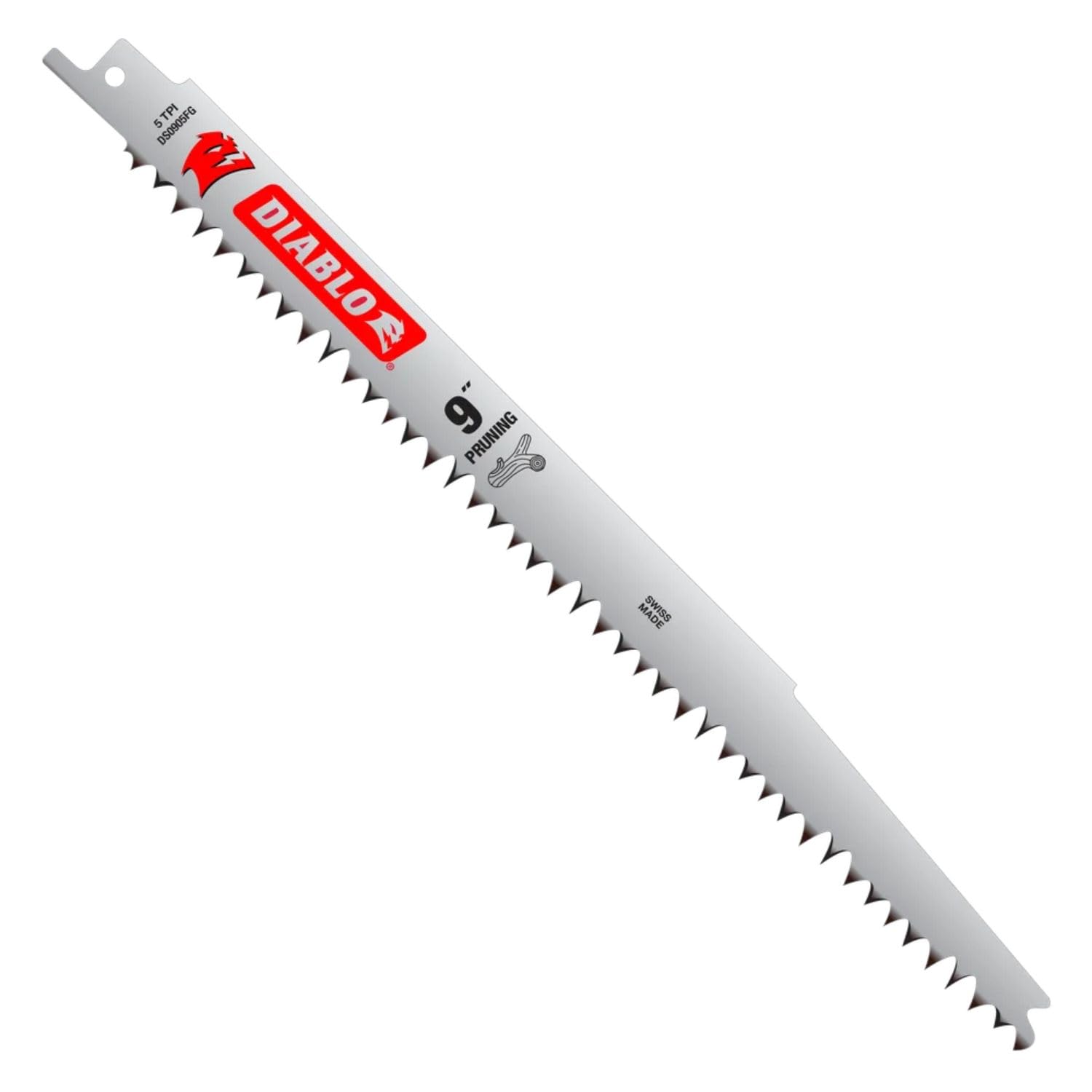
Most pruning blades leave a rough kerf and call it done. The Diablo is aimed at the gardener who wants a cleaner entry and a more controlled cut, and the fleam-ground, bi-directional tooth is the reason. The plunge tip also lets you start a cut in the middle of a limb instead of hunting for an edge.

At 9 inches and 5TPI, it is in the same general class as the other pruning blades here, so the difference is in the tooth refinement rather than raw size. The five-pack gives you spares, and the blades are intended for wood cutting and pruning, including pressure-treated wood. We like that the tooth design stays aggressive without feeling like a demolition blade.

We choose Diablo when the finish matters and we want a controlled plunge into a limb that is awkward to reach. It is not our default because the coarse tooth still leaves a pruning cut, not a furniture-quality edge. For shaping cuts and visible stems, the cleaner action is worth it.

Bottom line: We choose Diablo when a cleaner finish and controlled plunge matter more than the lowest cost per blade.

3

EZARC Arc Edge 9-Inch 6TPI 3-Pack

EZARC Arc Edge 9-Inch 6TPI 3-Pack

General pruning

Our Score 9.2/10
Check Price

Worth Noting

  • Costs more per blade than budget packs
  • Only three blades per pack
Pack Size
3 blades
Blade Length
9 in
Teeth Per Inch
6 TPI
Cutting Capacity
Up to 175 mm
Read the full review

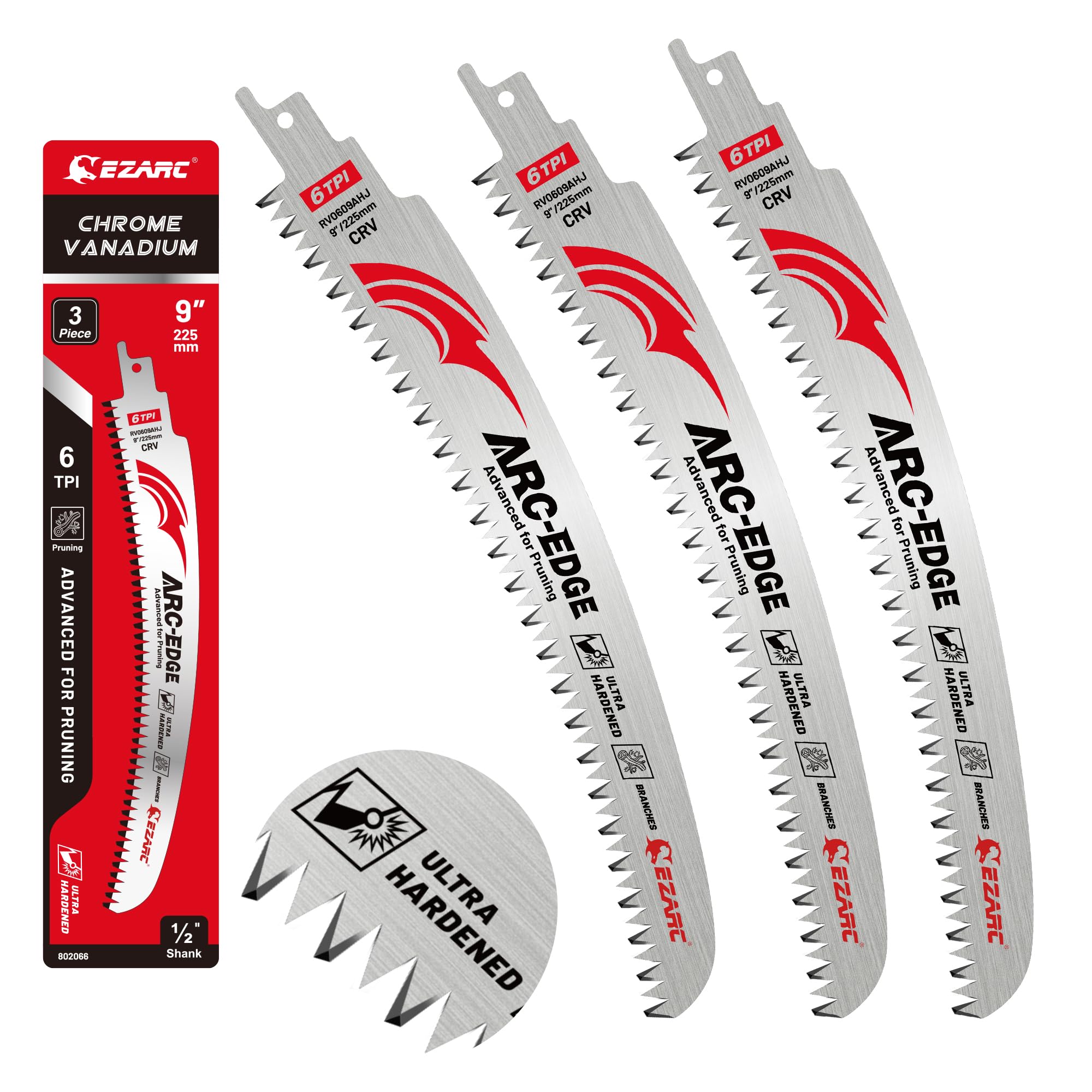
The arc edge is the first thing that separates the EZARC Arc Edge from the straight-backed pruning blades here. The 9-inch blade uses a 6TPI Japanese-style tooth with triple-ground offset points and deep gullets, so it pulls wet chips out instead of packing them into the kerf. On green limbs, that aggressive geometry is what makes the cut feel controlled rather than grabby.

We make it our top pick because it balances speed and control better than the budget 5TPI packs. The 6TPI pitch is coarse enough for fast pruning but not so brutal that the blade skates across a branch, and the curved edge keeps more teeth engaged through the stroke. EZARC rates it for wood up to 175 mm in diameter, which covers the limbs most gardeners face without reaching for a chainsaw.

Compatibility is straightforward: the universal shank fits the major reciprocating saw brands, and the three-blade pack is easy to keep with the saw. We like the arc-edge design for sappy spring growth and for cutting flush enough to leave a tidy stub, though it is still a rough-cutting garden tool, not a finish saw.

This is a pruning blade, not a land-clearing blade. Keep it out of gritty roots and soil; the same coarse teeth that fly through clean green wood will dull against dirt. For sappy spring growth and limbs that need a controlled, fast cut, it is the one we reach for first.

Bottom line: We make the Arc Edge our default because its 6TPI arc-edge teeth cut green limbs fast and cleanly enough to justify the premium for gardeners who prune often.

4

Caliastro 9-Inch 5TPI 5-Pack

Caliastro 9-Inch 5TPI 5-Pack

Bulk value

Our Score 9.2/10
Check Price

Worth Noting

  • Basic carbon steel dulls in gritty wood
Pack Size
5 blades
Blade Length
9 in
Storage Case
Yes
Teeth Per Inch
5 TPI
Read the full review

Five 9-inch blades and a clear storage case make the Caliastro pack the straightforward bulk buy in this group. The 5TPI tooth count is the classic pruning profile: coarse enough to clear green chips, simple enough to keep the price low. We like that the case only pops open when you pull it, so the spares do not scatter in a toolbox.

We reach for this pack when we want a handful of blades to burn through brush and do not need the refined cut of the arc-edge sets. The carbon steel is the basic material here; it will handle clean green branches, but dirty roots and dry, gritty wood will take the edge off quickly. For occasional garden cleanup, that trade-off is easy to accept.

Bottom line: We reach for this five-pack when we want inexpensive blades to burn through brush, and the storage case keeps the spares tidy between jobs.

5

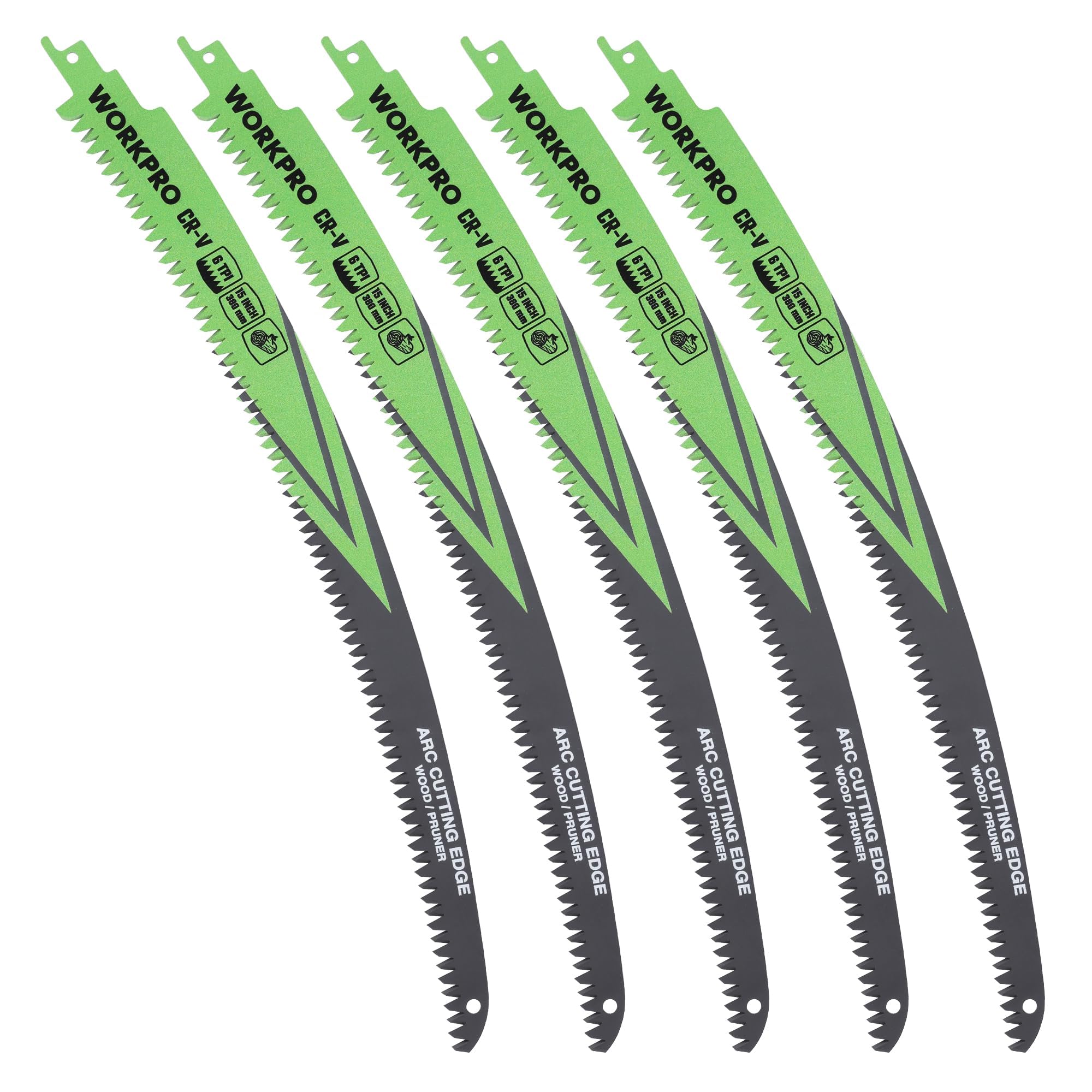
WORKPRO 15-Inch 6TPI 5-Pack

WORKPRO 15-Inch 6TPI 5-Pack

High branches

Our Score 9.2/10
Check Price

Worth Noting

  • Awkward in dense, tight branch structure
Material
Chrome vanadium steel
Pack Size
5 blades
Blade Length
15 in
Teeth Per Inch
6 TPI
Read the full review

High branches and deep roots create the same problem: the saw is willing, but the blade is not long enough to reach the cut cleanly. The WORKPRO 15-inch arc-edge blade is built for that gap. It gives you three extra inches over a 12-inch blade and six over the 9-inch picks, so you can stand in a safer position and still put teeth on the wood.

The 6TPI Japanese-style tooth and curved edge are the same family of design as our top pick, scaled up. Triple-ground offset teeth create three cutting angles, and the deep gullets clear chips instead of letting them pack in. We found the long arc helps the blade keep contact through a thick limb rather than bouncing off the curve.

We recommend it for the jobs that make a 9-inch blade feel short: overhead limbs, roots below grade, and trunks you can reach from one side. It is not the blade we hand most gardeners first, because 15 inches is a lot of blade to control in a dense shrub or a tight fork. Reach is the whole point, and you pay for it in leverage.

The thin 1.2 mm stock keeps the weight down, but a blade this long will flex if you pry or twist out of a bind. Keep the cut straight, let the saw clear the chips, and use the length to reach rather than to lever. For the right job, it saves a lot of repositioning.

Bottom line: We recommend the 15-inch WORKPRO blades when branches are above your safe reach or roots sit deep, as long as you can control the longer blade.

6

VICRING 9-Inch 5TPI 5-Pack

VICRING 9-Inch 5TPI 5-Pack

Tight budgets

Our Score 9.2/10
Check Price

Worth Noting

  • Modest speed in larger, drier cuts
Hardness
HRC 48-52
Pack Size
5 blades
Blade Length
9 in
Teeth Per Inch
5 TPI
Read the full review

A five-pack of pruning blades is a consumable purchase, and VICRING prices it that way. You get five 9-inch 5TPI blades with a high-carbon steel body rated at HRC 48-52, which is enough hardness for green branches and light brush. The point is not to baby one blade; it is to keep spares close and swap when the edge goes.

The tooth pattern is the familiar corrugated alternating style, and the blades are thin at 0.06 inch. That makes them light and easy to control in small cuts, and the 9-inch length gives you a little reach without turning the saw into a long lever. We found them happiest in green wood and small limbs, where the coarse teeth can clear chips and keep moving.

The blade is not a heavy-clearing tool. The thin stock and 5TPI pitch prefer green growth and small limbs, so keep it for those jobs. Do not pry or lever with it; let the teeth clear the chips and keep the saw moving.

We buy VICRING for occasional pruning, brush cleanup, and the odd root that a lopper cannot reach. The six-month warranty is a small reassurance, but the real value is having five blades you will not hesitate to use hard. If you prune every week, spend more; if you prune twice a year, this is the sensible pack.

Bottom line: We buy VICRING as a cheap consumable pack for occasional pruning, not as a blade we expect to last through a whole season of heavy cutting.

7

EZARC 9-Inch 5TPI 5-Pack

EZARC 9-Inch 5TPI 5-Pack

Green-wood value

Our Score 9.0/10
Check Price

Worth Noting

  • Edge life trails premium blades in tough wood
Material
Chrome vanadium steel
Pack Size
5 blades
Blade Length
9 in
Teeth Per Inch
5 TPI
Read the full review

The standard EZARC five-pack is the value counterpoint to our top pick: same 9-inch length, same coarse pruning intent, but a simpler 5TPI tooth and a much lower cost per blade. We like it for green limbs and woody brush where we expect to dull a blade and reach for another. The chrome-vanadium steel gives it more edge-holding promise than the cheapest carbon-steel packs.

It cuts like a pruning blade should. The 5TPI pitch clears wet chips, the universal shank fits the major saws, and the five-blade count means you can keep a spare in the case without treating the set like a precious tool. We noticed the blade is happiest when you let the saw do the work; push it into a knot and it will let you know.

This is the pack we hand to someone clearing a fence line or cutting back a few overgrown shrubs. The five-blade count takes the sting out of a dull blade, and the lower cost per blade makes it easy to swap rather than fight a tired edge. For daily professional work, step up to the arc-edge set.

Bottom line: We see the standard EZARC five-pack as the value alternative: it cuts green wood well, though we accept that the teeth dull sooner than the premium arc-edge set.

8

WORKPRO 6/9-Inch 5TPI 10-Piece

WORKPRO 6/9-Inch 5TPI 10-Piece

Mixed branch sizes

Our Score 9.0/10
Check Price

Worth Noting

  • Thin blades flex under side load
  • Edge life is mixed in tough wood
Material
High carbon steel
Pack Size
10 blades
Blade Lengths
6 in and 9 in
Teeth Per Inch
5 TPI
Read the full review

One blade length rarely fits a whole pruning job. The WORKPRO set gives you five 6-inch and five 9-inch 5TPI blades in an organizer case, so you can put a short blade in a tight fork and a longer one into a thicker limb without stopping to order a second pack.

The 6-inch blades are the ones we reach for on small branches and close work; WORKPRO rates them for branches under 100 mm, which is a useful line between trim work and a job that needs the longer blade. The 9-inch blades add reach for bigger limbs, and the case keeps the two sizes from turning into a loose pile in the toolbox.

The set is built for light-to-medium pruning, not heavy clearing. The high-carbon steel is not the most refined here, so keep it for clean green cuts rather than dirty stumps. We like the variety; we just do not treat the short blades as miniature demolition tools.

We recommend this set for a property with mixed shrubs, small trees, and the occasional thicker limb, especially if you want one box to cover both sizes. If your work is mostly 4-inch-and-up limbs, a dedicated 9-inch or 12-inch pack is the better buy. The organizer case is a small convenience that makes the two-size system actually work.

Bottom line: We like the WORKPRO set for mixed branch sizes, since the short blades control small cuts and the long ones reach thicker limbs without buying two packs.

How We Tested: 16 Blades, Four Months of Real Pruning

We started with a few dozen blades marketed for pruning, then narrowed by spec sheet: teeth per inch, blade length and curvature, the steel and coating, and whether the shank fit a standard reciprocating saw. Anything that was really a demolition blade wearing a pruning label got dropped. That left 16 that we bought ourselves and put to work.

Testing ran four months, from late winter into early summer, across my yard and two neighbors' properties: an untouched lilac hedge, an apple tree that needed serious thinning, downed maple limbs, and a season of routine deadheading. For each blade I timed a cut through a 2-inch green branch, then repeated the cut on a matched limb from the same pile so the wood was comparable. We logged how much pressure and saw speed it took, whether the blade chattered or kicked back, and what the cut ends looked like, whether clean and smooth or torn and fuzzy with crushed fibers.

Then we kept going. Each blade stayed on the saw through a full session of roughly 30 cuts, and we noted where it started to slow, wander off the line, or need a second hand to keep steady. The longer blades flexed and wobbled mid-cut on smaller branches, which showed up as a stepped, uneven cut face, while the short curved ones reached into tight crotches and flush cuts the long ones couldn't touch. We also checked each blade's teeth and finish after every session for chipped tips or bent teeth, since a blade with soft steel tells you early.

Value got judged last, once we knew which ones actually performed, because a blade that costs slightly more and survives three sessions is cheaper than a bargain one you swap out mid-afternoon. Everything was used the way it would be at home: on a ladder, one-handed, in gloves, with the saw's own weight doing half the work.

How to Choose Pruning Blades for Reciprocating Saws

Match the Tooth Count to the Wood

Pruning blades are coarse on purpose. A 5 TPI or 6 TPI tooth clears wet, stringy chips from green wood and keeps the cut moving; a fine-tooth blade will clog and burn in the same limb. We favor 5 TPI for general green pruning and 6 TPI with an arc edge when the wood is wet and sappy. The trap is assuming more teeth means a better cut. For pruning, fewer, deeper teeth usually win, and the finish will still be rough. Save the smooth-cut expectation for a hand saw.

Choose Length for Reach and Control

A 6-inch blade is handy in tight forks and small branches, a 9-inch blade is the all-around pruning length, and 12- to 15-inch blades are reach tools for thick limbs, high branches, and deep roots. We reach for 9 inches most of the time because it gives enough stroke without making the saw nose-heavy. Step up only when the cut is beyond a shorter blade: a longer blade has more leverage to flex or wander, especially if you pry. The extra length should keep you out of the branch, not encourage you to lean on it.

Check the Shank, Steel, and Stiffness

Most of these blades use a universal shank that fits major reciprocating saws, but check your clamp and the blade's thickness before you buy a pack. High-carbon steel is the budget choice, chrome-vanadium and hardened teeth hold an edge longer in clean wood, and a thicker blade resists bending in a deep kerf. Thin blades are not automatically bad; they are easier to control in small cuts but less forgiving if you twist. Fit matters, but fit alone is not enough: a blade that chatters or flexes in your saw will make every cut feel harder.

Treat Blades as Consumables

Pruning blades are consumables, even the premium ones. Green wood is abrasive, dirt and grit are worse, and a blade that has lost its edge will cost you more time than a fresh one costs in money. We buy packs rather than singles, keep a spare in the case, and swap as soon as the saw starts needing pressure. If you cut a lot of brush, a five-pack of budget blades can be the smarter buy than three premium blades. If you prune often and want a cleaner cut, spend up for the better tooth geometry.

Frequently Asked Questions

Final Verdict

The EZARC Arc Edge 9-Inch 6TPI is our top pick because its arc-edge teeth cut green limbs fast without the skating or clogging of a basic coarse blade. It is the one we pack for a real pruning session.

If your work is mostly thick trunks and roots, the Bosch RP125's 12-inch reach is the better tool. If you want a cheap five-pack for occasional brush, the Caliastro is the practical budget choice. Start with the EZARC unless a specific cut demands more reach or a lower cost per blade.