Planters & Plant Supports

Best Closed Glass Terrariums of 2026

A closed glass terrarium is a tiny greenhouse you can keep on a shelf—until the glass fogs, the soil turns swampy, and the plants start to sulk. The appeal is a sealed world that mostly waters itself and looks like a specimen under glass. The trick is finding one that holds humidity without going swampy, lets in enough light and air without cooking the roots, and has seams that don't weep onto your furniture. Get those right, and it's a low-maintenance landscape; get them wrong, and it's a science experiment gone brown.

I've kept moss and ferns in glass for years, and over the past eight months my team and I tested 12 closed terrariums on windowsills, desks, and shelves in varied light to see which stayed clear, sturdy, and plant-friendly. Size matters: you need depth for roots and a wide enough opening to plant without swearing. Appearance is decor, construction is the seal and edges, and value is whether the glass still looks good after wiping. The picks below are the ones I'd trust with a living planting.

1

NCYP Glass Cloche Dome

Top Pick
NCYP Glass Cloche Dome

Single specimen

Our Score 9.4/10
Check Price

Worth Noting

  • Only 4.7 inches across inside
Base
Included glass tray
Glass
Borosilicate
Dimensions
5.9 x 5.9 x 8.2 in
Ventilation
Top air hole
Read the full review

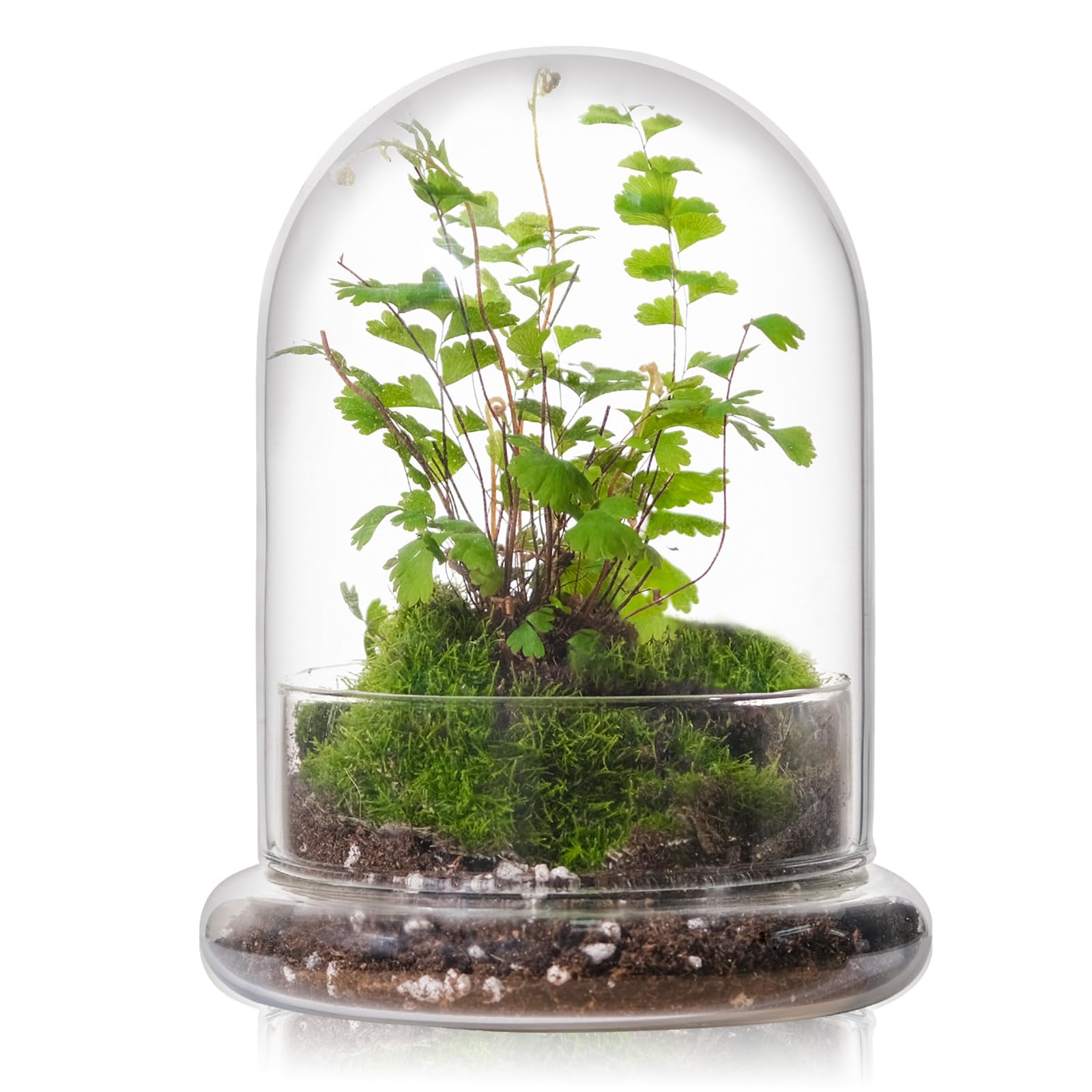
A 4.7-inch mouth on top of a 7.3-inch dome is the number that decides this one. It's enough air exchange that the glass usually clears on its own, and small enough that a humidity lover stays wrapped in damp air. For a single specimen, whether that's a Venus flytrap, a small begonia or a jewel orchid, this is the shape we pick.

The dome is borosilicate, so it handles warmth and the odd knock better than ordinary glass, and it lifts off a separate 5.9-inch tray. That two-piece design is the appeal: you plant into the tray, water the tray and drop the dome back over the top. Nothing hinges, nothing is fixed, and there's no rim to scrub around.

The small hole has a cost. After a heavy watering the glass can stay fogged for a day, and lifting the dome for an hour is the fix: no drama, but it's you doing the ventilating. The 1.7-liter volume also reads bigger than it feels once a pot and a drainage layer are in the tray.

Bottom line: If you're raising one humidity-loving specimen instead of a scene, this borosilicate dome does the job with less fuss than a box.

2

H Potter Wardian Case

H Potter Wardian Case

Display centerpiece

Our Score 9.4/10
Check Price

Worth Noting

  • Most expensive pick here by a wide margin
Glass
3mm panels
Access
Hinged roof, prop rod
Capacity
12.47 liters
Dimensions
9 x 9 x 12 in
Read the full review

The roof hinges up and stays open on a prop rod, and the rod is also how you vent the case on a warm afternoon without taking anything apart. H Potter builds it from six panes of 3mm glass around a cast resin planting tray, with a felt-lined bottom and a brass finial on top. It sounds like fussy detail until you've balanced a glass lid on your wrist while misting.

This is the only terrarium here we call furniture, and it's priced accordingly, by a wide margin the most expensive pick in this guide. The base is heavy and watertight, so unlike most of the boxes here you can water the soil rather than mist it, and the lead-free solder and even seams are the details you notice at arm's length. Nine inches across and 12 tall is smaller than the words Wardian case suggest, so tape it out on the shelf before you order.

Bottom line: Worth the splurge if the terrarium goes on a coffee table rather than a plant shelf: hand-built glass, a hinged roof and a base that holds water.

3

NCYP Grid House Terrarium

NCYP Grid House Terrarium

All-round planting

Our Score 9.2/10
Check Price

Worth Noting

  • Door rests loosely rather than sealing
  • Small plants only; no room for tall ferns
Frame
Copper foil, soldered
Access
Top swing door
Volume
6 liters
Dimensions
9.84 x 5.31 x 7.87 in
Read the full review

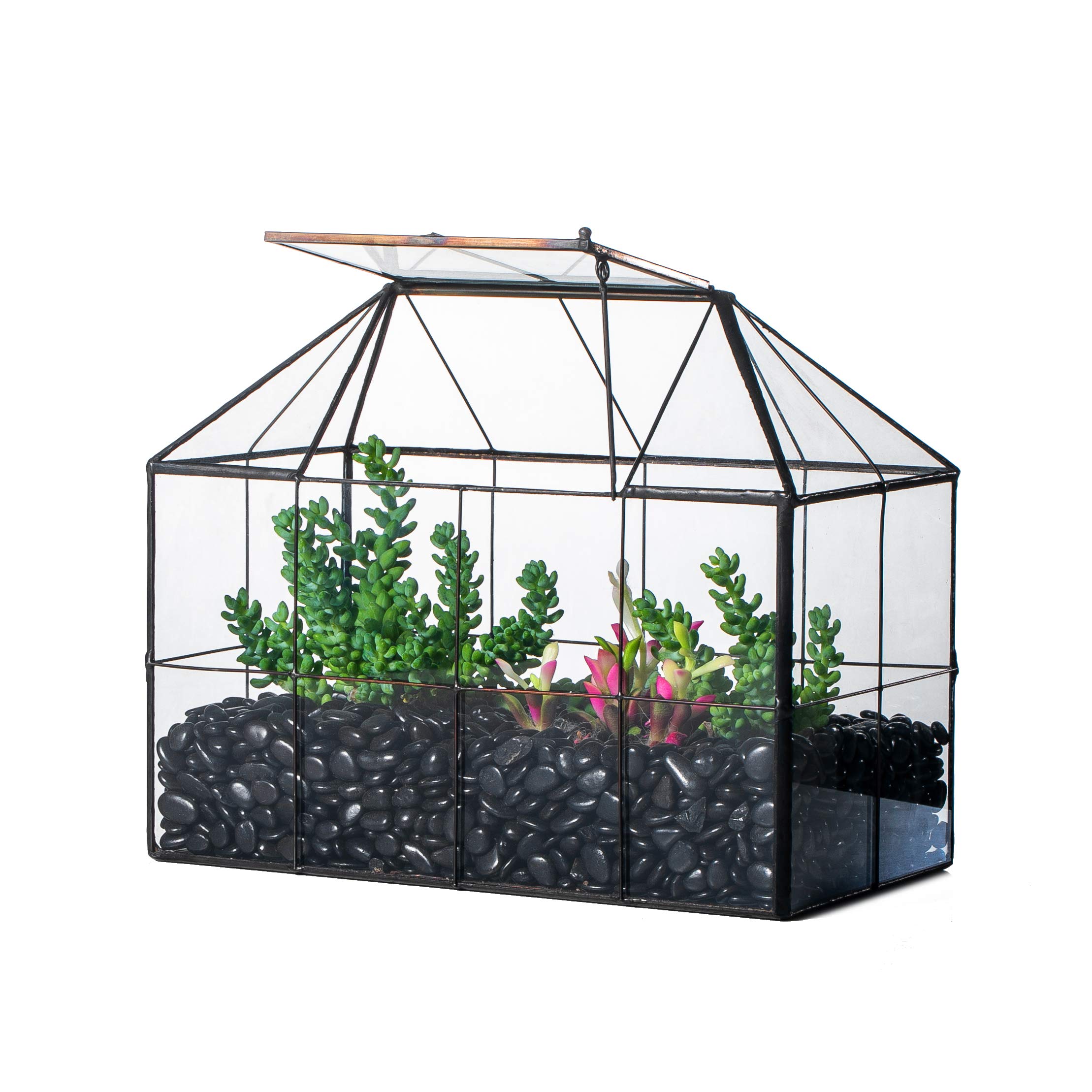
Six liters of interior volume across a 9.84 by 5.31 inch footprint is what puts this box at the top of our list. Most closed terrariums this size give you a narrow well you have to fish around in; this one spreads the planting area out under a top door that swings wide, so a moss floor, a stone path and two or three small ferns fit without elbowing each other.

For a first closed terrarium, this is the one we point people to. The door opens far enough to plant with a spoon and a pair of tweezers, and it stays where you put it while both hands are inside. The copper-foil frame seals the panels, so humidity builds and holds, which is good for ferns and moss and the reason to be careful with water: this box is not built to hold standing water, and a jug poured in will find the seams. Lay down gravel and charcoal, then mist the surface instead.

The door is the part to treat gently. It's a small hinge carrying a glass panel, and lifting it by the corner rather than the frame is how those hinges go. Expect to watch condensation for the first week or so while you learn how quickly this one dries.

What it holds is small plants: moss, a fern, a Venus flytrap, a couple of small succulents in a dry corner of the box. What it does beyond that is look like a piece of architecture rather than a plant pot, which is why ours ended up on the living-room shelf instead of in the plant corner.

Bottom line: Six liters of planting room, a top door that stays open while you work and panels that hold humidity make this the closed terrarium we recommend first.

4

Libproqia Rectangular Terrarium

Libproqia Rectangular Terrarium

Moss and moisture

Our Score 9.2/10
Check Price

Worth Noting

  • Lid lifts off completely; needs a resting spot
Frame
Black metal
Access
Top lid
Volume
3.44 liters
Dimensions
8.3 x 4.7 x 5.5 in
Read the full review

This is the box we reach for when the terrarium has to live on a shelf with a cabinet above it. At 8.3 by 4.7 inches and 5.5 inches tall it takes up the least space here, and it holds moisture better than anything else in the group: the glass stays beaded for days and the soil doesn't dry out between mistings. For moss and small ferns, that seal is worth more than the volume you give up.

The seal comes from glass panels set into a thin black frame with sealed edges, and the effect is a box you look through rather than a frame you look past. The interior is only 5.5 inches deep, which suits moss, selaginella and low ferns and rules out anything that wants to grow upward.

It's priced alongside the bigger boxes in this guide, which is worth being clear about: you're paying for the seal and the finish rather than capacity. Where that trade makes sense is a shelf with limited headroom and a planting plan built low to the ground. If you want height, put the same budget toward one of the taller cases here.

Bottom line: Pick this one when the shelf is shallow and humidity matters more than volume; nothing else in this group holds moisture this reliably.

5

YIMORENCE House Terrarium

YIMORENCE House Terrarium

Low landscapes

Our Score 9.2/10
Check Price

Worth Noting

  • Only 5.9 inches tall; low plantings only
Frame
Black metal
Access
Hinged top lid
Dimensions
9.8 x 7.9 x 5.9 in
Read the full review

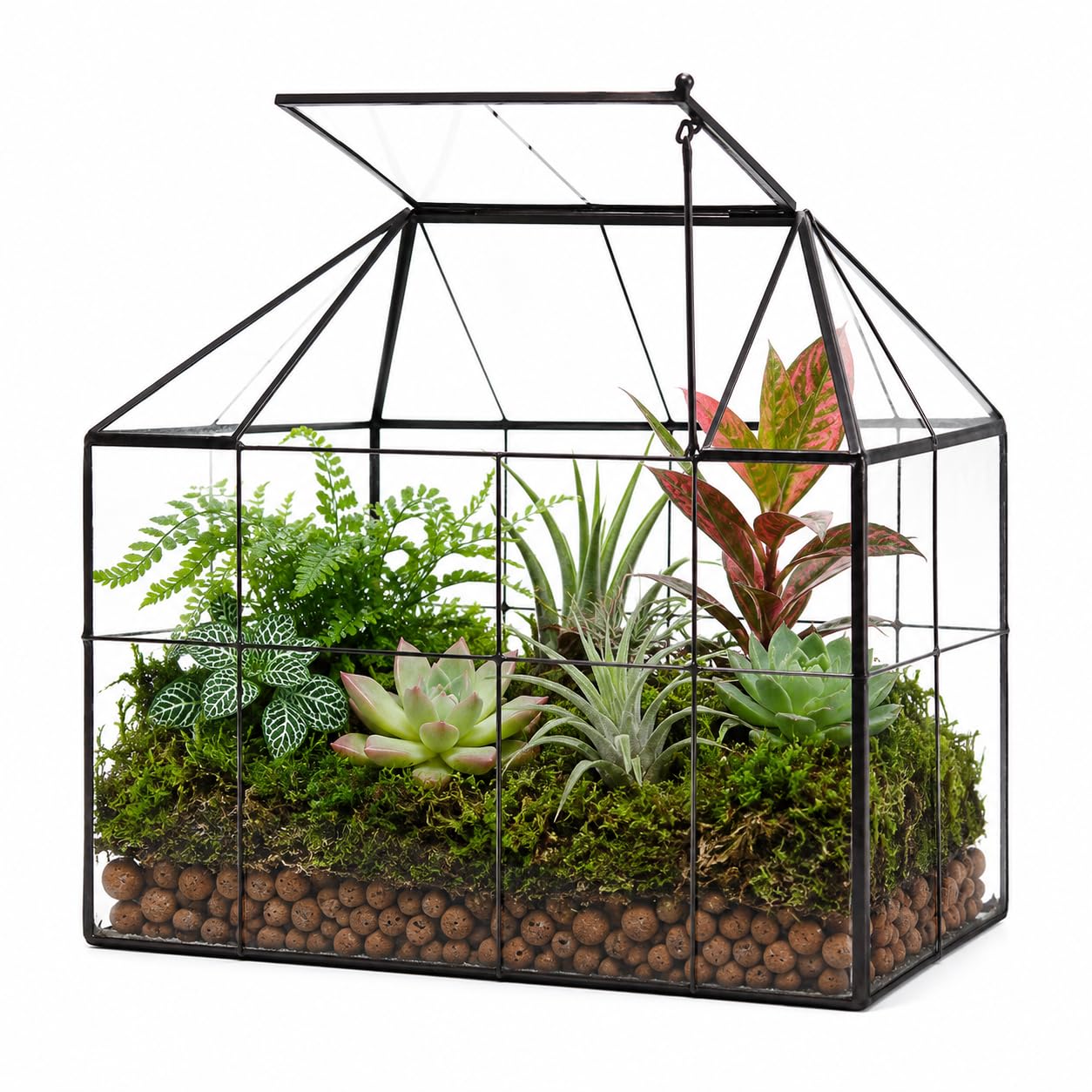
9.8 inches long, 7.9 deep and 5.9 tall: the proportions say what this box is for before you plant anything. It's a landscape case, a moss floor with a few stones and a piece of lichened driftwood, the whole scene visible from above through the glass.

The hinged top is our favorite thing about it. It stays attached, so you can hold a mister in one hand, prop the lid with the other and reach in without finding somewhere to put a loose pane of glass. On a box this wide you'll be reaching across it often, and that's the difference between a terrarium you fiddle with and one you leave alone.

Build-wise it's clear glass in a black metal frame, reinforced rather than wafer-thin, and the house silhouette gives it the look of a small Victorian greenhouse. Like most of the boxes here it isn't meant to hold standing water, so a drainage layer under the substrate and a mister rather than a jug keeps the seams dry.

Where it earns its place is the floor plan: no other glass box in this guide gives you as many square inches to build a scene in. The dollhouse shape is what sells it, and on a windowsill it reads as a decoration that happens to have plants in it, which is a harder trick than it sounds.

Bottom line: For a low, layered landscape with a lid that stays attached while you plant, this is the box to buy; it's all floor and almost no headroom.

6

AREPK Terrarium with Grow Light

AREPK Terrarium with Grow Light

Low-light desks

Our Score 9.2/10
Check Price

Worth Noting

  • Light suits low-light plants only
Light
10W LED with timer
Material
Borosilicate glass
Dimensions
5.9 x 5.9 x 9.8 in
Ventilation
Rotating ring
Read the full review

The light is the reason to consider this one, and it's better thought out than most built-in lamps: a 10W ring of red and blue LEDs, a timer you set once, and a separate low-voltage adapter instead of a brick that hogs the outlet.

The other half of the design is the ring the light sits on. Rotating it narrows or opens the mouth of the 5.9-inch cylinder, so you can close the top down to hold humidity or open it wide after watering. It's a more adjustable version of what the other terrariums here do with a lid, and it means this one is never fully sealed, which is either the point or the compromise depending on what you're growing.

At 9.8 inches tall there's room for a small fern, a carnivorous plant or a moss colony on a desk, though nothing with a wide spread. The light is the part to think hardest about: it supplements a dim corner rather than replacing a south-facing windowsill, and the output is modest by grow-light standards.

What we keep coming back to is the combination: one plug, one timer, one cylinder that holds humidity, on a desk with no room for a clamp lamp. It's the most expensive pick here short of the H Potter, and what you're paying for is the lamp and the timer rather than more glass.

Bottom line: The pick for a dim desk: an adjustable-vent cylinder with its own timer-controlled lamp, so no separate clamp light is needed.

7

Yimorence Tall Greenhouse

Yimorence Tall Greenhouse

Upright plants

Our Score 9.0/10
Check Price

Worth Noting

  • Top lifts off completely; no hinge
Access
Lift-off top
Weight
4.4 lb
Material
Reinforced glass
Dimensions
8.7 x 5.9 x 10.6 in
Read the full review

At 10.6 inches tall this is the tallest case in the guide short of the H Potter, and it's the one that lets a fern, a small orchid or a rooted cutting stand up instead of sprawling sideways. The footprint is modest at 8.7 by 5.9 inches, so it fits a windowsill that a wider box would overhang.

Humidity is where it performs. The top lifts off and the roof carries vents, so the air inside stays damp without going stale, and plants that sulk in dry room air settle in quickly. It also keeps a cat out of the succulents, which is a real argument for glass if you share a house with one.

For an upright plant on a mid-size budget, this is the one we point to: 10.6 inches of glass above the soil line at a price in line with the shorter boxes here. Two things to plan for. The top lifts off in one piece, so you need a hand free and somewhere to set it, and the base is deliberately unsealed so excess water can escape, which means a drainage layer inside and a saucer or mat underneath if it sits on wood.

Bottom line: The tall option for ferns and orchids: 10.6 inches of headroom, dependable humidity, and a base you'll want to set on a saucer.

8

WHJY Glass Cloche

WHJY Glass Cloche

Small propagations

Our Score 9.0/10
Check Price

Worth Noting

  • Shallow base leaves little room for substrate
Base
Included
Size
6 in
Glass
Borosilicate
Ventilation
No air hole
Read the full review

The cheapest thing in this guide, and about as simple as glass gets: a 6-inch borosilicate dome sitting on a shallow base, with no frame, no hinge, no lamp and nothing to assemble.

The dome sits closed on the base, so ventilation is something you do rather than something the terrarium does. Lift the glass off for an hour after watering and set it back when the condensation clears. For a propagation jar, a bit of moss or a single small fern that works, and the borosilicate takes a knock better than the price suggests.

What we tell a first-time buyer is that this is a sensible way to try a closed terrarium without committing much, and it's the one we hand out as a small gift. Don't expect it to be the last one you buy: once the plant fills the dome, you'll be shopping for something with more headroom.

Bottom line: A cheap, honest way to try a closed terrarium: a small dome for a cutting or some moss, as long as you don't mind lifting it to ventilate.

How We Tested Closed Glass Terrariums

We started by comparing specs and reviews for dozens of closed glass terrariums, then narrowed the field by interior volume, opening width, glass thickness, lid or door hardware, seal type, and price. That left 12 units, which we planted with moss, ferns, and small tropicals and lived with for eight months. They sat on a bright windowsill, a shaded bookshelf, a desk, and a kitchen counter—real spots where condensation, dust, and daily rearranging actually happen.

Each week we misted, wiped the glass, and checked whether water had seeped under the base or along the seams onto a paper towel. We opened and closed every lid and door repeatedly, looked for sharp edges or wobbly feet, and measured how much root room and hand room the opening actually gave us. To judge airflow, we watched how long condensation lingered after misting and whether the lid had a vent or a deliberate gap.

After eight months, the differences were visible: clear glass stayed clear, seams stayed dry, and plants did not rot; other units fogged for days, cooked in direct sun, or looked pretty but were too shallow to root into. We factored appearance into every pick—these are display pieces, not hidden utility bins—and judged value by whether the price matched the build, the footprint, and the planting space. Durability showed up in the small things: hinges that loosened, bases that scratched, glass that clouded after wiping.

How to Choose Closed Glass Terrariums

Start With the Opening

You'll open this thing more often than you expect: to mist, to wipe condensation, to pull out a leaf that has gone brown. So the mechanism matters more than the silhouette. A hinged lid or a swing door in the top is easiest to live with because it stays attached and leaves one hand free for the mister, which is why the YIMORENCE house and our top pick both work that way. A lift-off dome is simpler and cheaper, but you need somewhere to set the glass down and clearance above the shelf. If you want to tune humidity rather than just open and close it, look for a prop rod or a rotating ring.

Match the Interior Height to the Plants

The dimensions on the page describe the outside of the box, and on a framed terrarium the frame and base tray take a share of that. What matters is the clear height between substrate and glass. Around five inches will grow moss, selaginella and low ferns; a fern that unfurls upward, a small orchid or a rooted cutting wants closer to ten. A wide, shallow box and a tall one can hold the same volume and grow completely different plants. Measure the plant you have in mind at its mature size, add an inch, and buy for that.

Know What the Base Will Take

Most closed glass terrariums are framed or soldered, and the seams are not built to hold standing water. That is how they are made rather than a fault, and the boxes that say so plainly are being honest with you. The method that works is a drainage layer: an inch or two of gravel, a thin band of activated charcoal, a barrier of mesh or fabric, then substrate on top. Water with a mister rather than a jug, and if the base weeps, stand the whole thing on a saucer. The exception here is the H Potter, whose cast resin tray is watertight and takes a real watering.

Work With Condensation, Not Against It

Fogged glass is the system working: moisture leaves the soil, condenses on the coolest surface and runs back down. It becomes a problem only when it never clears. A small air hole, a prop rod or an adjustable ring gives you something to tune, and after a heavy watering you can simply lift the lid for an hour. The trap is sealing a terrarium over soggy soil and expecting moss to outcompete mold. If the glass stays clouded all day, leave it open overnight and cut back on misting until it settles.

Frequently Asked Questions

Final Verdict

If you're buying one closed terrarium this year, buy the NCYP grid house. Six liters of planting room, a top door that stays where you put it and panels that hold humidity make it the easiest of these to live with, and it's the one we recommend to someone who has never planted glass before.

Two alternatives earn their exceptions: the Libproqia if the shelf is shallow and you want the tightest seal here, and the H Potter if the terrarium is going where guests will see it and the budget is open.