Fencing & Farm Structures

Best T Post Drivers of 2026

A leaning T-post is rarely the post's fault. It starts with the drive: the top skips, the shaft kicks sideways, and by the time you've chased it with a sledgehammer, the whole fence line looks tipsy. A T-post driver is the fix — a weighted steel sleeve with handles that drops over the post and sends it down straighter, with far less hand abuse. The catch is that a bad one is worse than none: too heavy and you're wrecked by post 20; too loose and it rattles, mushrooms the top, or slips off mid-swing.

Over the past eight months, my team and I put 14 drivers through fence-line duty — garden beds, a small pasture, and plenty of stubborn clay. The winners share a few traits: enough heft to do the work, handles that stay comfortable with gloves on, and steel that doesn't dent or loosen at the welds. The right driver won't make rocky ground easy, but it will keep your posts plumb and your shoulders intact. The picks below are sorted by the jobs they handle best.

1

MTB Supply 24-Inch Post Driver

Top Pick
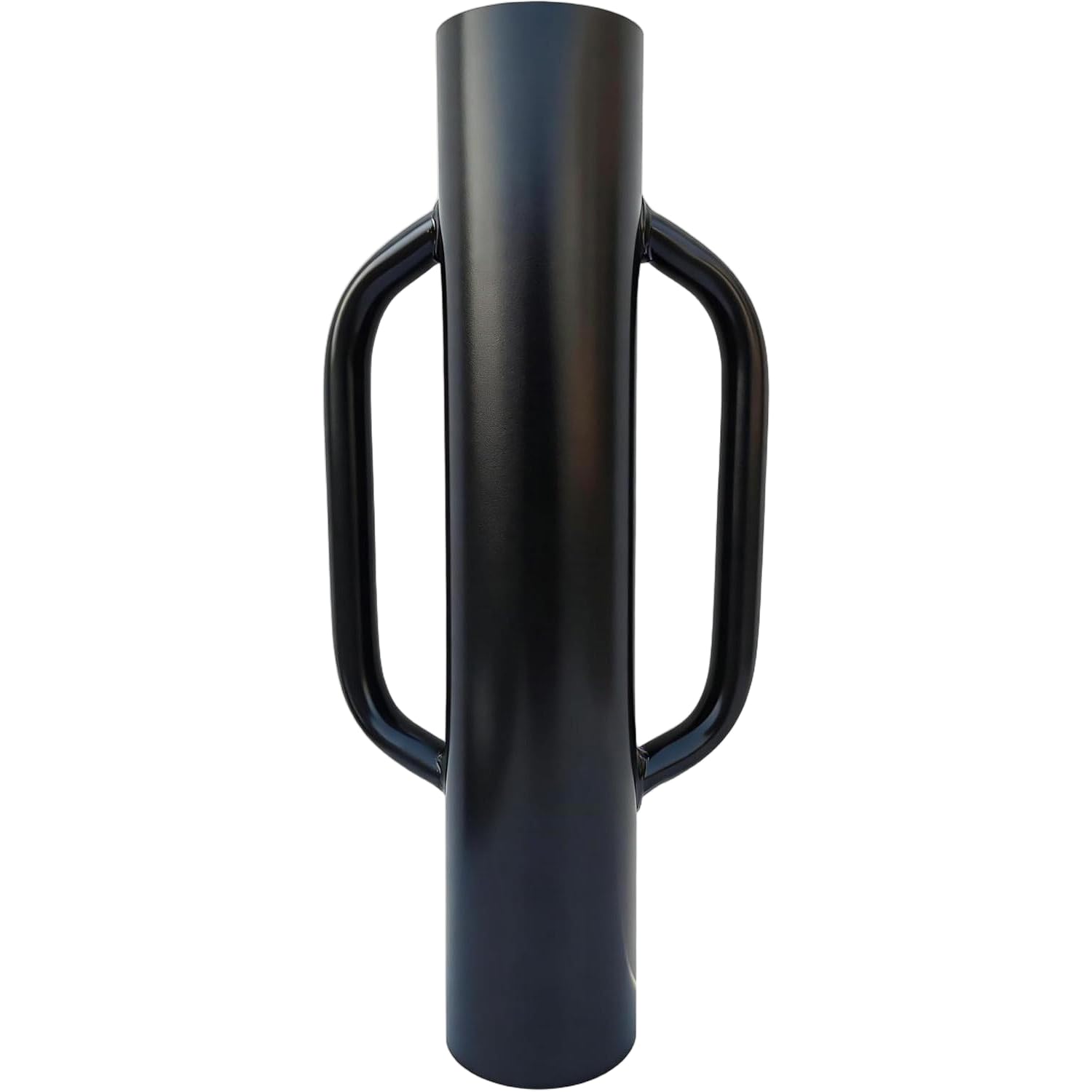
MTB Supply 24-Inch Post Driver

All-around fence work

Our Score 9.6/10
Check Price

Worth Noting

  • 2.67-inch mouth is snug on wider posts
Handle Type
Dual side handles
Drive Weight
12 lb
Overall Length
23.6 inches
Inside Diameter
2.67 inches
Read the full review

A 23.6-inch body paired with a 12-pound head is the combination that made the MTB the driver we kept reaching for. That length gives a longer, straighter lift than the 16- and 17-inch hand drivers here, and the 12-pound head has enough mass to move a common T-post without turning every drop into a wrestling match. The dual handles sit where you want them for a two-handed lift, and the black powder coat is there to shrug off weather and scrapes.

What we appreciated most is the rhythm. You set the driver over the post, lift it by the handles, and let the head fall; the 12 pounds do the work while you concentrate on keeping the post plumb. The round steel tube feels solid in the hand, and the long body gives you more room to correct a lean before the next drop.

It is not the lightest driver here, and that is the point. For a handful of garden stakes, an 8-pound model is easier on the shoulders. For a full fence line, the MTB's mass and length make more sense because you are not trying to generate force with your arms alone.

The MTB is the one we choose first when the posts are standard and the ground is workable. Check the mouth against your post, keep the lift vertical, and it settles into a steady pace.

Bottom line: We recommend the MTB as the default T-post driver for common fence posts: the 12-pound head and 23.6-inch body give a steady lift-and-drop rhythm.

2

LADECH 8-Pound Post Driver

LADECH 8-Pound Post Driver

Compact storage

Our Score 9.4/10
Check Price

Worth Noting

  • Needs more strokes in firm ground
  • Not the wide-fit option
Handle Type
Dual side handles
Item Weight
9.22 lb
Overall Length
15.8 inches
Inside Diameter
2.7 inches
Read the full review

The LADECH's 15.8-inch body is the shortest here, which makes it the one to consider for tight storage and lower lifting. It still carries a 2.7-inch mouth and a listed 9.22 pounds, so it is not a toy, but it is clearly aimed at smaller jobs.

The dual handles are designed for a secure grip, and the powder-coated steel is finished to resist rust. The short body makes it easy to keep the driver centered on a garden stake or a sign post, and the lighter package is less tiring to lift repeatedly. It is the kind of tool that fits on a shelf and comes out for a weekend project.

The trade-off is momentum. A shorter, lighter driver needs more strokes in firm ground, and the 2.7-inch mouth is not the wide-fit option. If you are setting a long fence line, the MTB's longer body and 12-pound head are easier to keep in a rhythm; if you are working around the yard, the LADECH's compact size is the advantage.

We like it for gardeners and homeowners who want a dedicated driver without a big storage footprint. It is not the hardest-hitting tool here, and it does not pretend to be.

Bottom line: We like the LADECH for tight storage and lighter users; its short body is easy to handle and still carries a 2.7-inch mouth.

3

VEVOR 14-Pound Post Driver

VEVOR 14-Pound Post Driver

Hard ground

Our Score 9.2/10
Check Price

Worth Noting

  • Fourteen pounds tires shoulders on overhead work
Material
Carbon steel
Drive Weight
14.1 lb
Overall Length
19.29 inches
Inside Diameter
2.7 inches
Read the full review

When the ground gets stubborn, a 12-pound driver can start to feel like a suggestion. The VEVOR's 14.1-pound head is the next sensible step up in this set, and its 19.29-inch body gives that mass room to travel before it lands.

We think it is the right manual driver for hard clay, packed gravel, and long posts that need more than a tap. The carbon-steel body and reinforced head are built for repeated impact, the loop handles leave room for gloves, and the 2.7-inch mouth fits many common T-posts and U-posts. It is a simple tool: no engine, no fuel, no extra setup.

The cost is in your shoulders. Fourteen pounds is manageable for one person, but the extra mass over a 12-pounder shows up after a long run, especially when you are lifting the driver overhead to clear a tall post. If your ground is merely firm rather than brutal, the MTB's lighter 12-pound head is easier to live with.

For a short, tough run, the VEVOR is the one we hand over without hesitation; for an all-day fence line, we pace ourselves.

Bottom line: Choose the VEVOR when the ground needs more than a 12-pound driver: the 14.1-pound head adds mass without turning the job into a two-person operation.

4

Sekcen 8-Pound Post Driver

Sekcen 8-Pound Post Driver

Wide posts

Our Score 9.2/10
Check Price

Worth Noting

  • Lighter head needs more lifts in hard ground
Material
Powder-coated steel
Drive Weight
8.25 lb
Overall Length
17 inches
Inside Diameter
2.9 inches
Read the full review

The 2.9-inch inside diameter is the reason to look at the Sekcen before the rest. That mouth is the widest among the manual drivers here, so it takes standard T-posts, U-posts, and wider stakes that can bind in a 2.7-inch tube. If your posts are inconsistent or you have a mix of metal and wooden stakes, that extra clearance is worth having.

At 8.25 pounds, it is a lighter driver, and we found that suits garden work, shorter posts, and anyone who does not want to haul 14 pounds over their head. The 17-inch body is compact enough to store on a shelf, and the dual handles give a secure two-handed lift. The powder-coated steel is straightforward to wipe down after a muddy job.

The lighter head is the catch. In hard ground, you will make more lifts than you would with the 12-pound MTB or the 14.1-pound VEVOR, and the shorter body gives you less travel to build momentum. That is a fair trade for the wider fit and easier handling, but it is not the driver for a long line of stubborn posts.

For a small property with mixed posts, the Sekcen is the one that avoids the frustrating moment when a driver will not go over the top.

Bottom line: We reach for the Sekcen when post fit is the question: the 2.9-inch mouth takes wider stakes, and the 8.25-pound head is easy to manage.

5

Gtongoko 8-Pound Post Driver

Gtongoko 8-Pound Post Driver

Light garden jobs

Our Score 9.2/10
Check Price

Worth Noting

  • Lighter head needs more lifts in hard ground
Handle Type
Dual side handles
Item Weight
7.94 lb
Overall Length
17 inches
Inside Diameter
2.7 inches
Read the full review

The Gtongoko is the lightest driver here, and that is both its appeal and its limit. At 7.94 pounds, it is easy to lift over a post and easy to pack away, which makes it a good match for garden stakes and occasional fence repairs rather than a full line of hard posts.

The 2.7-inch inside diameter covers many standard T-posts and U-posts, and the dual side handles are shaped for a straightforward lift-and-drop. The powder-coated steel should resist rust, and the 17-inch body is compact enough to store without a dedicated corner of the shed. It is a simple tool, and simple is what you want when you are balancing a post with one hand.

The lighter head asks more of you. In firm ground, you will make more lifts than with a 12-pounder, and the shorter body gives less travel to build momentum. The wide mouth can also rock on a thin stake if you twist the driver on the way down; keep the lift vertical, and it behaves better.

It is the driver we keep for the odd job, not the one we plan a fence around.

Bottom line: The Gtongoko is the lightest driver here, a good match for garden stakes and occasional posts where lifting ease matters more than speed.

6

FOREHOGAR 12-Pound Post Driver

FOREHOGAR 12-Pound Post Driver

Mixed yard posts

Our Score 9.2/10
Check Price

Worth Noting

  • Less travel than longer drivers in hard ground
  • Won't fit posts wider than 2.5 inches
Post Fit
Up to 2.5 inches
Drive Weight
11.9 lb
Overall Length
16.5 inches
Inside Diameter
2.7 inches
Read the full review

A plain 12-pound build with a 16.5-inch body is what FOREHOGAR offers, and that familiar recipe is the point. It is not trying to be the widest, longest, or heaviest driver here; it is trying to be an easy one to own.

The 2.7-inch inside diameter handles many common T-posts and U-posts, while the opening is rated for posts up to 2.5 inches in diameter. The dual handles are roomy, the powder-coated steel is finished for weather, and the short body gives you a compact tool to store. At 11.9 pounds, it sits in the same working class as a 12-pounder.

What we noticed is that the short body makes it easy to control on garden stakes and shorter posts. You are not managing a long tube overhead, and the 12-pound head still has enough mass to move a post in workable soil. In really hard ground, it will take more drops than the VEVOR or Yellow Paw, and the 16.5-inch body gives less travel.

We recommend it for a homeowner who wants one manual driver for a mix of garden stakes, sign posts, and the occasional fence repair. It is the middle of the road in a useful way: enough weight to work, not so much that it becomes a chore.

Bottom line: FOREHOGAR is a sensible middle-weight manual driver for common T-posts, with a 12-pound head and a 16.5-inch body that stores easily.

7

Yellow Paw 18.5-Pound Driver

Yellow Paw 18.5-Pound Driver

Tough posts

Our Score 8.8/10
Check Price

Worth Noting

  • Heavy enough to wear out casual users
  • Long body needs overhead clearance
Handle Type
Extra-wide handles
Drive Weight
18.5 lb
Overall Length
24 inches
Inside Diameter
2.75 inches
Read the full review

At 18.5 pounds, the Yellow Paw is not the driver we hand to someone who wants a quick garden-stake job. It is built for the opposite situation: a line of posts in hard ground where a lighter driver bounces and you want mass doing the work.

The 24-inch body is the longest here, and the extra-wide handles give gloved hands room to grip without pinching. With a 2.75-inch opening, it clears standard T-posts and many U-posts, and the powder-coated steel has the plain, industrial look of a tool that expects to be left outside.

We recommend it for strong users with a tough run of posts, not for the whole afternoon if you can avoid it. The weight that makes it effective is also the weight you lift on every stroke, and the long body needs overhead clearance. On a short stretch of stubborn ground, that trade is worth it; on a long fence, a 12- or 14-pounder is easier to pace.

The Yellow Paw is the specialist in this group: the driver we keep for the posts that have fought back.

Bottom line: The Yellow Paw is our pick for hard ground and strong arms: 18.5 pounds and a 24-inch body put real mass behind each drop.

8

JACKCHEN 52cc Gas Driver

JACKCHEN 52cc Gas Driver

Long fence lines

Our Score 8.4/10
Check Price

Worth Noting

  • 42-pound body is hard to lift overhead
  • Much more expensive than manual picks
Engine
52cc two-stroke
Item Weight
42 lb
Impact Energy
55 joules
No-Load Speed
6500 RPM
Read the full review

The 42-pound lift is the first thing to understand about the JACKCHEN. This is not a hand driver with an engine bolted on; it is a two-handed power tool that you position over a post, start, and guide while the engine does the pounding.

The 52cc two-stroke engine, 55 joules of impact energy, and 6500 rpm no-load speed are aimed at long fence lines, orchard rows, and farm work where speed matters. We appreciate the two sleeves for different post sizes and the rubber-plastic handles, which give you something to hold against the recoil. In soft to workable soil, it turns post setting into a production task.

We recommend it for large jobs and for people who already have a system for handling a heavy, fuel-powered tool. The weight is the price of that speed: 42 pounds is a lot to lift over a tall post, and it is not a tool you casually pull out for six garden stakes. The main shaft and drive-end durability are the other question marks; this is a machine that may need service, not a hand tool you expect to last forever.

For a contractor or a landowner with hundreds of posts, the time savings can justify the bulk. For everyone else, a manual driver is simpler and easier to live with.

Bottom line: The JACKCHEN is for long fence lines, not small gardens: it drives fast, and the gas engine saves the shoulders on repeated posts.

How We Tested T-Post Drivers

We started by pulling every T-post driver we could find from farm-and-ranch suppliers and home improvement stores, then narrowed the field by steel gauge, handle design, listed weight, and price. We ruled out anything with spot-welded handles, plastic grips that looked likely to split, and sleeves that didn't have a clear top plate. That left 14 drivers, and we used each one for eight months.

Most of the testing happened along a backyard fence line and two garden plots, with a side run on a friend's small pasture. We drove six-foot T-posts into clay, loam, and one stretch of rocky ground, rotating drivers so every model hit the same conditions. For each driver, we counted strokes to set a post, checked plumb with a level, then pushed each finished post side-to-side to see how much it moved. We also noted whether the driver stayed seated between strikes or slipped, and whether it left the post top mushroomed.

Comfort got as much attention as steel. We weighed each driver and checked sleeve fit and handle opening against common T-post sizes, then drove 20 posts in a row with and without work gloves, paying attention to handle shape, vibration, and where the weight sat. Durability checks came after every session: we looked for dents at the striking face, loose handles, chipped coatings, and rust at the welds. To judge value, we compared each driver against a sledgehammer and against the rest of the field — a heavier model wasn't worth much if it tired us out or cost twice as much for the same result.

How to Choose T Post Drivers

Match the head weight to the job

A driver works by lifting and dropping mass, so weight is the first decision. An 8- to 10-pound driver is easier to handle for garden stakes, shorter posts, and smaller users; expect more lifts in firm ground. A 12- to 14-pound driver is the all-purpose range for common T-posts and mixed soil. An 18-pound model makes sense for a short run of stubborn posts, not an all-day fence. The MTB's 12-pound head is the balance we prefer for most work; the Yellow Paw's 18.5 pounds is the specialist.

Measure the post, not the label

Inside diameter is where a driver can disappoint. The common 2.7-inch mouth covers many T-posts and U-posts, but posts vary at the tabs, and a wooden stake can be wider than its nominal size. Measure the widest point of the post you plan to drive and compare it with the driver's inside diameter, not its outside width. The Sekcen's 2.9-inch mouth is the widest among the manual picks here; the MTB's 2.67-inch mouth is snugger. If the fit is close, size up rather than plan to force it.

Length, handles, and control

A longer body gives you more travel and a better chance of keeping the drop vertical; a shorter body is easier to store and less awkward overhead. The 23.6- and 24-inch drivers here suit fence lines, while the 15.8- to 17-inch models suit garden stakes and tight sheds. Handles matter as much as length: dual side handles let you lift with both hands, and roomy loops leave space for gloves. If the handles pinch or the body feels too short, you will fight the tool instead of the post.

Manual or gas: pick by project size

Manual drivers are quieter, simpler, and ready when you are. A gas driver such as the JACKCHEN makes sense when you have a long fence line and the speed justifies a 42-pound tool, fuel, and more maintenance. For a few dozen posts, a manual 12- or 14-pounder is less fuss and easier to control. For hundreds of posts, the gas unit's pace can win out, provided you have a second person for the lift and a plan for service.

Check the impact end

Repeated impact concentrates stress at the top cap, the welds, and the handle mounts. Look for a closed, reinforced top and clean welds, and inspect those areas before each session. Avoid using a driver with a cracked cap or a loose handle; a failure under load is not worth the risk. The VEVOR and FOREHOGAR have straightforward welded steel construction, while the gas JACKCHEN has more mechanical parts that can need attention. A simple manual driver has fewer things to go wrong.

Frequently Asked Questions

Final Verdict

Start with the MTB Supply 24-inch driver. Its 12-pound head and 23.6-inch body give the best balance of mass, control, and common-post fit in this set, and it is the one we reach for when the job is a normal fence line. If your ground is harder, step up to the VEVOR's 14.1 pounds; for a short run of brutal posts, the Yellow Paw's 18.5 pounds earns its weight. For hundreds of posts, the gas JACKCHEN makes sense if you are ready for the lift.