Fencing & Farm Structures

Best Greenhouse Heaters of 2026

A greenhouse heater has one job: keep the plants you've babied all season from turning to mush on the first hard freeze. If you've ever watched a forecast drop into the 20s and wondered whether one unit could save your seedlings, you're not alone. A good heater buys you a buffer against cold snaps without cooking your plants or tripping a breaker. Over the past seven months, my team and I ran ten greenhouse heaters through a full winter—October through April—in a backyard greenhouse and a community garden hoop house.

Greenhouse heaters aren't repurposed space heaters. Damp air, condensation, and tight clearances change what's safe and what lasts, and a thermostat that reads two degrees off can mean frozen starts. We paid attention to heat output on cold nights, warm-up speed after the door opened, noise, compact size, build quality, durability after months of damp air, and value. We also checked safety details like hot housings and cord placement around wet soil, and the picks below are the ones that passed without babysitting.

1

Air Choice Greenhouse Heater

Top Pick
Air Choice Greenhouse Heater

Small greenhouses

Our Score 8.6/10
Check Price

Worth Noting

  • No published coverage rating
  • 12.5-amp draw wants its own circuit
Power Draw
120V, 12.5A
Thermostat
Digital, 40 °F minimum
Cord Length
7.5 ft
Heat Settings
750W, 1,500W, and fan only
Read the full review

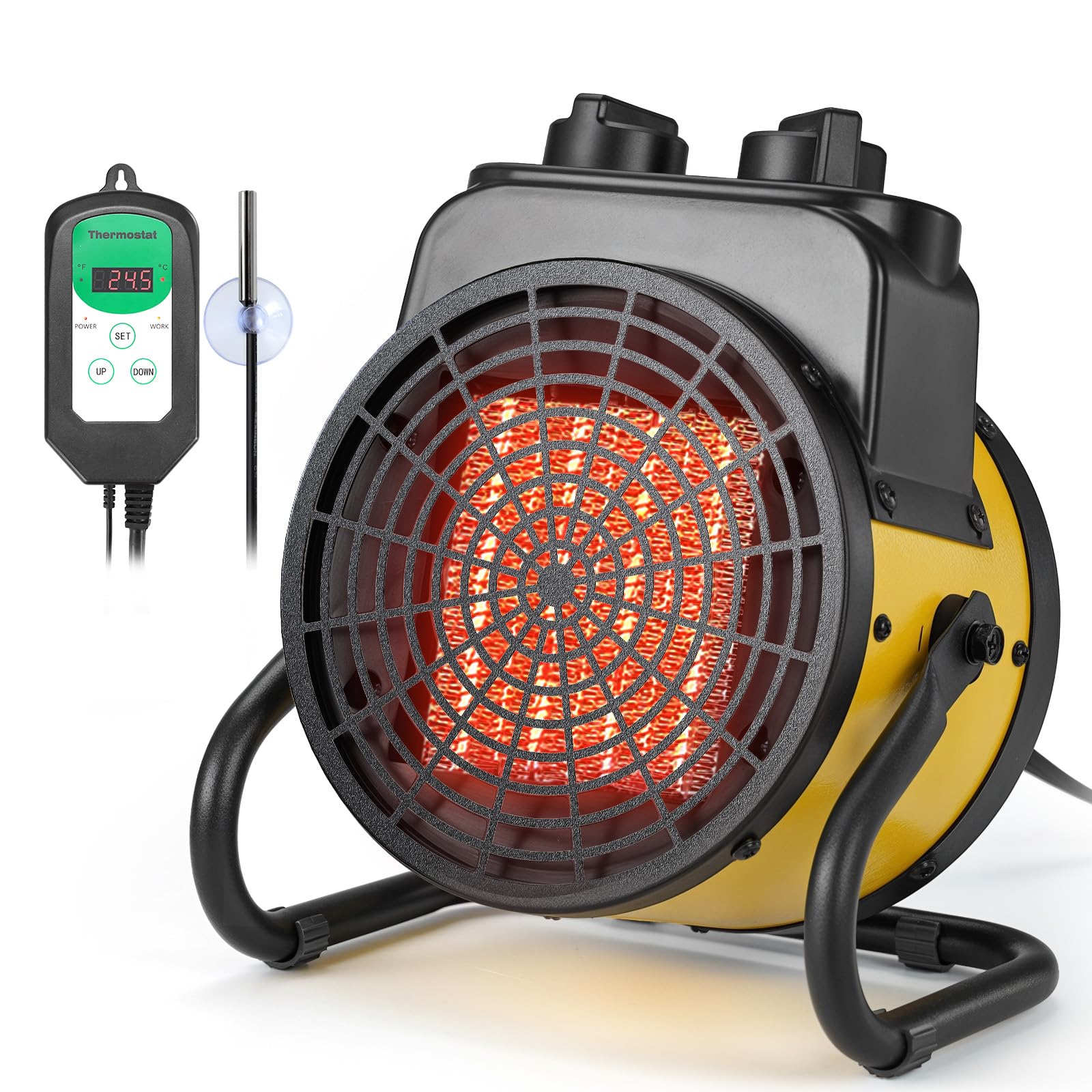
The number that decides whether a greenhouse heater earns its place is not the wattage on the box — it is the lowest temperature the thermostat will hold. Plenty of small heaters stop at 60 °F, which is room comfort, not plant protection. The Air Choice goes down to 40 °F on an independent digital controller with a waterproof probe on a lead, so it responds to the air where you have put the probe instead of the air drifting past the housing. That is the single reason it is our top pick.

The rest of the package holds up. There are three modes — 750 watts, 1,500 watts, and fan only — and the fan-only setting gets more use than we expected, because moving air through a closed, damp greenhouse on a mild afternoon is worth doing on its own. The PTC element has no glowing coil to warm up, so it is producing heat within seconds of switching on, and the flat little body is small enough to sit between pots on a bench. The 7.5-foot cord is a genuinely useful length in a greenhouse, where the nearest outlet is usually behind a shelf.

Plan the circuit before you plan the plants. At 1,500 watts it pulls 12.5 amps, which means it wants a 15-amp circuit largely to itself rather than sharing with grow lights and a heat mat. Air Choice also publishes no square-footage rating, so you are sizing this one by the structure and the breaker rather than a number on the listing. For a hobby greenhouse or a decent grow tent, that is the right class of heater.

Bottom line: Our pick for a small greenhouse or grow tent: the 40 °F setpoint and remote probe make it the one heater here that protects plants rather than just warming a room.
2

Kiroto Smart Greenhouse Heater

Kiroto Smart Greenhouse Heater

Remote monitoring

Our Score 8.6/10
Check Price

Worth Noting

  • Highest price in this group
  • No moisture rating for a damp house
Controls
Wi-Fi app, 70° swing
Heat Output
1,500W
Coverage Claim
150 sq ft
Temperature Range
41 to 113 °F
Read the full review

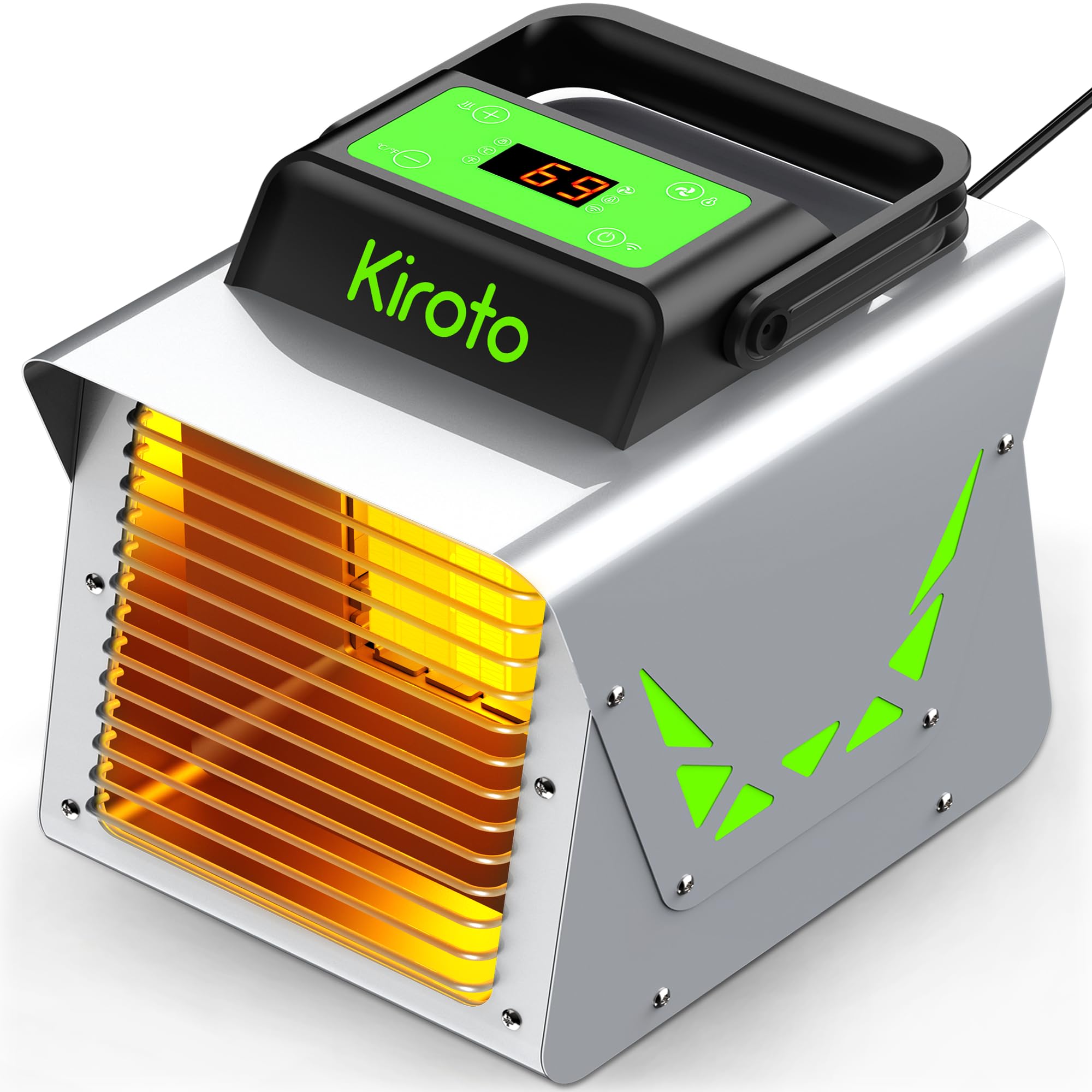
Every other heater in this guide has to be adjusted in person. The Kiroto is the one you can check from the house: it joins your Wi-Fi through the Smart Life app, so you can change the setpoint, switch it to fan, and get a warning if the temperature runs away in either direction without pulling on boots. For a greenhouse at the far end of a yard, or a week away in February, that is the feature that decides the purchase rather than a nice extra.

Underneath the app it is a 1,500-watt heater rated for 150 square feet, with a 41 to 113 °F range and a 70-degree swing that sweeps warm air across a bench instead of blasting one aisle. At roughly 8 by 6 by 7 inches and 8 pounds it is the smallest unit here, which makes it easy to tuck on the end of a shelf or on the floor between pots. Heat and fan modes cover the seasons, and the 41 °F floor is low enough to be a real frost setting rather than a token one.

The limits are specific rather than vague. The coverage claim is the smallest in this group, no moisture rating is published, so it needs to sit where misting and hose spray will not reach, and the whole proposition rests on your signal reaching the greenhouse. Test that before you order, because a smart heater on a weak connection is an expensive dumb heater. Where the signal is good, the swing is the detail we did not expect to care about — it is what stops one corner of a small house from being the only warm spot.

Bottom line: Buy the Kiroto if you cannot be in the greenhouse every evening; app control and a 41 °F setpoint are worth the premium as long as the Wi-Fi reaches the door.

3

DR Infrared DR218 3000W

DR Infrared DR218 3000W

Large greenhouses

Our Score 8.4/10
Check Price

Worth Noting

  • Runs only on a 240-volt circuit
  • Some units stop heating within a season
Heat Output
3,000W
Coverage Claim
600 sq ft
Moisture Rating
IPX4
Power Requirement
240V, 12.5A
Read the full review

Three thousand watts is a different class of heater, and the DR218 is the only unit here that will hold temperature in a big, leaky greenhouse on a hard freeze. Whether you can own it comes down to one number: 240. It runs on a 240-volt, 12.5-amp circuit — the outlet behind an electric dryer or a shop welder — not the 120-volt socket by the back door. If you cannot have that circuit run, this is not your heater, however well suited it is to the job.

What the wiring buys you is a genuinely greenhouse-shaped machine. The IPX4 rating means it tolerates spray and drips in a way nothing else here claims to, and in a house that gets hosed down and misted, that is the specification we care most about. It heats radiantly and moves air with a fan, so it warms the plants and the soil surface rather than only the air between them, and it claims 600 square feet. The 10-by-10-inch footprint slides under a bench, and 13 pounds of steel stays where you set it down.

Control is the compromise. There is no numbered thermostat — a dial from low to high — so you find your setting by watching a min-max thermometer and you cannot return to last night's position exactly. Longevity is the other caveat: heaters that quit after a season come up often enough to be worth knowing about, and there is at least one case of the housing sparking and smoking, which is why we would not tuck this one behind a curtain of plastic. Keep it on its own breaker with the breaker within reach, clear of anything that can fall against it, and check the cord and housing every few weeks through the winter.

Bottom line: We recommend it for one job only — a large, unheated greenhouse with a 240-volt circuit already in place — and for that job nothing else here comes close.

4

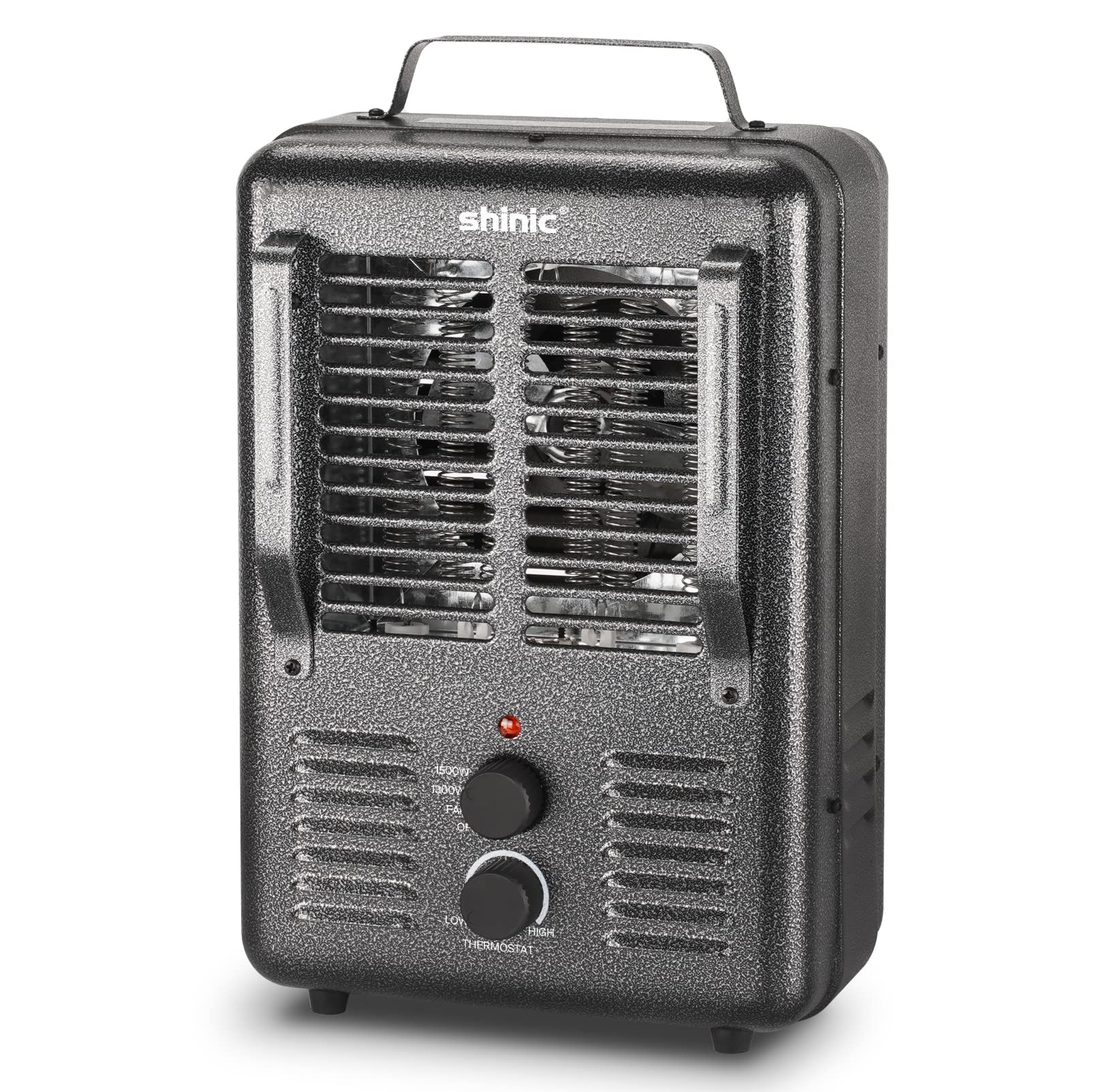
Shinic 1500W Milkhouse Heater

Shinic 1500W Milkhouse Heater

Budget warm-up

Our Score 8.4/10
Check Price

Worth Noting

  • Thermostat will not set below 60 °F
  • Indoor-rated, with no splash protection
Safety
Tip-over and overheat shutoff
Thermostat
Rotary, 60 to 90 °F
Heat Settings
1,500W, 1,300W, and fan
Coverage Claim
200 sq ft
Read the full review

This is the cheapest heater here, and it looks the part in the least objectionable way: a metal box, a fan, a rotary knob, a three-prong plug, and a handle on top. Nothing about it is clever. For a shed, a garage workshop, or a greenhouse you are pushing into growth in March, that is fine — sometimes a heater just needs to make cold air warm.

Then you reach the thermostat, and the arithmetic changes. The dial runs from 60 to 90 °F, and 60 is shirt-sleeve weather, not a frost-free greenhouse. Set as low as it goes and you are paying to hold a small house at room temperature through January, which is the opposite of what most people want a greenhouse heater for. It is a warm-up heater rather than a plant-protection heater, and the difference only shows up in the coldest six weeks of the year.

What it does well is straightforward: 1,500 watts and 1,300 watts plus a fan-only setting, a 200-square-foot claim, an all-metal case, tip-over and overheat shutoffs, and a body small enough — under 10 inches wide, 15.8 inches tall — to sit on a shelf out of the way. The hesitation is damp. This is an indoor-rated heater with no splash protection, and while the shutoffs are there, it is a heater to supervise: GFCI outlet, off a wet floor, clear of hose spray, and not running overnight in a sealed house while you sleep.

Bottom line: We rate it as a cheap warm-up for a shed, garage, or spring greenhouse — the 60 °F thermostat floor rules it out as winter frost protection.

How We Chose and Tested Greenhouse Heaters

We started by pulling together every heater marketed for greenhouses, then filtering out models with vague output claims, exposed elements that looked risky around damp soil, or footprints too large for a standard 6-by-8-foot greenhouse. That left ten units, from small fan-forced heaters to larger models with digital thermostats. We ran them from October through April in a backyard greenhouse and a community garden hoop house, swapping each one in for at least two weeks.

On the coldest nights, we placed a separate thermometer at bench height and another near the floor, then logged how long each heater took to lift the space by 10 degrees. We opened the door for five minutes to mimic a morning watering session and timed the recovery. Thermostats got checked against our own readings, and we noted whether a unit cycled on and off steadily or overshot the set temperature. Noise was judged from two feet away—quiet enough to talk over, or a drone you'd hear from the house.

Each heater also had to earn its floor space. We measured footprints, checked whether the housing stayed cool enough to touch near wet pots, and looked at cord length and placement. Build quality got inspected at the seams, fasteners, and fan grilles; after months of condensation, we noted corrosion, rattles, or fans that started to whine. And because a heater is only a bargain if it lasts, we weighed the price against the heat it actually delivered.

How to Choose Greenhouse Heaters

Check the Circuit Before the Wattage

Nearly every plug-in heater here tops out at 1,500 watts, and that is not a coincidence. On a standard 120-volt, 15-amp circuit, 1,500 watts pulls 12.5 amps — close to all a shared circuit will carry alongside a couple of lights. So 1,500 watts is the sensible ceiling for a hobby greenhouse, a grow tent, or a shed wired like a house.

A large, unheated glass house is a different problem. Holding temperature through a hard freeze takes 240-volt equipment, which means an electrician and a dedicated circuit, so find out what your outlet is before you fall for a spec sheet. Treat coverage claims as estimates too: a sealed, twin-wall house holds heat that a rattling old aluminum frame will not. You will also see the same heater sold under several brand names in this category, so compare the setpoint range, the probe and the cord rather than the badge.

The Setpoint Is the Whole Point

You are not heating a greenhouse for comfort; you are keeping the water inside plant cells from freezing, which usually means holding somewhere around 40 to 45 °F. That makes the bottom of the thermostat range the most important number in the listing. A heater that stops at 60 °F will cost you a fortune holding a small house at living-room temperature, and it cannot be asked to do anything cooler.

Digital control with a remote probe beats a rotary dial here: you set a number, the probe reads the air where the plants are, and the heater cycles against that. With a dial you find a position by watching a thermometer, then try to remember where it was. Put the probe at canopy height, out of the heater's airstream and away from the door you open fifty times a week.

Plan for Wet, Not Just Cold

A greenhouse is a damp building. Condensation runs down the glazing, misting wets the benches, and the floor is often wet. An IPX4 splash rating is the one to look for, and it is rare in this category — most heaters publish no moisture rating at all and should be treated as dry-goods appliances.

That is a siting decision as much as a shopping one. Raise the heater off a wet floor on a block or a shelf, keep it clear of hose spray and drip lines, run it on a GFCI-protected outlet, and plug it straight into the wall rather than a power strip. If the only outlet is across the garden, have one fitted closer, because a long thin extension cord feeding a 12.5-amp heater is exactly the combination that starts fires.

Fan Mode, Air Movement, and Noise

Still, saturated air is what grows botrytis, so a fan-only setting earns its place in a winter greenhouse even on days that need no heat at all. Moving air also spreads warmth past the corner where the heater sits, which matters in a long, narrow house where one end stays cold.

Fans are also the part you hear. Expect some noise, and treat a new rattle as a service issue rather than a quirk — a fan on its way out is usually noisy before it dies, which gives you time to swap the unit before a cold night rather than during one.

Frequently Asked Questions

Final Verdict

Our pick is the Air Choice. It is the one heater here that lets you set 40 °F and walk away, and the remote probe means the number on the controller is the number where your plants actually are — which is the whole job in a winter greenhouse.

If your greenhouse is large, unheated, and already has a 240-volt circuit, the DR Infrared is the better machine and the only one here with splash protection. If you are away more than you are home, pay the premium for the Kiroto, but check the Wi-Fi at the door before you order.