Watering & Irrigation

Best Soaker Hoses of 2026

A soaker hose is the least glamorous thing in the garden and the one doing the quietest work: you lay it down, crack the tap a quarter turn, and water sweats out along the whole run, right where the roots are, while the leaves stay dry and the weeds between rows don't get a free drink. That's the promise, anyway. In practice, plenty of them soak the first ten feet and give up, pop a fitting at the spigot, or kink into a permanent memory of wherever you coiled them in the fall. A good one just does the job, season after season, without you thinking about it.

I've killed more soaker hoses than I'd like to admit, so this spring my team and I put 12 of them through five months of real watering — raised beds, a sloped tomato row, and a hedge that has never once been adequately watered. Here's the thing nobody tells a first-time buyer: these hoses seep rather than spray, which means pressure and run length matter more than anything printed on the package. A 100-footer on a weak spigot will barely wet its last third, and running one full blast is how you blow a connector. Below are the ones that actually delivered water end to end — whether you've got a single bed or a whole backyard of them.

1

Water Right 700 Series Soaker Hose

Top Pick
Water Right 700 Series Soaker Hose

Everyday garden watering

Our Score 9.0/10
Check Price

Worth Noting

  • A 4.2-pound coil to haul and store
  • Costs more than any other hose here
Length
50 ft
Material
Polyurethane
Warranty
5 years
Max Pressure
150 psi
Read the full review

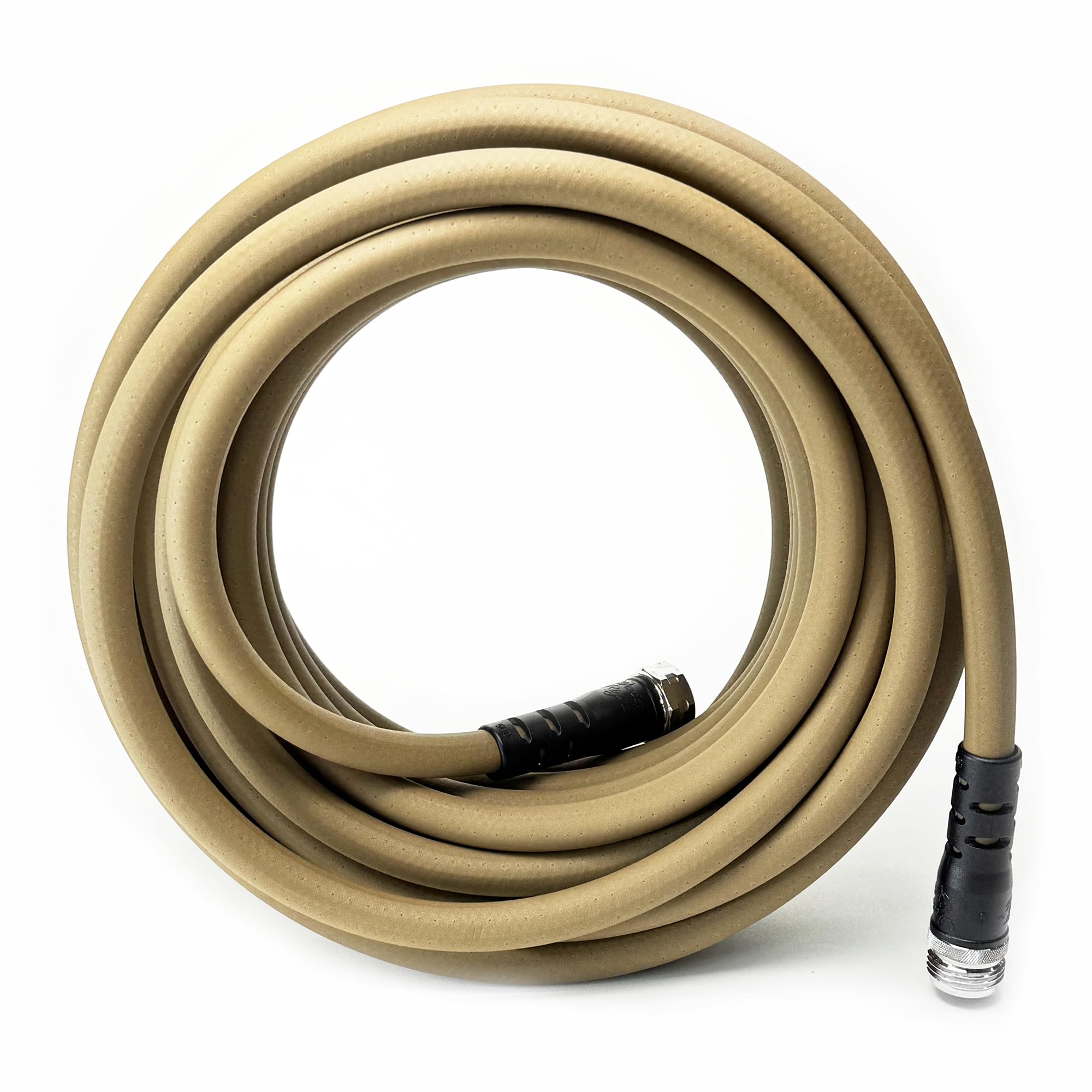
Cheap soaker hoses fail the same way. A split opens mid-run, water jets out of one spot, and the rest of the bed stays dry while you stand there with a shovel. The Water Right 700 Series is the hose in this group we trust to still be in the ground three summers from now. It is the strongest here on both build quality and even watering, and the complaints that dog almost every other soaker hose barely come up.

Polyurethane is the reason. At 50 feet and 4.2 pounds it stays where you drop it instead of skittering under the mulch like the flat vinyl weepers, and it bends around a shrub without folding over on itself. Both ends carry strain reliefs, which is exactly where cheap hoses give out first, and the 150 psi maximum means a fully open tap is not going to threaten it. We also appreciate that the material is listed as drinking-water safe and leaves no black residue on your hands after a morning of coiling and staking.

Two practical notes before you buy. Hard water will clog the pores over time, and an inline filter between the tap and the hose is the fix; lawn chemicals are worth keeping off the hose itself for the same reason. Run it through a vegetable bed and it is one of the few soakers here we are glad to put next to food crops, which is the part that matters if you grow anything you eat.

Bottom line: We recommend it to anyone tired of replacing a soaker every spring: it waters evenly to the end of the run and is the most durable hose here.

2

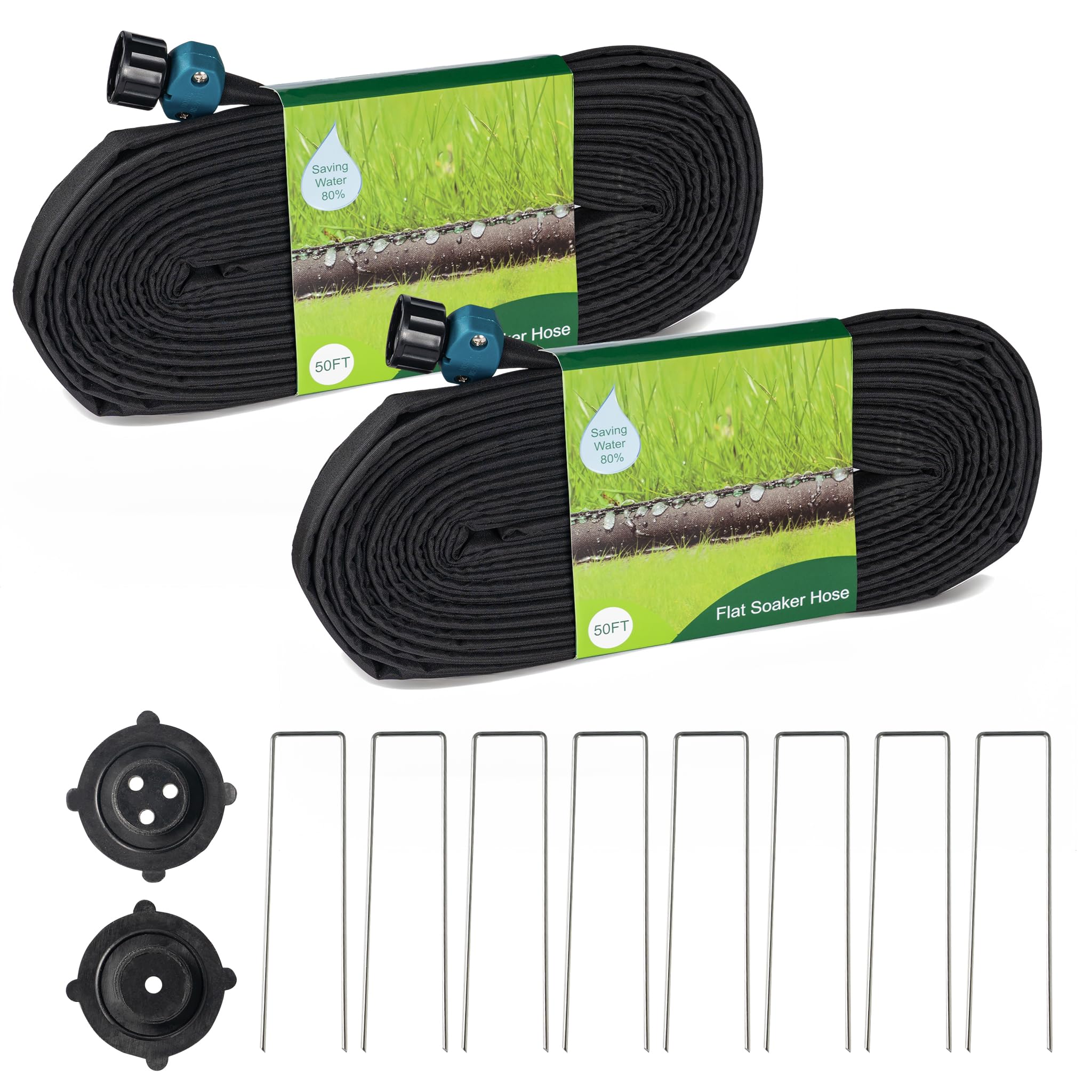
One Stop Gardens Flat Soaker Hose

One Stop Gardens Flat Soaker Hose

Vegetable rows

Our Score 8.6/10
Check Price

Worth Noting

  • Seams are the first thing to give out
Length
50 ft
Material
Woven nylon
Thread Size
3/4 in.
Flow Control
Miser discs, up to 75% reduction
Read the full review

Two small discs are the most interesting thing about this hose. Drop a miser disc into the fitting and you cut the flow by up to 75 percent, which turns a fast weeper into the slow soak you actually want on clay, or on a slope where water would otherwise run off before it sank in. The thread is a standard three-quarter inch, so it hooks straight to the spigot without an adapter.

The rest is a flat woven-nylon weeper: fifty feet, light enough to flop over your arm, lying flat along a vegetable row where a round hose would roll out of place. Full flow and it gushes; with a disc in, it seeps. That range is why it earns a spot here, because most soakers give you one speed determined by your tap.

It is also the least expensive hose in this group, which makes the kinks easier to forgive. Ask it to turn a tight corner around a shrub and it folds on itself and stops feeding the far side, so route corners in a gentle loop and stake them. Laid straight down a row and left alone, it does what the pricier hoses here do, only more slowly, and more slowly is the point.

Bottom line: For straight vegetable rows on a tight budget, we have not found better value here: the miser discs make a genuinely slow soak.

3

KOBAZ Sprinkler Soaker Hose

KOBAZ Sprinkler Soaker Hose

Narrow strips

Our Score 8.6/10
Check Price

Worth Noting

  • End fittings can let go under pressure
Length
50 ft
Included
Metal stakes and end cap
Material
PVC
Max Pressure
60 psi
Read the full review

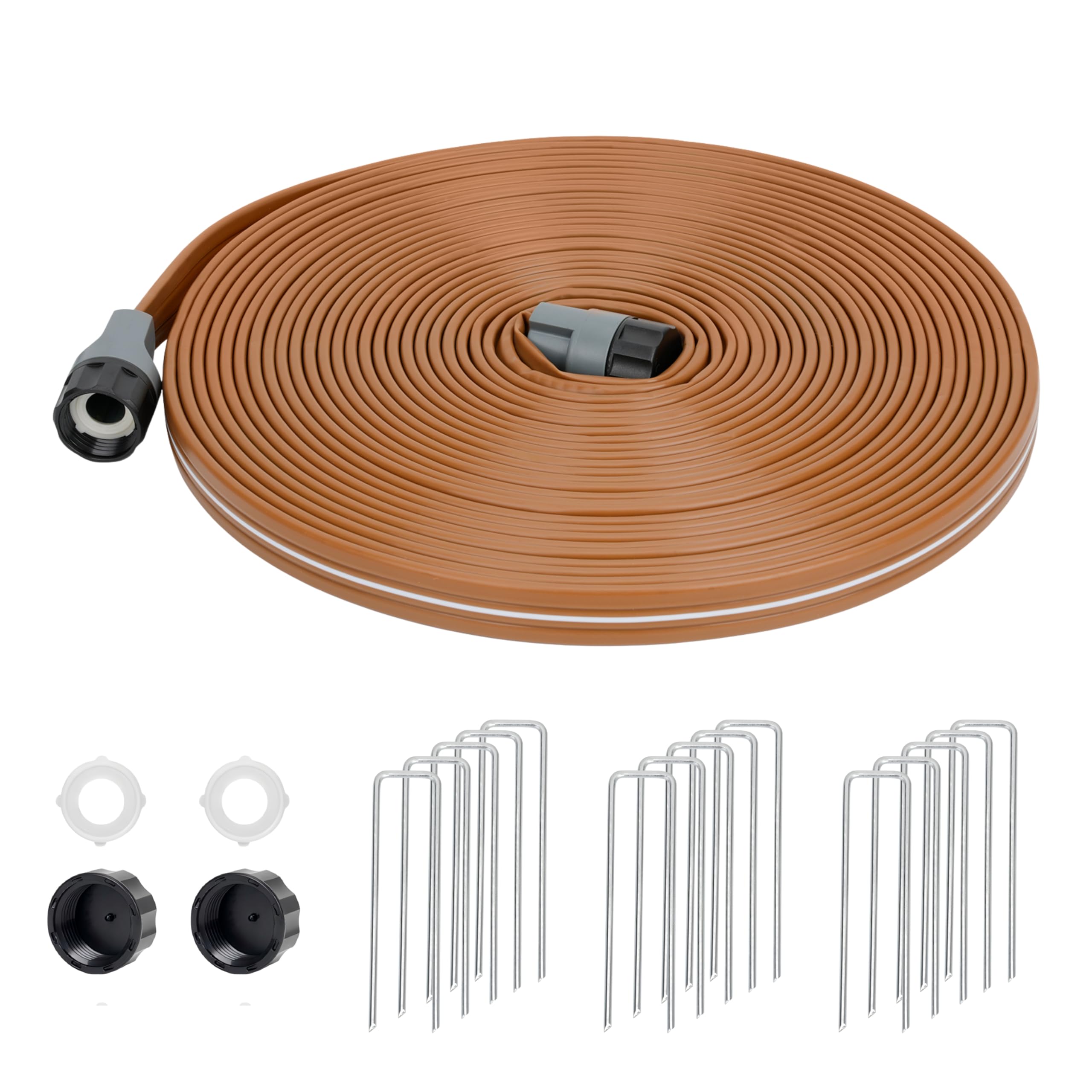
A sprinkler hose you can flip over and use as a soaker is a genuinely useful thing, provided your garden is shaped for it. Face the holes up and this one throws a fine mist a few feet to each side; face them down and it weeps along the row. That dual behavior is the whole pitch, and it holds up as long as you know which of the two you need.

We like it for a parkway strip, a fence line, or a bed of annuals along a path, anywhere the spray has soil to land on. In a tight mixed border it is the wrong tool: the mist settles on foliage and paving while the roots stay dry, and you spend the evening moving the hose instead of doing something else. Treated as a light-duty strip waterer, it earns its place, and the brown PVC all but disappears against mulch.

The build is three PVC tubes with closely spaced micro-holes, rated to 60 psi, with a removable end cap that lets you add a second hose or flush grit out of the line. Metal stakes and spare gaskets are in the box, which is more than most here include. Flushing at the start of the season is worth the two minutes it takes.

Bottom line: We like it for narrow strips and paths where its mist has somewhere to land, not for dense mixed borders.

4

LINEX Sprinkler Soaker Hose 2-Pack

LINEX Sprinkler Soaker Hose 2-Pack

Two beds at once

Our Score 8.6/10
Check Price

Worth Noting

  • Water favors the first stretch of each hose
  • Fine ports clog when soil covers them
Length
50 ft x 2
Included
6 steel stakes
Material
PVC
Max Pressure
60 psi
Read the full review

Two fifty-foot hoses and six steel stakes come in the box, and that is the practical argument. Run one down each side of a bed, or couple them into a single hundred-foot line, and you have the stakes to pin both without a trip to the hardware store.

The hose itself is three PVC tubes with small holes punched along the length, UV-treated and blue-green, rated to 60 psi. The trapezoidal stakes have a six-inch profile that holds the hose down flat, and the sections join end to end. It is light enough to lay out in a couple of minutes, which is why it threads around curves and along a yard so easily.

Evenness is where it gives ground. These are fed from one end, and the further you get from the tap the weaker the output, so on a low-pressure spigot the last stretch of a single fifty is the part that disappoints. The fine ports also load up when soil splashes onto them, and a flush with the end cap off before storage is the difference between an even weep and a few strong jets next June. Bring the pair inside before the first freeze; PVC left full of water over winter is how these end up split in spring.

Bottom line: Two hoses and six stakes make this the practical buy for watering two beds at once, as long as even output is not critical.

5

Hourleey Flat Soaker Hose 100 ft

Hourleey Flat Soaker Hose 100 ft

Long foundation lines

Our Score 8.4/10
Check Price

Worth Noting

  • Long runs can leave the far sections dry
Length
100 ft (2 x 50 ft)
Material
PVC and nylon
Connection
Linkable end to end
Max Pressure
150 psi
Read the full review

A hundred feet is the number that sells this one, and it earns it. Two fifty-foot sections come in the box, linkable end to end, for a foundation line, a fence row, or a bed that runs the whole length of a yard. The flat profile slides under mulch and rolls up small enough to hang on a hook in the shed.

We like it best for coverage rather than precision. Laid as one hundred feet it wets a long strip; laid as two fifties off a splitter it waters two separate runs, which is how we use it. The dual-layer PVC and nylon carries a 150 psi rating, so pressure is not what limits this hose. Distribution is, and that is true of every long soaker on a household tap.

Stakes come in the box, which saves a trip, and the flat shape makes it the easiest hose here to put away at the end of the season. What we watch with any flat sleeve is the fabric layer. Once it abrades, the even weep turns into a spurt from one spot, so lift it over gravel and driveway edges rather than dragging it across them.

Bottom line: Our choice when the run is long: a hundred feet of linkable flat hose for foundations, fence lines, and beds that stretch.

6

Rocky Mountain Goods Soaker Hose

Rocky Mountain Goods Soaker Hose

Rubber hose fans

Our Score 8.2/10
Check Price

Worth Noting

  • Water thins toward the far end of a long run
  • Stiff and awkward to uncoil when cold
Length
50 ft
Diameter
5/8 in.
Material
Recycled rubber
Warranty
7 years
Read the full review

Seven years is a long warranty for anything that lives outdoors, and it says something about how Rocky Mountain Goods regards this hose. The fifty-footer is recycled rubber rather than vinyl, with reinforced quick-attach fittings and an end cap for linking a second one, and it is the rubber option we point people toward when they want a soaker that lies down and stays down.

Rubber behaves differently from the flat fabric hoses. It goes down with some weight to it, so it holds the line you give it around curves instead of springing back, and it softens in the sun, which is the moment to lay it out if the coil has been sitting in a cold garage. Under a layer of mulch it disappears and keeps the soil damp along the row without the runoff you get from a sprinkler.

The wrinkle on a fifty-foot rubber hose is pressure. Water thins as it travels, and the far end weeps noticeably less than the first stretch once the tap is only partway open, so split the run in two or open the tap further and it evens out. Give the supply coupling a clean washer and a firm hand; a drip there is almost always seating rather than the hose. Against our top pick you give up cold-weather flexibility and the drinking-water listing, and you keep a hose that stays exactly where you put it.

Bottom line: Buy this if you want rubber weight and a long warranty without a premium price; it is our pick for hoses that stay where you lay them.

How We Tested the Best Soaker Hoses

We started by pulling every soaker hose we could find from the major garden suppliers and the big-box shelves, then cut the list down by length, diameter, material (recycled rubber versus vinyl), and connector style. Anything shipped without an end cap or with a flimsy crush washer got dropped before it ever saw a garden. That left 12 hoses, which we ran from late spring through the end of summer.

Each hose was laid along a 40-foot bed of tomatoes and peppers and run for 45 minutes at a quarter turn. Afterward we dug a trowel in at the first, middle, and last ten feet of every run to see how deep the moisture actually went — the gap between the near end and the far end was the single biggest differentiator. We also timed how long it took before the far end showed any dampness, and wrapped a dry paper towel around each spigot connection to catch the slow drips that only show up after twenty minutes under pressure.

Sturdiness got tested the unglamorous way: we dragged each hose around a hard 90-degree corner of a raised bed and watched whether it kinked and whether it sprang back, uncoiled them on cool mornings when vinyl stiffens, and coiled and uncoiled them weekly to check for cracking at the fold. Two hoses spent the whole season above ground in full sun to see how the surface held up. Throughout, we compared price per foot against how evenly each one actually watered, since a cheap hose that soaks half a bed isn't a bargain.

How to Choose Soaker Hoses

Match the Run to Your Water Pressure

Every soaker hose loses pressure as water travels through it, so the last ten feet of a long run weep less than the first ten. That is why a hundred-foot hose on a household tap can leave the end of a bed dry while the beginning puddles. If your bed is longer than about fifty feet, buy two shorter hoses and a Y-splitter at the tap instead of one long one, and check the far end the first time you run it.

It is also why our long pick arrives as two fifty-foot sections. Length you can split is more useful than length in one piece, and a splitter costs less than replacing a hose that never watered the back of the border.

Pick the Material for the Way You Garden

Rubber is heavy, lies where you put it, and softens in the sun, which suits a hose that stays in one bed all season. Flat vinyl and fabric weepers are light, roll tight, and cost less, but the sleeve takes the wear and they are the shortest-lived type here. Polyurethane costs the most and handles the cleanest: no black residue on your hands, flexible in cool weather, and often listed as drinking-water safe.

Whatever you buy, drain it and store it out of the sun before the first hard freeze. A soaker left full of water over winter is the one that splits in spring.

Fittings Cause Most of the Leaks

When a soaker hose drips, the hose is usually innocent. The leak is at the tap, where a missing or hardened washer, a cross-thread, or too much torque has opened a gap. Hand-tighten plus a quarter turn rather than cranking it down, keep a spare end cap so a linked run can be closed off, and check the thread is the standard three-quarter inch before you buy.

Flat Weeper or Round Soaker?

Layout decides this one. A flat weeper lies under mulch and follows a straight row without rolling out of place, but it kinks when you ask it to turn a tight corner, so route corners in a gentle loop and pin them with a stake. A round soaker coils around shrubs and perennials and handles curves, at the cost of bulk and visibility.

Rows, and you want flat. Individual plants and curves, and you want round. If the answer is both, buy a short length of each rather than forcing one hose to do two jobs.

Frequently Asked Questions

Final Verdict

If you want one hose to buy and forget, it is the Water Right 700 Series. It weeps evenly to the end of a fifty-foot run, it is listed safe for the water that reaches your vegetables, and it is the only hose here whose long-term record is not the weak part of the story. It costs more than the rest, and we think a hose you stop replacing every spring is worth the difference.

Two cases change the answer. For a long foundation line or fence row, the Hourleey hundred-footer covers far more ground for far less, as long as you run it as two fifties. For rows of vegetables on a tight budget, the One Stop Gardens flat weeper with a miser disc in place does a slow, thorough soak for the least money here. Just keep it in straight lines.