Watering & Irrigation

Best Rain Barrels of 2026

A good soaking rain is free water for the garden — until you stand at the window watching most of it sheet off the roof, down the driveway, and into the storm drain. A rain barrel is the simplest fix there is: park it under a downspout, catch what falls, and dip a watering can when the beds get dry. It's less about the water bill and more about never dragging a hose across the yard again.

We spent eight months with 12 of them — slim columns wedged against a garage wall, big flat-backed tanks, a couple of decorative ones — and the differences are not subtle. The thing first-time buyers get wrong is fit: a barrel has to sit level, line up with the downspout you actually have, and set its spigot high enough that a watering can clears the rim. Miss on any of those and it doesn't matter how good it looks. The picks below got all three right.

1

FCMP Catalina 45

Top Pick
FCMP Catalina 45

Small patios

Our Score 9.2/10
Check Price

Worth Noting

  • Fixed lid makes interior harder to scrub
Lid
Fixed, small opening
Hose
3.5 ft with shut-off valve
Capacity
45 gallons
Dimensions
22.5"L x 20.5"W x 29.75"H
Read the full review

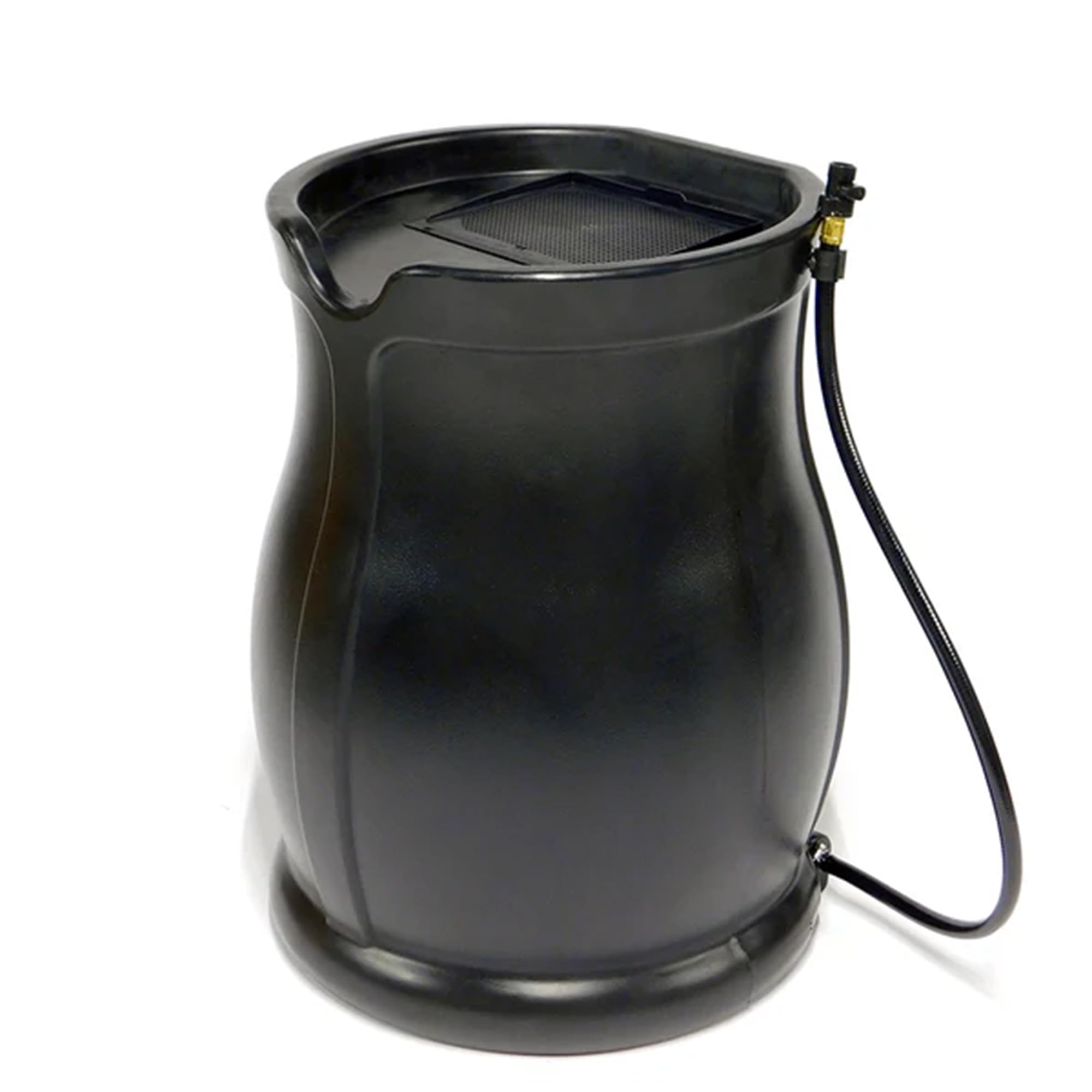
A small fixed lid changes how a rain barrel feels around a patio. The Catalina 45 has a contained top with a small opening, a flat back, and a 3.5-foot hose with a shut-off valve; we point to it when the barrel will sit near a walkway, a deck, or a household with young children.

The 45-gallon body is the smallest of our picks, but the footprint is the reason it earns a spot: 22.5 by 20.5 by 29.75 inches, with a flat back that tucks against siding. We found the short hose useful for filling a watering can without dragging it to the spigot. The trade-off is capacity: a heavy storm fills it quickly, and there is less reserve for a dry stretch. The barrel is 20 pounds empty, so one person can position it before filling.

The fixed lid is the feature we kept coming back to, because it keeps hands and scoops out of the water without a separate lock. The 45-gallon tank suits a patio or a couple of beds rather than a whole garden. If you need to water a long border, the Raincatcher or Lakewood will save more trips. The hose is short enough to store on the barrel, but long enough to reach a can set beside it.

Bottom line: For a tight patio or a household with curious kids, we think the Catalina's contained 45-gallon body and short hose make it the calmer pick.

2

FCMP Raincatcher 4000

FCMP Raincatcher 4000

All-around use

Our Score 9.0/10
Check Price

Worth Noting

  • Can crack after a season outdoors
Weight
25 lb
Linking
Side spigots and linking kit
Capacity
50 gallons
Dimensions
24"L x 24"W x 32"H
Read the full review

Two side spigots, a mesh screen, and a linking kit arrive with the Raincatcher 4000, and that completeness is why it is our default. The 50-gallon body has a flat back and a wide opening, so it sits close to the house without making the downspout connection a puzzle. We like that one barrel can serve a hose on one side and a watering can on the other.

The wide top screen is easy to lift and rinse, and the side spigots sit where a hose can be threaded without crawling behind the barrel. We appreciated that the linking kit was in the box; it turns a second barrel from a future project into a same-afternoon job. The overflow hose is equally practical, since it gives the excess water somewhere to go besides the foundation. We also liked the gray color, which reads as a utility barrel without calling attention to itself.

One practical check: the barrel is 32 inches tall and 25 pounds empty, so the downspout needs to end above the screen rather than at the side of the drum. We set ours on a level patio and left room for the overflow hose to run downhill. Once full, the 50-gallon body is not something to drag, so decide on the spot before you fill it. The screen is the part to check after a storm; leaves collect there before they reach the water.

Bottom line: We recommend the Raincatcher 4000 to anyone who wants one barrel to do everything: fill cans, run a hose, and link a second barrel later.

3

RTS Premium 55

RTS Premium 55

Easy cleaning

Our Score 9.0/10
Check Price

Worth Noting

  • Lid can be fussy to reseat when full
Lid
Removable
Spigot
Brass
Capacity
55 gallons
Dimensions
33.5"L x 21.25"W x 33.5"H
Read the full review

The Premium 55 has a removable lid, a flat back, a brass spigot, and an aluminum screen. The 55-gallon body is finished in woodgrain with black stripes, so it is meant to pass for a wooden barrel rather than a plain plastic tank. It is 33.5 inches tall and 28 pounds empty, so one person can set it before filling.

We found the lid useful for reaching in with a brush or a small bucket, and the brass spigot is a nicer touch than the plastic taps on cheaper barrels. The woodgrain finish is the other draw; it hides the plastic better than a plain color, especially against a fence or shed. The flat back also lets it sit close to siding without a wide gap.

We think the Premium 55 is the pick for someone who wants easier cleaning and a more finished look, and who does not need the raised stand. The 55-gallon capacity sits between the 50-gallon barrels and the 60-gallon Lakewood, so it is a middle choice on storage. The removable lid is the feature that earns it a place. If the barrel will sit beside a deck, the finish is worth the extra care; if it will be behind a shed, a plainer barrel does the same job.

Bottom line: We choose the RTS Premium 55 when a removable lid and a woodgrain finish matter more than a built-in stand.

4

Good Ideas Nantucket 50

Good Ideas Nantucket 50

Curb appeal

Our Score 8.8/10
Check Price

Worth Noting

  • Upper spigot can seep at the molding
Spigots
Two metal
Capacity
50 gallons
Dimensions
23.25"L x 23.25"W x 32"H
Planter Top
4-inch
Read the full review

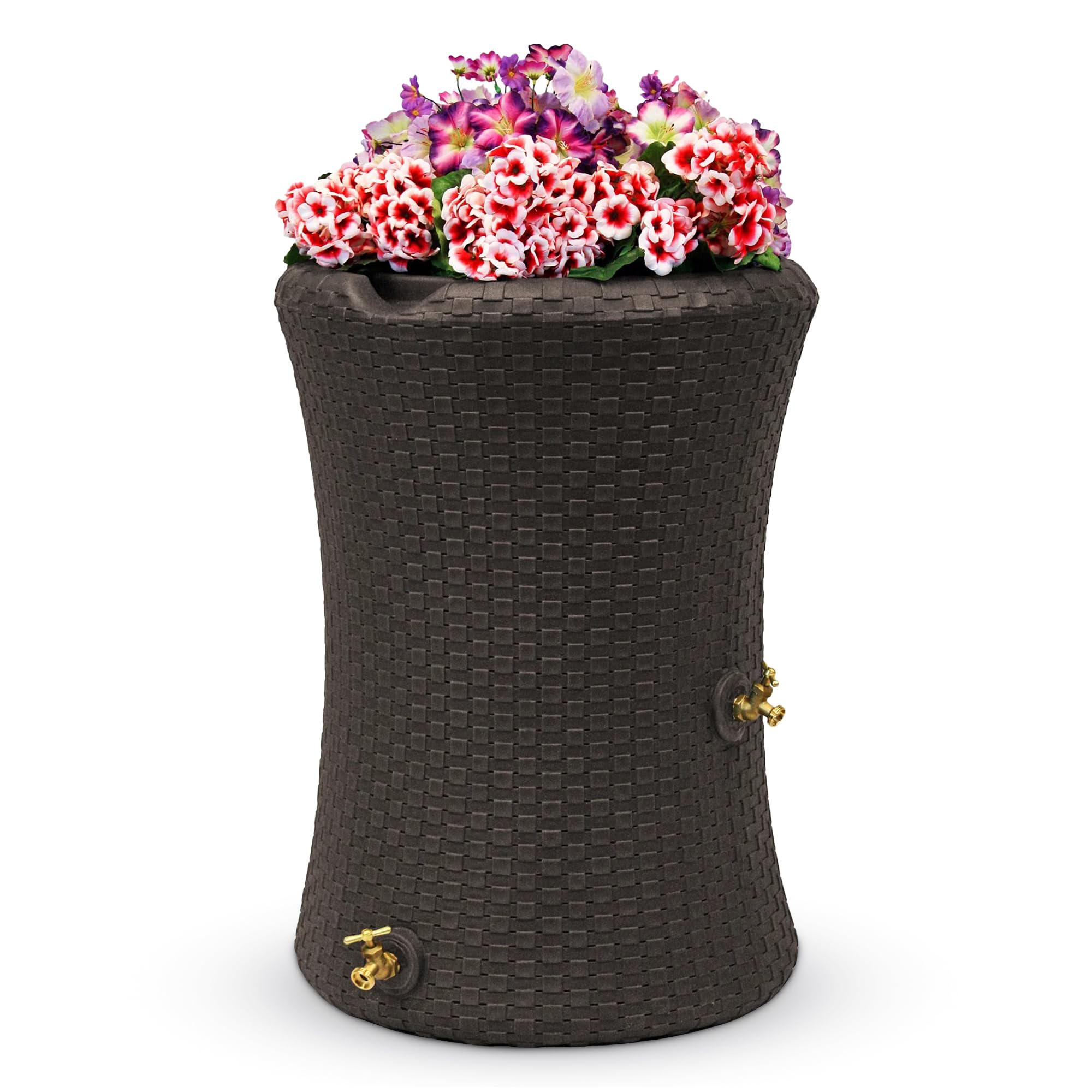
A 4-inch planter sits on top of the Nantucket, and the barrel's dark brown body is meant to be seen rather than hidden. The 50-gallon drum has a mesh screen, two metal spigots, and a routed overflow channel that sends excess water to the front instead of toward the foundation. The barrel is 32 inches tall and 23.25 inches square, so it needs a real corner rather than a gap between shrubs.

We think the planter earns its place if the barrel is going beside a deck or a front walk. In our testing, the two spigots were the more useful feature: one takes a hose, the other fills a tall bucket without moving the barrel. The overflow channel is the quiet advantage, since it keeps a heavy rain from dumping against the wall.

The planter is only 4 inches across, so it is for herbs or small flowers, not a vegetable patch. The dual spigots also mean more fittings to check for a snug seal at setup; we tightened ours before the first rain. Set it where you can reach both spigots; a barrel tucked behind a shrub wastes the second one. For a visible spot, the extra bit of garden on top is worth the fuss.

Bottom line: We like the Nantucket for the gardener who wants the barrel to look intentional, with two spigots that make filling a can or hose easy.

5

Step2 Lakewood 60

Step2 Lakewood 60

Large gardens

Our Score 8.6/10
Check Price

Worth Noting

  • Can split along seams after a season
Base
Integrated stand
Height
46 inches
Spigot
3/4" brass
Capacity
60 gallons
Read the full review

At 46 inches tall, the Lakewood puts its brass spigot at about the height of a watering can's handle, so you are not stooping to fill it. The height comes from a molded stand, and the barrel itself is a double-walled 60-gallon rectangle with a stainless-steel mesh screen and a 3/4-inch brass spigot.

We think that arrangement is worth the extra vertical space. In our testing, the raised spigot made filling a can faster, and the wide base felt stable on a level patio. The 60-gallon capacity is the largest in this group, so it holds more of a long storm before the overflow has to work. We also appreciated the metal spigot, which feels more substantial than the plastic taps on several other barrels.

The trade-off is the shape: 46 inches tall by 24 inches wide, it needs a downspout that ends high enough and a spot where the height does not block a window. We set ours on a level patio and checked that the overflow ran away from the house. The barrel is 34 pounds empty, so bring it into place before the first rain. If your downspout is low, the Catalina or Raincatcher is a better fit.

Bottom line: If your garden needs the biggest tank here and you are tired of kneeling at a spigot, the Lakewood's raised 60-gallon body is the one we choose.

6

Laspeiraux Collapsible 53

Laspeiraux Collapsible 53

Renters and storage

Our Score 8.4/10
Check Price

Worth Noting

  • Soft shell less rigid than molded plastic
Storage
Folds flat when empty
Capacity
53 gallons
Material
Three-layer PVC
Dimensions
23.62"L x 23.62"W x 27.56"H
Read the full review

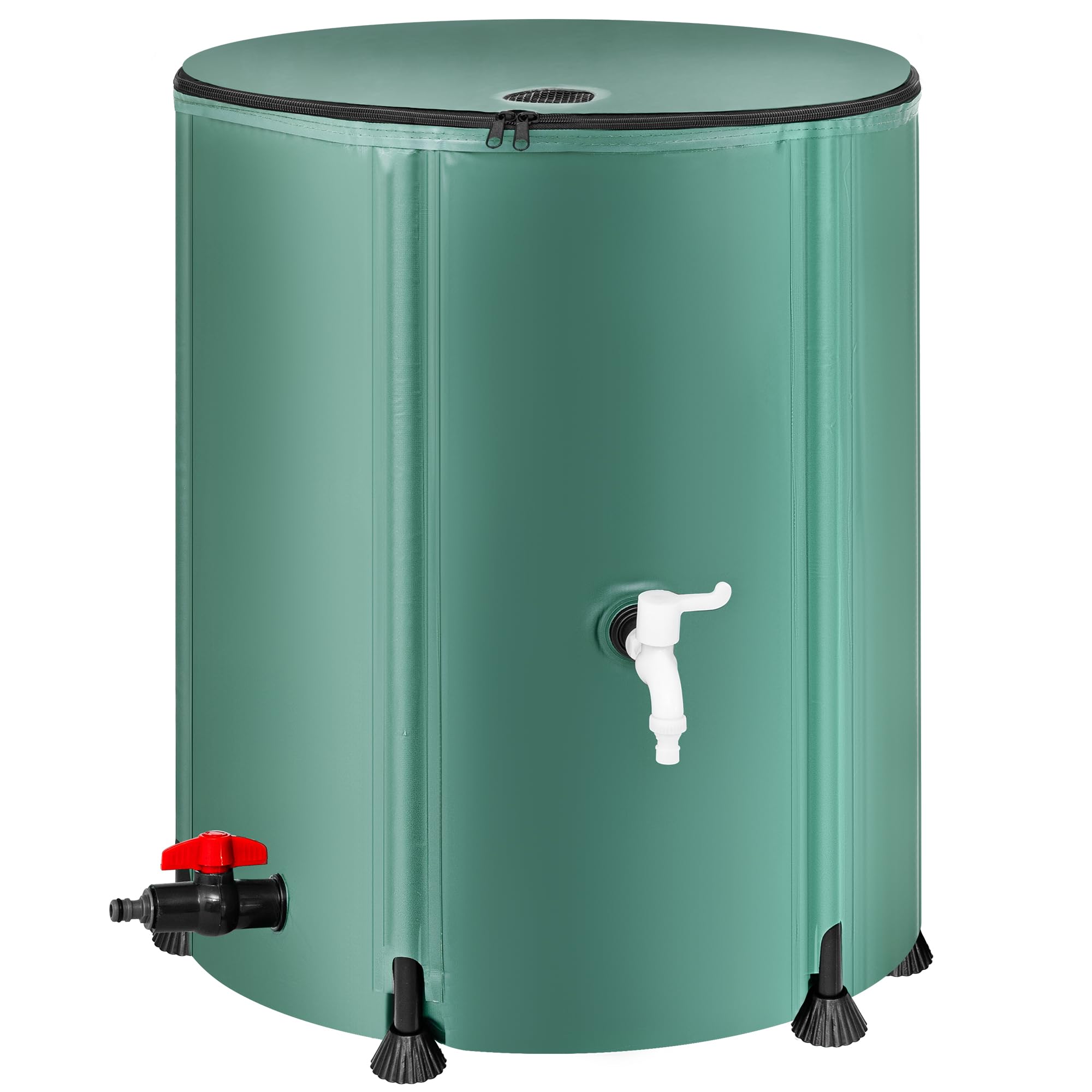
The Laspeiraux folds down to a fraction of its size when empty, which is unusual for a 53-gallon barrel. It is built from a three-layer PVC shell with a screw-in faucet and a mesh top, and the square footprint measures 23.62 inches on each side. The barrel is 27.56 inches tall, so it sits lower than the Lakewood and is easier to reach over.

We found the screw-in faucet one of the easier connections to make: there is no bundle of small parts to cross-thread, and the mesh top keeps leaves out of the water. The footprint is close to the rigid barrels, so it does not save floor space while full; the savings come when the season ends and it goes into a bin. The faucet sits low, so a shallow can or a short hose is easier than a deep bucket.

We think the Laspeiraux is the right pick for a renter who wants rainwater without a permanent fixture. The collapsible body is the reason: it stores in a shed and sets up again in minutes. Fill it where it stands, keep the screen seated, and plan to drain it before the first freeze. It is the one we reach for when the shed is small and the barrel cannot stay out all year.

Bottom line: The Laspeiraux is our pick for renters and small yards because it holds 53 gallons and then folds away when the season ends.

How We Tested a Dozen Rain Barrels Through One Full Season

We started by rounding up every barrel on the market that ships with a spigot, an overflow port, and some kind of debris screen, then filtered by capacity, footprint, and whether the lid seals tightly enough to keep mosquitoes out. Price and the accessories already in the box — diverters, hoses, downspout adapters — decided the rest. That left 12 barrels, which we set up at homes and a community garden over eight months, from the first spring storms through fall.

Setup was timed, solo, with a stopwatch and no second pair of hands: unbox, seat the spigot with thread tape, level the base, cut and fit the downspout. Then each barrel went under a real gutter. After every storm we pressed a dry paper towel along the seams, the spigot threads, and the base to catch weeping leaks, and we watched the sides for bulging once a barrel was full.

Day to day, we drained them into watering cans, a soaker hose, and a bucket line, timing how long a two-gallon can took to fill and checking whether the spigot sat high enough to clear the rim. Full barrels sat through a July heat wave and into October, which is where we saw which plastics went chalky or soft. Appearance got judged from the patio, not the warehouse floor, and we kept a running note of what came in the box versus what needed a trip to the hardware store.

How to Choose Rain Barrels

Capacity and Footprint

Most residential barrels here hold 45 to 60 gallons, and that range matters less than the space you can give it. A flat-back body sits close to siding, while a round barrel needs more clearance. Measure the wall, the downspout height, and the path to the garden before ordering. We put more value on a footprint that fits than an extra five gallons. A full 50-gallon barrel is heavy, so place it where it will stay; moving it afterward is a job you do not want.

Leak-Free Fittings and Overflow

The weak points are the spigot, the overflow outlet, and any linking kit. Ask where the overflow sends water; you want it running away from the foundation, not under the barrel. Threaded plastic spigots cross-thread easily, so start them by hand and use the supplied tape. If you plan to connect two barrels, buy the linking kit with the first one. We think a simple barrel with a tight, well-placed overflow beats a larger one with a fussy connection.

Spigot Height and Hose Access

A bottom spigot sounds convenient until you try to fit a watering can under it. A stand or an elevated base buys clearance and makes filling easier, but it also raises the center of gravity, so level the base. If you plan to use a hose, check that the spigot is threaded and that the barrel sits uphill from the garden. Gravity gives a slow, gentle flow, so plan on a short run. We prefer a raised 45-gallon barrel to a 60-gallon one that forces us to kneel.

Lids, Screens, and Cleaning

A removable lid makes cleaning and dipping a can easier, but a fixed lid with a small opening is a good choice near a play area. Either way, the screen needs to seat tightly enough to keep leaves and mosquitoes out. Check the lid after a storm; a warped or loose cover is the usual way debris gets in. We look for a wide opening on barrels that will be cleaned often, and a contained top on barrels placed close to the house.

Frequently Asked Questions

Final Verdict

For most yards, the FCMP Raincatcher 4000 is the barrel we point to first: it arrives with the screen, overflow, side spigots, and linking kit that make a 50-gallon barrel useful from day one. If the watering can is the main tool, the Step2 Lakewood's raised 60-gallon body is easier to live with. For a tight patio, the Catalina 45's contained lid is the calmer choice.