Watering & Irrigation

Best Heavy Duty Garden Hoses of 2026

Nothing ruins a Saturday of yard work faster than a hose that folds over on itself the moment you round the corner of the house, then dribbles instead of spraying. Heavy-duty hoses exist to take that abuse — hot sun, cold mornings, concrete driveways, shrubs you drag them through. The trick is that tough doesn't have to mean stiff and miserable to handle, and what a good one actually fixes is the small stuff: no kinks to chase, no puddles at the fittings, no wrestling match at the spigot.

Over the past seven months, my team and I have put 12 heavy-duty hoses through a full growing season, and the pattern is clear — the ones that hold up are the ones that stay easy to move. Here's a bit of yard wisdom worth having before you buy: the ply count printed on the package tells you less than how the couplings are attached and how the hose behaves on a chilly morning. Watering is a chore you'll repeat hundreds of times a year, so the picks below are the ones that stopped feeling like one.

1

GAGALUGEC Metal Hose

Top Pick
GAGALUGEC Metal Hose

Light yard watering

Our Score 9.2/10
Check Price

Worth Noting

  • Rated only from 32 to 140 °F
Length
50 ft
Material
Stainless steel and PVC
Max Pressure
550 psi
Temperature Range
32 to 140 °F
Read the full review

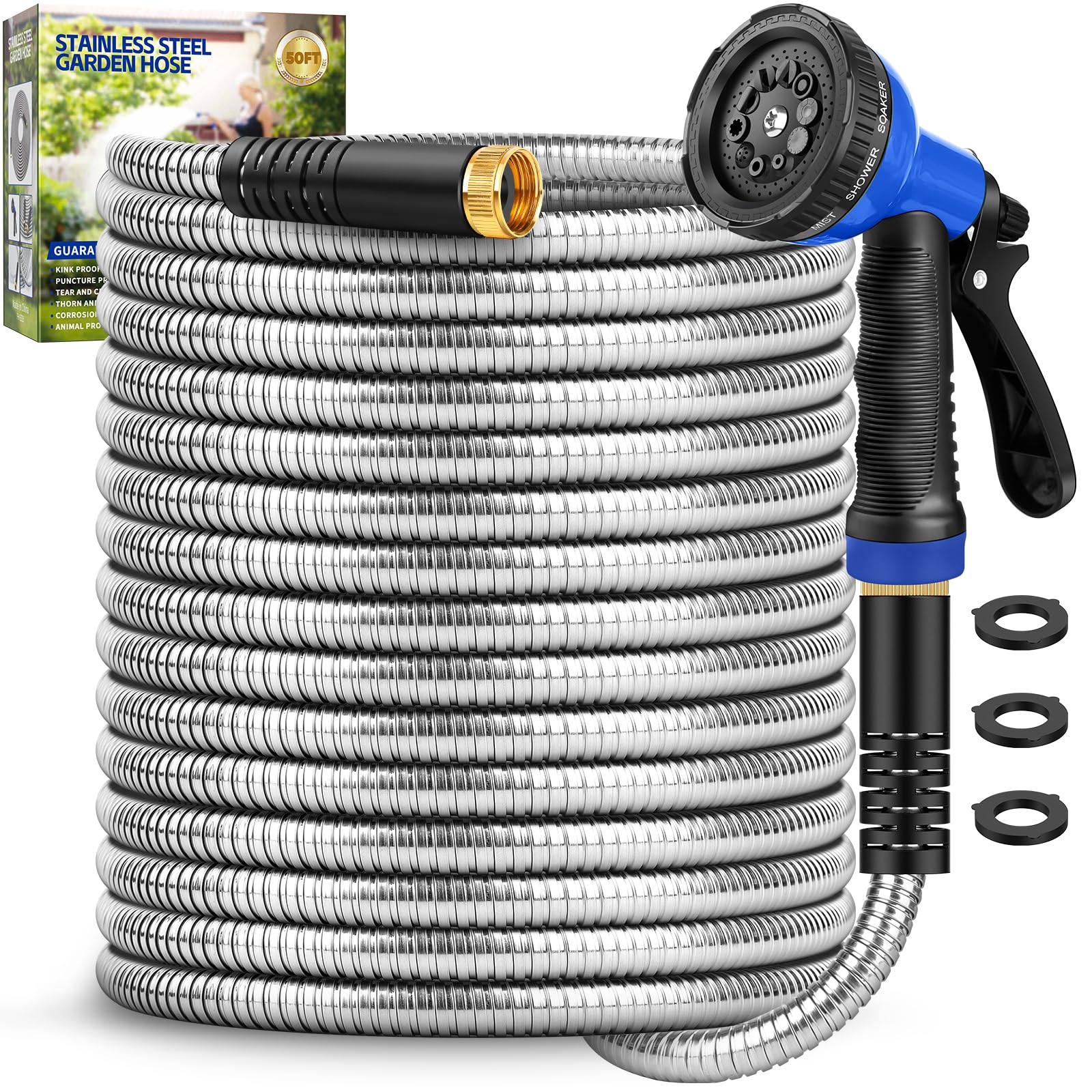
The box is the pitch here: a 50-foot stainless hose, a ten-mode spray nozzle, and three spare gaskets, at the lowest price in this group. The hose itself is four pounds, rated to 550 psi, and built with a rotating collar at the spigot end so the body does not fight the thread as you tighten it.

For watering beds, rinsing a patio and filling a can, we think it is plenty of hose: light enough to carry in one hand and cheap enough to buy a second one for the front yard. Where it gives ground to the other metal hoses is the temperature window, since 32 to 140 degrees Fahrenheit means a freezing night is the end of it if you leave it out. Treat it as a three-season hose and it earns its place.

Bottom line: A light, inexpensive metal hose that handles everyday watering well, as long as it does not have to sit through a hard freeze.

2

Guitrees 5/8 in. Rubber

Guitrees 5/8 in. Rubber

Short hot-water runs

Our Score 9.0/10
Check Price

Worth Noting

  • Heavier than the metal and hybrid hoses here
Length
50 ft
Fittings
Solid brass 3/4 in. GHT
Material
Braided rubber
Inside Diameter
5/8 in.
Read the full review

Fifty feet is the length most yards actually need, and hot water is the feature almost nothing else here offers. The Guitrees is rated for both hot and cold supply, so it can run off a utility sink or a mixing valve rather than a cold spigot, and it is built as a rubber hose with five-layer braiding and solid brass three-quarter-inch fittings.

The ends are what we check first on any rubber hose, and these are properly done: solid brass, a clean seat, and threads that mated without fuss. Hand-tight was enough to keep them dry. The body feels like a tool, thick and a little stiff when new, and clearly built to be dragged rather than carried.

This is our pick when the run is short and the water is warm, and the one to take if you are plumbing a hose bib off a utility sink. The caveat is handling: it is heavier in the hand than the metal and hybrid hoses here, and with the water off it is limp enough to kink on the way to the beds. Charge it first and it straightens out under pressure.

Bottom line: Short run, hot water, and rubber that feels like a tool rather than a toy: this is the hose we recommend when 50 feet is all you need.

3

Kebose Metal Hose

Kebose Metal Hose

Budget metal hose

Our Score 9.0/10
Check Price

Worth Noting

  • Bundled nozzles are the weakest part
Length
50 ft
Included
Ten spray nozzles
Material
Stainless steel
Max Pressure
150 psi
Read the full review

The Kebose is one of the cheapest ways into a metal hose here, and it does not feel like a compromise in the hand: 50 feet of stainless jacket over a flexible core, 5.5 pounds, a 150 psi rating, and ten spray nozzles in the box. It coils small enough to hang on a hook by the tap, and the smooth jacket slides along a path edge without snagging on every twig.

For a first metal hose, or a second one for the far side of the house, this is the value pick of the set. It does the everyday jobs without complaint, and at this end of the price range that is the whole brief. Two things to know: the connections are where hoses like this eventually weep, so check the washer each spring, and the bundled nozzles are the weakest part of the kit, fine for beds and buckets but not the spray head you will keep for years.

Bottom line: The budget pick we are comfortable recommending: light, easy to coil, and good enough for everyday watering without spending much.

4

Briggs & Stratton 8BS100

Briggs & Stratton 8BS100

All-round heavy duty

Our Score 8.8/10
Check Price

Worth Noting

  • 100 feet takes real space to coil
  • Sealing depends on a properly seated washer
Length
100 ft
Material
Rubber
Couplings
Nickel-plated brass
Max Pressure
200 psi
Read the full review

Rubber is why this hose is our top pick, and rubber is also why your arms know about it by the end of a long watering. The body is heavy-gauge rubber over industrial-style reinforcing, the two ends are crush-proof nickel-plated brass, and it carries a 200 psi maximum pressure rating. The weight buys something real: a rubber hose lies where you drop it instead of springing back into a coil, and it takes concrete and gravel without the scuffing that shortens the life of a lighter cover.

The ends are where hoses actually die, and this one has the best hardware in the group: machined brass, male and female, with a rubber washer doing the sealing. Hand-tight is all they need, because a wrench on brass threaded into a plastic spigot is how threads get chewed up. Keep a spare washer in the shed; a washer that has been crushed or baked in the sun is the usual reason a good hose starts weeping at the tap.

Kink resistance depends on pressure more than on the hose. Run it out with the water on and give the coupling a half-turn as you go, and it behaves like a much stiffer hose; drag a limp, empty length around a tight corner and it will fold. Charge it before you pull and the folds mostly stop happening, which is the one habit this hose rewards.

A hundred feet is the quiet luxury of the thing. One connection at the spigot reaches most of a big lot, so there is no second hose to join and no coupling to blow apart in the middle of the yard. On a small city lot that length is a coil you have to store, and one of the 50-foot picks below is the easier hose to live with.

Bottom line: Our overall pick: real rubber that stays where you drop it, crush-proof brass at both ends, and 100 feet of reach for a big yard.

5

Continental Premium Rubber

Continental Premium Rubber

Cold-weather rubber

Our Score 8.8/10
Check Price

Worth Noting

  • Heaviest hose here at 19 pounds empty
Length
100 ft
Material
Rubber with brass fittings
Max Pressure
130 psi
Temperature Range
-40 to 190 °F
Read the full review

If the spigot is on the shady side of the house and the hose stays out until November, start here rather than with our top pick. The Continental is the cold-weather half of the rubber pair: heavy-gauge rubber, brass male and female fittings, a rated range of -40 to 190 degrees Fahrenheit, and a 130 psi maximum. It is sold as a cold-water hose that keeps its flexibility, which is the quality that matters when you are watering in gloves.

Between the two 100-foot rubber hoses here, we rate this the better winter hose and the Briggs the better all-rounder. The trade is weight and a pressure ceiling: 19 pounds empty is the heaviest hose in this group, and 130 psi is the lowest maximum of the seven. Neither number matters at a household spigot; both matter when you are hauling the coil up a slope or over a wall.

Kink behaviour sits in the middle of this set. It bends rather than fighting you, and a bend works out by hand because the rubber is supple rather than stiff. What sets it apart from the other rubber hose is the warranty: a limited lifetime term on a hose built to be left outside is the closest thing to a long-term bet in this group.

Bottom line: For a hose that has to stay usable through a real winter, this is the rubber one we point to, as long as the heaviest coil here does not put you off.

6

Unywarse Metal Hose

Unywarse Metal Hose

Linking two lengths

Our Score 8.8/10
Check Price

Worth Noting

  • Aluminium collars rather than brass
  • Inner tube cannot be inspected under the jacket
Length
50 ft
Material
Stainless steel over PVC
Connectors
Aluminium, both ends
Max Pressure
150 psi
Read the full review

Threads on both ends are the reason to look at this one: two 50-foot lengths join into a 100-foot run, and you can break them apart again when half the yard is enough. The collars are extended aluminium, which gives you something to grip with wet hands, and the soft shell behind them takes the strain when the hose is pulled around a corner.

In the yard it is the easiest of the metal hoses to live with. The stainless jacket slides over concrete and around bed edges, the 5.8-pound body lifts with one hand, and it resists tangling in a way rubber never quite manages. Remember what the jacket is: armour over a PVC tube. It protects the part that carries water without making that part indestructible, so do not drive over it and do not leave it charged through a freeze.

The included nozzle is a ten-pattern head with rubber grips and a trigger lock, and the lock is the detail we appreciated most, because holding a spray pattern by hand for five minutes while a can fills is a fast route to a sore thumb. The patterns run from jet to shower, and it seals without a fight.

So this is the metal hose we recommend for a yard that needs 100 feet but does not want to store it in one piece, and the one to buy if you already own a 50-footer worth extending. Check the collars each spring; aluminium is the softer metal at the joint, and cross-threading one once is enough to make it weep for the rest of its life.

Bottom line: The metal hose to buy if you want 100 feet without storing 100 feet: join two, split them again, and keep the trigger lock.

7

beitopamz Hybrid Hose

beitopamz Hybrid Hose

Light, flexible handling

Our Score 8.8/10
Check Price

Worth Noting

  • Softer cover scuffs on rock and concrete
Length
50 ft
Weight
6 lb
Fittings
Brass 3/4 in.
Material
Hybrid polymer
Read the full review

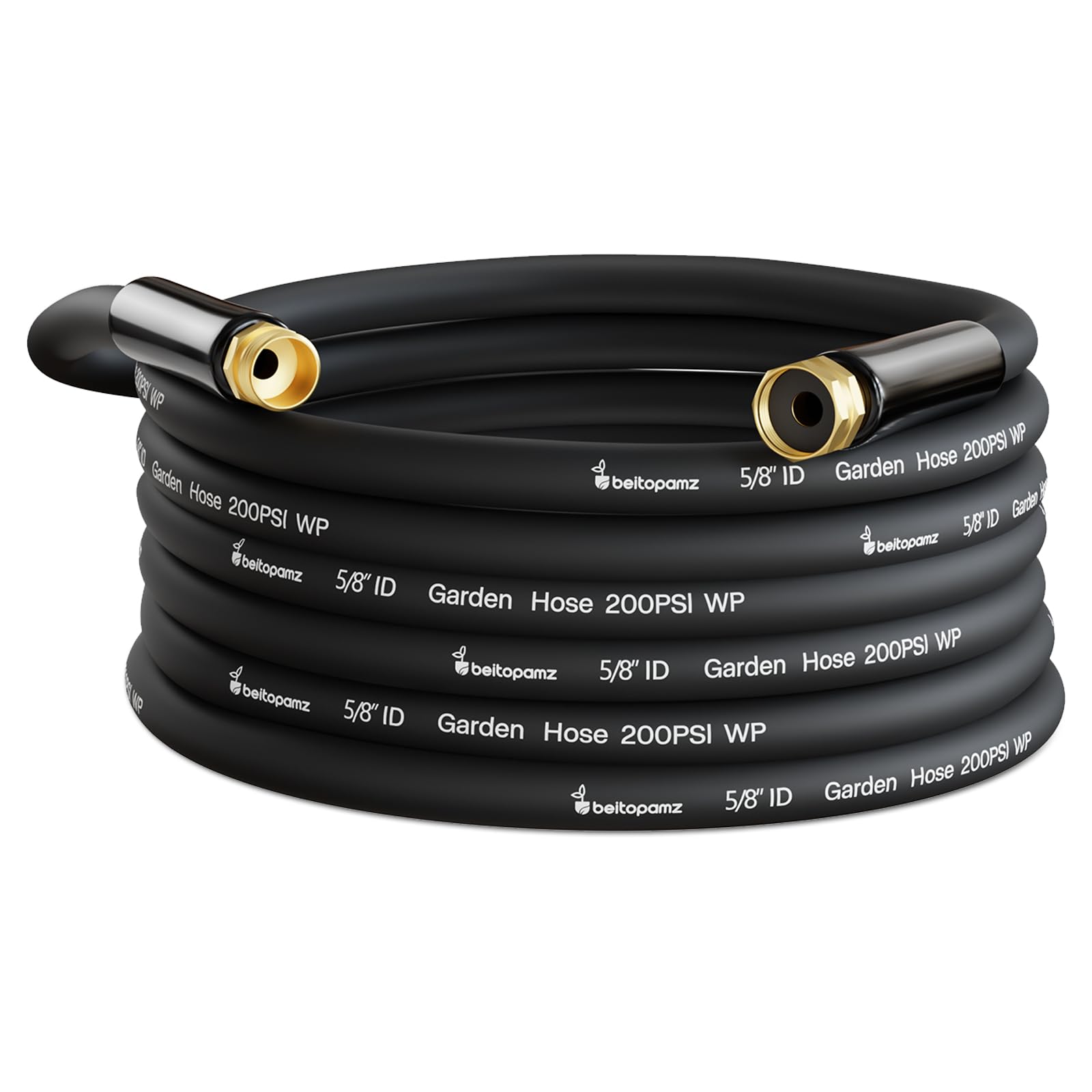
Six pounds for 50 feet is the number that decides this hose: the hybrid NBR and PVC body is light enough to carry one-handed around the beds, and the brass three-quarter-inch fittings and crush-resistant aluminium collars mean the weight saving does not come out of the ends. We think that is the right trade for a small yard with a lot of short trips to the tap.

Hybrid polymer behaves differently from rubber. It is suppler in the cold, coils tighter, and stays round under pressure, but it is also a softer material, so rock edges and bed borders scuff it faster than they would mark a rubber hose. Empty and limp, it folds around a tight corner like anything else; get water into it and it straightens.

Where it wins is the dragging. A 50-foot rubber hose is a two-handed lift once it is charged, and this one is not, while the O-ring in the female coupling keeps the spigot joint dry without a wrestling match. If your yard is small enough that 50 feet reaches everything, the lighter hose is the one you will actually take out of the shed.

Bottom line: The hybrid hose we reach for on a small yard: light, flexible, and fitted with brass where it counts.

How We Tested the Best Heavy-Duty Garden Hoses

We started with about 40 hoses sold at national retailers and garden centers, then narrowed by reading spec sheets: inside diameter, ply construction, coupling material, stated burst pressure, listed weight, and price per foot. Anything with a plastic coupling or a warranty under five years came off the list, though we kept a few lighter, cheaper models to see whether the extra money and heft bought anything real. That left 12 hoses, which we used from spring into fall — seven months of ordinary watering.

Testing happened where hoses actually live: around the foundation, across a concrete driveway, up a slope to raised beds, and onto a reel at the end of the day. We ran each one at full pressure and felt along the fittings for drips, then left it pressurized in the sun for an afternoon and checked again. Every hose got dragged around a 90-degree corner with the water running to see whether it folded and stayed folded or sprang back, and we timed how long one person took to wind 50 feet onto a reel. We also weighed each hose dry and again full of water, since heavy-duty and heavy aren't the same thing.

Durability got the least glamorous test. The same hoses sat out through cool mornings in the low 40s, were kinked on purpose and then straightened, and got dragged over pavement instead of grass. We noted which ones scuffed, which stayed flattened where they'd been coiled, and which couplings started weeping by midsummer. All of it went against price: a hose that lasts five seasons at twice the cost beats one that leaks by August, and a couple of the cheapest models made that case for us.

How to Choose Heavy Duty Garden Hoses

Start with the material, then the length

Rubber is the traditional answer and still the most abrasion-resistant. It lies flat, does not leap back into a coil, and stays flexible when the temperature drops; the cost is weight, and 100 feet of it is a two-handed pull once it is charged. A hybrid polymer like the beitopamz is far lighter and very supple, but the cover is softer and scuffs on rock and concrete.

A stainless jacket over an inner tube is the lightest option of all and slides over anything, but the jacket is armour rather than the hose itself: the tube inside is what fails, and you cannot see it happening. Rough ground and long runs point to rubber; a lot of lifting and short runs point to metal.

Brass, aluminium, and the washer that does the sealing

The couplings matter more than any claim on the box. Brass is the harder, longer-lived choice and the one to want at the spigot, where a hose is connected and disconnected all season. Aluminium is lighter and cheaper but cross-threads more easily, and crush-proof collars survive being driven over, which is the most common way a good hose dies.

The seal itself is a rubber washer or an O-ring, not the thread. That is why hand-tightening is enough and a wrench is a mistake on a soft spigot, and why the washer is the first thing to check when a joint starts weeping.

Pressure ratings are a ceiling, not a target

Every hose here states a maximum pressure and most also claim a far higher burst figure. Your spigot supplies a fraction of either, so the biggest number on a listing is not the better hose. The rating tells you how much margin the body has; it tells you nothing about whether the seam at the collar was crimped properly.

We put more weight on the fittings and the material than on the burst claim. A hose rated at 130 psi is not a weak hose if the brass and the tube are good, and a 500 psi claim will not save one that leaks at the tap.

Length, storage, and what you will actually drag

Match the length to the yard rather than to the price. A 100-footer covers a big lot from one spigot and spares you a joint in the middle of the lawn, but it is a bulky coil to store and a long pull when charged. Fifty feet is the easier hose for most yards and one you can coil on a hook in ten seconds.

If you only occasionally need more reach, look for a metal hose with threads at both ends so two lengths can be joined and split again. That is cheaper than the long hose and easier to store, though each coupling costs a little flow.

Winter, sun, and where the hose lives

Rubber keeps its flexibility in the cold, hybrids stiffen, and a metal hose is fine until water freezes inside the tube, which is what splits it. Whatever you buy, drain it and hang it before the first hard freeze rather than leaving it charged on a reel through a cold snap.

Sun is the slower killer. UV breaks down covers over a few seasons, so a shaded hook or a reel with a cover adds years to any of these, including the expensive ones.

Frequently Asked Questions

Final Verdict

For most yards, the Briggs & Stratton 8BS100 is the hose to buy. Rubber that lies flat and takes rough ground, brass at both ends, and enough length to cross a big lot from a single spigot: it is the pick we keep coming back to when a reader has a long run and does not want to think about the hose again.

Two situations change the answer. If your winters bite and the hose stays outside, the Continental's cold-rated rubber and lifetime warranty make it the better bet, at the cost of the heaviest coil here. And if the whole job is a small yard, a light 50-footer is the hose you will actually carry out of the shed: the Kebose for value, or the beitopamz if you want hybrid flexibility with brass where it counts.