Watering & Irrigation

Best Smart Sprinkler Controllers of 2026

A sprinkler controller does one job — open the valves on a schedule — but a smart one checks the forecast before it does. It skips a cycle when rain is coming, stretches the gap between waterings when the week turns cool, and lets you change a program from the couch instead of the garage. My own dial timer never did any of that, and I spent two summers paying for water my lawn didn't need. That's the promise here: less water, a healthier yard, one less thing to remember.

The catch is that the hardware barely differs from one unit to the next — what separates them is the app, the wiring instructions, and how gracefully they handle a weak Wi-Fi signal. Over the past seven months, my team and I installed 12 controllers on real in-ground systems, and the differences showed up fast. Most homes run four to eight zones, and nearly every controller swaps onto the same low-voltage wires the old one used — setup, not the screwdriver work, is where a good pick earns its keep. The picks below handled both without a fight.

1

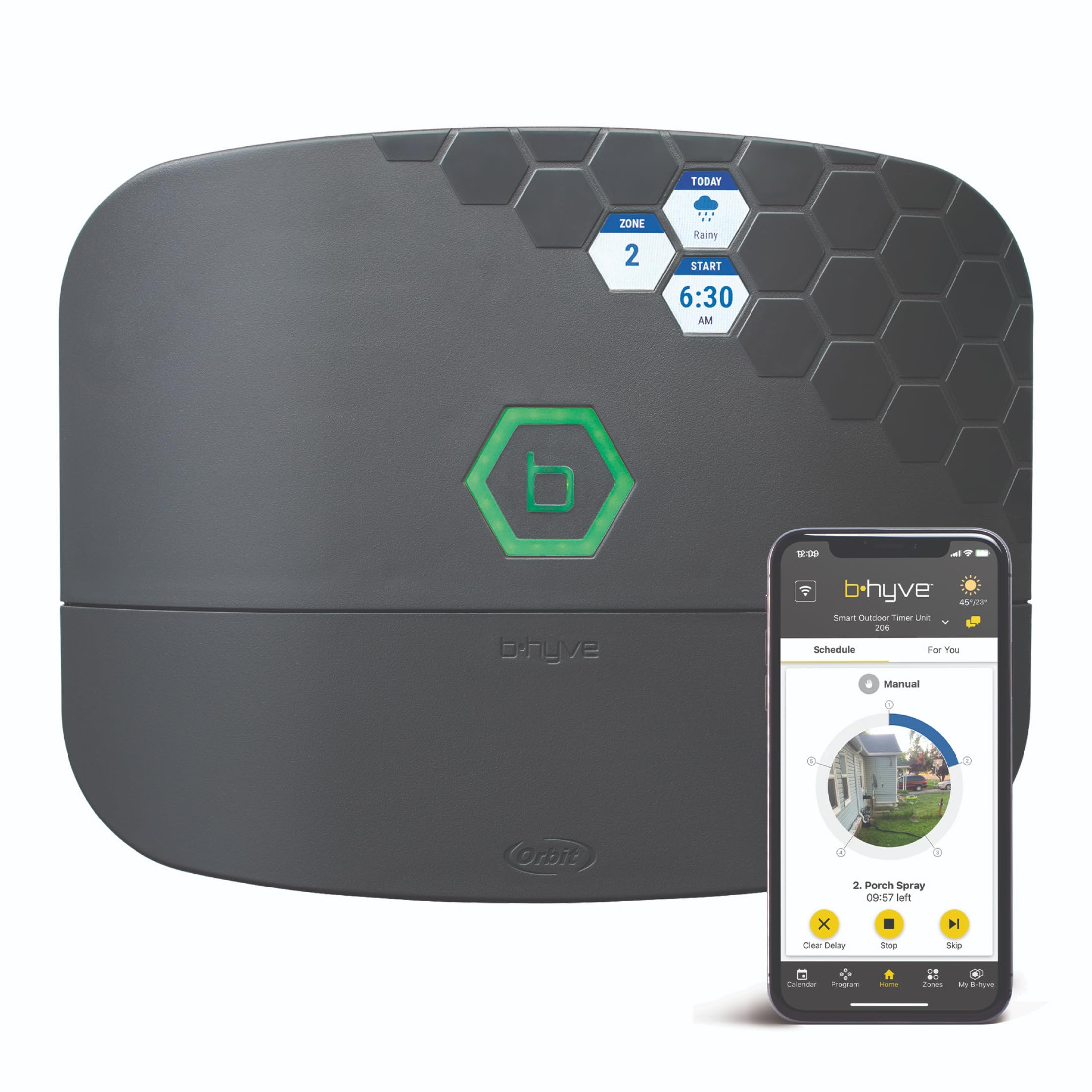
Orbit B-hyve 6-Zone

Top Pick
Orbit B-hyve 6-Zone

Most home yards

Our Score 9.0/10
Check Price

Worth Noting

  • Long-term reliability is uneven
Zones
6
Control
App and Alexa
Warranty
2 years
Placement
Indoor/outdoor
Read the full review

Six zones, a weatherproof case, and forecast-based scheduling are the combination that makes the Orbit B-hyve our default recommendation. The app handles schedules, manual runs, and rain delays, and the panel still gives you a status check at the box. We like that it does not ask you to choose between a smart schedule and a controller you can walk up to.

Installation is the part that worries most people, and the B-hyve keeps it manageable: the wiring terminals are plainly laid out, and the app walks you through setup. Label every zone wire before you disconnect the old controller—that one habit prevents most of the headaches. Alexa is supported for basic commands, but the app is where the useful control lives.

The trade-offs are capacity and placement. Six zones is plenty for a compact yard but short for a system with more valves; if you have eight zones, go straight to the XR or another eight-zone model. WiFi can drop at the edge of coverage, so mount it where the signal is strong and check the schedule after a storm. We still think the combination of price, outdoor rating, and weather-aware scheduling makes it the easiest first smart controller to live with.

Bottom line: We recommend the B-hyve for a typical six-zone yard because it pairs forecast-based watering with an outdoor-ready case and a straightforward app.
2

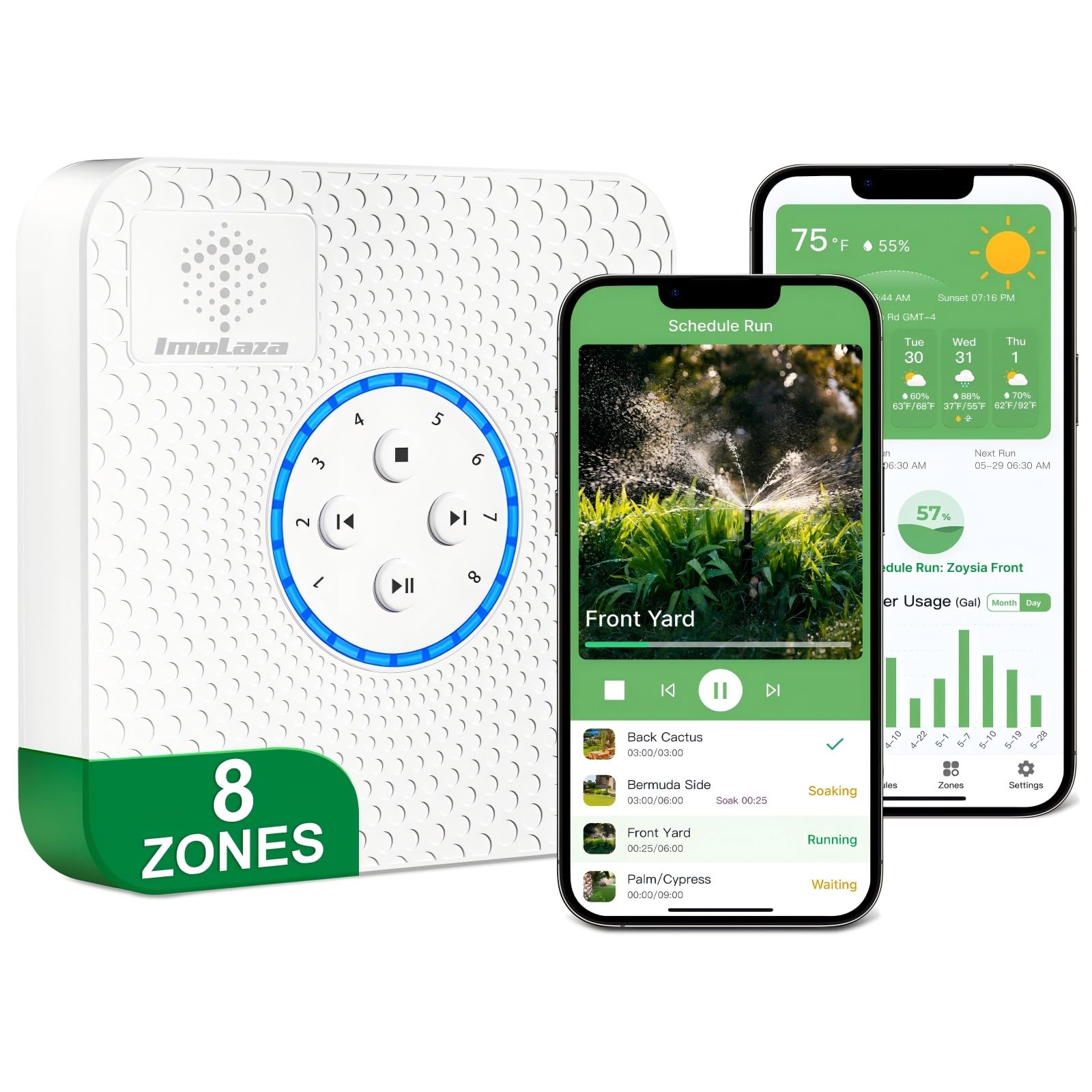
ImoLaza 8-Zone

ImoLaza 8-Zone

Water savings

Our Score 9.0/10
Check Price

Worth Noting

  • WiFi connection can be inconsistent
Zones
8
Placement
Indoor/outdoor
Subscription
None
Weather Inputs
ET and hyperlocal weather
Read the full review

The ImoLaza's real-time evapotranspiration engine is the feature that separates it from the simpler timers here. It uses hyperlocal weather plus ET to decide when the soil is actually drying out, and it can skip watering for rain, wind, freeze, or saturated ground. We like that the smartest watering on this list does not come with a monthly fee.

That makes it our pick for water savings. Eight zones cover a normal in-ground system, the case works indoors or out, and the app adds fault detection for open or short circuits plus leak alerts. Fault alerts are the kind of thing you do not appreciate until a valve sticks on. We think the extra control is worth the learning curve if you are trying to stop guessing at run times.

The learning curve is real: soil type, slope, sun exposure, and plant needs all feed the schedule, and the app asks you to think about them. We wish the setup felt lighter, but the payoff is a controller that adjusts more intelligently than a forecast-only timer, especially when your zones have different soil and sun exposure.

Bottom line: We recommend ImoLaza for gardeners who want the most water-wise scheduling here and don't mind a little more setup in exchange for ET-based control.

3

Hunter HPC400 4-Zone

Hunter HPC400 4-Zone

Expandable systems

Our Score 8.8/10
Check Price

Worth Noting

  • Expansion modules sold separately
Control
Hydrawise app and touchscreen
Placement
Outdoor rated
Expandable To
32
Zones Included
4
Read the full review

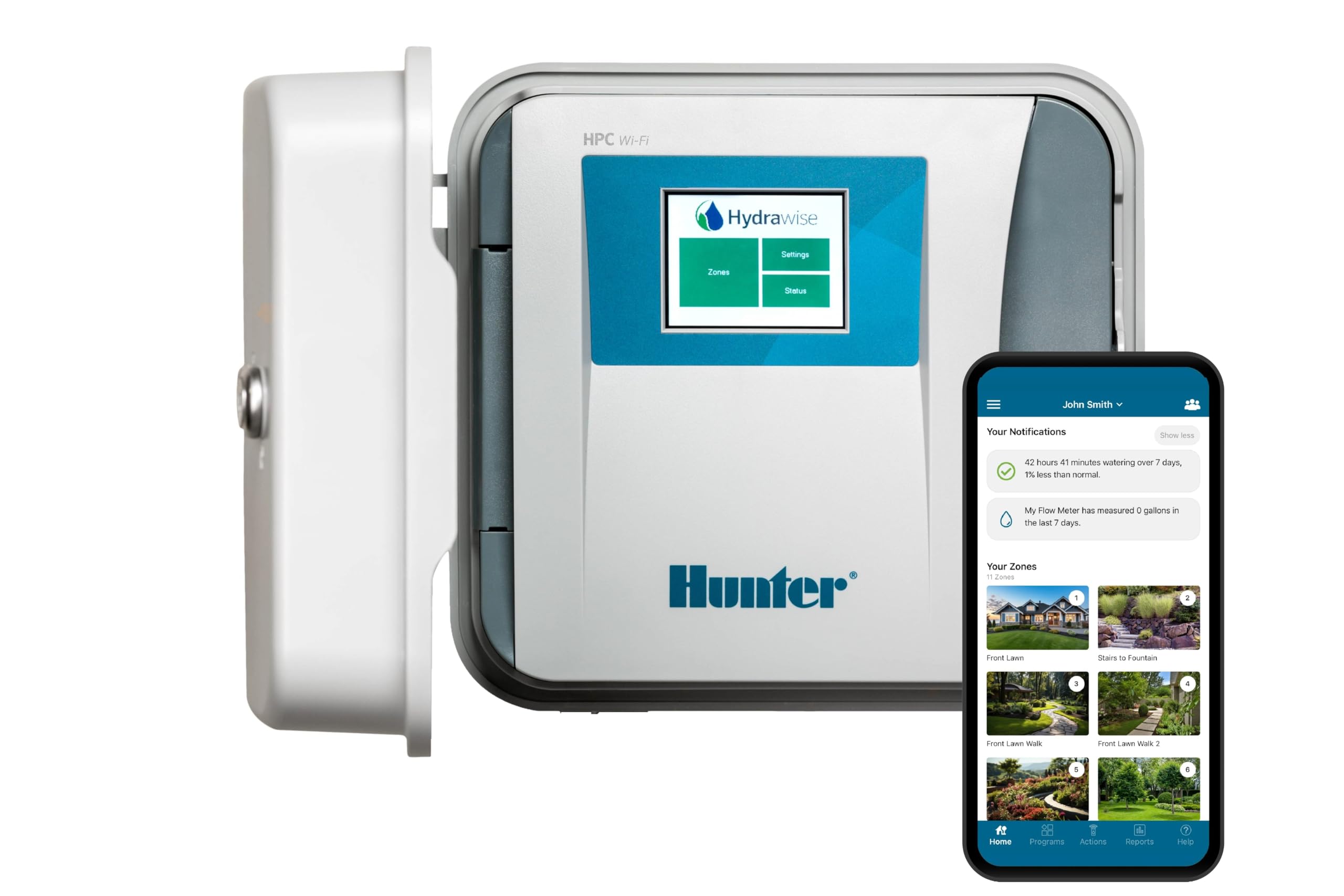
The expansion path from four zones to 32 is the Hunter HPC400's reason to exist. It ships with four zones, but the Hydrawise platform scales, and the outdoor-rated cabinet and touchscreen make it feel like installed-system hardware rather than a consumer gadget. That scalability is the reason to pay attention.

Hydrawise uses local weather stations and forecast data to adjust schedules, and the app handles remote control and usage tracking. The touchscreen is a nice change from dial-based timers, especially for labeling zones and testing valves at the panel. We liked having both a physical interface and the app, because troubleshooting at the box is faster than walking back to a phone.

The catch is the buy-in. Four zones included is modest, and the value depends on actually needing more zones later. The app is capable but has a learning curve, and the controller is heavier than the plastic boxes here. For a system that may reach twelve or twenty zones, that expandability is worth it; for a fixed four-zone yard, the HiOazo or Orbit is simpler.

Bottom line: For a growing system that needs outdoor-rated hardware and room to reach 32 zones, the HPC400 is the expandable controller we recommend.

4

Orbit B-hyve XR 8-Zone

Orbit B-hyve XR 8-Zone

Larger yards

Our Score 8.6/10
Check Price

Worth Noting

  • WiFi pairing can be fussy
  • Smart routine can misfire
Zones
8
Control
App and Alexa
Display
Digital
Placement
Indoor/outdoor
Read the full review

The larger eight-zone cabinet and prominent display are the first things you notice about the B-hyve XR. It takes the formula that makes the standard B-hyve easy to live with and stretches it to eight zones, with app-based scheduling and weather-aware watering. For a yard that has outgrown six zones, that is the point.

The app is familiar if you have used Orbit before, with flexible schedules, manual zone runs, and quick adjustments from the phone. We like having a display on the unit for checking status at the panel, especially when you are troubleshooting a valve. Setup is straightforward, and editing the schedule when the season changes does not take long.

The trade-off is value. You pay more than the six-zone model for two extra zones, and if ET-driven soil intelligence is what you want, ImoLaza is the better fit. What you get here instead is a larger, outdoor-ready cabinet and the same easy app. For a straightforward eight-zone yard, we think that is a fair trade. If you only have six zones, the standard B-hyve is the better value; the XR earns its place when the extra capacity is real.

Bottom line: For an eight-zone yard that needs an outdoor-ready controller and a familiar app, the XR is the Orbit we recommend over the six-zone model.

5

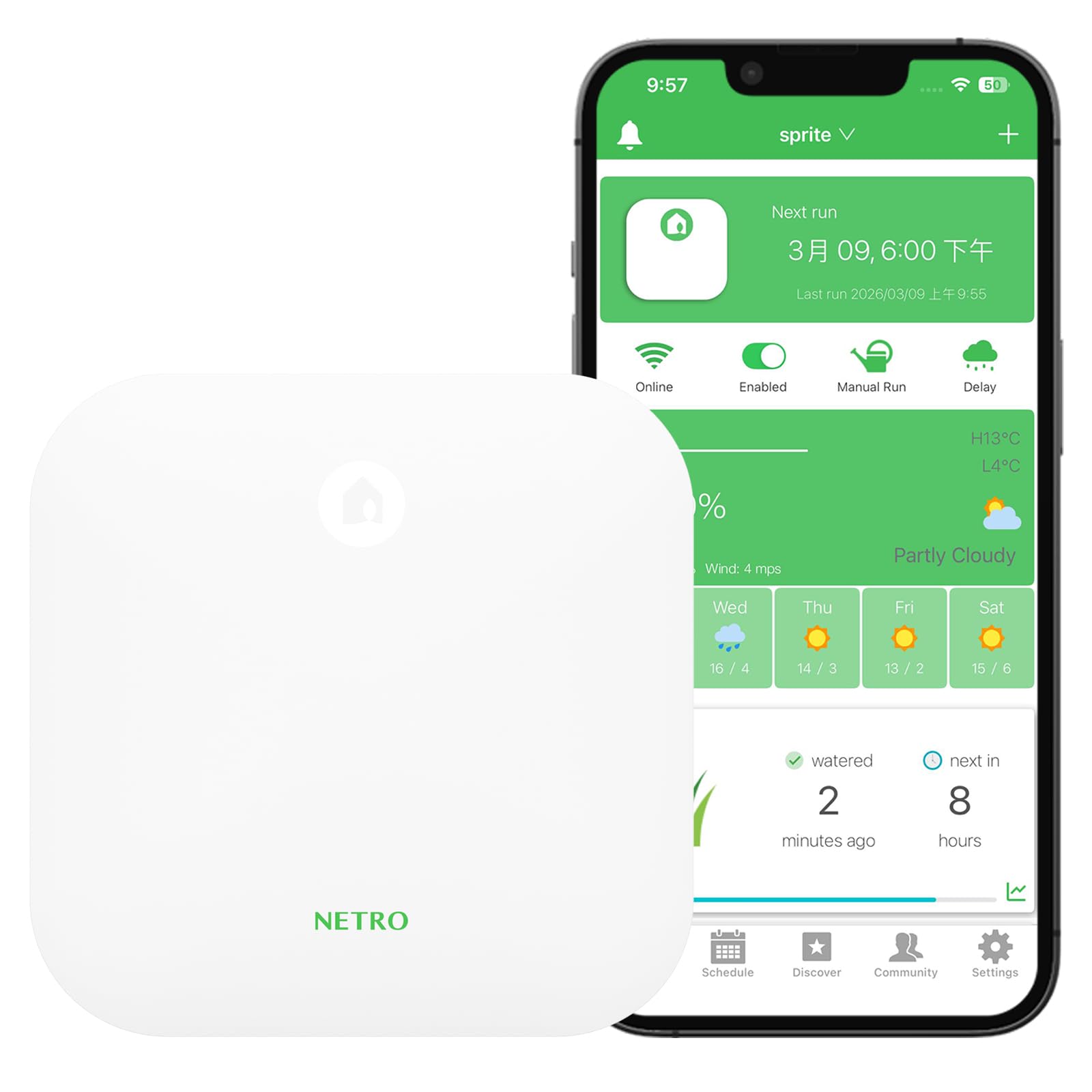
Netro Sprite 12-Zone

Netro Sprite 12-Zone

Many zones

Our Score 8.6/10
Check Price

Worth Noting

  • App interface can be complicated
Zones
12
Placement
Indoor
Dimensions
5.7 x 5.7 x 1.2 in
Weather Service
Location-based forecasts
Read the full review

Twelve zones in a box this small is the Netro Sprite's main appeal. It is an indoor controller, so it belongs in a garage or utility room, but it covers a lot of valves and brings location-based weather, rain skips, and a plant library into the app. We like it for a large yard with many small zones, where a six-zone controller would leave you swapping wires.

The app is where the experience lives, and it is customizable: you can set schedules by area, adjust for local restrictions, and let the weather service trim run times. The small footprint is a real convenience in a crowded garage, and the built-in level helps you mount it straight. The screen is minimal, so expect to do almost everything from your phone.

The bigger caution is what happens when the connection fails. A controller that depends on WiFi for its schedule can leave a zone running far longer than planned after an outage, so put it on a strong signal and check the schedule after the internet comes back. That is a condition to manage, not a reason to rule it out if twelve zones is what you need.

Bottom line: The Sprite is our pick when you need twelve zones on an indoor panel and want weather-aware scheduling without jumping to a premium controller.

6

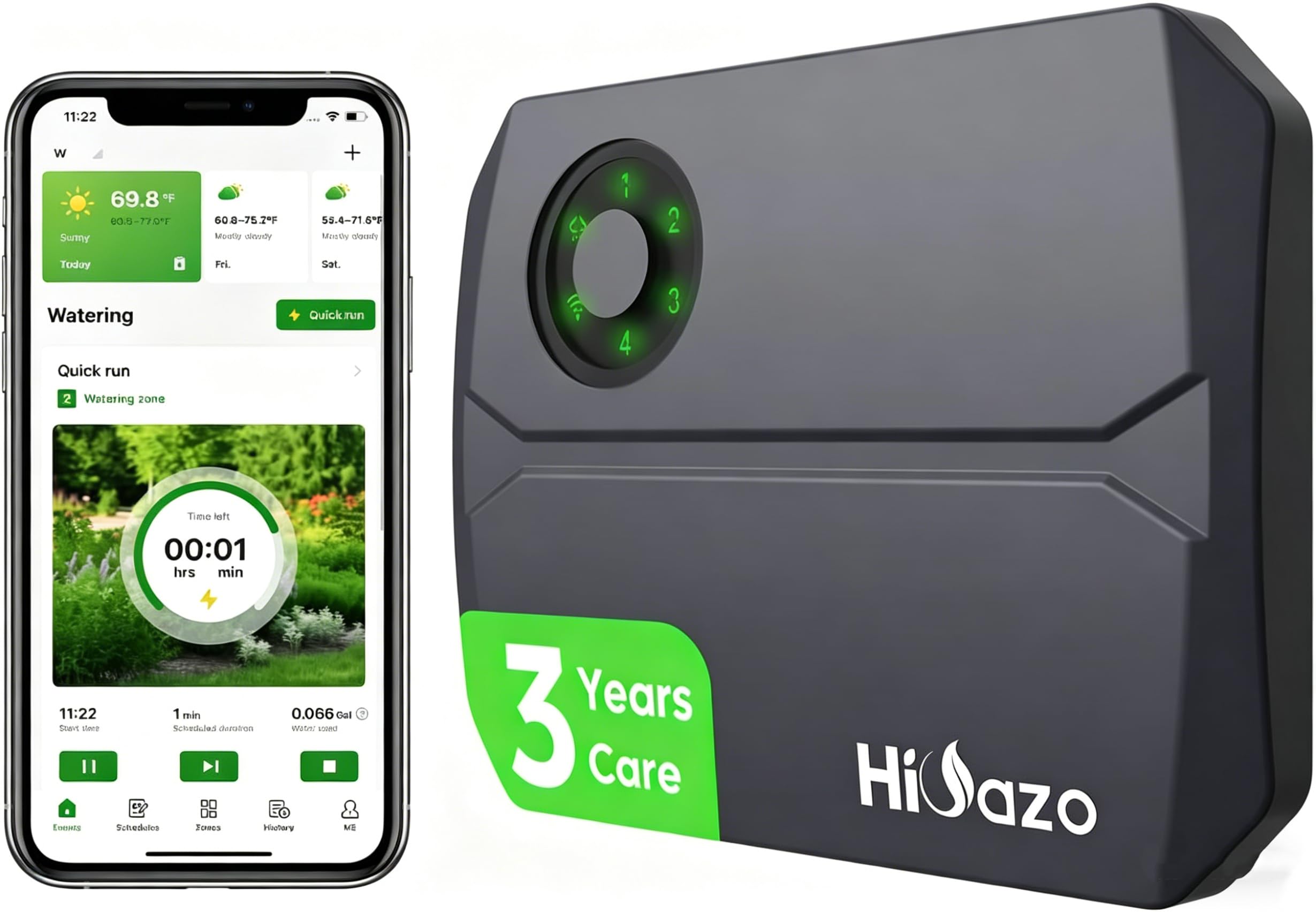
HiOazo 4-Zone

HiOazo 4-Zone

Small systems

Our Score 8.4/10
Check Price

Worth Noting

  • WiFi pairing can fail
  • Rain skip can be inconsistent
WiFi
2.4GHz
Zones
4
Weather Skips
Rain, freeze, and wind
Watering Plans
16
Read the full review

The HiOazo is the least expensive way into smart watering here, and it does not strip out the features that matter. Four zones, sixteen watering plans, and rain, freeze, and wind skips are all handled through the app. The controller is compact, so it does not take over a shelf. For a small yard, a few raised beds, or a rental where you do not want to spend much, that is a compelling package.

We were surprised by how much scheduling flexibility it packs in: separate plans per zone, soak cycles, and a weather threshold. The four-zone limit is the main constraint; if your system has five or more valves, look at the six-zone Orbit or the eight-zone models. The HiOazo makes sense when four zones is genuinely all you have.

The app is not the most polished here, and we wish it gave clearer feedback when a weather skip is overridden. For the money, it is still a useful starter controller—just not one to trust blindly. Test every zone and the rain hold in the first week, while you are still paying attention.

Bottom line: For a small yard with four zones or fewer, the HiOazo is the budget controller we recommend for simple, app-based watering.

7

Rain Bird ARC6 6-Station

Rain Bird ARC6 6-Station

Simple indoor

Our Score 8.2/10
Check Price

Worth Noting

  • WiFi can fail to stay connected
Stations
6
Placement
Indoor
Voice Control
Alexa and Google Assistant
Weather Adjustment
Postal-code forecast
Read the full review

The ARC6 is the simplest controller here, and it is built for an indoor panel. It has six stations, postal-code weather adjustment, and an app that lets you set, monitor, and delay schedules from your phone. If your controller lives in a garage or utility room, that is all you need.

We like the straightforward Rain Bird app for the basics: starting a manual run, changing a schedule, and checking the forecast are all easy to find. The catch is that manual zone testing is clunky—you cycle through zones rather than jumping straight to the one you want. The display helps at the panel, and Alexa and Google Assistant are supported for voice control.

The app covers the basics, and the weather adjustment uses your postal code to trim watering. We wish the rain adjustment had finer control; it is more of a broad seasonal trim than a precise skip. That is a limitation to accept at this price, not a reason to avoid it if you mostly want remote control.

Where it fits: a small indoor system on a budget, with a homeowner who wants app control but does not need the extra soil intelligence of the ET models. It is the one here we treat as a basic remote timer rather than a full smart-watering system.

Bottom line: For a small indoor system that needs basic app control and postal-code weather adjustment, the ARC6 is a sensible budget choice.

How We Tested 12 Smart Controllers Through a Full Watering Season

We started by pulling every controller that met the same basic brief: support for at least eight zones, compatibility with standard 24-volt AC valves plus a master valve or pump relay, and a companion app for both iOS and Android. That left a couple of dozen candidates, which we narrowed by reading manuals for rain-sensor support, pump wiring, and whether the unit could run a schedule without a cloud connection. The 12 that made the cut went onto real in-ground systems — my six-zone yard, two neighbors' lawns, and a family member's older setup with a pump — and ran from spring startup through fall shutdown, roughly seven months.

Installation happened on a Saturday morning with a screwdriver and the zone labels off the old unit. We timed how long each swap took one person working alone and noted where the app's wiring guide actually helped and where it left us guessing. Then we went after the Wi-Fi on purpose: one controller was set up at the far corner of the yard from the router, we rebooted the network mid-week, and we watched whether it came back online by itself or had to be re-added. A mid-summer breaker trip turned into a reliability check too — everything was left unpowered for an hour to see which schedules survived. And after the first hard rain, we noted which units skipped a cycle and which watered the lawn anyway.

Ease of use got judged the honest way: I handed my phone to someone who'd never opened the app and asked them to build a schedule for a sloped lawn, counting the taps and the wrong turns along the way. Through July and August we adjusted run times zone by zone and walked the yard looking for dry corners and runoff at the curb, since a pretty schedule means nothing if the coverage is uneven. At the end of the season we asked the blunt question of every unit: did this do anything the cheaper controller next to it couldn't?

How to Choose Smart Sprinkler Controllers

Count zones before you shop

Walk the valve box and count every zone, including drip lines and spare valves. A controller with more zones than you need is fine—you can leave the extras unused—but one with too few forces you to combine plantings that should water differently. Expansion matters only if you expect to add zones; the Hunter HPC400 is the expandable pick here, while the four-zone HiOazo is the right shape for a genuinely small system. We treat zone count as the first filter because it is the one spec you cannot fix in the app.

Know what weather smart really means

Basic weather adjustment trims run times from a forecast; a rain sensor or delay only stops watering after or during rain. Better controllers add freeze and wind skips, and the most advanced use evapotranspiration, or ET, to estimate how fast soil is drying. Check that the skips you want work without an extra module. The Orbit B-hyve and ImoLaza both handle forecast-based skips; ImoLaza goes further with ET. We look for the skip types named in the app, not just the word smart on the box.

Match the cabinet to where it will live

An indoor-only controller belongs in a garage or utility room; an outdoor-rated model can go on an exterior wall. Wherever it lives, it needs a protected outlet and enough slack in the valve wires. Before disconnecting the old unit, label every wire and photograph the terminal block. Most swaps reuse the existing wiring and mounting holes, but check the controller's support for a pump or master valve if your system has one. We photograph the old block every time because the new app's zone labels only help if the wires go back correctly.

Treat WiFi as part of the install

App control is only as good as the connection. A controller that drops off the network can miss a weather skip or leave a zone running longer than intended, so test the signal at the mounting spot and use the 2.4GHz band when the controller requires it. We put a stable connection above voice control or an extra schedule. After an outage, open the app and confirm the schedule and weather hold; that habit catches more problems than any spec sheet.

Frequently Asked Questions

Final Verdict

Most yards do not need the most complicated controller; they need one that covers the valves, survives the weather, and skips watering when the forecast says so. The Orbit B-hyve is our default because it does those things at a price that makes sense for a first smart controller, and its six-zone limit is easy to check before you buy.

If water savings is the main goal, ImoLaza's ET scheduling is the step up. If you need eight zones, the B-hyve XR is the simpler choice; if you expect to expand past that, the Hunter HPC400 is worth the premium. Start with your valve count and your WiFi signal, and the rest of the decision gets much easier.