Watering & Irrigation

Best Sprinkler Heads of 2026

A sprinkler head is a small, unglamorous brass or plastic part that decides how your whole watering season goes: how far the water reaches, how evenly it falls, and how much of it lands on the driveway instead of the zucchini. A good one disappears into the job; a bad one has you out there at dusk with a screwdriver, nudging it two feet to the left for the third night running.

I've replaced enough of these to know the failure is rarely dramatic: a head that never quite covers the corner of the bed, threads that don't match the riser already in the ground, a nozzle missing from the box. We've spent five months with 16 heads on raised beds, a sloped lawn, and a narrow side strip. First-time buyers are usually surprised that the head is rarely the expense — the water and the replanting are — so it pays to buy one you can adjust and re-nozzle rather than the cheapest thing on the shelf. The ones worth screwing on are below.

1

Rain Bird 5000 Rotor 2-Pack

Top Pick
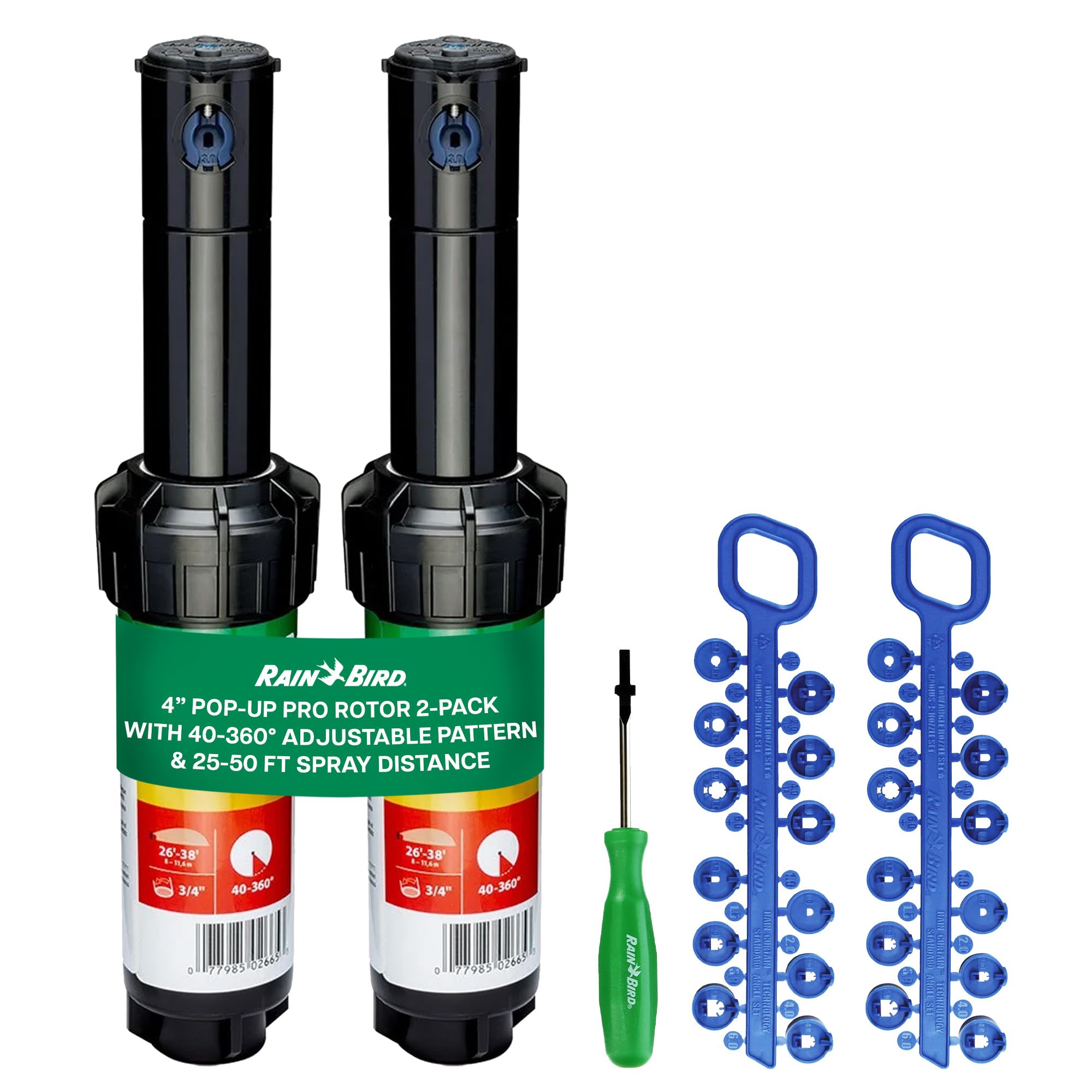
Rain Bird 5000 Rotor 2-Pack

Most lawns

Our Score 9.2/10
Check Price

Worth Noting

  • 3/4-inch inlet won't fit 1/2-inch spray bodies
Arc
40–360°
Inlet
3/4 in NPT
Nozzles
16 included
Spray Distance
25–50 ft
Read the full review

Sixteen nozzles in the box is the reason this one leads our list. A rotor only performs as well as the nozzle screwed into it, and the 5000 two-pack ships a whole tree — eight low-angle, eight standard-angle Rain Curtain nozzles — so a windy corner can get a low-angle pattern while the sheltered middle of the zone gets a standard one. That is the flexibility most heads make you buy separately. The 40- to 360-degree arc and 25- to 50-foot throw cover ordinary residential spacing, and the 3/4-inch inlet drops straight into a standard rotor body.

Adjusting it is the part we enjoyed. Arc and radius both set from the top with a flat-blade screwdriver while the zone is running, so you watch the pattern move as you turn the screw instead of guessing, walking back to the valve and running it again. On a system with six or eight heads to dial in, that is an afternoon saved.

Two things to know before you order. The 3/4-inch inlet means this replaces a rotor, not the 1/2-inch spray bodies on an older system, so check the fitting you are pulling out. And open the box before you dig — the nozzle tree is the whole point of this bundle, and it is the piece that goes missing.

Bottom line: The one we point most people to: sixteen nozzles let you tune the pattern to the zone, and the arc sets from the top without pulling the head.

2

Rain Bird AG-5 Impact Head

Rain Bird AG-5 Impact Head

Well water

Our Score 9.2/10
Check Price

Worth Noting

  • Needs solid pressure to pop and throw
  • Audible clatter close to the house
Arc
20–360°
Inlet
1/2 in NPT
Nozzles
5 color-coded included
Spray Distance
24–45 ft
Read the full review

If your water comes from a well, a pond or a reclaimed line, start here. The AG-5 is an impact head built for exactly that: fewer fine passages to silt up than a gear rotor, a brass-weighted arm that swings through grit instead of jamming on it, and five color-coded nozzles in the box to set the flow. It throws 24 to 45 feet from a 1/2-inch inlet, with an arc that runs from 20 degrees up to a full circle.

The diffuser screw is what earns it a place beyond dirty water. Turning it breaks the stream into finer droplets and pulls the radius back by up to a quarter, by hand, with no tool — so the same head that throws 45 feet down an open run can be tamed for a strip beside a driveway or a bed against the house.

Pressure is the catch. An impact arm needs a solid push to trip and to keep swinging, and a weak lateral leaves it barely clearing the grass with half the throw. It also clatters as the arm swings — fine at the far end of a property, less fine under a bedroom window at five in the morning.

Bottom line: Worth the premium if your water comes from a well, a pond or a reclaimed line — this is the head that shrugs off grit instead of clogging on it.

3

Orbit Voyager 55461

Orbit Voyager 55461

Clay and slopes

Our Score 9.2/10
Check Price

Worth Noting

  • Low rate means longer run times
Arc
40–360°
Inlet
3/4 in NPT
Spray Distance
Up to 35 ft
Precipitation Rate
0.24 in/hr
Read the full review

A quarter of an inch per hour is the number worth understanding here. That is a low precipitation rate, and on clay or a slope it is the difference between water soaking in and water running down the gutter. The Voyager delivers it from a gear-drive rotor that throws up to 35 feet on a 40- to 360-degree arc, sits on a 3/4-inch inlet, and carries a five-year warranty — the longest here.

Adjustment is by flat screwdriver on top of the head, and the arc stops take a couple of minutes to set. We ran these on a zone that mixes sun and shade and came to appreciate the low rate for a second reason: the ground took the water instead of puddling, so we were not trimming run times to stop it running off.

For a heavy-soil lawn, or any zone with a fall across it, this is our pick: it puts water on slowly enough that the soil sets the pace rather than the valve. The reservation is the plastic — the adjustment slot is soft enough that a poorly fitting screwdriver will chew it, so use a proper flat blade and stop when you feel the limit.

Bottom line: Our pick for clay and slopes: the low precipitation rate gives the ground time to take water in instead of shedding it into the gutter.

4

Hunter PGP-ADJ Rotor 2-Pack

Hunter PGP-ADJ Rotor 2-Pack

Large properties

Our Score 9.0/10
Check Price

Worth Noting

  • One 3.0 GPM nozzle, no nozzle tree
Arc
40–360°
Inlet
3/4 in NPT
Nozzle
3.0 GPM installed
Spray Distance
22–52 ft
Read the full review

Fifty-two feet is the number that separates this Hunter from everything else on our list. The PGP-ADJ shares the 3/4-inch inlet and the 40- to 360-degree arc of the Rain Bird 5000 but throws further at the top end, which matters on a corner where the head sits at the fence and the far side of the lawn is a long way off. The gear drive is water-lubricated, so rotation is smooth and quiet rather than a series of clacks.

This is the head we reach for when a zone has ground to cover: a big lot, a slope that runs to the property line, or a run you are rebuilding around 45- to 50-foot spacing. It is also the cheapest per head in this group, which makes the single-nozzle limitation easier to live with — you are paying for reach and a proven gear drive, not for a box of parts.

That limitation is worth spelling out. One 3.0 GPM nozzle comes installed and there is no tree in the box, so a zone with mixed arc sizes needs nozzles bought separately if you want precipitation matched. Check for the adjustment wrench before you start digging, too; it is the piece that goes missing, and a spare Hunter wrench in the toolbox beats a second order. The 100 psi maximum pressure suits systems that would overwhelm a lighter head.

Bottom line: Buy it if your zone has to reach further than the top pick can — it is the longest-throw rotor here and the cheapest per head in this group.

5

Orbit Saturn III 55469

Orbit Saturn III 55469

Small yards

Our Score 9.0/10
Check Price

Worth Noting

  • Maximum rated pressure is only 40 psi
  • 25-foot throw limits head spacing
Arc
40–360°
Flow Rate
2 GPM
Spray Distance
Up to 25 ft
Maximum Pressure
40 psi
Read the full review

Forty psi is the first thing to check on the Saturn III. That is its maximum pressure, well under what most residential systems deliver at the valve, and it tells you who the head is for: small yards, older systems on a weak lateral, and zones where the heads sit close together. Inside that envelope it is a tidy piece — 40 to 360 degrees of arc, up to 25 feet of throw, a 2 GPM nozzle, a bottom inlet filter and no key needed for adjustment.

The 2 GPM nozzle is the practical part, and it is why we kept this one on the list. Low demand means a modest lateral can carry several heads without starving the last one in the run, and a 25-foot throw suits beds and small yards where a 35- or 50-foot rotor would water the fence and the neighbor's car.

It is sold as a replacement for Hunter, Rain Bird and Toro rotors, though the reducer some installations need is not in the box, so check the thread on the body you are pulling out. The build is ordinary rather than precise, and this is a head to fit and forget rather than service. Put a gauge on the zone before you buy — if the needle sits above 40 psi, this is not the head for that line.

Bottom line: A sensible small-yard head that keeps zone demand low, provided your system runs at or under the pressure it is rated for.

How We Tested Sprinkler Heads Across a Full Season

We started with a list of more than 40 heads sold at hardware stores and irrigation suppliers, then narrowed it by the things that decide whether a head is worth installing: standard thread fittings, replaceable nozzles, published throw distances, and spare parts you can order on their own. Anything with a proprietary connector or vague specs got cut. That left 16 heads, which we ran from April through September — five months of real watering.

Installation was the first filter. I screwed each head onto an existing riser and onto three different hoses, once by hand and once with a wrench, timing the swap to see which ones demanded a tool. We also opened every box and counted the pieces against the parts list before any water ran, since a missing nozzle or stray O-ring means a second trip to the store.

For coverage, we laid out a grid of tuna cans across a raised bed and a sloped lawn strip, ran each head for 20 minutes, and measured what landed in every can. Heads that threw a ring with a dry center, or that soaked the sidewalk, got marked down, and we turned each adjustment collar through its full range to find where the spray broke into mist instead of reaching. A few ran overnight under pressure, and a few ran unfiltered well water, to see how quickly the nozzles clogged.

At the end of the season we took every head apart and looked for hairline cracks, stripped threads, and mineral crust around the nozzles. Value came down to one question: when something wears out, can you swap a small nozzle, or are you buying the whole head again?

How to Choose Sprinkler Heads

Start with the zone, not the yard

Three head types do three different jobs. Gear-drive rotors throw a single rotating stream 25 to 50 feet and suit open lawn with heads spaced well apart. Fixed spray heads top out around 15 feet and are the right answer for narrow strips, parkways and beds where a rotor's minimum radius would water the sidewalk. Impact heads throw far, tolerate grit and adjust by hand, which is why they hang on around wells and older systems.

Measure from the head to the far edge of what it has to cover before you order. If that distance is under about 20 feet, a rotor's shortest setting will overshoot it; if it is 40 feet, no spray head gets there. Match the throw printed on the box to the run you actually have.

Check the inlet before you dig

Rotor bodies take a 3/4-inch NPT inlet; spray bodies usually take 1/2 inch. That one difference decides whether a new head drops onto the riser you already own or needs an adapter, and it is how a bargain box of rotors ends up stalling a Saturday. Take the old head with you, or measure the threads, before you buy.

Do not force a plastic thread to make it fit. Cross-threading a riser turns a cheap replacement into a dug-up lateral. Wrap the threads with tape, hand-tighten, and give it a quarter turn with a wrench at most.

Nozzles decide whether the zone waters evenly

The nozzle, not the body, sets how much water comes out. A head sweeping a full circle needs roughly twice the flow of a half-circle head beside it, or the arc covering less ground gets the same soaking as the one covering more. That is matched precipitation, and it is why a nozzle tree is worth the money: you fit each head to its arc instead of accepting whatever came screwed into it.

A single preinstalled nozzle is fine on a zone where every head is set the same. The moment you have a corner head and a full-circle head on the same lateral, plan the extra nozzle order at the same time.

Pressure and soil narrow it down

Two figures settle more than any marketing claim: the maximum pressure a head is rated for and the precipitation rate it puts down. A head rated to 40 psi is the wrong buy on a system running at 60, and a high-flow nozzle on clay sends part of every cycle down the gutter. Low-precipitation rotors, around a quarter inch per hour, give heavy soil time to take in what is falling.

Put a gauge on an outdoor tap on the same service and read it once. Static pressure reads higher than a running zone, so treat the number as a ceiling rather than a measurement, but it will tell you immediately whether a low-pressure head belongs on that line.

Frequently Asked Questions

Final Verdict

For most lawns, the Rain Bird 5000 two-pack is the head to buy. The nozzle tree saves a second order and a second weekend of tuning, the arc and radius set from the top while the zone is running, and the 25- to 50-foot throw covers standard residential spacing.

Go Hunter PGP-ADJ when a run has to reach past 50 feet, and the Rain Bird AG-5 when your water carries grit from a well or a pond. On a small yard fed by a weak lateral, the Saturn III is the one that won't over-demand the line — provided you have checked the pressure first.