Watering & Irrigation

Best Smart Hose Timer of 2026

A hose timer sounds like a small thing until you've spent a July evening standing in the yard with a wand in your hand, watching half the water run down the driveway. The smart versions promise to give those evenings back: screw one onto the spigot, tell it when and for how long, and let the beds get watered whether you're on the couch or three states away. The catch is that you're also bolting a small computer to the side of the house — one that has to hold a seal under constant pressure, keep a Wi-Fi signal, and survive until October.

Over the past seven months, my team and I ran 12 of these timers through a full watering season — raised beds, deck pots, a soaker hose along the fence — and the ones worth buying separated themselves quickly. The pattern: the app is rarely what fails. It's the fitting at the spigot, the battery door, the schedule that quietly doesn't fire. The picks below held their seals and their schedules from spring through fall.

1

LinkTap G2S

Top Pick
LinkTap G2S

Leak alerts

Our Score 9.0/10
Check Price

Worth Noting

  • Premium price for a one-outlet timer
Weather
Rain skip, anti-freeze
Connection
Wired Ethernet gateway
Flow Alerts
Leak, clog, valve
Battery Life
Up to 2 years
Read the full review

A hose timer fails in two ways you cannot see: a valve that sticks open and a leak inside the body. The LinkTap G2S is the pick here that watches for both. It has real-time flow monitoring that alerts you to leaks, clogs, and valve faults, and anti-freeze protection opens the valve when temperatures drop below a set threshold instead of letting ice build up.

What makes it our top pick is the combination of that monitoring with a two-year battery and an IP66 housing. The inlet is an aerospace-grade composite that is lead-free and rust-proof, and the self-adaptive threads are meant to avoid seizing onto the faucet. We paid close attention to the flow alerts because they turn a dumb watering mistake into a notification before it becomes a flooded bed.

The gateway is the part to understand before ordering. It wants a wired Ethernet connection at the router, not just a WiFi signal, and that can rule out a shed or a detached garage without a cable run. Once it is connected, the wireless range is generous and the scheduling is flexible. The app can program multi-cycle schedules by day, week, or month, and it can start or stop water instantly.

For a garden with drip lines, a pool top-up, or a remote property where a surprise leak is expensive, the LinkTap earns its keep. It is a one-outlet timer, so a multi-zone garden needs more than one unit, but the monitoring and freeze protection are the features that separate it from the rest of this group.

Bottom line: The LinkTap G2S is our top pick because it pairs real-time flow alerts and anti-freeze protection with two-year battery life, making it the set-and-forget choice for a serious garden.

2

RainPoint 2-Zone

RainPoint 2-Zone

Two-zone gardens

Our Score 9.0/10
Check Price

Worth Noting

  • Needs a 2.4 GHz network with its own SSID
App
2.4 GHz WiFi hub
Modes
Normal, interval, cycle/soak
Zones
2
Schedules
6 per zone
Read the full review

Two independent zones are the reason to look at the RainPoint. Each zone gets its own schedule and up to six watering plans, and the three modes cover a normal soak, a short interval cycle, and the cycle-and-soak pattern that works well for new plantings or compacted soil.

We think this is the best two-zone timer here for a garden that has different needs on each side of the faucet. The seasonal adjustment is the detail we like most: you can scale every zone up or down by a percentage as the season changes instead of rewriting each schedule. Smart Scenes can also tie watering to weather and to other RainPoint devices, which makes the system feel more like a small controller than a hose gadget.

The build is sturdier than the budget timers, and the app is straightforward once the hub is paired. A two-zone unit is also the cleanest way to run a drip line and a sprinkler from one spigot without an external splitter and two separate timers. If you only have one hose, you are paying for a second zone you may not use.

Bottom line: Choose the RainPoint if you water two areas on different schedules; its independent zones and seasonal adjustment are the reason it earns a runner-up spot.

3

Shrivee WiFi Timer

Shrivee WiFi Timer

Tight budgets

Our Score 8.6/10
Check Price

Worth Noting

  • IP55 rating is modest for year-round exposure
App
Smart Life, Tuya
Range
Up to 984 ft
Outlets
1
Weather Rating
IP55
Read the full review

The Shrivee is the budget gateway timer we point to for a single hose, and the surprise is how much of the useful kit is included. You get the gateway, a brass inlet with a built-in filter, rain delay, manual mode, mist mode, and a stated range of up to 984 feet. We think that combination is the right one for a gardener who wants app control without paying for flow monitoring or a second zone.

The Smart Life and Tuya app is familiar and quick to set up, and the schedule options cover the basics: timed watering, weekly cycles, and a manual run when you want to hose something down. The gateway means the timer can sit farther from the router than a WiFi-only unit, which is the practical reason to choose it over the no-hub Insoma. A single hose on a protected faucet is its sweet spot.

Bottom line: The Shrivee is the budget pick we point to for a single hose, since it includes a gateway, a brass inlet, and a long RF range without extra cost.

4

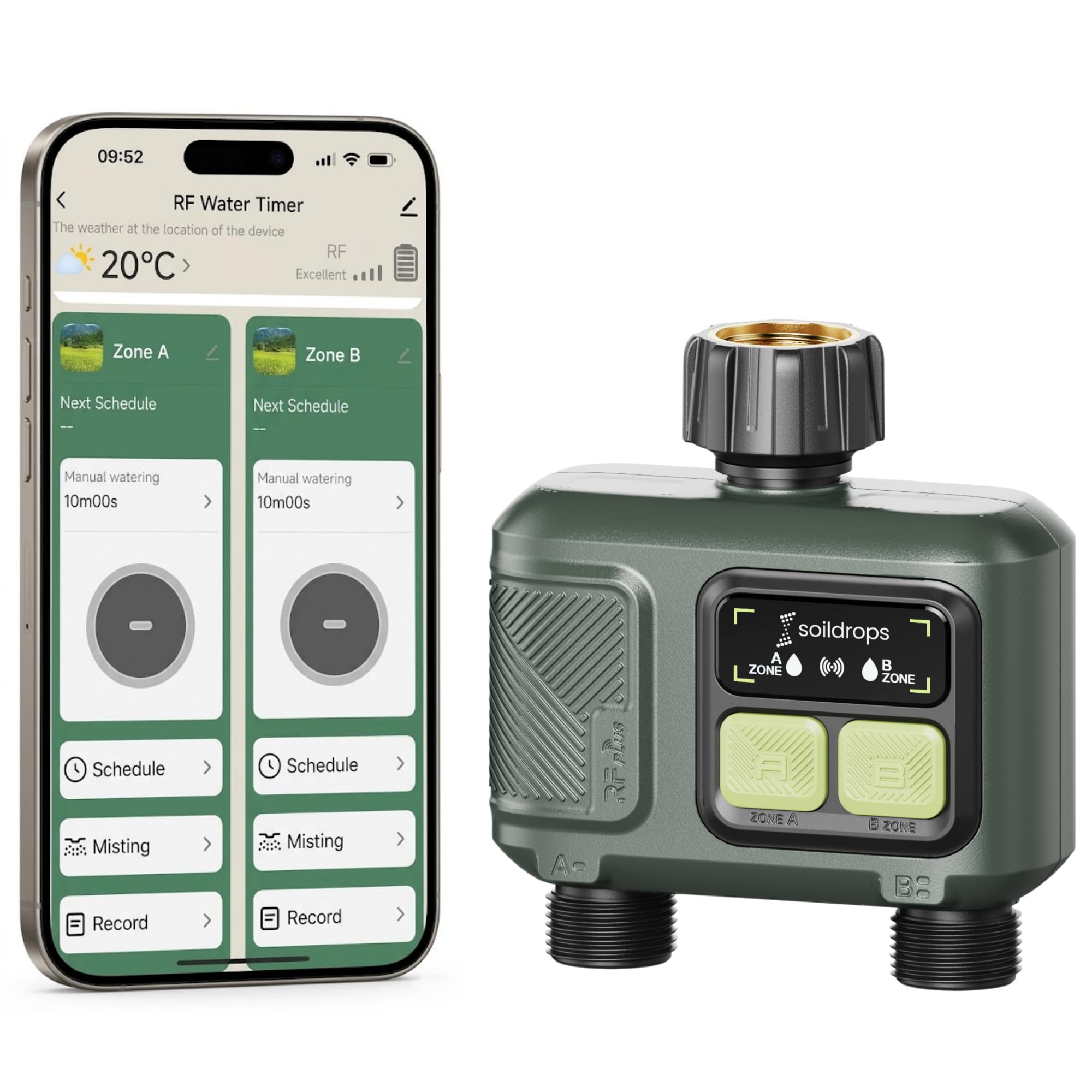
Soildrops WHT-002

Soildrops WHT-002

Long-range yards

Our Score 8.6/10
Check Price

Worth Noting

  • One outlet per timer; multi-zone yards need extra units
Range
Up to 984 ft
Battery
Up to 8 months
Devices
Up to 64
Weather
Rain delay
Read the full review

The Soildrops is built for the far corner of the yard. Its gateway uses sub-GHz RF to reach up to 984 feet, and the timer runs on two AA batteries with a stated life of up to eight months. That is not the two-year battery of the premium picks, but it is long enough to get a timer through a growing season without a charging cable or an outdoor outlet.

The weather delay is the feature we expect at this price, and the OTA updates and AES-128 encryption are less common details at the budget end. The app can show watering history, and the gateway supports up to 64 devices, so the system can grow beyond a single bed if you add timers later.

What we like most is the placement freedom. A sub-GHz signal handles walls and distance better than a WiFi-only timer, so a spigot behind a shed or at the edge of a field is less of a problem. The 64-device support also means the gateway can become the hub for a larger yard rather than a single-hose accessory.

We think the Soildrops is the long-range pick for a large yard or a remote spigot, especially where WiFi is unreliable. It does not match the LinkTap for flow monitoring or freeze protection, but it solves the range problem at a midrange price. If your faucet is close to the router, the simpler Insoma is easier to live with.

Bottom line: For a large yard with a weak WiFi spot, the Soildrops is our long-range pick, with a 984-foot gateway range and an eight-month battery rating.

5

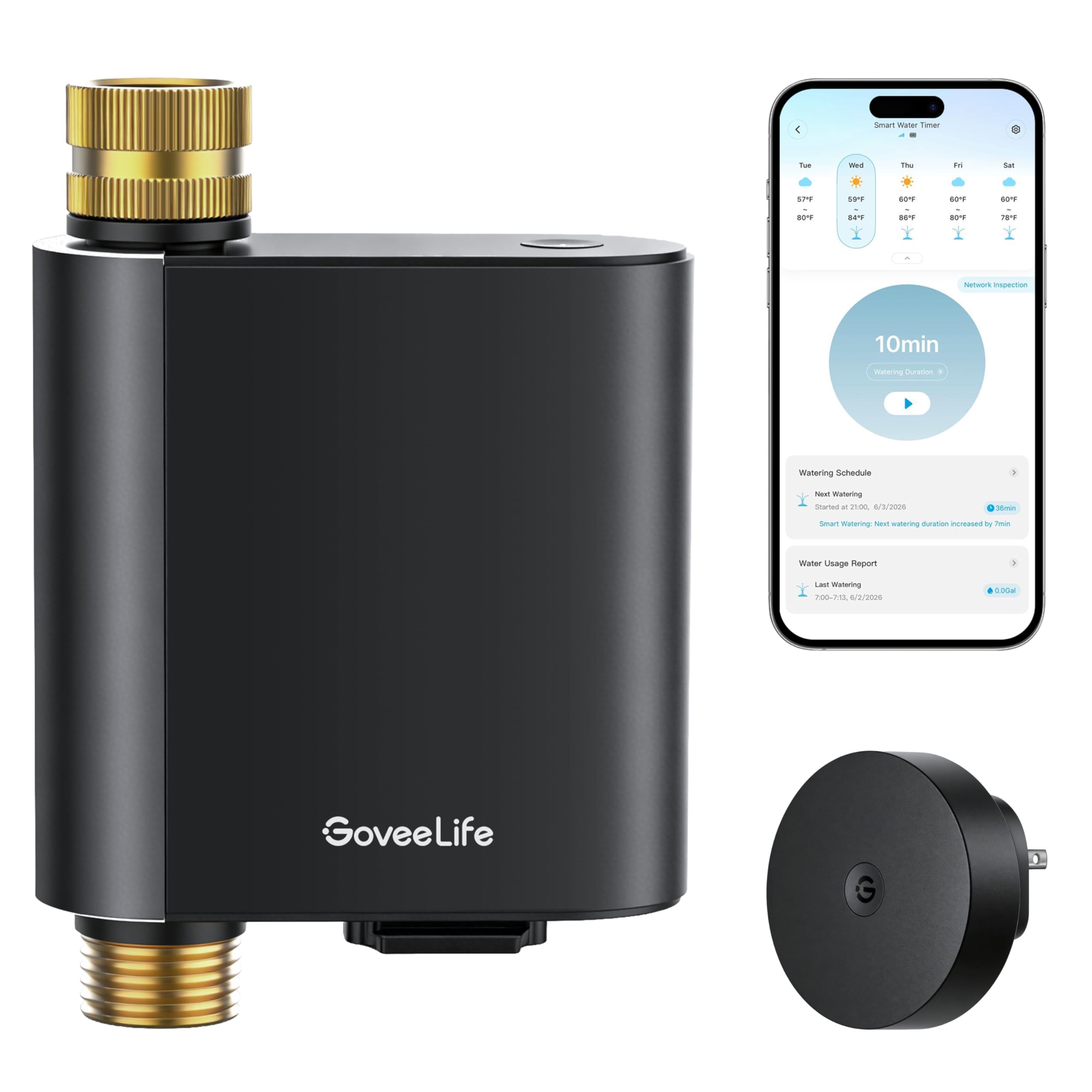
GoveeLife H5901

GoveeLife H5901

One-zone value

Our Score 8.4/10
Check Price

Worth Noting

  • Water-use charts are a rough guide
Range
Up to 1,640 ft
Battery
2 years
Outlets
1
Weather Inputs
Rain, light, temp, humidity
Read the full review

The GoveeLife H5901 is the value pick we keep coming back to for a single hose. Its weather-adaptive mode pulls rain, light, temperature, and humidity data and adjusts the schedule instead of simply canceling a cycle, which is a more useful kind of smart watering than a timer that only knows the clock.

The kit includes a gateway with a stated range of up to 1,640 feet, and the system can handle up to 64 devices. That is more headroom than most gardens need, but it means a weak WiFi corner is less of a problem. The dual brass inlets, IP67 housing, two-year battery rating, and ten schedules are the practical details we appreciate; the three modes cover continuous, intermittent, and custom watering.

One outlet is the limit. If you water a vegetable bed and a flower border on different schedules, the RainPoint's two zones are the better shape. For a single bed, a small lawn, or a drip line, the H5901 gives you weather adaptation and a long-range gateway without the premium of the top pick.

Bottom line: For one hose, the GoveeLife H5901 is the value leader here: weather-adaptive watering, brass inlets, and a 1,640-foot gateway range without a premium price.

6

Insoma WiFi Timer

Insoma WiFi Timer

No-hub setups

Our Score 8.4/10
Check Price

Worth Noting

  • WiFi-only needs a strong signal at the faucet
Hub
Not required
Inlet
Brass
Outlets
1
Schedules
20
Read the full review

No hub is the Insoma's best trick. It connects directly to a 2.4 GHz WiFi network through the Smart Life app, so there is one less box to power, mount, and pair. The setup is about as simple as this category gets.

The schedule count is generous for the price: ten normal schedules and ten cycle-and-soak schedules, with a manual run from one minute to 24 hours. Brass inlets and outlets are a nice touch at this end of the range, and Alexa and Google support mean you can start or stop watering by voice without opening the app.

We think this is the best no-hub option here for a single hose. It does not have the flow alerts or anti-freeze protection of the LinkTap, and it will not manage two zones, but it covers the core job with a clean app and a sensible schedule set. For a patio spigot or a small yard, it is the simplest way into smart watering.

Bottom line: When there is no room for another hub, we point to the Insoma WiFi timer: 20 schedules, brass fittings, and a straightforward app at a budget price.

7

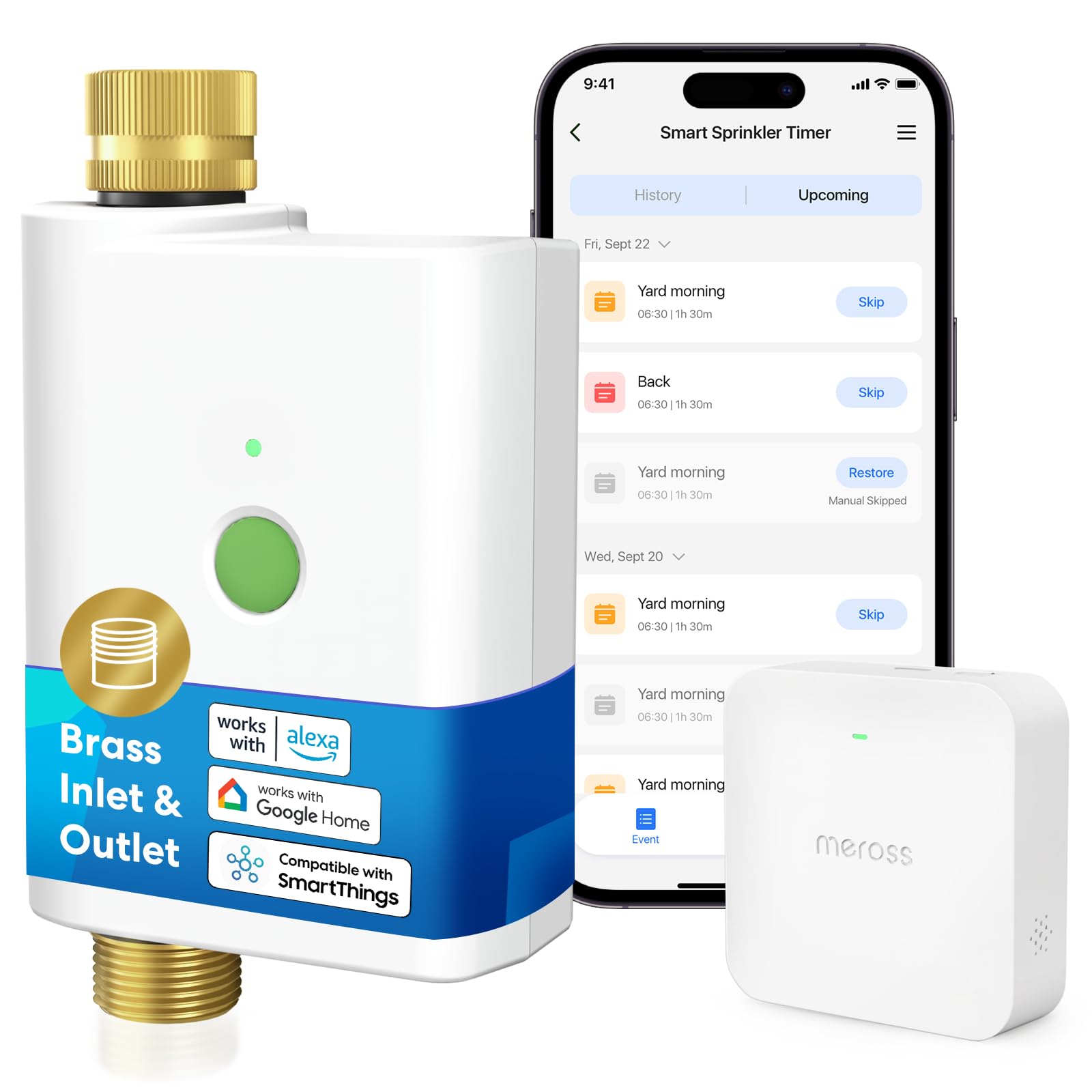
meross MST100

meross MST100

Apple HomeKit

Our Score 8.2/10
Check Price

Worth Noting

  • Battery compartment needs a screwdriver
Hub
Included
HomeKit
MSH400 hub only
Outlets
1
Weather Skip
Rain, freeze, wind
Read the full review

HomeKit is the reason to look at the meross MST100, but the hub model decides whether you actually get it. The MSH400 hub supports Apple Home; the MSH450 hub does not, even though it runs the timer. That is the first thing we check before recommending this kit, because the difference is invisible in a product photo.

The rest of the package is solid: brass inlet and outlet, an IP65 housing, weather-based skips for rain, freezing, and windy conditions, and a two-year warranty. The app allows eight or more programs a day and durations from a minute to nearly twelve hours, which is more flexibility than most hose watering needs.

We think this is the best fit for an Apple Home household that can confirm the MSH400 hub. The brass fittings are a meaningful upgrade over plastic at this price, and the weather skip is aggressive enough to pause watering before a storm rather than after. Siri, Alexa, and Google all work through the hub, so it does not lock you into one voice assistant.

Setup is where the kit asks for patience. The instructions are not the clearest, and the app can take a few tries before the hub and valve settle in. Once they do, the schedule is easy to adjust and the manual run is quick. If you want the simplest possible install, the Insoma no-hub timer is easier; if you want HomeKit, this is the one to get.

Bottom line: Apple Home users should start with the meross kit, provided they confirm the MSH400 hub for HomeKit, because it adds brass fittings and weather skips at a midrange price.

8

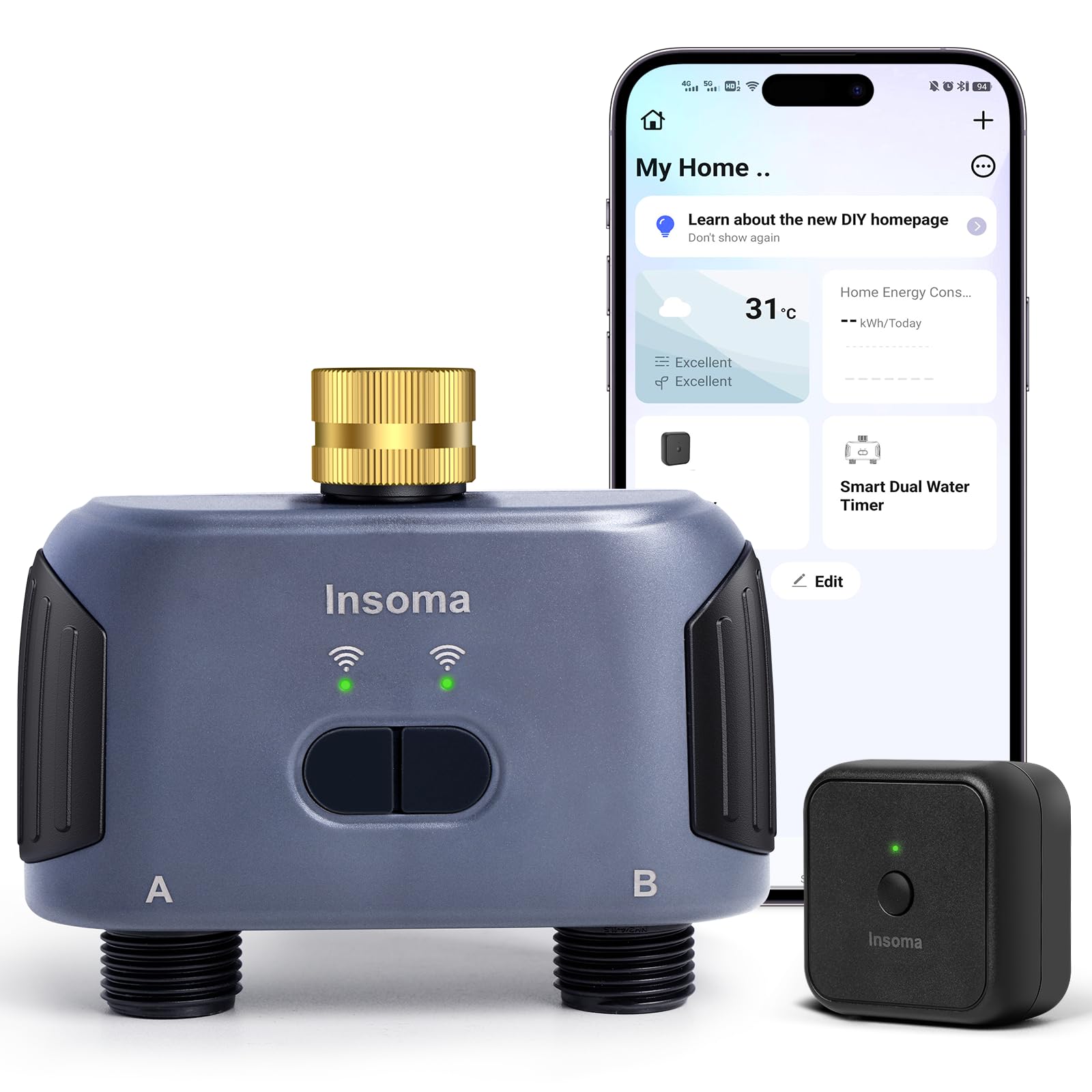
Insoma 2-Zone

Insoma 2-Zone

Budget two-zone

Our Score 8.2/10
Check Price

Worth Noting

  • 2.4 GHz WiFi only
Hub
Included
Inlet
Brass
Zones
2
Schedules
10 per zone
Read the full review

If the RainPoint's two-zone system is more than you want to spend, the Insoma two-zone timer is the budget route to the same layout. It has two independent zones, ten schedules per zone, a manual run that goes up to nearly 24 hours, and a rain delay. The hub is included, and the brass inlet is a useful upgrade over an all-plastic connection.

The app is the Smart Life/Tuya ecosystem, so you get Alexa and Google voice control and a familiar scheduling screen. Each zone can run its own timed or cycle schedule, which is the important part: you can soak the vegetable bed in the morning and run a shorter cycle on the flower border without changing both.

The hardware feels closer to the budget end than the RainPoint. The body is plastic, the app is the only place to manage the zones, and the schedule tools are less polished than the RainPoint's seasonal adjustment. That is the trade for the lower price, and it is a fair one if you mostly want two hoses on separate timers.

We think this is the right two-zone pick for a tight budget or a first smart setup. It does the core job, the zones are genuinely independent, and the hub is included. If you want the more flexible seasonal adjustment and a more solid feel, the RainPoint is worth the step up.

Bottom line: The Insoma two-zone timer is the budget way to run two independent hose schedules, though you need to power and pair its hub.

How We Tested Smart Hose Timers Through a Full Season

We started with a long list of smart timers that fit a standard outdoor spigot, then cut it to 12 by comparing valve type, zone count, power source, and how much of the scheduling the companion app lets you control without a subscription. Each one went onto a real spigot and ran for seven months, from the first spring watering through the end of the season. I timed setup solo with a stopwatch — box open to first schedule firing — and noted every step that sent me back to the paper manual.

Leaks got checked the way you'd actually find one: pressurize the line overnight, then the next morning run a dry paper towel around the collar, the battery door, and the hose connection. To see whether a ten-minute run delivers what it claims, we aimed each timer's output into a bucket, weighed it, and compared the total against the app's own gallon counter. Connectivity we tested where it's hardest — the far corner of the yard, behind a fence — and again after deliberately restarting the router, to see which timers reconnected on their own and which needed a nudge.

Durability meant leaving them mounted through heat waves and two storms, then looking for cracked housings, fogged displays, and sun-chalked plastic. For customizability, I built the same schedule on every app: separate zones, every-other-day restrictions, a rain skip, and one mid-season change. Ease of use got a second set of eyes — a neighbor who'd never touched a smart timer set up a schedule on each unit while I watched. Value came down to whether the extras were things we actually used by August.

How to Choose the Right Smart Hose Timer

Decide between a hub and a WiFi-only timer

A WiFi-only timer is the simplest install: one box on the faucet and one app. The catch is range. Outdoor spigots often sit at the edge of the network, and a weak signal can make a capable timer feel broken. A gateway system puts the radio in a better spot and can reach farther; the LinkTap gateway wants a wired Ethernet connection, while GoveeLife and Shrivee use their own hubs. If your faucet is within strong WiFi, the Insoma saves a box. If it is not, pay for the gateway.

Match zones to the way you water

One outlet is enough for a single bed, a lawn strip, or a soaker hose. Two zones make sense when you water a vegetable bed and a flower border on different schedules, or when you want a drip line and a sprinkler on the same faucet. Independent zones are the feature to look for; a timer that merely splits one schedule across two outlets is not the same. RainPoint gives each zone six schedules and seasonal adjustment, while the Insoma two-zone offers ten schedules per zone at a lower price.

Treat rain skip as a convenience

Weather-based watering can save water, but it is not a rain gauge. These timers use forecast or local weather data, so a passing shower may not register, and a forecast can be wrong. The useful version lets you set a delay and adjust the percentage for the season; RainPoint's seasonal adjustment and GoveeLife's weather inputs are good examples. Anti-freeze protection is a different feature, and the LinkTap is the pick here that opens the valve when temperatures drop.

Look at the parts that touch water

Brass inlets resist seizing better than plastic, and a built-in filter helps keep grit out of the valve. Check the IP rating if the timer lives in full sun or rain; IP55 is fine under an eave, while IP66 and IP67 are more forgiving. Battery life is a placement decision as much as a convenience: a two-year rating lets you mount the timer where a charging cable cannot reach. Use fresh batteries of the stated type, and keep the battery compartment seal clean when you change them.

Check smart-home support before you buy

Alexa and Google support is common, but HomeKit is not. The meross kit works with HomeKit only on the MSH400 hub; the MSH450 hub does not, so confirm the hub model if Apple Home is the point. App quality matters more than the logo list: Smart Life and Tuya are widely used but vary by device, and a dedicated app can be better or worse depending on the version. If you want one app for several hoses, check how many devices the gateway supports. GoveeLife and Soildrops both list support for up to 64 devices.

Frequently Asked Questions

Final Verdict

The LinkTap G2S is the smart hose timer we recommend first. It is the only pick here that pairs real-time flow alerts with anti-freeze protection, and its two-year battery life makes it the closest thing to set-and-forget watering. The wired Ethernet gateway is the trade-off. If you water two zones on a tighter budget, choose the RainPoint; for a single hose where WiFi is strong, the Insoma is the simplest no-hub option.