Fencing & Farm Structures

Best Small Garden Sheds of 2026

The first time I tried to wedge a mower, two bikes, and a bag of potting soil into a one-car garage, I understood why so many people eventually give up and buy a shed. A small one — 6 by 4, maybe 8 by 6 — is the difference between a garage you can park in and a garage you climb through sideways. It also gets the expensive stuff out of the weather, which is the part people underestimate until the second winter, when the bike chain has seized and the mower won't start.

The catch is that you buy most of these sight unseen, and the photo online is often a rendering. Over the past year my team assembled and lived with seven small sheds, from resin kits to wood and metal, and put them through a full run of seasons. The thing that surprised me most: the footprint on the listing is almost always the roof, not the base, so subtract the eaves before you measure your patio. Beyond size, the sheds below earned their spot on how much they actually swallowed, how they held up, and whether one person could raise them in an afternoon.

1

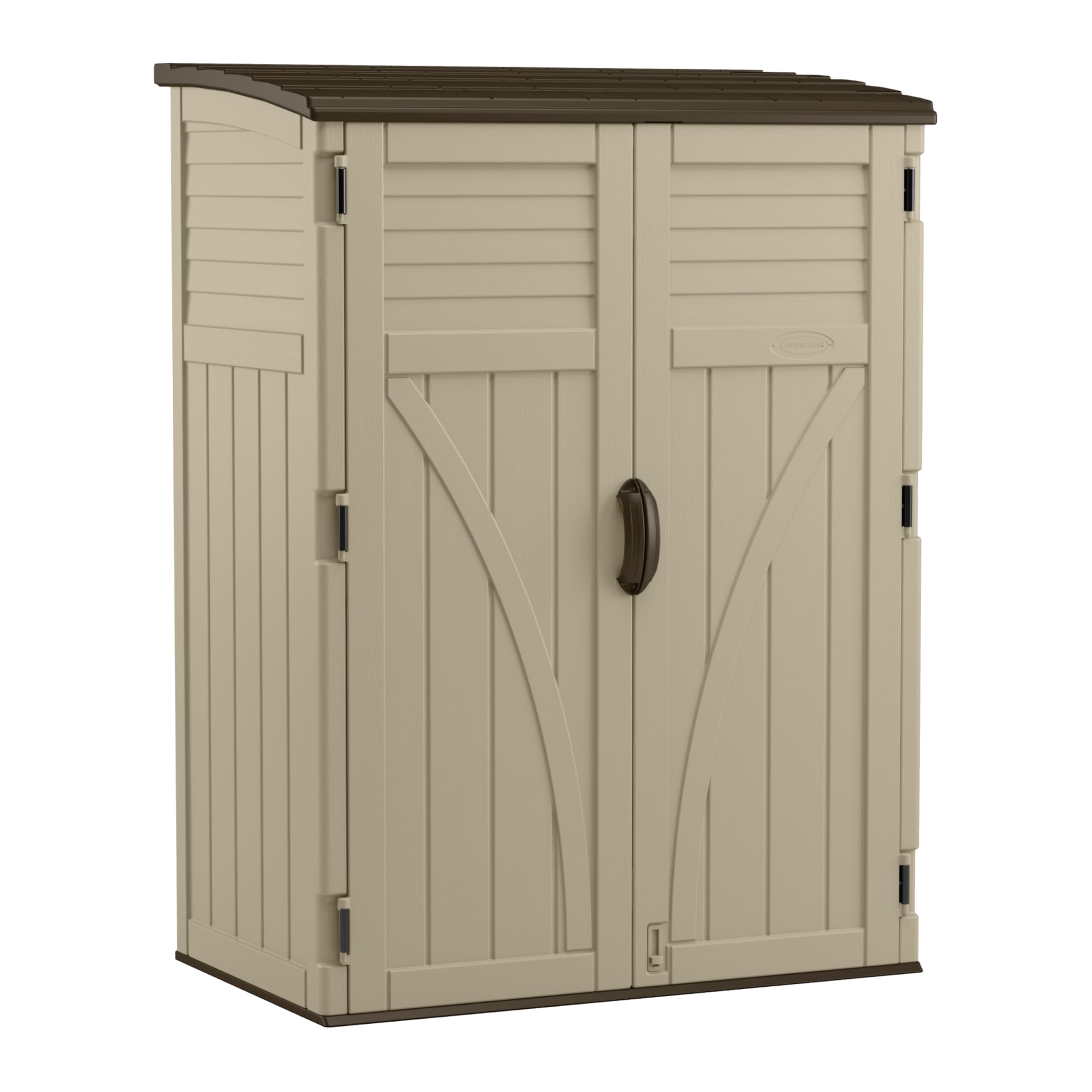
Suncast 54 cu ft Vertical Shed

Top Pick
Suncast 54 cu ft Vertical Shed

Wall-side tool storage

Our Score 8.8/10
Check Price

Worth Noting

  • Door hinges loosen and need re-tightening
Floor
Included
Capacity
54 cu ft
Shelving
Up to three shelves, 16 in. apart
Footprint
32.5"D x 53"W x 71.5"H
Read the full review

Three feet of depth and 53 inches of width is all the ground this takes, and it spends that footprint going up. At 71.5 inches tall, rakes, shovels, a broom, and a closed patio umbrella stand in their own corner instead of leaning against the fence. On a narrow lot, that vertical trade is the entire argument for buying it.

We think it is the best default here for exactly that reason. The floor comes in the box, the two doors take a padlock, and three pairs of molded notches at 16-inch intervals let you add up to three shelves as your gear changes — you supply the shelves, and a cheap wire unit cut to length is all that takes. Nothing about it needs a concrete pour or a second set of hands.

The hardware is where our enthusiasm cools. The clips that line panels up before the screws go in are fussy, and the hinges work loose over a season — put a screwdriver on them every few months and they stay tight. The lock is a deterrent rather than a guarantee, since a resin panel will pry, so treat it as a way to keep the shed shut rather than a safe.

What we keep coming back to is how little yard it costs. Cushions, gas cans, a bag of potting soil, and every long-handled tool we own went in, and it still reads as a cabinet standing against the fence rather than a building in the garden. If a shed has been on the list for years because the yard is small, this is the shape that changes your mind.

Bottom line: For most small yards this is the shed we point people to: 54 cubic feet against a wall, a floor in the box, and shelves you can add where you need them.

2

GDLF Wood and Metal Cabinet

GDLF Wood and Metal Cabinet

Covered patios

Our Score 8.8/10
Check Price

Worth Noting

  • Panels can arrive split or cracked
  • Wants cover from direct rain
Door
Lockable deadbolt, lock not included
Interior
31.1"W x 13.8"D x 62"H
Material
Fir wood with iron doors
Footprint
17.1"D x 33.8"W x 65.5"H
Read the full review

Seventeen inches of depth is the number that defines this cabinet. At 33.8"W x 17.1"D x 65.5"H it is built to stand on a porch or against a garage wall, long-handled tools on one side and shelves on the other, and nothing about it wants to be out in the open.

Under cover, we think it is the best-looking thing in this group: fir wood, black iron door frames, a deadbolt-ready latch, and a footprint that fits where a shed simply will not go. The interior is 31.1"W x 13.8"D x 62"H, enough for a hoe, a lopper, and a shelf of pots, and the fir smells like fir for the first month — welcome to some of us, less so to others.

Wood outdoors is a commitment, and this is a cabinet rather than a shed. Panels can arrive split at the edges, and a thin fir body will not shrug off a season of driving rain the way a resin box does. Give it a covered spot and a coat of finish on the exposed faces and it will look after itself; leave it against an open fence and the first wet winter will show you why we mention it.

Bottom line: A porch cabinet rather than a shed: we like the fir and iron look and the 22-inch door, but it belongs under cover where rain cannot reach it.

3

Aoxun 64 cu ft Resin Shed

Aoxun 64 cu ft Resin Shed

Bulky gear

Our Score 8.6/10
Check Price

Worth Noting

  • Partitions and shelves cost extra
  • 138.9 pounds, so assemble it in place
Base
Widened anti-topple plate
Doors
Four, upper and lower linked
Capacity
64 cu ft
Footprint
29.72"D x 52.36"W x 75"H
Read the full review

Two of the four doors are joined by connecting bars, so lifting the top handle brings the lower panel with it and the whole side of the cabinet swings clear. It reads like a gimmick in the listing and stops reading like one the first time you slide a generator in: 26.18 inches of door width and 29.72 inches of depth let you load this like a locker rather than post things through a letterbox.

The rest of the shape is sensible too. A widened bottom plate pushes the center of gravity out toward the corners, which matters on a 75-inch-tall cabinet standing on a patio, and the high-density polyethylene wipes clean with a hose. At 138.9 pounds it is the heaviest cabinet here, so build it where it is going to live rather than dragging it into position afterward.

Between this and the Suncast, we take the Aoxun when what goes in is wide and awkward, and the Suncast when it is tall and thin. The 64 cubic feet is real, but the partitions are bought separately — budget for them, because an empty tall box turns into a pile within a month, and the pegboard-style back panel only earns its place once something is hanging on it.

Bottom line: We like this one for bulky loads: four doors open the full width, and 64 cubic feet is the most of any wall-hugging cabinet here.

4

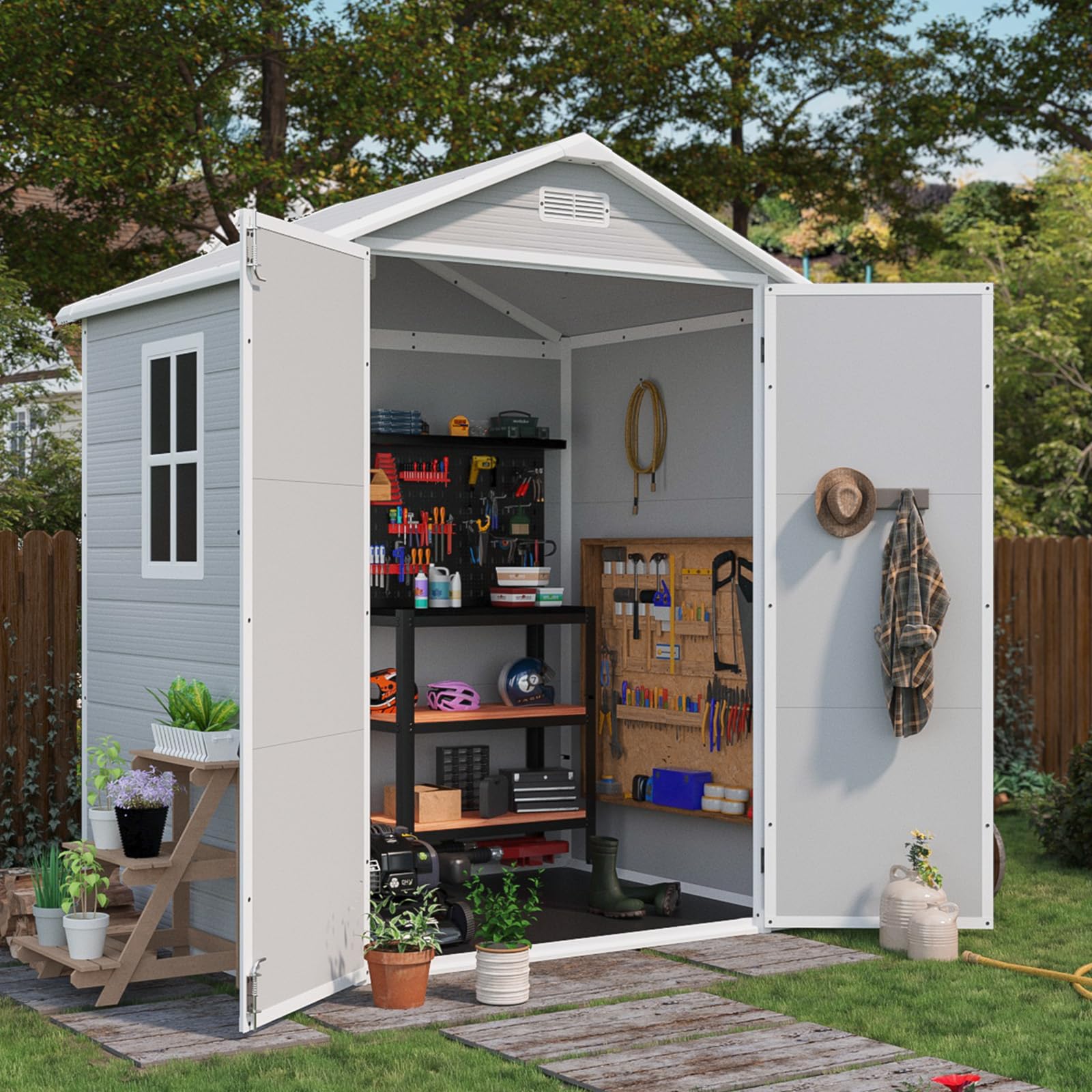
Patiowell 6x4 Resin Shed

Patiowell 6x4 Resin Shed

Small backyards

Our Score 8.6/10
Check Price

Worth Noting

  • A full day of assembly, more if solo
  • Instructions uneven from step to step
Doors
Lockable double doors
Footprint
48.8"D x 67.1"W x 82.2"H
Floor Area
22.76 sq ft
Lighting And Vents
Window and vent panels
Read the full review

The Patiowell sits between the tall cabinets and the Keter in size: 22.76 square feet of floor, 82.2 inches of headroom, and a floor panel in the box. Where the Manor is deep and narrow, this one is wide and shallow — 48.8"D x 67.1"W x 82.2"H — which is the shape that suits a shed parked along a back fence rather than squeezed between a house and a hedge.

We like it most as a first shed on a small lot. The double doors clear a wheelbarrow, the window and vent panels mean you are not opening the door to find out what is inside, and the plastic is sturdier than the panels look — it is the metal ceiling beams and corner brackets doing the structural work, and they are what make it feel solid once it is up.

Give it a dead-level base and the doors hang true; on a slope they rub instead of latching, and no amount of hinge adjustment fixes a pad that is out. That is the whole risk with this one — not the panels, the pad. Set it on pavers or a timber frame and the doors behave for years.

One number worth knowing before you order: at 82.2 inches this is the tallest shed here, which is lovely for headroom and awkward if there is a fence cap, a gutter, or a low branch over the spot. Measure the clearance as well as the ground.

Bottom line: A wide, shallow walk-in shed with a floor and a window for less than the Keter, as long as you can give it a genuinely level base.

5

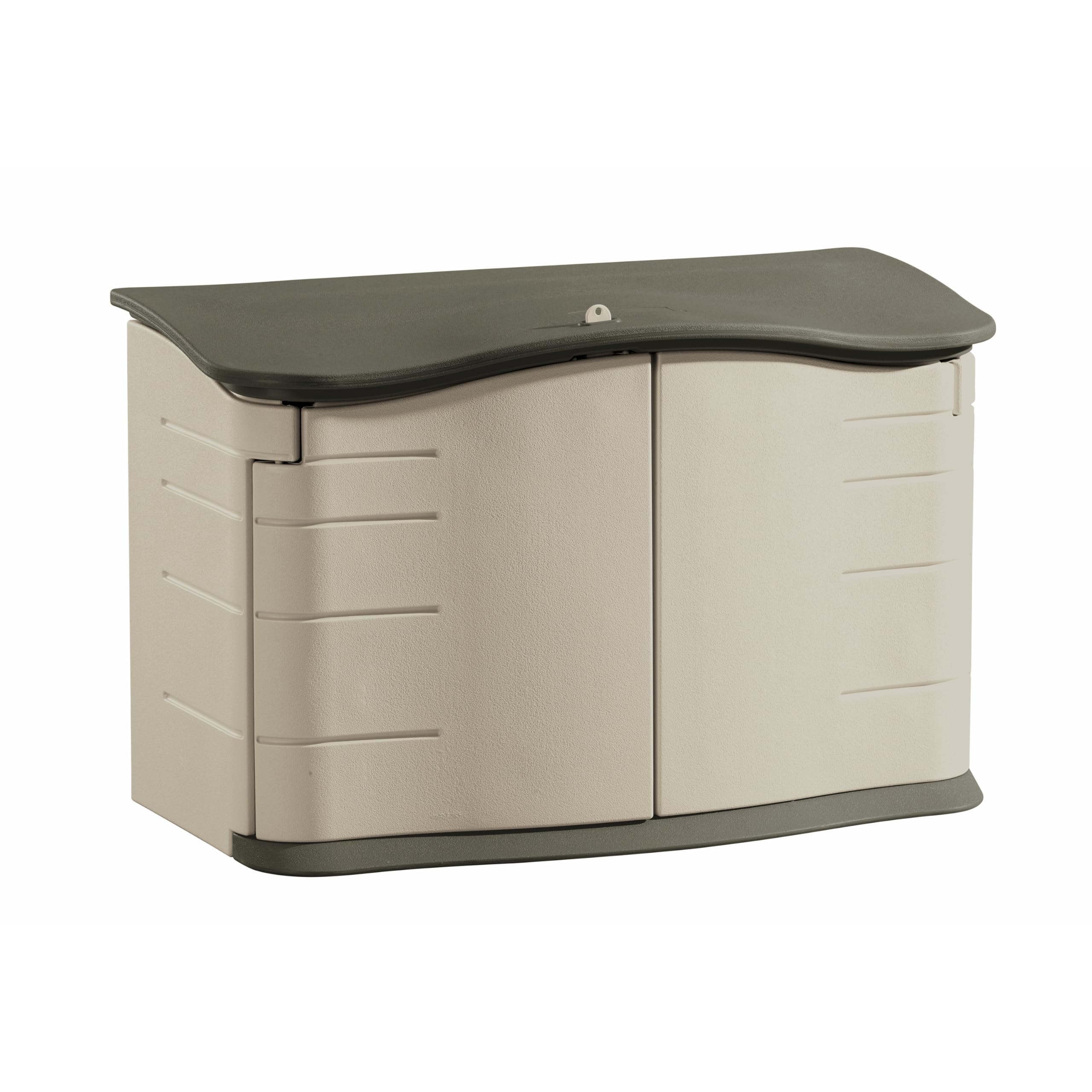
Rubbermaid 4.5 x 3 ft Horizontal Shed

Rubbermaid 4.5 x 3 ft Horizontal Shed

Cushions and bins

Our Score 8.6/10
Check Price

Worth Noting

  • 36-inch height rules out upright tools
  • Seams let in wind-driven rain
Lid
Hinged, doubles as seating
Weight
49.7 lb
Footprint
28"D x 55"W x 36"H
Construction
Double-wall resin
Read the full review

A 36-inch box that takes a padlock and holds a winter's worth of cushions is a different animal from a shed, and we think that is exactly the point. It sits under a window, at the end of a deck, or against the front of the house without announcing itself as a building, and the lid doubles as a bench or a drinks table — more useful on a patio than it sounds in a listing.

The numbers are 28"D x 55"W x 36"H and 49.7 pounds, and that lightness is a feature: two people can pick it up and move it to the spot that works, which is not true of anything else here. Double-wall resin and an impact-resistant floor let it hold pool chemicals, a generator, or two trash cans without the sides bowing.

What it will not do is stand a rake up. Thirty-six inches of interior height means long-handled tools go in diagonally or not at all, and the doors sit behind the lid, so you lift the lid first every time — fine once a week, tedious on a Saturday afternoon. Rain is handled; wind-driven rain can find the seams. For cushions, chemicals, and bins, none of that matters.

Bottom line: A 36-inch box that doubles as a bench: we like it for cushions, chemicals, and bins, but rakes and shovels will not stand up in it.

6

Keter Manor 4x6 Resin Shed

Keter Manor 4x6 Resin Shed

Walk-in storage

Our Score 8.0/10
Check Price

Worth Noting

  • Panels flex noticeably before the frame is squared
  • Two people and most of a day to build
Capacity
131.8 cu ft
Warranty
5 years
Footprint
75.6"D x 51.2"W x 78"H
Lighting And Vents
Skylight, window, vents
Read the full review

Once you can stand up inside a shed, the mower stops being the biggest thing you own. At 78 inches tall, with doors that run nearly the full 51.2-inch front, the Manor takes a push mower, beach chairs, bikes, and the patio cushions with room left to walk past them — 131.8 cubic feet, more than twice what the tallest cabinet here holds. We think that makes it the pick for anyone whose clutter is bulky rather than long.

The frame is what holds the idea together. Steel reinforcement runs through the walls, and once the whole thing is squared on a level pad and anchored down, it stops feeling like a plastic box and starts behaving like a small building. Skip either step and you will spend the first spring adjusting doors that were fine in the summer.

The panels themselves are the compromise. They flex more than the word resin suggests, and it is the internal steel doing the structural work — which is also why the shed feels solid only after it is squared. The five-year warranty is the longest coverage stated on anything in this group, and it is the detail that quiets our worry about the plastic going chalky after a few summers of UV.

The skylight surprised us more than any other feature. It turns a shed you open and reach into blindly into one where you can see the back corner at four in the afternoon in November. Small thing, and you notice it every single time.

Bottom line: If you want to step inside and shut the door behind you, the Manor is the one: 131.8 cubic feet, a skylight, and a five-year warranty.

7

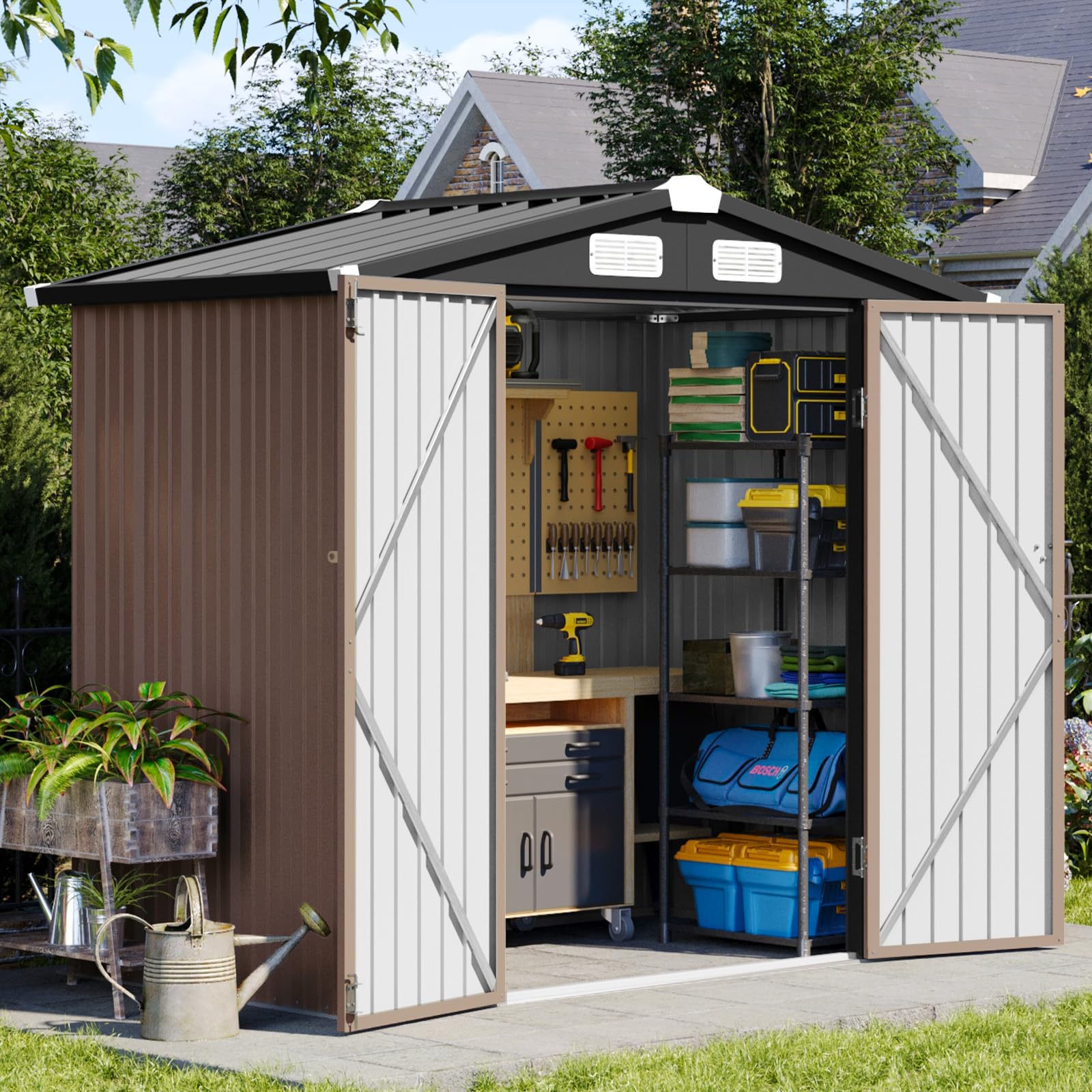
Aoxun 6 x 4 ft Metal Shed

Aoxun 6 x 4 ft Metal Shed

Tight budgets

Our Score 8.0/10
Check Price

Worth Noting

  • Thin steel creases and dents in transit
  • Needs a base you provide
Roof
Sloped, with air vent
Doors
Single or double hinged
Material
Galvanized steel
Footprint
75"D x 49"W x 74"H
Read the full review

This is the least expensive way in this group to get a lockable six-by-four footprint, and that explains everything else about it. Galvanized steel panels, a sloped roof with a vent, a hasp for a padlock — no resin, no trim, no attempt to look like anything but a tool store.

Every joint is a screw and there are a great many of them, so budget a day, a helper, and a cordless driver on low torque. Sort the panels by number before you start; the drawings are small, and the difference between two similar panels is usually discovered on the second attempt. Check the boxes for creases before you sign for delivery, because the steel is thin enough to arrive bent.

Where it earns its place is value, not refinement. A creased panel is cosmetic and permanent, and you will see it every time you walk past, so keep touch-up paint in the cupboard. Anchor it, too — an empty steel box on open ground is a sail. What stayed with us after a wet spring was how dry the inside kept once the vent was clear and the base had not settled.

Bottom line: We think it is the right first shed when the budget is tight and the tools are simple, as long as you expect thin steel and supply the base yourself.

How We Tested Seven Small Garden Sheds

We started by pulling every small shed we could find in the 4-by-6 to 8-by-10 range, then cut the list by material, listed footprint, what came in the box, and price. Seven made it into our yards — a mix of resin, wood, and metal, some shipping flat in boxes and one arriving on a pallet. Each was built where it would actually live, on grass, gravel, and a poured pad, so questions about bases and anchoring got answered honestly instead of on a level workshop floor.

Assembly came first, stopwatch running. I built every shed solo to find out where a second set of hands was genuinely required, followed the manual step by step and noted where the instructions skipped something or contradicted the hardware bag. We also recorded what the box left out — floors, anchors, and hasps are the usual omissions — and folded those costs into the final verdict.

Then we filled them. A mower, two bikes, a wheelbarrow, long-handled tools, bags of soil, and a shelf of paint cans went in and out for a year. We measured inside wall to wall rather than trusting the spec sheet, checked headroom at the doorway, and watched how much floor stayed usable once the big items were parked. Hooks went up, and where shelving wasn't included, we added our own to see whether the framing could carry the weight.

A full year outdoors handled the rest. After storms we checked for water tracking down the seams and pooling on the floor; in summer we looked at condensation, chalky panels, and finishes that had gone flat. Sturdiness got the crude test — a shoulder leaned into the wall, the door swung one-handed — and by the cold months we were watching hinges for sag and screws for rust. Every shed was judged against its price with the extras included, not the sticker alone.

How to Choose Small Garden Sheds

Measure the Base, Not the Size Name

A 5x3 shed is rarely 5 feet by 3 feet at ground level. The name often describes the roof, the base is narrower, and the interior is narrower again once you allow for wall thickness — one of the smallest sheds here is listed at 59.1 by 29.5 inches and still gets called 5x3. Stake the base out on the ground first, then check the door swing and the height against the nearest window, fence cap, or gutter.

Do the second measurement standing where the shed will sit. Headroom that looks generous in a listing can put a roofline through a view you liked, and a 17-inch-deep cabinet against a porch wall takes up less than you think until the door is open.

Resin, Steel, or Wood

Resin is the low-maintenance default: no rust, no repainting, and double-wall panels that hold their shape and take a fastener at the frame. Steel costs less per square foot and dents in exchange — a crease is cosmetic but permanent, and thin sheet gets hot in full sun. Wood looks best and asks the most, wanting cover, a finish every year or two, and a careful look at the panels when they arrive.

We take thick double-wall resin over thin single-wall every time, because the difference is what you feel when you lean on it. Choose by exposure first, then by how much upkeep you will genuinely do.

Floor, Base, and Anchor

A floor panel keeps boxes off damp ground and is worth having on a resin shed; steel sheds usually want a pad instead. Whichever you buy, the base decides how the doors hang — a shed set on soil or a slope goes out of square, and doors that rub on day one keep rubbing. Pavers on a compacted, levelled bed or a timber frame both work.

Then anchor it. We rank a level base above a lockable door, because a lock on a shed that will not shut is decoration, and an empty resin or steel box in an exposed yard is a sail with a hasp on it.

Assembly Is the Real Price

Resin sheds snap and screw together, steel sheds are all screws, and both take longer than the box claims. Two people is the practical minimum for anything with roof panels; one person can put up a cabinet in an afternoon. Sort and count the parts before you start, keep the drawings flat and well lit, and run a cordless driver on low torque so you do not strip the plastic.

If a part is missing or split, stop and call before you improvise. A shed built around one bad panel never sits square, and the door will tell you so every spring.

Keeping Tools Dry

Water gets into a shed two ways: through the roof and out of the air. A sloped roof with a clear vent handles the first; condensation handles the second, which is why a metal tool rusts in a shed that never leaked. Leave a gap between stored items and the walls, keep bags of compost and soil off the floor, and do not seal a damp shed tight.

On a dry, breezy day, prop the door for an hour. It is the cheapest maintenance a shed gets.

Frequently Asked Questions

Final Verdict

We keep coming back to the Suncast BMS5700D because it answers the problem most small yards actually have: too much long-handled gear and too little ground. It stands against a fence, takes a padlock, and gives you 54 cubic feet without a concrete pour.

If you need to walk in and store the mower and the cushions too, the Keter Manor earns its place as the biggest interior here, and the Aoxun metal six-by-four is the one to take when the price is the deciding number and the tools are simple. Everything else on this list is a version of those three decisions.