Greenhouses & Hydroponics

Best Grow Lights for Indoor Plants of 2026

Every February I end up with the same sad tray of tomato seedlings: tall, pale, and leaning so hard toward the window that they topple by March. That stretch is the plant telling you it isn't getting enough light, and on a winter windowsill in most homes it never will. A grow light fixes that one thing — it delivers the intensity and hours that seedlings, herbs, and houseplants would get outdoors in June, in a room that sees maybe four decent hours of sun. The results show up fast: tighter growth, deeper color, and starts that survive the move outside.

The catch is that grow lights are sold on numbers that mean little on their own, so brightness and honest light quality are where shopping gets hard. My team has spent the past eight months with 14 of them, through a full seed-starting season and a kitchen-herb winter, and the pattern held: the ones worth buying stayed bright, ran cool, and kept their timer honest. Value came down to a footprint that matched a real shelf. Everything below earned its spot.

1

VIPARSPECTRA P700

Top Pick
VIPARSPECTRA P700

Most home setups

Our Score 9.4/10
Check Price

Worth Noting

  • About 2 x 2 ft of useful coverage in veg
Dimming
4 levels
Mounting
Hanging
Power Draw
70 watts
Rated Coverage
2 x 2 ft
Read the full review

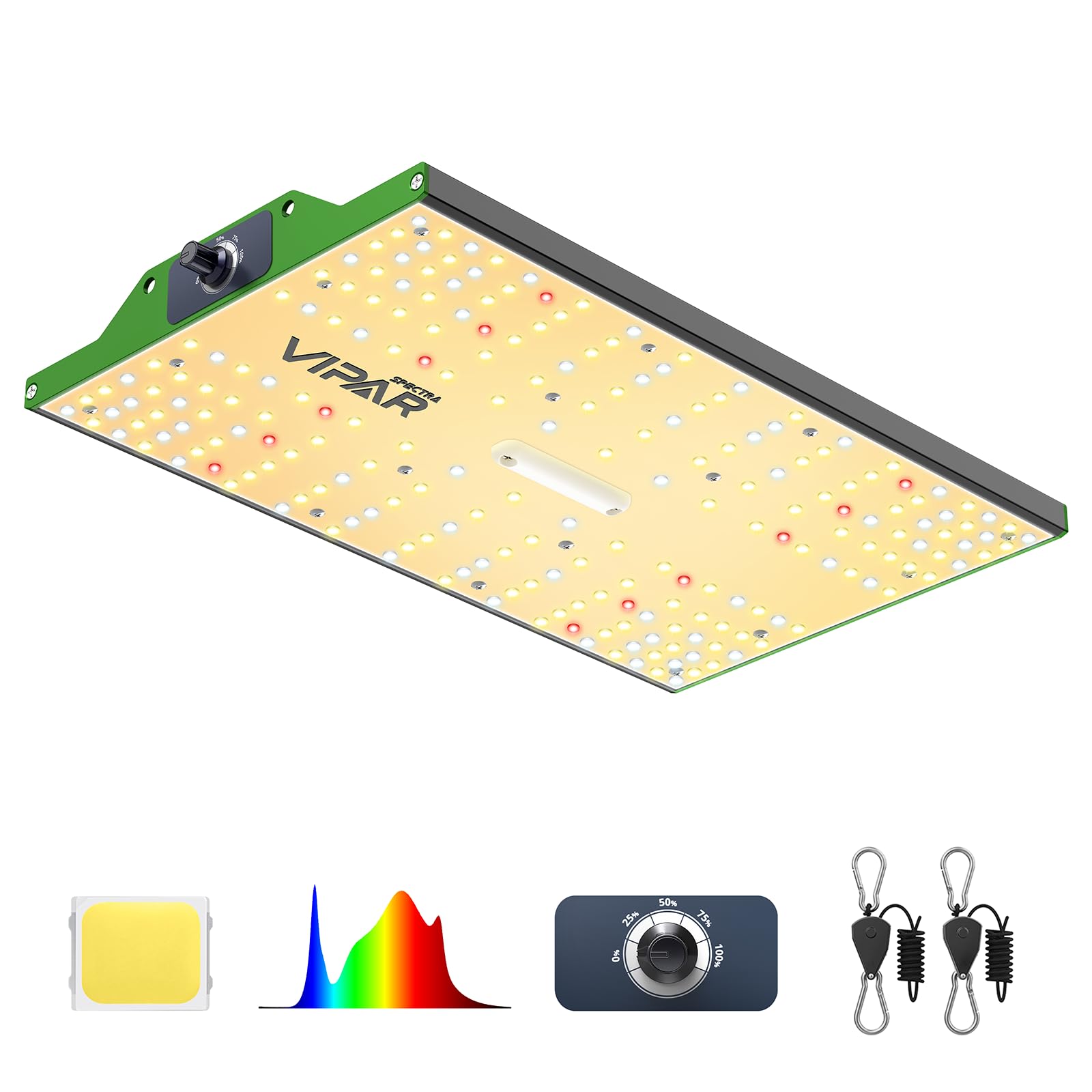
Seventy watts, 11,000 rated lumens and a four-position dimmer are what decided this for us. The P700 is the least expensive of the hanging panels in this guide, and it is the one we never had to talk ourselves into: the output is strong enough to carry a small canopy through flowering, the dimmer drops low enough that seedlings do not scorch, and the fanless aluminum body keeps a spare room from turning into an oven.

The honest limit is coverage. VIPARSPECTRA rates it for a 2-by-2-foot vegetative area, which is one shelf bay or two or three larger pots, not a four-foot bench. Intensity falls off at the edges of anything wider, so if your plants spread along a wall, plan on two units or step up to a 200-watt fixture.

The dimmer is the only control on the fixture, with no separate power switch, so a plug-in timer does the scheduling. Build quality is the pleasant surprise at this price: the aluminum slab is thick, hangers come in the box, and the three-year warranty runs longer than most of the lights here.

Bottom line: We recommend the P700 to anyone lighting a defined 2-by-2 area: it dims for seedlings, runs cool, and undercuts the other hanging panels here.

2

Barrina T5 8-Pack

Barrina T5 8-Pack

Plant shelves

Our Score 9.4/10
Check Price

Worth Noting

  • No timer in the box
Control
Individual bar switches
Mounting
Tape, clips, cable ties
Pack Size
8 bars, 2 ft each
Total Power Draw
80 watts
Read the full review

A bare plant shelf is the awkward case in this category. A panel hangs too far away and throws half its light over the front edge; a clip-on lights one pot. Barrina's answer is eight two-foot bars that link together, drawing 80 watts in total, with connectors, mounting clips, tape, and cable ties in the box.

What won us over is how the set scales. Two bars light a single shelf; four or six turn a bookcase into a grow station; the spares wait in a cupboard until the collection grows. Each bar switches on its own, so the top shelf can run without the bottom, and the 5000K light reads as clean daylight rather than a laboratory.

They run cool enough to sit inches from leaves, which is the whole point of a bar. Mounting is where care pays off: the adhesive tabs are the weakest part of the kit, and a bar that lets go takes seedlings with it. Cable ties hold, and the built-in magnets grip if your shelving is steel.

Bottom line: For a shelf, cabinet, or windowsill row, this eight-bar set is the pick: bright, cool-running, and cheaper than fitting panels over the same space.

3

Spider Farmer SF2000

Spider Farmer SF2000

2x4 grow tents

Our Score 9.2/10
Check Price

Worth Noting

  • Premium price for a home setup
Dimming
Dial dimmer
Warranty
5 years
Power Draw
200 watts
Rated Coverage
2 x 4 ft
Read the full review

Two hundred watts across a 2-by-4 footprint puts the SF2000 in a different bracket, and the price says so. This is the light for someone who has decided the tent is staying up: 606 diodes, a detachable driver, a dimmer that runs from seedling intensity to full flower, and 6.6 pounds of aluminum that hangs flat.

Output is not subtle. This is more light than a windowsill collection can use, and the plants we kept under it grew into the extra. The dimmer is what keeps it manageable — run it low over cuttings and wind it up as they root — and because it is fanless there is no hum in the room.

Where we land is that the premium only pays off at the right size. A 2-by-2 shelf wastes this fixture; a 2-by-4 tent is exactly the shape it was built for. The risk to know about is a board or driver failing early, and five years of warranty is what makes that tolerable.

Bottom line: For a 2-by-4 tent and a grower who wants more light than they need, the SF2000 is the one to buy — it dims right down and still has output to spare.

4

VIVOSUN LumaLight 100W

VIVOSUN LumaLight 100W

Humid spaces

Our Score 9.2/10
Check Price

Worth Noting

  • Smart control needs the sold-separately GrowHub
Dimming
Dial
Dimensions
11.8 x 11.8 x 2.2 in
Power Draw
100 watts
Water Resistance
IP65
Read the full review

Most grow lights in this guide would rather not be splashed. The LumaLight is rated IP65, which means it can take water and nutrient spray without you worrying about the driver — a real distinction on a misting shelf, over a bathroom plant, or in a tent that never really dries out.

The rest of the package is tidy. A hundred watts across 336 diodes in an 11.8-inch square, a dial dimmer, and rope hangers in the box. It runs cool, and the square shape sits naturally over a 2-by-2 area or beside a second unit across a 4-by-2. One unit is a 2-by-2 light; expect to buy two for anything wider.

Where it earns its place is in the awkward spots the other fixtures avoid: a corner that gets sprayed, a shelf above a misting tray, an orchid stand in a steamy room. It dims low enough for seedlings, and that is the control that matters day to day.

Bottom line: For humid rooms, misting shelves, and plants that get sprayed, the LumaLight is the one we point to: sealed, cool-running, and dimmable.

5

MARS HYDRO TS1000

MARS HYDRO TS1000

Long benches

Our Score 9.2/10
Check Price

Worth Noting

  • Runs hot in a sealed space
  • Board sections can fail
Dimming
0-100%
Beam Angle
120 degrees
Power Draw
150 watts
Daisy Chain
Yes
Read the full review

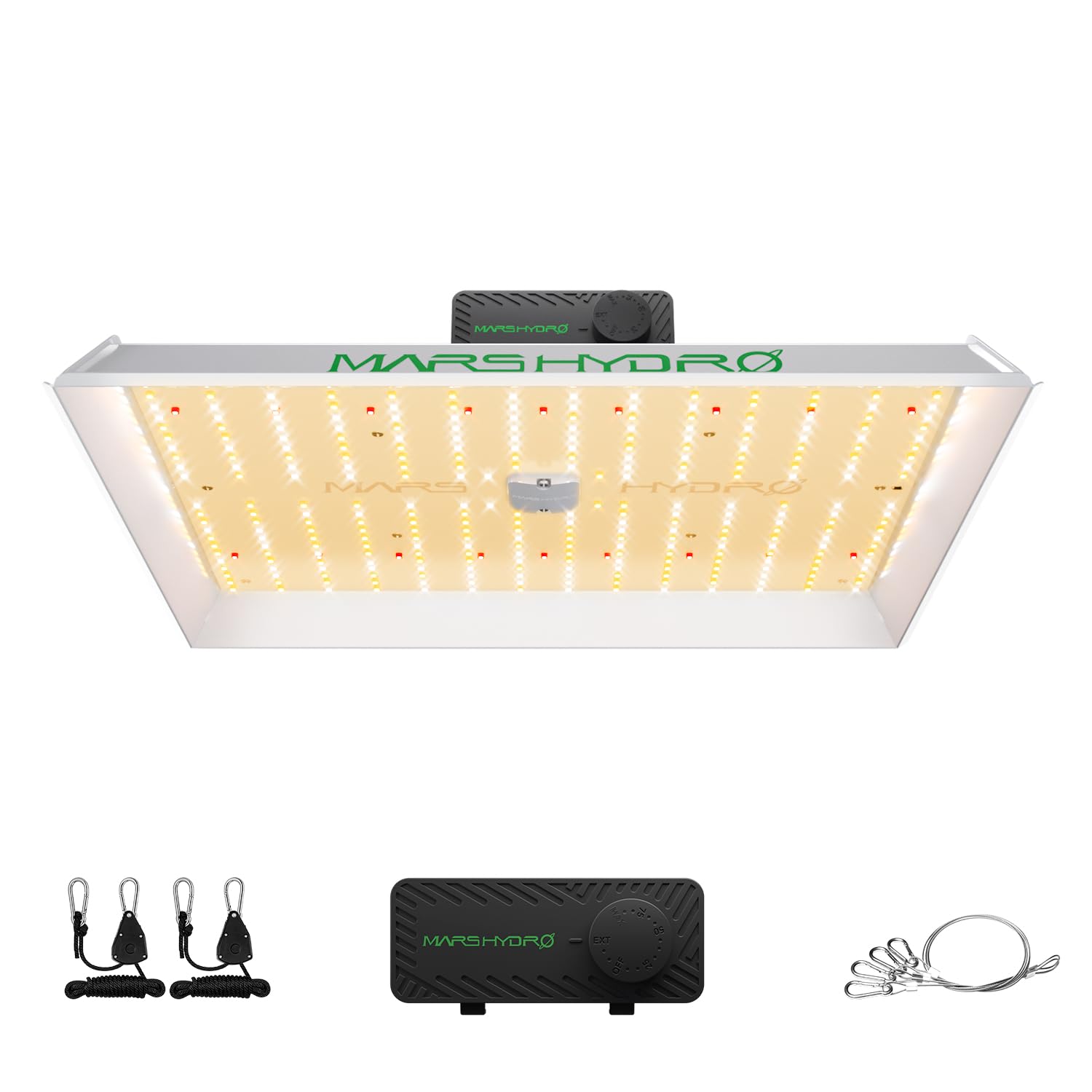
The feature that separates the TS1000 from the other panels here is the daisy chain: run one light into the next and feed a row from a single outlet, which is exactly what a basement bench with three or four fixtures needs.

A 150-watt draw across 354 diodes produces the kind of brightness that shows on the plants. The reflective hood and 120-degree spread fill a square footprint more evenly than a bare board, and set-up is a hook, a hang, and a plug.

The dimmer lives on the external driver, which is fine at chest height and awkward when the light is hung near the ceiling. The range is full, from a whisper to everything it has, and it takes seedlings down without scorching them.

We recommend it for a bench or a pair of small tents where one circuit and one dimmer simplify everything. It is not the sealed fixture the VIVOSUN is, and it does not carry the Spider Farmer's warranty, but on output for the money it sits near the front of this group.

Bottom line: For a long bench or a pair of small tents, the TS1000 earns its place on the daisy chain and a genuinely full dimming range.

6

GooingTop Clip-On

GooingTop Clip-On

Desks and shelves

Our Score 9.0/10
Check Price

Worth Noting

  • Useful only within a couple of feet
Timer
4, 8, or 12 hours
Mounting
Clamp
Power Draw
10 watts
Color Temperature
6000 K
Read the full review

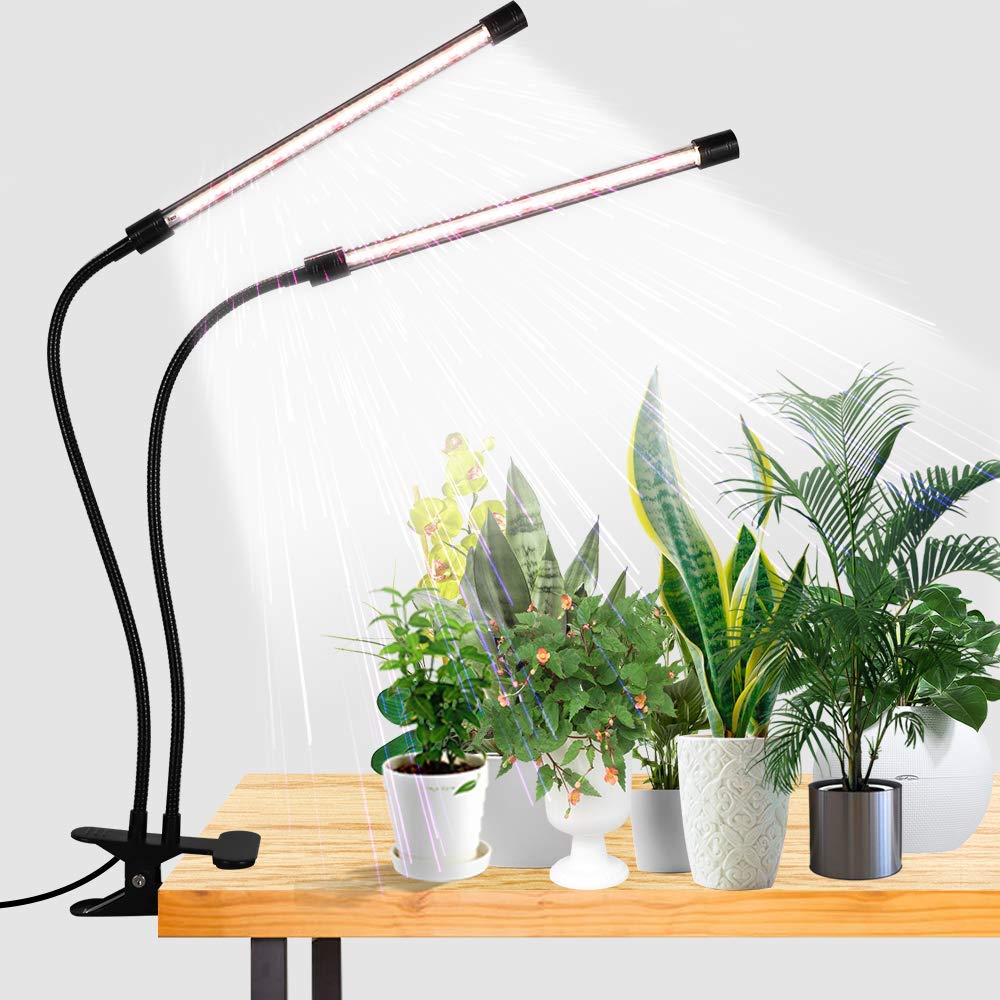
The clamp is the whole idea, and GooingTop got it right: a jaw that bites a shelf edge, two goosenecks that hold whatever shape you bend them into, and a push button that cycles 4, 8, or 12 hours and repeats every day without being reset.

Ten watts does not sound like much, and it isn't — this is a light for plants within a couple of feet, not a room. Over a windowsill of herbs or a shelf of pothos it does the job, the 6000K output looks like daylight, and the timer means the light comes on whether or not you remember.

The risk with this one is longevity. Units that fail tend to fail early, so test both heads in the first week and keep the 12-month warranty somewhere findable. At this end of the range, though, it is the cheapest light here that also schedules itself.

Bottom line: For one shelf or a desk of small plants, this clamp light is the easy buy: a timer that repeats daily, a clamp that holds, and very little power draw.

7

LEOTER 80-LED Gooseneck

LEOTER 80-LED Gooseneck

Seedlings and herbs

Our Score 9.0/10
Check Price

Worth Noting

  • One-year warranty only
Power
USB
Timer
3, 9, or 12 hours
Dimming
10 levels
LED Count
80
Read the full review

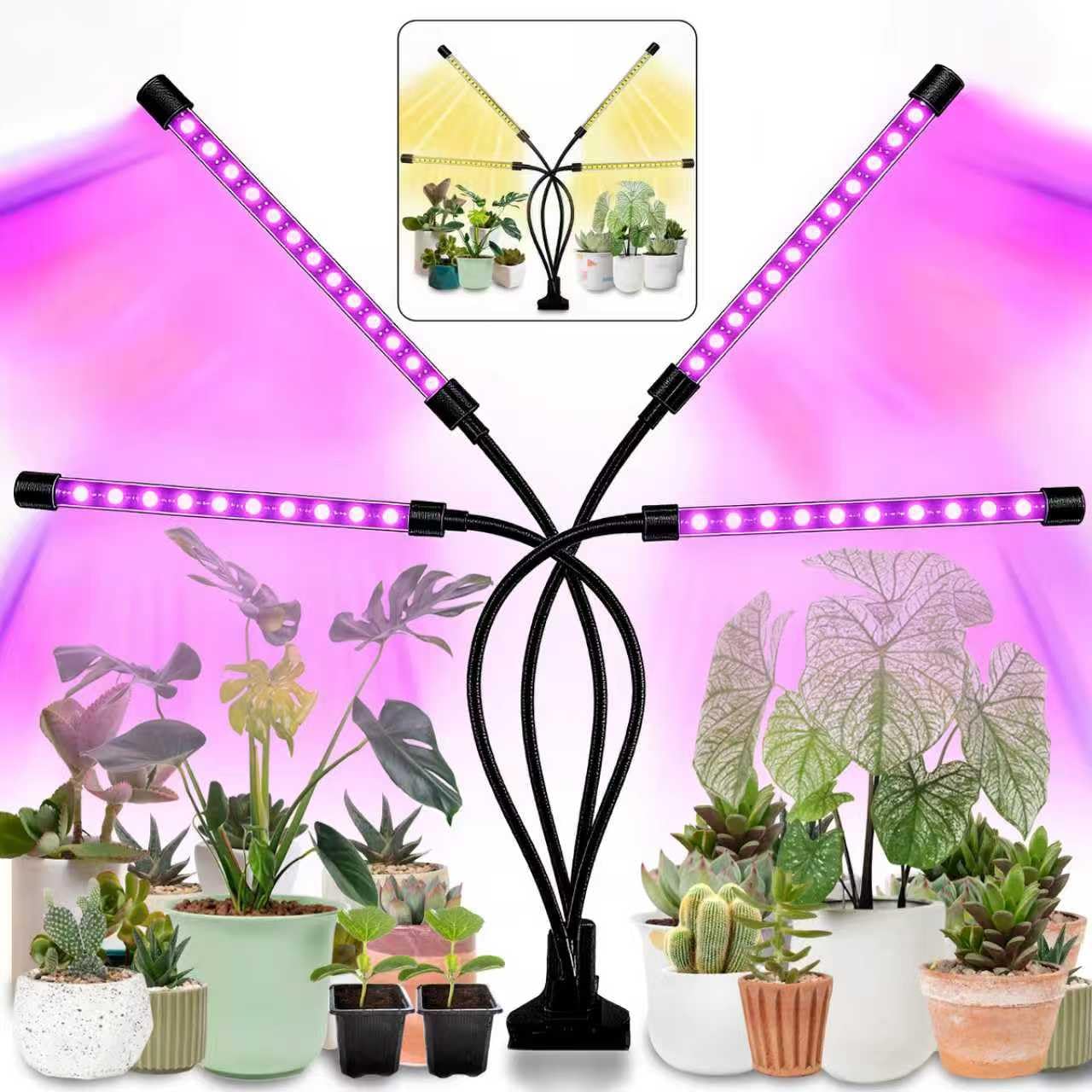
Four heads on bendable arms is the practical advantage here: one unit lights a row of small pots, each arm aimed at a different plant, instead of one beam covering all of them badly.

The controls are more than this price usually buys — 10 brightness levels, three spectral mixes, and a repeating 3-, 9-, or 12-hour timer from a single button. The red and blue mixes are there if you want them; we kept it on white, which is the setting you will actually live with in a room.

It is a close-range light. Useful intensity drops off past a foot or so, which is fine for seedlings and African violets and not enough for a big monstera in a dark corner. Clip it so the heads sit just above the leaves and it earns its keep.

Longevity is the part we trust least — the units that fail tend to fail in the first few months — so we rate it as a good first light rather than the last one you buy. For someone sowing a tray of seeds on a shelf in February, that trade is easy to take.

Bottom line: For starting seeds on a shelf without spending much, the LEOTER gives you four aimable heads, 10 dimming levels, and a timer on one clamp.

8

SANSI Pot Clip 2-Pack

SANSI Pot Clip 2-Pack

Single pots

Our Score 9.0/10
Check Price

Worth Noting

  • One pot per light
Timer
3, 6, or 12 hours
Mounting
Pot clip
Pack Size
2 lights
Power Draw
5 watts per light
Read the full review

Instead of clamping to a shelf, the SANSI clips to the rim of the pot itself. That solves a problem the other small lights here do not: the light moves with the plant when you move it, and it works on a windowsill or a stand with no lip to grab.

Five watts per head is genuinely small, and the pair arrives smaller in person than the photos suggest. What they do, they do neatly: a 3-, 6-, or 12-hour repeating timer, four dimming levels, a gooseneck that holds position, and a two-year service commitment behind a low-voltage input.

Bottom line: For a handful of individual pots, the SANSI pair is the tidy answer: clip it to the rim, set the timer, and the light travels with the plant.

How We Tested the Grow Lights

We started with every complete fixture we could find — one with a built-in timer or dimmer, a stand or hanging kit, and a stated coverage area — then cut anything that couldn't light a two-foot shelf, anything with a cord shorter than six feet, and anything whose listing wouldn't state actual power draw. Fourteen made the cut, from flexible strip lights to full panel-and-stand kits.

Each fixture went into a real spot: a seed-starting shelf in a basement, a north-facing kitchen counter with basil and parsley, a dark corner holding a monstera, and a garage bench where I overwinter citrus. We measured light with a PAR meter at 12 and 18 inches below each panel, at full power and at the lowest dimmer setting, then took the same readings in month eight to see what had faded. Then we just watched the plants — tight, stocky seedlings and deep leaf color under some fixtures, pale stretched stems under others.

Most people set these on a timer and forget them, so we did the same: 14 hours a day, every day, on whatever timer each fixture shipped with, logging every reset, drift, and flicker. After a six-hour run we put a hand on the housing and the driver to feel how hot each got, and checked the leaf edges of plants sitting close to the panel for scorch. We tape-measured the true lit footprint instead of trusting the coverage claim, along with the clearance each hanging kit needed and whether the fixture would actually slide under a shelf. Durability came down to handling — hanging hardware on and off, gooseneck arms re-bent, dust and hard-water spots wiped off the diodes — and reliability to whether it still behaved in month eight the way it did in week one. Value we judged as usable light per dollar, not raw wattage.

How to Choose Grow Lights for Indoor Plants

Start With the Canopy, Not the Wattage

A 5-watt gooseneck and a 100-watt panel can both keep a plant alive; what separates them is area. Small clip lights deliver useful light within a foot or so of the leaves. A 70-watt panel like the VIPARSPECTRA P700 is rated for a 2-by-2-foot canopy, and the 200-watt Spider Farmer roughly doubles that in one direction. Watts tell you how much power goes in, not how far the light spreads.

Measure the shelf, bench, or tent floor you want lit before you shop, then match. A four-foot shelf wants a bar set or two panels — one panel in the middle leaves both ends dim.

Match the Fixture to Where the Plants Live

Hanging panels suit a floor corner, a tent, or a bench with headroom above it. Bars mount under a shelf and put light inches from the leaves, which is how most houseplant collections are actually lit. Clip-ons and pot clips are for one or two plants on a desk, windowsill, or stand.

The trap with anything that clamps is the surface. A clamp needs a lip to bite, and a rimless ceramic pot, a glass shelf, or a rounded rail gives it nothing to hold. That is where the SANSI pot-clip design earns its place. Look at the edge you plan to clip to before you order, not after.

Dimming and Timers Are Worth Paying For

Dimming does two jobs: it stops seedlings scorching under full output, and it lets a brighter fixture sit closer to the canopy without burning leaves. A panel with a dimmer covers far more of the grow cycle than a fixed-output one, which is much of why the P700 and the SF2000 rank where they do here.

Scheduling is a separate purchase. Built-in repeating timers are standard on the small lights here and absent from most panels; an inexpensive plug-in timer solves it. Either way, aim for 12 to 16 hours a day on a consistent schedule — irregular light is harder on plants than a slightly short day.

Heat, Noise, and Living With It

Panels at this size are fanless, so noise is rarely the issue. Heat is. A 100- to 200-watt fixture raises the temperature inside a closed tent noticeably, which changes how often you ventilate. In an open room the same light is unremarkable.

For a room you sit in, choose white full-spectrum over red-and-blue. It looks like a bright window rather than a grow operation, and the plants do not need the purple. If your plants get misted, the VIVOSUN's sealed housing matters more than a few extra watts.

Frequently Asked Questions

Final Verdict

Buy the VIPARSPECTRA P700 if you are lighting a defined area — a shelf bay, a pair of large pots, a corner of a room — and want a fixture that dims, runs cool, and undercuts the other panels here.

If your plants live on a long shelf instead, the Barrina bars fit that shape better. If a 2-by-4 tent is going up, spend once on the Spider Farmer. And if it is three pots on a windowsill, the GooingTop clamp light is all the hardware you need.