Planters & Plant Supports

Best Row Cover Hoops of 2026

The first time I draped a bedsheet over my lettuce ahead of a 30-degree night, it sagged onto the leaves and froze there anyway. Row cover hoops are the fix: arched supports that hold fabric, insect netting, or shade cloth up off the plants so the cover can actually do its job. Get them right and you buy weeks at both ends of the season and stop a late frost from erasing six weeks of seedling care.

The catch is that a hoop is only as good as its grip on the soil — I've watched a cheap set pop out of a raised bed in a gust and take a row of peas with it. Spacing matters more than height, too: most covers need support every few feet or they pool water and crush what's beneath. My team and I put 13 sets through seven months of real weather, and the ones worth buying all hold their arch when it counts. The picks below are sorted by what each does best, from frost nights to bug pressure.

1

LANEVAN Garden Hoops

Top Pick
LANEVAN Garden Hoops

Fuss-free arches

Our Score 8.8/10
Check Price

Worth Noting

  • Highest cost per arch here
  • No spare hoops or extension rods
Frame
One-piece fiberglass
Hoop Length
6.56 ft
Hoops Per Kit
6
Cover Fastening
Clips included
Read the full review

Six hoops, each a continuous 6.56-foot length of fiberglass, arrive already bent into an arch. There are no short rods to join and no connector sleeves, and that one omission is the most useful thing about them: on nearly every other kit here the joint is what lets go first, either sliding apart or snapping right at the sleeve.

That's why this is our top pick. Assembly is never the hard part of a row cover hoop; holding the arch together through a windy April is. With nothing to come apart, the frame is doing the same job in week ten that it did on day one, and of the frames we handled this one moved least once the legs were in the ground. Three or four inches of burial at each end keeps it upright, and the whole set pulls out and coils up in a couple of minutes at the end of the season.

Give the unpacking a minute of respect. The hoops ship coiled and zip-tied, and a fiberglass band that gets free under tension can whip across your hand. Wear gloves, cut one tie at a time, and let each hoop open on its own instead of hauling it straight — the manufacturer's own instructions make the same point. Get that part right and the six arches are standing in under ten minutes.

Then check the geometry. Bent over a 3-foot bed with the legs buried, a 6.56-foot hoop leaves roughly 2 feet of clearance at the crown, which suits lettuce, kale, spinach and strawberries and comes up short over a staked tomato. You get six arches and no spare rods, and the cost per arch is the highest in this group. If you want a tall tunnel or a 20-foot run, one of the rod kits does that job for less.

Bottom line: Six finished 6.56-foot arches with nothing to come apart — this is the frame we recommend for most raised beds, provided two feet of headroom clears your crop.

2

Xuwzenkl Garden Hoops

Xuwzenkl Garden Hoops

Tight budgets

Our Score 8.4/10
Check Price

Worth Noting

  • Short 16-inch rods add a joint to every arch
  • Clips are too small for thick frost fabric
Frame
Plastic-coated fiberglass
Rod Length
16 in
Kit Contents
30 rods, 25 metal connectors, 20 clips
Claimed Tunnel Span
7 ft
Read the full review

Twenty-five metal connector sleeves come in this kit, which is unusual at the price and the main reason we rate it. Plastic joints are where cheap hoop kits let you down — they split, or they grip so loosely that an arch sags apart in wind. The rods are plastic-coated fiberglass, which we appreciated every time we pushed a leg into the soil, because there were no splinters to pick out of our palms afterward.

The box holds 30 rods of 16 inches, 25 connectors and 20 clips, which builds about six arches of roughly 7 feet when you run five rods to a hoop. That is enough to take a cover down a pair of raised beds, and because everything comes apart, the whole kit stores in the corner of a shed between seasons.

The honest caveat is stiffness. These rods are thin, and an arch built tall out of five of them flexes once wind gets under a heavy cover. Keep the hoops low and wide, drive the legs 3 or 4 inches down, and treat this as a frame for netting, insect mesh and light frost fabric rather than a weighted plastic sheet. Used that way, it is the best value in this group.

Bottom line: Metal connectors at a budget price make this our value pick; keep the arches low and it will hold netting and light cover through a season.

3

WYRJXYB 36-Piece Hoops

WYRJXYB 36-Piece Hoops

Wide, long beds

Our Score 8.4/10
Check Price

Worth Noting

  • Thin rods flex when arches are built tall
  • Clips can tear fine netting
Frame
Double-layer fiberglass
Rod Length
17 in
Kit Contents
36 rods, 36 connectors, 24 clips
Assembled Size
102 x 22.8 in
Read the full review

A long run is where a kit like this earns its keep. Thirty-six 17-inch rods and 36 connectors build six arches that stretch to roughly 8 feet along the ground, so a 4-foot-wide bed gets a tunnel with cover to spare at the sides.

Putting one together is the usual tent-pole routine — join the rods, bend the run into an arch, push the ends in — and it goes fast once you stop overthinking the connectors. We kept ours low and wide, which is the shape this frame handles best, and the sleeves held the rods snugly enough that nothing dropped out while we carried a half-finished hoop across the yard.

Value is the other half of the argument. Six long arches for roughly what two finished ones cost is a good trade when the cover going over them is light: bird netting on the blueberries, shade cloth in July, insect mesh on the brassicas. Plan to sit a heavy frost blanket on top through a wet winter and you want a stiffer frame than this one.

Bottom line: Buy it for length: thirty-six rods build six arches long enough for wide beds and long rows, and we accept a little sway in exchange.

4

FuBegi 60-Piece Hoops

FuBegi 60-Piece Hoops

Whole-garden coverage

Our Score 8.2/10
Check Price

Worth Noting

  • Clips are small for heavy frost fabric
Rod Length
17 in
Item Weight
3.73 lb
Kit Contents
60 rods, 60 connectors, 40 clips
Claimed Tunnel Span
8 ft
Read the full review

Sixty rods, sixty connectors and forty clips make this the biggest kit we tested. Run six rods to an arch and you have ten hoops; redistribute them and you get fewer, taller ones. Either way it is a box that covers a whole vegetable garden rather than a single bed.

Coverage is the entire argument, and nothing else here stretches as far for the money. The rods are the same double-wall fiberglass the other kits use, the connectors seat with a firm push, and the whole bundle comes in under four pounds — light enough to carry to the far end of the plot in one trip. We noticed the difference most when we stopped rationing hoops and started setting one every three feet instead.

The catch is consistency between rods. Some arrive a hair too thick for the connectors and some a hair too loose, so sort them before you start: pair the tight ones with the tight sleeves and set the odd ones aside as spares. Ten minutes of sorting saves an hour of wrestling with a hoop that will not seat. Past that there is little to complain about at this size.

Bottom line: Sixty rods makes this our coverage pick — one box for a whole vegetable garden, if you set aside ten minutes to sort the rods first.

5

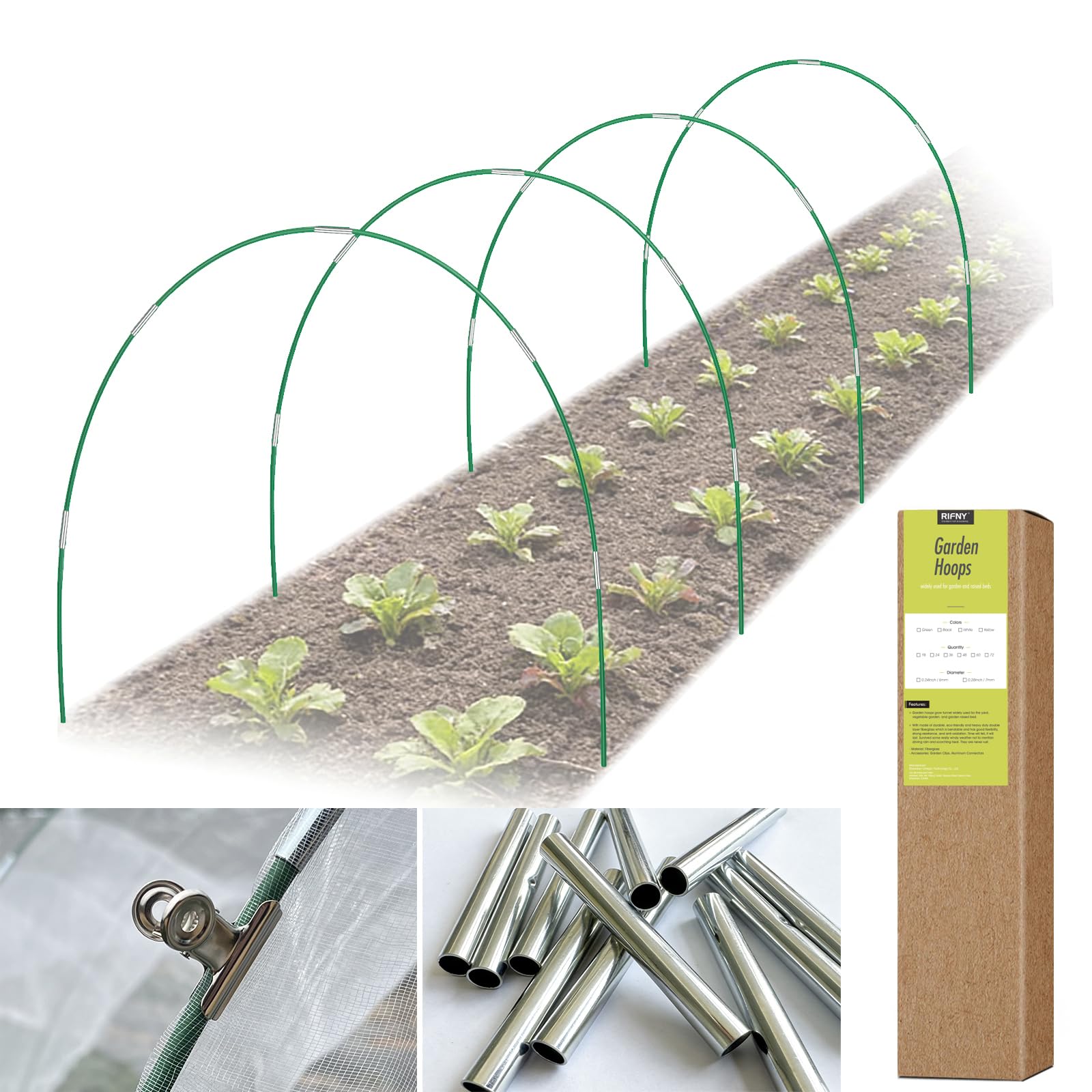
RIFNY Garden Hoops

RIFNY Garden Hoops

One raised bed

Our Score 8.2/10
Check Price

Worth Noting

  • Height tops out around 3 feet
Build Size
2-4 ft wide, 1.9-3 ft tall
Rod Length
17 in, 0.28 in diameter
Kit Contents
24 rods, aluminum connectors, 12 stainless clips
Read the full review

One 4-foot bed, one cover, one season — that is the job this kit is sized for, and it does it without leaving you to store sixty spare rods in the garage.

Twenty-four 17-inch rods of 0.28-inch fiberglass, aluminum connectors and 12 stainless steel clips. Depending on how tall you build, that is four to six arches, and the listing puts the working range at 2 to 4 feet wide — the middle of what most raised beds need.

The hardware is what lifts it above the other small kits here. Aluminum sleeves do not split the way plastic ones do, and stainless clips outlast the green plastic sort that goes brittle after a summer in the sun — small upgrades that decide whether the same arch is still usable next spring. What we noticed first is that the joints stay loose until the arch is under tension, so the rods can drop out while you carry a half-built hoop; assemble it where it is going. Twelve clips is also on the thin side for a full run, and a handful of binder clips fills the gap.

Bottom line: We point single-bed gardeners here: aluminum joints and stainless clips in a small 24-rod kit that stores on a shelf.

6

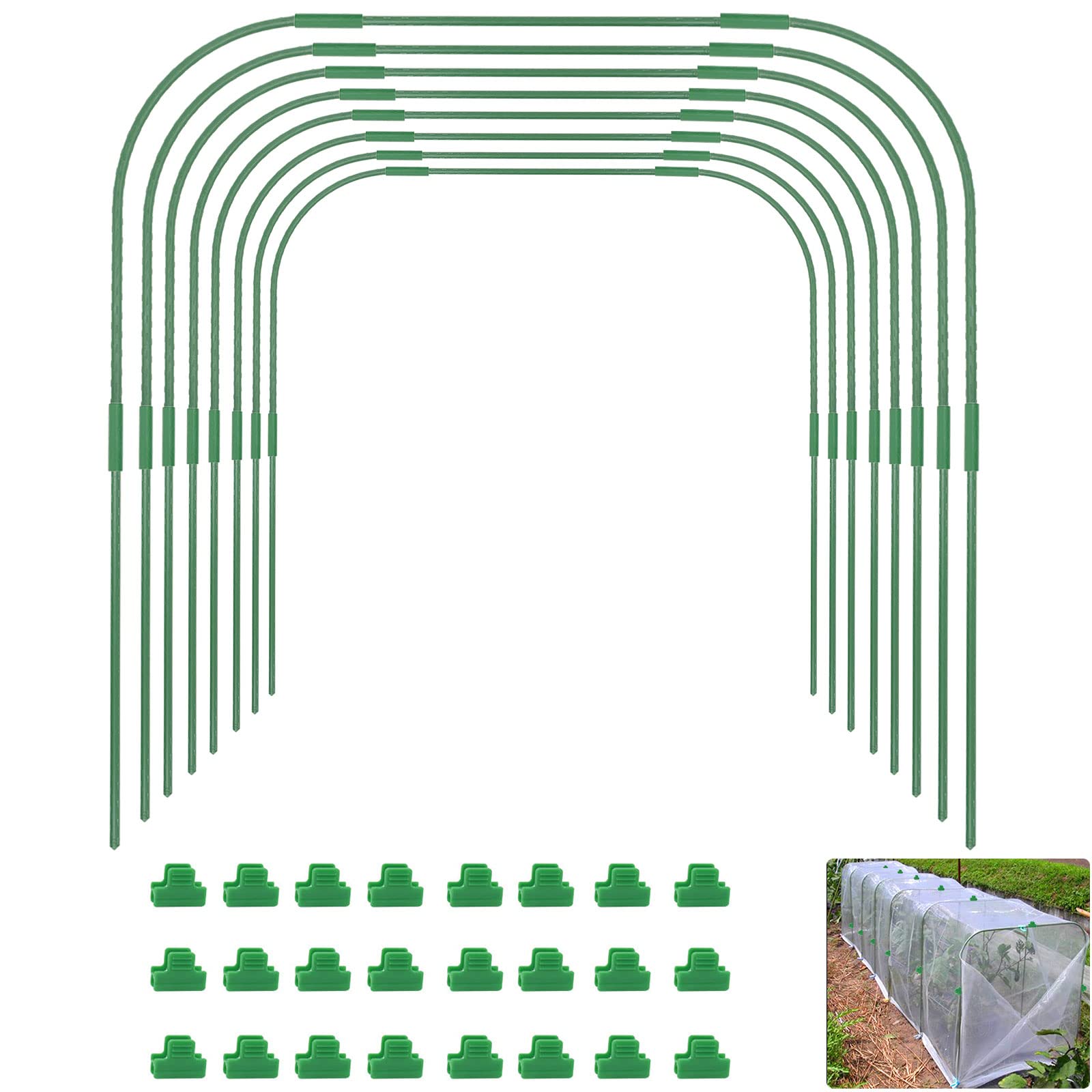
highydroLED Greenhouse Hoops

highydroLED Greenhouse Hoops

Taller crops

Our Score 8.2/10
Check Price

Worth Noting

  • Only 24 clips for eight arches
Frame
Plastic-coated steel
Set Size
41.3 x 31.5 in
Kit Contents
16 curved tubes, 24 straight rods, 32 connectors, 24 clips
Sets Per Kit
8
Read the full review

Thirty-one and a half inches of headroom, with nothing stacked to get there. Instead of bending straight rods into an arch, this kit pairs 16 curved top tubes with 24 straight ones and 32 connectors, so the roof of the tunnel arrives pre-shaped at 41.3 by 31.5 inches. That is the reason we keep it in this roundup: it is the only set here that clears a pepper plant without you improvising height out of extra rods.

The frame is plastic-coated steel rather than fiberglass, and that changes the handling. It is heavier in the hand, it holds a wide span without bowing across the top, and the sharpened ends push into soil cleanly. The coating keeps rust off the outside; the cut ends of the tubing are where moisture gets in, so dry the legs before the set goes away for winter.

Adjustability runs both ways — add a straight rod to raise the crown, drop one as the season turns. Eight sets is enough to run a proper tunnel down one bed, and there is no slack in the connectors or the 24 clips, so count the parts before you start. It reads as a small structure rather than a kit you fold into a bucket.

Bottom line: We keep this one for tall crops: a pre-shaped 31.5-inch tunnel that clears peppers and staked tomatoes without stacking extra rods.

7

LifeisLuck Garden Hoops

LifeisLuck Garden Hoops

Kit with extras

Our Score 8.0/10
Check Price

Worth Noting

  • Clips will not grip thick frost fabric
Bed Width
2.5 to 3.5 ft
Rod Length
17 in
Kit Contents
60 rods, 60 connectors, 27 clips, 20 m floral wire, gloves
Sets Per Kit
12
Read the full review

Twenty meters of floral wire, a pair of gloves and 27 clips ride along with 60 rods and 60 connectors. That is a more complete box than anything else here, and the wire is the piece we reach for most — it ties cover down at the ends and corners where a clip has nothing to grip.

Twelve sets and 60 rods stretch a long way. The listing puts the working span at 2.5 to 3.5 feet, so a run of three or four raised beds is realistic, and assembly is the same tent-pole routine as the rest: join the rods with the connectors, bend the run into an arch, push the ends in. We were glad of the gloves, since fiberglass rods start shedding splinters once the coating scuffs.

Where it lags is refinement. Plastic parts are the first thing to go brittle after a season of sun, so treat the frame as a season-by-season tool rather than a permanent structure. Nothing in the box is heavy, and nothing in it pretends to be.

Judged as a starter kit, it is the most complete one here. Wire, clips and gloves in the same box means no second order the night before a frost warning, and 60 rods covers a real garden rather than a token bed. At this end of the price range that is a trade we are happy to make.

Bottom line: We like it best as a whole-garden kit on a budget: plenty of rods, wire and gloves in one box, though the plastic fittings decide how long it lasts.

How We Tested Row Cover Hoops, From First Frost to Last

We started with more than 40 hoop sets from garden catalogs and big-box shelves, then cut the list by what actually limits a hoop's usefulness: span width, arch height, leg spacing, and whether the material can be bent and re-bent season after season. Thirteen sets made the final cut — fiberglass, steel, and plastic — and each spent seven months in the ground, from a March cold snap through the first hard frost in October.

Every set went into a real bed: raised beds in a backyard, a windy community-garden row, and a patch of clay-heavy in-ground soil. I timed solo assembly with a stopwatch, from opening the box to cover secured, and noted where instructions were needed or joints required tools. On gusty days I watched which arches bowed and stayed bowed, and which popped their legs the moment the fabric was pulled taut.

Protection got the most attention. I logged overnight temperatures under one layer and two against the open air, then walked the rows the next morning looking for frost burn at the leaf edges. Netting over kale and cabbage was checked weekly for caterpillars and aphids, with an uncovered row beside it for comparison. Each set also got used with at least two covers — lightweight row fabric, heavier freeze cloth, insect mesh, shade cloth — and we measured usable height at the center with the cover on, since an arch that sags under fabric is shorter than its label claims.

By season's end we were checking for split fiberglass, rust at the ferrules, cracks at the bends, and legs gone brittle in the sun, plus cost per foot of row. A few stayed in the ground through winter; the rest went into a shed to see how they came back out in spring.

How to Choose Row Cover Hoops

Work Out the Arch Before You Count Rods

A rod kit is sold by the piece, but what you're buying is an arch. Each hoop needs four to six 16- or 17-inch rods joined end to end, and the count decides both span and height: five rods over a 3-foot bed, with 3 or 4 inches buried at each end, gives roughly 2 feet of clearance at the crown. Add a sixth and the arch goes wider or taller, and also floppier, because every extra sleeve is another place the frame flexes.

Sketch the arch you want over your widest bed, work out how many rods that takes, and check the kit has enough to build that arch as many times as you need. A box of 60 rods sounds vast until you are running six rods per hoop.

Joints and Material Decide How Long It Lasts

Two designs are worth knowing about. Most kits here are bundles of short fiberglass rods joined by sleeves — metal sleeves hold far better than plastic ones, which split or loosen over a season. The alternative is a one-piece hoop that arrives as a finished arch, with no joint to fail at all. Fiberglass suits the job either way: it bends without taking a set and it doesn't rust, though the coating can scuff and start shedding splinters, so keep gloves in the shed.

If the frame is going to live outdoors year-round rather than come in each autumn, pay for the one-piece design or the metal joints. That is the single upgrade that separates a frame you keep from a frame you replace.

Match the Height to What You're Growing

Row cover over lettuce, spinach, brassicas or strawberries is happy under 18 to 24 inches. Anything you stake or trellis — tomatoes, peppers, dwarf beans — needs 3 feet or more, which usually means more rods per arch and a stiffer frame to carry them.

Read the span in a listing carefully: an 8-foot figure is the total length of the assembled hoop, not the tunnel's height, and a good part of that length disappears into the soil at each end. Where you need real headroom without stacking rods, a pre-shaped set with curved top pieces is the cleaner answer.

Fixing the Cover and Holding the Frame Down

The clips in the box are sized for the rod, which means they grip insect mesh and thin netting well and fight anything heavier. For a frost blanket or shade cloth, plan on wire or wider clips, and clip at every arch rather than every other one.

Wind is what actually takes these frames down. Bury the legs 3 or 4 inches, set arches about 3 feet apart, and run the tunnel across the prevailing wind rather than in line with it. A frame lifted, dried and stored loose at the end of the season will outlast one left out through a wet winter.

Frequently Asked Questions

Final Verdict

Six finished arches that don't come apart is why the LANEVAN set takes the top spot. If your beds run about 3 feet wide and what you're covering stays under two feet tall, it's the frame to buy, and the higher cost per hoop buys you a season without re-engineering.

Step away from it in two cases. Covering a long run or a whole plot costs less with a rod kit — FuBegi for volume, Xuwzenkl for small money and metal joints. And if you grow anything you stake, the pre-shaped highydroLED set saves you stacking rods to find the height.