Homesteading & Harvest

Best Pressure Canners of 2026

A pressure canner is the rare kitchen purchase where a bad choice doesn't just cost you dinner — it can cost you a whole season of tomatoes, or leave you with jars that look perfect and aren't safe to open. That's the worry I hear most from first-time buyers, and it's a reasonable one. What a good canner actually delivers is shelf-stable low-acid food — stock, dried beans, corn, venison — that a water bath can't handle safely, in batches large enough to justify the afternoon.

I've put up stock and tomatoes in my own kitchen for years, and over the past nine months my team and I have cooked under pressure with eight canners, from bare-bones weighted-gauge models to heavy dial-gauge rigs. Here's a piece of wisdom that surprises most newcomers: a weighted gauge regulates itself and never needs recalibrating, while a dial gauge should be checked against a master gauge every season — which changes how much fiddling your canning days actually involve. The picks below are the ones worth the cabinet space.

1

Presto 01781 23-Quart Canner

Top Pick
Presto 01781 23-Quart Canner

All-round home canning

Our Score 9.6/10
Check Price

Worth Noting

  • Heavy and awkward once loaded with jars
  • Wide footprint needs a big burner and shelf space
Weight
12 lb
Cooktop
Regular and smooth-top ranges
Capacity
23 quarts
Pressure Control
Dial gauge, full pressure range
Read the full review

Twenty-three quarts is the number that decides most canning weekends. Loaded properly, the 01781 takes seven quart jars, or nine pints in the bottom with a second layer stacked above, and it handles water bath for jam and pickles as readily as pressure for beans, stock and meat. One pot covering a whole preserving season is why we make this the default recommendation for a first serious canner.

The dial gauge is the other half of the case. Reading pressure instead of inferring it from a jiggle lets you hold 11 pounds and see the needle drift when a burner misbehaves, and Presto rates the pot for regular and smooth-top ranges, so a glass cooktop doesn't rule it out. The 76-page book that ships with it covers process times, altitude corrections and safety basics in plain language, which matters more than it sounds: a canner is only as good as the numbers you run it by. Gauge accuracy was what we paid closest attention to across the stovetop models, and this is the easiest one to check because the weight and the dial give you two readings to compare.

Do that check before your first load. A needle that stalls at 5 pounds is the fault that turns up on this model, and it fails quietly: the jars still seal and you find out months later, when you open one. Bring the canner up to pressure with the 15-pound weight on, confirm the dial agrees, and replace the gauge if it doesn't. It's a wear part, not a reason to give up on the pot.

Bottom line: Twenty-three quarts, a gauge you can actually read, and a midrange price that leaves room for jars: this is the canner we point most people to first, and it suits the widest range of kitchens here.

2

All American 930 30-Quart

All American 930 30-Quart

Lifetime buy

Our Score 9.6/10
Check Price

Worth Noting

  • Very heavy to move when full
  • Lid clamps must be tightened evenly to seal
Seal
Metal-to-metal, no gasket
Weight
21.3 lb
Capacity
30 quarts
Material
Cast aluminum
Read the full review

There is no rubber gasket anywhere on the 930. The lid and the body are machined flat and clamp together metal to metal, so there's nothing to dry out, crack, or hunt for in the middle of a tomato glut. Every other canner here seals on a gasket, and a gasket is a wear item you buy again, store flat over winter and sometimes discover has hardened since last September. We like that the 930 turns that maintenance into a non-issue.

What the money buys is mass and capacity. Thirty quarts takes up to 14 quarts or 19 pints in a single run, more than anything else in this group, and the body is cast aluminum with reinforced edges rather than stamped sheet. Set against the Presto 01781 it's heavier, larger and several times the outlay, and that's the trade: the 930 is the one we point at anyone who intends to can for thirty years and prefers to solve the problem once.

Twenty-one pounds empty is the price of all that metal. A full 30-quart canner needs two hands, a clear path and a plan for where it lands, so you'll likely leave it on the burner through cool-down rather than lift it hot. The other thing to learn is the lid: the clamps want to come down evenly, a little at a time, or the machined faces don't sit flat and the seal won't hold. Get that right and there is very little left to go wrong.

Bottom line: If you want to buy a canner once, this is the one: a cast-aluminum body, a machined seal with no gasket to replace, and capacity nothing else here matches, paid for in weight and price.

3

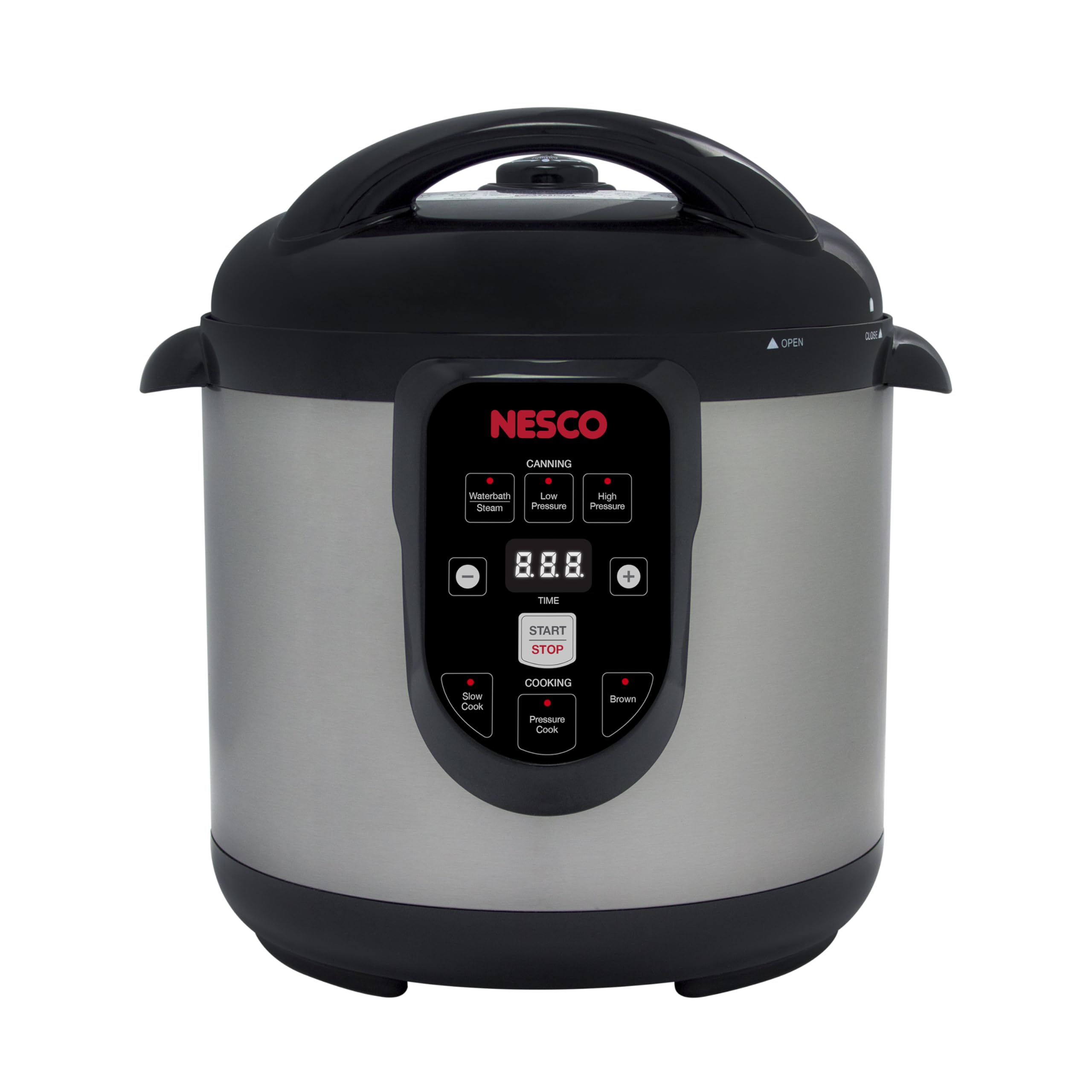
NESCO NPC-9 Electric Canner

NESCO NPC-9 Electric Canner

Small batches

Our Score 9.4/10
Check Price

Worth Noting

  • Directions skip steps a beginner needs
Modes
Pressure, slow cook, steam and water bath
Safety
Locking lid and float valve
Weight
22 lb
Capacity
9.5 quarts
Read the full review

Four wide-mouth quarts is not a lot of canner. But if your garden arrives in handfuls, a few jars of salsa, two pints of beans, the last of the romas, the NPC-9 is the one that actually gets used, because it plugs into the counter and does the pressure work itself. That's the case for it: not capacity, but the fact that a small batch stops being a project.

It holds pressure on its own, with a locking lid and a float valve that won't let you open it while there's pressure inside, and it runs water bath and steam as well as pressure. Presets handle the thinking: pick a mode, set a time, walk away. The comparison that matters is with a stovetop: no burner to adjust, no hot kitchen, and no reason to stay in the room while the jars process.

The manual is where it stumbles. Steps are skipped or assumed, and process times are better taken from a USDA guide than from the booklet, so read it end to end before the first batch and keep a second reference open. Set against the Presto 02144, it's the smaller, less polished version of the same idea, and for a few jars a week the smaller one is the better fit.

Bottom line: Our pick for a few jars at a time: plug it in, set it, and let it hold pressure while you get on with something else entirely.

4

Presto 02144 Digital Canner

Presto 02144 Digital Canner

Hands-off big batches

Our Score 9.2/10
Check Price

Worth Noting

  • Natural cool-down can't be rushed between loads
  • Needs permanent counter space and an outlet
Weight
20.5 lb
Control
Digital, automatic
Capacity
12 quarts
Canning Modes
Pressure and water bath
Read the full review

The 02144 is for the cook who has already spent an afternoon watching a needle. Choose the food, the jar size and your altitude and it holds pressure itself, counts down and prompts you at each stage, for pressure canning and water bath both. It also keeps most of its heat inside the cabinet instead of radiating it into the room, which on an August afternoon is the difference between canning and not canning.

Repeatability is where the money goes. The controls walk you through warming the jars, bringing pressure up, processing and the natural release, and the booklet explains why each step exists rather than only which button to press. The jar-warming step in particular is the sort of thing an experienced canner does by habit and a new one forgets; having the machine ask for it is a genuine advantage in a first season.

Twelve quarts is the catch. Figure five or six quarts, or about eight pints, per load, so a real tomato harvest means two or three runs, each with a natural cool-down you can't shorten without risking seals and siphoning. We think it earns its price if the automation is what gets you canning on a weeknight, and doesn't if you measure a canner in jars per afternoon.

Bottom line: Worth the premium for anyone who wants the canner to hold pressure so they don't have to, and who cans in batches small enough for twelve quarts to cover.

5

Mirro 22-Quart Canner

Mirro 22-Quart Canner

Weights over dials

Our Score 9.0/10
Check Price

Worth Noting

  • Manual is thin on charts and process times
Racks
Two racks
Capacity
22 quarts
Material
Aluminum
Pressure Settings
5, 10 and 15 PSI
Read the full review

Three separate regulator weights, 5, 10 and 15 pounds, do the pressure control on the Mirro, with no dial to misread and nothing to recalibrate. You drop on the weight that matches your altitude, the canner rocks at that pressure, and the whole system is legible from across the kitchen. For anyone raised on a weight-only canner, this is the familiar method done with more care than usual.

Twenty-two quarts puts it in the same bracket as the T-fal: two racks, dual cool-touch handles, a polished aluminum body that wipes down, and enough room for a full-size batch of quarts. It's the least expensive way into a big stovetop canner in this group, which is a large part of why it's here.

Seating the lid is the part that needs attention. Set it crooked and the canner will sit there refusing to build pressure, which reads as a broken appliance and is usually just a lid that went on a quarter inch off. Lay it flat, clamp evenly, and wait for the weight to start rocking before you walk away. Do that once and the Mirro is as straightforward as canning gets.

Bottom line: The straightforward choice for a weight-and-jiggle canner: three pressures, 22 quarts, and nothing to calibrate before you start.

6

T-fal 22-Quart Canner

T-fal 22-Quart Canner

Value stovetop canning

Our Score 8.8/10
Check Price

Worth Noting

  • Gas and coil burners only
Racks
Two canning racks
Cooktop
Gas and electric coil
Capacity
22 quarts
Pressure Settings
3 PSI settings
Read the full review

Check your cooktop before you check the jar counts. T-fal lists this one for gas and electric coil burners and makes no claim for induction or smooth glass tops, which is the sentence that decides the purchase in a lot of kitchens. On a glass range, look up the manufacturer's guidance on canner diameter and loaded weight before you order, because a 22-quart pot is not a small load on an element.

On gas or coil it is a great deal of canner for the money. Twenty-two quarts takes 24 half-pints, 18 pints or 7 quarts in one run, three pressure settings cover the range without swapping parts, and two racks come in the box so a second layer doesn't need improvising with a cake rack. We rate it the value pick of the stovetop group: it gives up the Presto's long record, and it asks less for the same batch size.

What it doesn't have yet is a decade of history behind it. It hasn't been in as many kitchens as the 01781 or the 930, so treat your first season as the audition: run a load of water-filled jars, confirm the gauge and the weight agree, and watch how the lid seats before you commit a summer's tomatoes to it. The specifications, at least, are unusually specific about what fits.

Bottom line: A big, capable stovetop canner for gas or coil ranges, and the one we reach for when the batch is large and the budget is at the low end of this group.

How We Tested the Pressure Canners

We started with spec sheets, narrowing the field by capacity, burner compatibility, gauge type, and — a filter that eliminated several candidates — whether replacement gaskets and weights were actually available to buy. Owner reviews flagged two recurring failures, warped bottoms and gaskets that quit after a season or two, so anything without a parts supply got cut before we ever filled it.

Over nine months we ran all eight canners through real batches: quart jars of chicken stock and pints of green beans, processed on both a gas burner and a glass-top range. We weighed each canner empty on a kitchen scale, because a loaded 23-quart pot is a different animal to lift off a back burner, and we measured body height against our tallest jars plus headspace, and against the cabinet shelf it would have to live under.

Pressure control got the closest attention. We timed the come-up from cold water to 10 and 15 psi, watched how steadily the weight jiggled once it got there, and adjusted the rings on models that let you choose 5, 10, or 15 pounds. Every dial gauge was checked against a calibrated master gauge before testing and again at the end. For lid seals, we counted how many batches each gasket lasted before it needed reseating, watched the rim for escaping steam, and noted whether the lid twisted free easily or had to be coaxed after cooling.

We also logged the softer stuff: how loud the weight rattles on a quiet evening, whether the manual actually explains altitude adjustments, and whether we'd willingly drag the thing out on a Tuesday night. Value, in the end, came down to how few of those small annoyances a canner saddled us with.

How to Choose Pressure Canners

Stovetop or electric: who watches the gauge

A stovetop canner is the cheaper route to a large batch, and it needs you nearby: you trim the burner to hold 10 or 11 pounds for the full process time, which on low-acid foods can run past an hour. Electric models like the NESCO and the Presto 02144 hold pressure and run the clock themselves, which is the entire reason to pay more for less capacity.

We think that trade is worth it if canning happens on weeknights after work. If you put up a season's worth in two long weekends, a stovetop's bigger loads win and the attention is part of the job.

Match capacity to your harvest, not to the spec sheet

A 23-quart canner takes seven quart jars, or nine pints in the bottom with a second layer above. A 12-quart electric takes five or six quarts. Count the jars you actually put up in a season, divide by what fits in one load, and that's the number of evenings you're committing to.

The trap is assuming the biggest pot is the easy answer. A full 23-quart canner is heavy, needs a burner it can sit flat on, and wants a cupboard shelf with real headroom.

Check the cooktop before anything else

Aluminum canners are happiest on gas and coil burners. Some are rated for smooth glass tops, as the Presto 01781 is; others state gas and coil only, as the T-fal does. On a glass range, look up the manufacturer's guidance on canner diameter and loaded weight before you order, because a wide, heavy pot on a small element is the expensive mistake in this category.

Induction needs a magnetic base, and none of the aluminum canners here claim it. If induction is your range, that single fact narrows the field for you.

Dial gauge, weighted regulator, or both

A weighted regulator rocks at its rated pressure and needs no calibration. A dial shows you exactly where you are and flags drift, but the gauge itself can drift too. We prefer canners that give you both: hold pressure on the weight, confirm it on the dial.

Altitude changes the number. Above 1,000 feet the required pressure climbs, and most guides move you from 10 or 11 pounds up to 15. A canner with three selectable weights, like the Mirro, is easier to set correctly at altitude than one with a single fixed regulator.

Seals and parts you can still buy in five years

Most canners seal on a rubber gasket that hardens over time and eventually needs replacing; the All American clamps metal to metal and has no gasket at all. A gasket is a wear item and an easy swap, but only if the model is still supported.

Before buying an unfamiliar brand, check that gauges, gaskets and weights are sold separately. Store the lid off the pot rather than clamped down, and the seal lasts longer.

Frequently Asked Questions

Final Verdict

The Presto 01781 is the canner we point most people to: 23 quarts, a dial you can read, and a smooth-top rating that keeps a glass range in play. Buy the All American 930 instead if you want the last canner you'll own and don't mind moving 21 pounds empty; buy the NESCO or the Presto 02144 if the reason you don't can is the standing and watching.

Everything else here is a variation on those three questions: how big a batch, what your cooktop allows, and how much of the process you want to hand over.