Ponds & Water Gardens

Best Pond Skimmer Nets of 2026

For a few weeks every spring, my pond becomes a debris magnet — catkins, maple seeds, and a winter's worth of oak leaves that somehow wait until the ice melts to sink. A skimmer net is the only thing that gets that mess out before the water turns green, and the gap between a good one and a flimsy one shows up on the very first scoop. Bag depth, mesh size, and how the pole locks are what separate skimming from stirring, and those three details decide whether the job takes five minutes or an hour.

I've netted this same pond for years, and this spring through early fall my team and I worked through 13 nets — flat heads, deep bags, coarse mesh, fine mesh — scooping leaves, algae film, and the occasional very unhappy frog. A shallow net just pushes floating leaves around, and a pole that creeps under load turns a quick pass into a workout. The picks below are the ones that held their shape, emptied cleanly, and didn't cost more than the plants they're protecting.

1

SISUPASSIE 20-Foot Skimmer Net

Top Pick
SISUPASSIE 20-Foot Skimmer Net

Large ponds

Our Score 9.0/10
Check Price

Worth Noting

  • Nearly five pounds to swing
Frame
Foldable
Weight
4.94 lb
Pole Length
Up to 20 feet
Read the full review

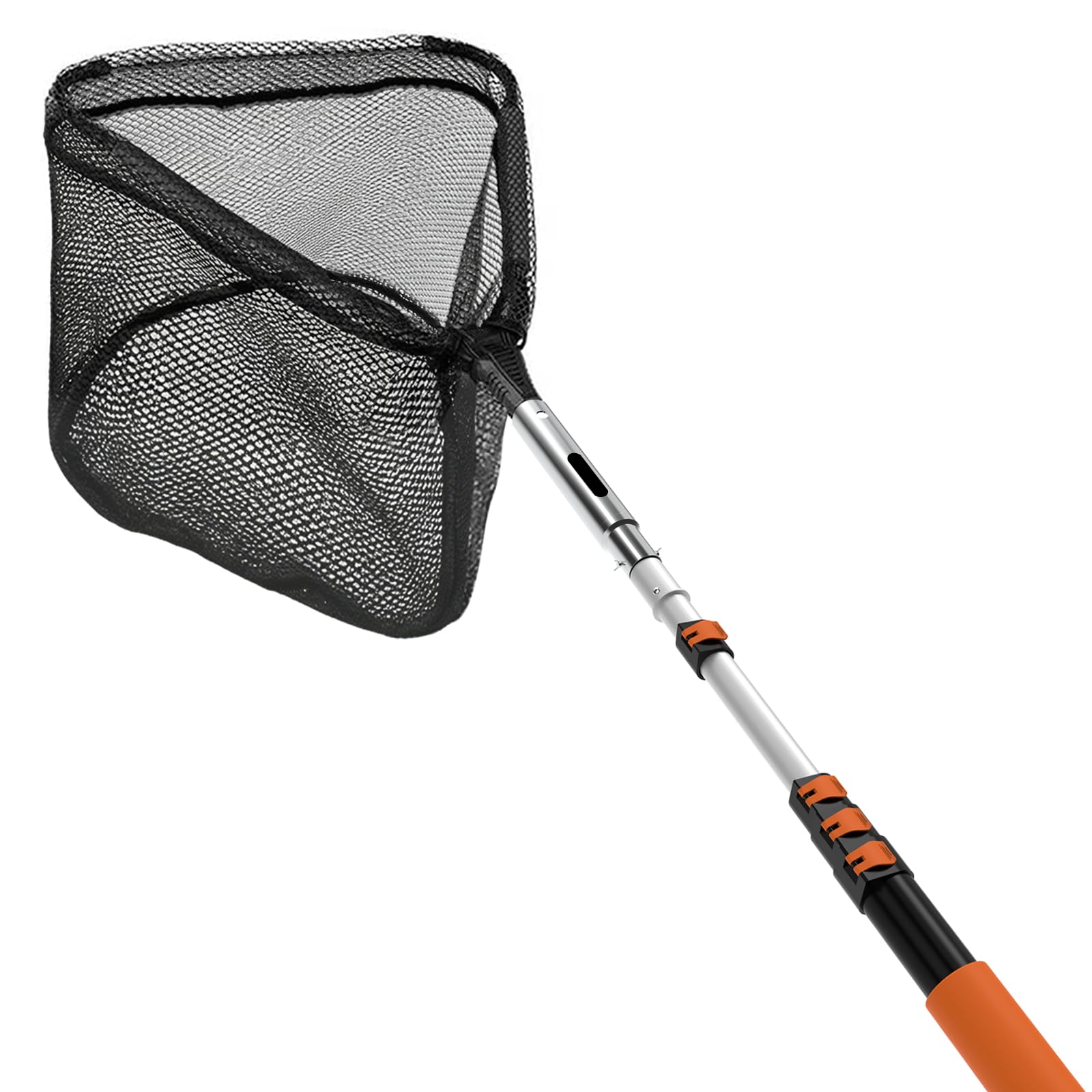
Twenty feet of telescopic pole and a folding head make this a specialist, and the specification says so plainly. It also weighs just under five pounds, which you notice on the first sweep and think about by the twentieth. The pole is corrosion-resistant aluminum alloy with a soft non-slip grip, and the frame collapses for storage.

Where it is genuinely useful is a pond you can only work from one place: a big garden pond, a naturalized pond, water you cannot walk around. From a single spot on the bank, twenty feet covers water no other net here touches, and the folding head means it stores in a shed corner instead of living on the lawn. The large bag holds plenty before it needs emptying.

The trade is that you sweep in arcs rather than lifting, and a full bag at that length is a two-handed job. It is also the newest design in this group, so buy it for the reach it gives you rather than as your only net. A short net will still do the edge work more comfortably.

Bottom line: Buy this if you can only reach your pond from one spot, since we have not found another net here that covers twenty feet.

2

Aquascape Heavy-Duty Pond Skimmer Net

Aquascape Heavy-Duty Pond Skimmer Net

Pond first buy

Our Score 8.8/10
Check Price

Worth Noting

  • Mesh wears with sun exposure
  • Replacement bags are not sold separately
Mesh
Soft fine nylon
Weight
1.4 lb
Handle Length
36 to 69 inches (telescopic)
Read the full review

Most of the nets in this guide began life as pool equipment with a pond label added. This one is a pond tool first: the bag is soft nylon, the end of the frame is capped so the mesh cannot tear at the tip, and nothing about the head is going to scrape a fish. That combination is why it is our default for a pond owner's first net.

The handle runs from 36 to 69 inches, which covers the ordinary job of standing on the bank of a backyard pond and reaching the far edge without kneeling in the mud. At 1.4 pounds it is light enough to work one-handed for a full lap. The mesh is fine enough to lift pollen, duckweed, and the soft green algae that gathers along the margin, and if a fish ends up in the bag you can tip it back without handling the animal.

A tight weave drains slowly, so the rhythm is scoop, lift, let it drip, tip it out. The pole also gets springy at full extension with a loaded bag, which is why we keep one section in when the net is heavy and save the last few inches for light surface work.

The frame and handle will outlast the bag. Soft nylon is gentle on fish and it does wear, so rinse the bag, hang it to dry, and keep the net out of the sun between uses rather than leaning it against the shed wall full of wet leaves.

Bottom line: If your pond has fish in it, this is the net we point you to: soft nylon that will not scrape a koi, a handle that reaches 69 inches, and a capped frame that keeps the bag intact.

3

Poolvio Deep Skimmer Net with Pole

Poolvio Deep Skimmer Net with Pole

Deep ponds

Our Score 8.8/10
Check Price

Worth Noting

  • Heavy to handle with a loaded bag
Weight
3.04 lb
Pole Length
3 to 10 feet (adjustable)
Pole Material
1.0 mm aluminum
Bag Dimensions
17 x 16 x 17 inches
Read the full review

Three feet collapsed, ten feet extended. That spread is the reason this one is in the guide, because it puts the middle of a wide pond within reach from the bank and turns a wading job into a leaning job. The pole is 1.0 mm aluminum with clip buttons rather than twist collars, and the head is a deep bag, 17 by 16 by 17 inches, with a weighted tab at the bottom.

Where it earns its place is a pond you cannot walk around. Ten feet lets you sweep the far half from one spot, and the deep bag holds a serious load before you walk back to empty it. The beveled leading edge glides along the bottom as well, so it doubles as a tool for sunken leaves and sludge rather than surface debris alone.

What you pay for that reach is weight and flex. A full bag at full extension is the load this pole likes least, and the strain lands on the joints, so we shorten it for the heavy scoops and save the last sections for light floating debris. If you mostly work within six feet of the bank, a lighter net is the better tool.

Bottom line: We reach for this one on wide ponds: ten feet of pole and a deep bag let you skim open water from a single spot on the bank.

4

Sepetrel Pool Skimmer Net with Pole

Sepetrel Pool Skimmer Net with Pole

Budget reach

Our Score 8.8/10
Check Price

Worth Noting

  • Thin pole flexes at full length
  • Standard mesh misses fine particles
Mesh
Standard nylon
Weight
1 lb
Total Length
40 to 72 inches
Pole Material
Corrugated aluminum
Read the full review

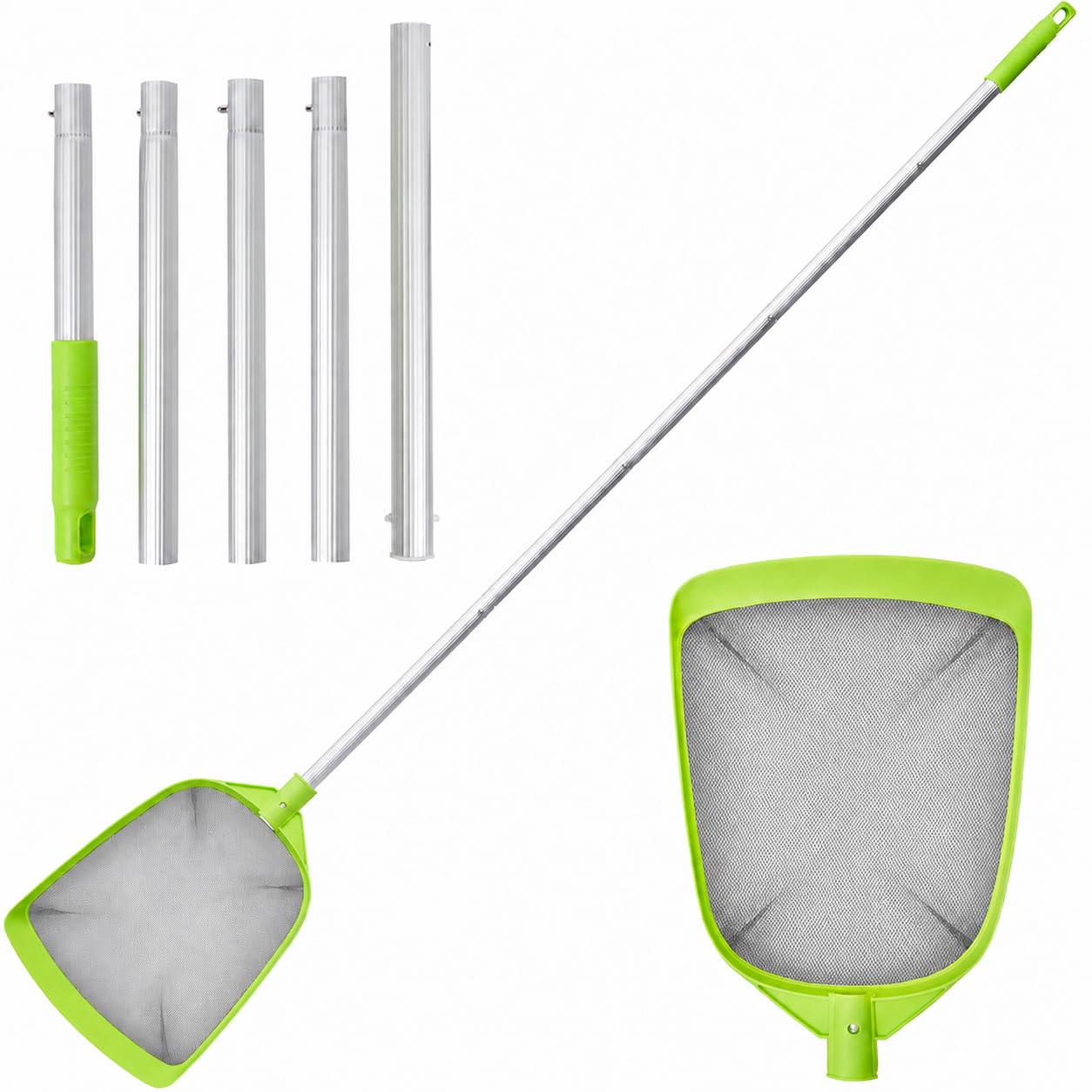
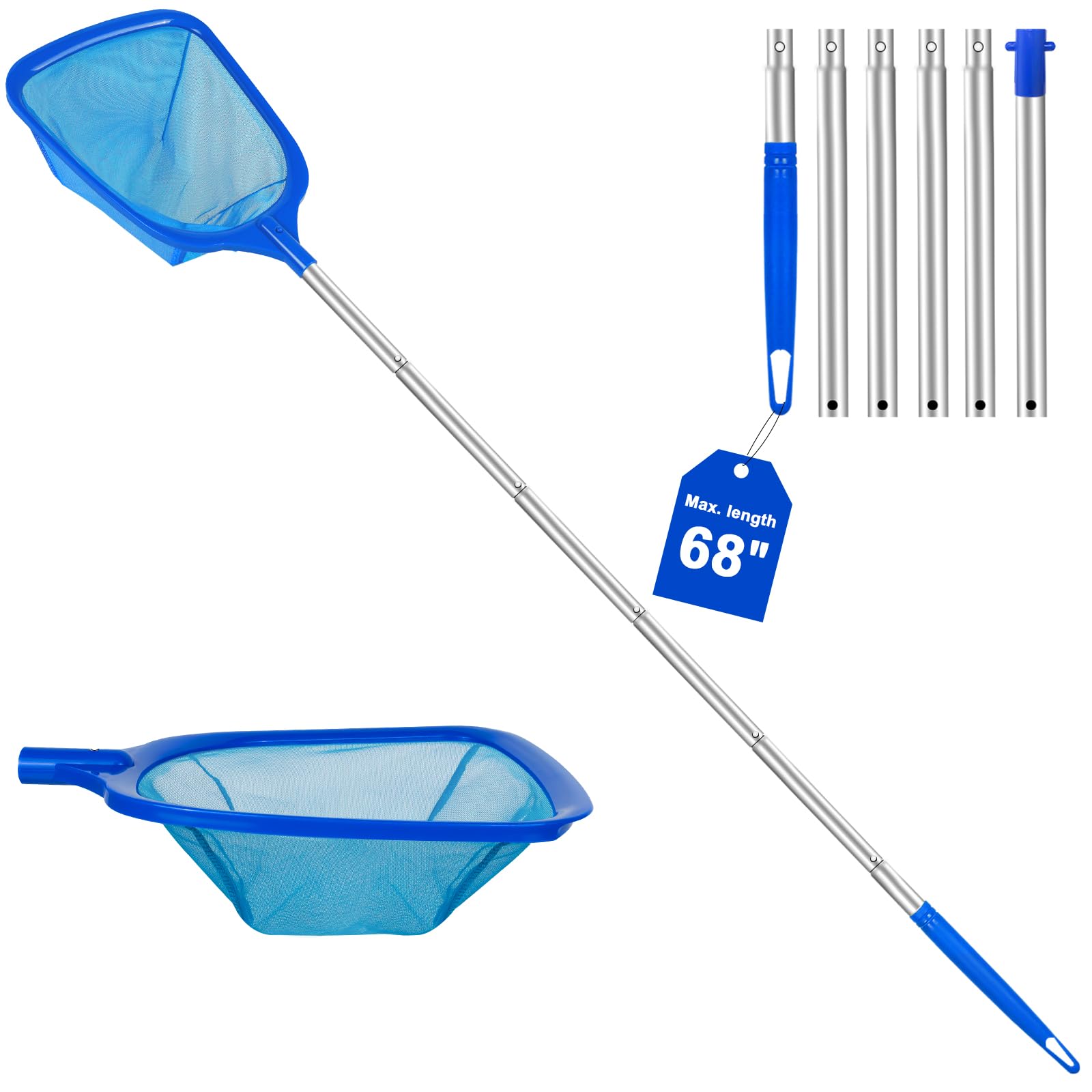
This is the least expensive way here to get six feet between you and the water. Total length runs 40 to 72 inches in four aluminum sections, the head latches on rather than twisting into place, and the whole thing weighs about a pound, light enough that a full lap of the pond does not feel like a chore.

It is a pool skimmer by design, and that shows in the mesh, which is standard nylon rather than the fine weave the pond-specific nets use. Leaves, twigs, and drowned insects come out; duckweed, pollen, and the fine green film mostly do not. For a pond under trees where the debris is leaves, that is the right trade, since a coarser bag drains and empties faster. You can also shorten the pole by leaving sections off when you are working close.

The aluminum is thin, and you feel it when the bag is loaded at full length. Run a thumb along the cut ends of each section before the first use and press the latch home every time you fit the head. At this money none of that is a surprise, and it remains the cheapest route into real reach.

Bottom line: For ponds where the debris is leaves rather than duckweed, we take 72 inches of reach at about a pound, and the lowest price here.

5

Aquascape Pond Shark 3-in-1

Aquascape Pond Shark 3-in-1

Algae scraping

Our Score 8.8/10
Check Price

Worth Noting

  • Telescoping collars slip and rotate the head
  • Heavy once the bag is full of wet debris
Tools
Net, rake and scraper
Head Shape
Rectangular
Handle Length
60 inches (telescoping)
Frame Material
Alloy steel
Read the full review

Rake teeth and a scraper edge are things a mesh bag simply cannot offer, and they are the reason this tool is here at all. Three implements share one head: a net for leaves and twigs, a row of teeth for pulling string algae, and a scraping blade for reeds and rooted weed along the margin.

On string algae the teeth do what a soft pond net will not, hooking and hauling the mass instead of pushing it aside. The scraper works the same way along the edge of a planting bed, and the rectangular head lays flat so you can work the bottom as well as the surface. It holds a large load before you have to walk back and empty it.

The bag is stiff where it meets the frame, so flip-dumping a load of wet muck takes a firm shake rather than a flick of the wrist. Set the length you want before the tool goes into the water, and expect a scraping pass to be more of a two-handed drag than a lift.

So it is not the net to buy first; the Aquascape Heavy-Duty covers everyday skimming with less weight in the hand. But a pond that grows string algae or has reeds along the margin gets a job done here that no amount of netting will finish, and that is worth shelf space.

Bottom line: We recommend it as a second tool: the rake and scraper pull string algae and margin reeds that no mesh bag can handle.

6

ROMIVO Telescopic Skimmer Net

ROMIVO Telescopic Skimmer Net

Small water features

Our Score 8.8/10
Check Price

Worth Noting

  • Tops out at 5.7 feet of reach
  • Small head means more passes
Mesh
Ultra-fine
Weight
10.2 oz
Pole Length
2.6 to 5.7 feet
Read the full review

Set beside the five-foot POOLWHALE, this is the smaller, lighter version of the same idea: a compact head on a 2.6- to 5.7-foot aluminum pole, with fine mesh and a protective edge that will not scratch a liner. It weighs about ten ounces, and you can leave it by the back door without noticing it is there.

That is the case it is built for, a patio pond, a half barrel, a small raised water feature you can stand next to. The fine mesh takes small floating debris, the sections adjust quickly to a comfortable working height, and the whole thing is light enough to use daily rather than saving the job up for the weekend.

Beyond arm's length plus five feet, it runs out of tool. The head is small, so clearing a real pond takes more passes, and the pole flexes when you push it through the water. If your water is wider than a few steps, the POOLWHALE or the Sepetrel gives you more reach for similar money. If it is a bucket-sized feature, this is the one that actually gets used.

Bottom line: Our pick for a patio pond you can stand beside: light, fine-meshed, and short enough to keep by the back door.

7

POOLWHALE 5-Foot Fine Mesh Skimmer

POOLWHALE 5-Foot Fine Mesh Skimmer

Small ponds

Our Score 8.6/10
Check Price

Worth Noting

  • Five-foot maximum reach
  • Frame and joints flex under a full bag
Mesh
Ultra-fine
Weight
1 lb
Total Length
1.3 to 5 feet
Pole Diameter
3/4 inch aluminum
Read the full review

The weave is the whole argument here. This is one of the finer meshes in the group, and it shows on the debris other nets leave behind: gnats, pollen, pine needles, the small material that goes straight through a standard bag. The cost is speed. A tight mesh pushes water ahead of it, so a fast sweep just builds a bow wave, and slow deliberate passes are what make it work.

The pole is 3/4-inch aluminum in click-together sections and runs from 1.3 to 5 feet, with a molded plastic frame that will not mar a liner. Assembly takes seconds, and the whole net is about a pound, so it is easy to keep by the pond and use for a couple of minutes a day instead of saving the job up.

Five feet is the ceiling, though, and that decides who it is for. Standing at the edge of a small pond, a stock tank, or a patio water feature, you are working at three or four feet and the net is exactly right. On anything you need to reach across, the short pole and small head mean more walking and more scoops, so spend your reach elsewhere.

Bottom line: We keep this one for small ponds and stock tanks, where an ultra-fine mesh and a five-foot pole are exactly enough tool.

How We Tested Pond Skimmer Nets

We started with every skimmer net we could find that shipped with a telescoping pole and a head wide enough to matter, then cut the list by head width, mesh size, pole material, and price — from around $15 up to just under $70. Thirteen made it to the water. Testing ran through one full pond season, April to September, on a half-acre garden pond and two smaller livestock ponds, and each net did the same jobs in the same order so the comparisons held up.

In spring that meant catkins and floating maple seeds every few days; in summer, string algae and the film that collects along the banks; by September, wet oak leaves that sink the second they touch water. We timed how long each net took to clear a ten-foot stretch of shoreline, and we watched how much debris stayed in the bag on the lift — more than one dumped half its load back into the pond when the mesh went slack.

Every net was assembled out of the box first, with notes on whether the sections snapped or threaded, how much slop sat in the joints, and whether the head arrived square to the pole. Then we loaded it at full extension with a scoop of wet leaves to see whether the twist lock held or crept, whether the pole bowed, and how heavy the whole thing felt working one-handed from the bank. Nets stayed outdoors between sessions, which is how we caught UV brittleness, rust blooming at the rivets, and mesh pulling loose from the frame. Anything that wobbled or slipped got marked down regardless of price; the ones that finished the season straight and intact are the ones worth your money.

How to Choose Pond Skimmer Nets

Reach decides the net before anything else

Add your arm to the net's total length and compare that to the distance from where you actually stand to the far bank. For a small backyard pond of eight to ten feet across, a five- or six-foot net is enough from one side. Past about twelve feet, or if you can only work from one spot, look at ten feet and up.

Listings mix total length with handle length, so read both: a net advertised as five feet is usually five feet with the head on, not five feet of pole. And treat the very long poles as specialists. Twenty feet of reach is wonderful from a fixed spot on the bank and tiring everywhere else, because the weight sits at the far end of the pole.

Fine mesh or fast mesh

Mesh is a trade. A tight weave catches duckweed, pollen, algae and gnats but pushes water ahead of the bag, so it planes along the surface if you sweep quickly. Standard nylon skims leaves fast and lets the small particles through.

Match it to your debris rather than your ambitions. A pond under deciduous trees mostly needs leaves out, and a coarse bag drains and empties faster. A pond that turns green with duckweed or collects pollen needs the fine weave, and you accept slower passes to get it.

Fish, frogs, and liners

This net goes into water with animals in it. Soft, knotless nylon and a capped or rounded frame are the features that matter; bare wire ends and hard metal edges are what scrape a fish or a liner. A deep or drop-shaped bag lifts a fish without pinning it flat against the frame.

Before the first use, run a hand around the frame and the cut ends of the pole sections. A burr or an exposed wire tip is easy to file down or send back, and much harder to spot with a struggling fish in the bag.

Joints fail before handles do

Most of the trouble with these nets concentrates at the joint: twist collars that will not hold, push buttons that pop out, a section that rotates under a loaded bag. Set the length before the net goes into the water, tighten every collar, and check again after a heavy scoop.

If you plan to work at full extension often, buy the thickest pole you can. The 1.0 mm aluminum on the Poolvio carries more load than the thin corrugated sections on the budget nets, and that difference shows up on the first bag of wet leaves rather than the tenth.

Storage and the second season

These nets wear out from sun and wet storage more often than from work. Rinse the bag, hang it to dry, and store the net collapsed and out of the weather; a bag left on the bank with wet leaves in it goes brittle at the seams.

Collapsible and folding heads earn their keep here simply because they fit in a shed instead of leaning against it. Before you buy, decide whether you are willing to replace the whole net when the mesh goes, because on many of these the bag is not sold on its own.

Frequently Asked Questions

Final Verdict

Our default is the Aquascape Heavy-Duty: soft, fish-safe nylon, a capped frame that survives the tip, and 69 inches of reach at 1.4 pounds, which is the right balance for a backyard pond you can walk around.

Choose the Poolvio instead when the pond is wide enough that you will always be skimming from one bank, since ten feet of pole is worth carrying the extra weight for. And if the water is small enough to stand beside, the Sepetrel gives you six feet of reach for the least money here.