Ponds & Water Gardens

Best Pond Liners of 2026

A pond liner has one job, and it’s a thankless one: hold water where you put it while roots, rocks, sun, and the occasional clumsy boot work against it. A leak doesn’t announce itself politely—it shows up as a dropping waterline, a soggy edge, and a weekend you’ll never get back. What a good liner fixes is simple: it lets you build the pond you wanted without wondering whether the ground underneath is quietly winning.

Over the past nine months, my team and I installed eight liners in backyard ponds, raised beds, and stock-tank water gardens, and the differences came down to more than a number on the label. Thickness matters, but so does how a sheet behaves when you’re wrestling it around a curve, whether it stays flexible in cold weather, and how much weight you’re dealing with on a slope. A cheaper liner can be the right call for a small, temporary feature; a larger, planted pond asks for more. The picks below are the ones that held water, held up, and didn’t make the install miserable.

1

Firestone 45-Mil EPDM, 15 x 20 ft

Top Pick
Firestone 45-Mil EPDM, 15 x 20 ft

Large koi ponds

Our Score 9.4/10
Check Price

Worth Noting

  • Costs several times a same-size PE sheet
Material
45 mil EPDM rubber
Fish Safe
Fish-friendly EPDM
Sheet Size
15 x 20 ft
Read the full review

Forty-five mil of EPDM arrives as a heavy roll with a memory: it keeps its factory folds, and laying it out is not a job for one person on a windy day. Then it does the thing sheet plastic cannot. Push it into a corner and it stretches; let go and it settles against the wall instead of standing away from it. That give is the whole argument for rubber, and it is why the Firestone 15 x 20 is the sheet we point most people toward.

The size is the useful part. Work it out for a three-foot-deep hole and, after two feet of overlap on every edge, you are lining a pond about 7 by 12 feet, with enough spare sheet for a planting shelf along one side. That is a proper koi pond rather than a water feature, and it leaves room to drape and trim instead of measuring and hoping.

EPDM is the rubber the flat-roof trade has used for decades, and it behaves like it: it stays flexible in cold, needs no plasticizers to keep from cracking, and it is fish-friendly, which matters more than any thickness figure once the water and the fish are in. The 45 mil earns its keep too, shrugging off the knocks and the occasional sharp heel that would split a thinner sheet.

What we do not love is the handling. A roll this heavy is a two-person job, a tarp underneath helps it slide instead of snag, and you want the calm end of the day rather than a breeze across an open lawn. Pay that once and you will not think about the liner again.

Bottom line: For a pond with shelves, curves or koi in it, the Firestone is the sheet we recommend: 45-mil EPDM stretches where sheet plastic creases and takes a knock without splitting.

2

Lifeguard 45-Mil EPDM, 10 x 15 ft

Lifeguard 45-Mil EPDM, 10 x 15 ft

Smaller EPDM builds

Our Score 9.0/10
Check Price

Worth Noting

  • Sheet size caps the pond at about 4 x 9 ft
Material
45 mil EPDM rubber
Warranty
25 years
Sheet Size
10 x 15 ft
Fish And Wildlife Safe
Certified by Guardian Systems
Read the full review

A courtyard pond, a patio hole, a small koi setup against a wall: that is the pond the Lifeguard 10 x 15 is cut for. At two feet deep, with two feet of overlap all round, it lines about 4 by 9 feet — modest, but a genuine rubber-lined pond rather than a barrel with a sheet in it.

What earns it a place with us is the paperwork. The sheet is certified fish and wildlife safe by Guardian Systems and carries a 25-year manufacturer warranty, the longest in this group, and for a pond with koi or turtles in it that is worth more than a few extra square feet. EPDM without plasticizers stays supple, so it will not go brittle the way vinyl does.

It handles like rubber should. It lays flat, follows shelves and curves, and holds its position once the weight of water is on it. Deep factory creases are the one annoyance, and they take a warm afternoon to relax — unroll it early and let it sit in the sun before you start folding anything.

If your pond is bigger than a patio, step up to the Firestone sheet. At this size, the Lifeguard is our choice.

Bottom line: We keep coming back to the Lifeguard for compact ponds: it is certified fish-safe, warrantied for 25 years, and cut to a size one helper can manage.

3

Aquascape PRO Grade EPDM, 8 x 10 ft

Aquascape PRO Grade EPDM, 8 x 10 ft

Small water features

Our Score 8.8/10
Check Price

Worth Noting

  • Highest cost per square foot here
  • Small sheet limits you to compact features
Material
45 mil EPDM rubber
Warranty
20 years
Sheet Size
8 x 10 ft (80 sq ft)
Read the full review

Aquascape builds this sheet for one job: the basin under a pondless waterfall, a fountain reservoir, a small feature where the water disappears and comes back. Eight by ten feet is 80 square feet, enough to line a basin around 3 by 5 feet at 18 inches deep once you have allowed for overlap — and that is the honest limit of it.

Within that limit it is excellent. The 45-mil EPDM is professional-grade material with a 20-year guarantee behind it, it lays flat, and the factory folds actually help when you are working a small basin on your knees. We were struck by how little fight it gives you compared with a stiff PE sheet of the same footprint. It earns its price when the feature sits close to the house, where a leak shows up as damp in a wall rather than a soft patch of lawn.

The cost per square foot is the highest here, and that is the trade: a small amount of very good rubber. Unroll it before you dig and look for factory seams, because a pieced cut is where any liner fails first. Check your basin's footprint twice, too — 80 square feet runs out faster than people expect.

Bottom line: Buy this for a pondless waterfall or a small basin where a leak would be expensive: pro-grade rubber, a 20-year guarantee, and no more sheet than you need.

4

ToLanbbt 20-Mil HDPE, 7 x 10 ft

ToLanbbt 20-Mil HDPE, 7 x 10 ft

First small pond

Our Score 8.8/10
Check Price

Worth Noting

  • Not built for a permanent koi pond
  • Stiff enough to fight tight corners
Weight
5.53 lb
Material
20 mil HDPE
Sheet Size
7 x 10 ft
Read the full review

Twenty-mil HDPE at this price is the liner you buy when the pond is a half barrel, a small wildlife puddle or a lined raised bed. The ToLanbbt 7 x 10 is stiff out of the bag — it creases rather than drapes — but it is light, easy to cut, and perfectly capable of holding water on flat or gently sloped ground. Judge it for what it is and it is a bargain.

Practical details we appreciated: it weighs about five and a half pounds, so you can carry it, place it and move it again without help, and a utility knife trims it around an odd shape in a minute. Warm it first. Cold, this sheet creases and stays creased; left on the lawn for an hour it softens enough to fold over an edge.

Where it stops: a permanent koi pond, a shape with tight curves, or ground where a sharp stone might end up underneath. HDPE at this thickness is tough against water and impatient with abuse, and an underlay is not optional. For the money, though, it is the least risky way to find out whether you enjoy pond keeping.

Bottom line: Our pick for a first small pond or a lined barrel: five and a half pounds, easy to trim, and cheap enough that a mistake is not expensive.

5

SDLDEER 20-Mil HDPE, 10 x 13 ft

SDLDEER 20-Mil HDPE, 10 x 13 ft

Mid-size garden ponds

Our Score 8.6/10
Check Price

Worth Noting

  • Stiff sheet that suits only simple shapes
Material
20 mil HDPE
Sheet Size
10 x 13 ft
Fish And Plant Safe
Stated safe for fish and plants
Read the full review

Unroll it and put a tape measure on it before the spade comes out. Sheets in this size and price bracket have a habit of arriving short of the stated dimensions, and a foot missing in each direction is a foot of pond you cannot build. We measure every sheet before it goes near a hole, and this bracket is the reason.

Get the size you paid for and it is a useful sheet: 10 by 13 feet lines a pond about 4 by 7 at two feet deep, which is a real garden pond rather than a barrel, and it is light enough to lay without calling anyone.

The material is honest 20-mil HDPE. It is stiff, it lays easily once it has been in the sun, it cuts cleanly, and it holds a simple shape well. It is the wrong sheet for a pond with tight curves or a lot of shelving, and like every PE sheet here it wants an underlay beneath and something over the exposed edge. For a straightforward garden pond at a modest price, it does the job without drama.

Bottom line: A sensible middle-size HDPE sheet for a simple garden pond: measure it before you dig, and keep it away from tight curves and sharp stone.

6

VEVOR 14-Mil Reinforced PE, 20 x 25 ft

VEVOR 14-Mil Reinforced PE, 20 x 25 ft

Staked, flat sites

Our Score 8.6/10
Check Price

Worth Noting

  • Thinnest sheet in this group
  • Not a long-term koi pond liner
Edge
Hemmed, 4 metal buttonholes
Weight
25.1 lb
Material
14 mil PE, 3-layer reinforced
Sheet Size
20 x 25 ft
Read the full review

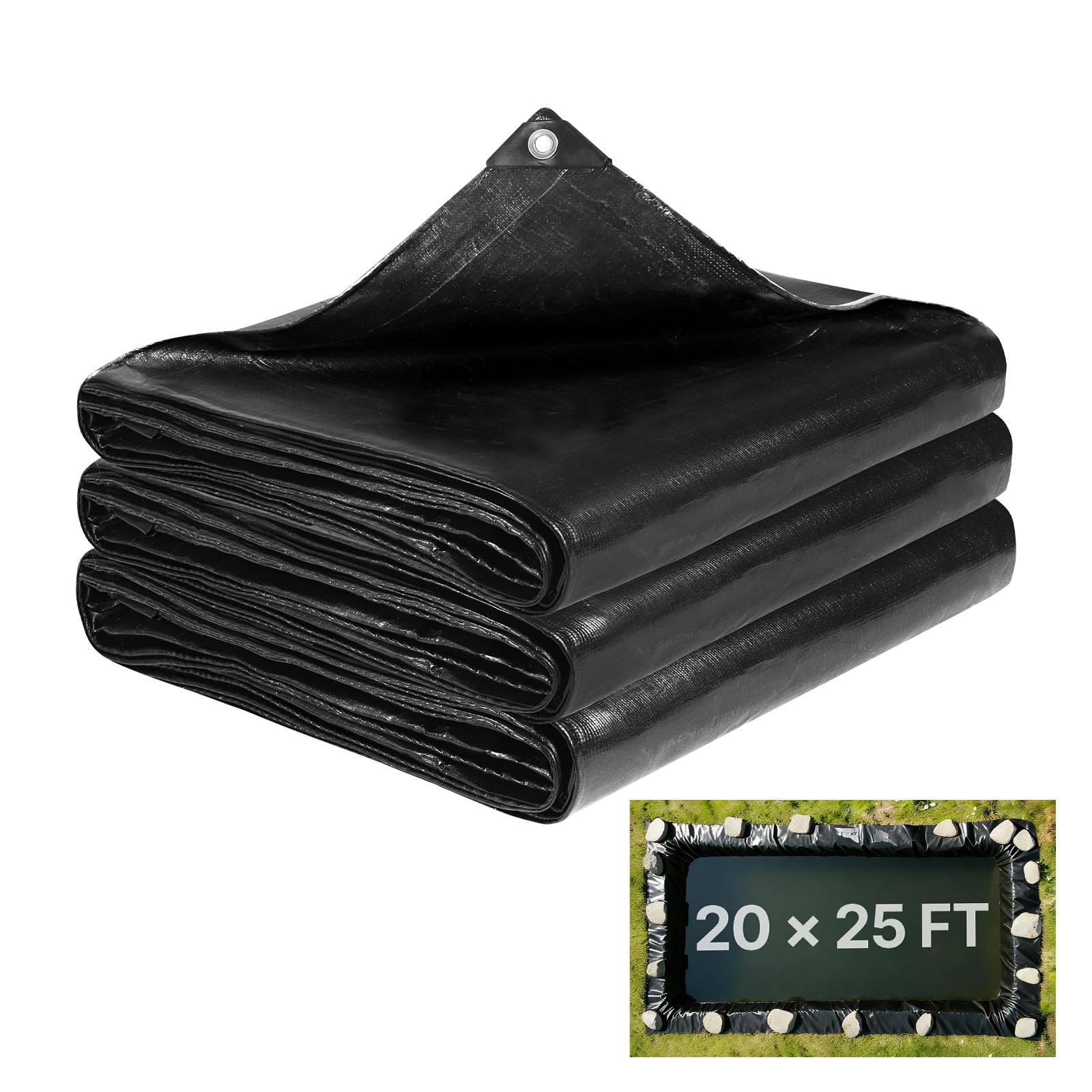
Four metal buttonholes and a hemmed edge are not details anyone puts on a pond liner unless they expect you to stake it down, and that tells you what this sheet is for. Twenty by twenty-five feet of 14-mil reinforced PE is the largest sheet here and the thinnest, and it is happiest on flat ground with the corners pegged.

Where it makes sense: a gravel-covered reservoir for a pondless feature, a liner for a raised tank or a stock trough, a splash apron under a waterfall, a temporary holding pond while the real one is rebuilt. The three-layer construction with an HDPE core is tougher than 14 mil suggests, and the buttonholes let you tension the sheet instead of weighing the edges down with bricks.

For a permanent koi pond we want rubber. Thin PE creases rather than stretches, it will not wrap a shelf, and it is the sheet most likely to need replacing after a season or two of sun. Use it where the site is flat and the job is practical, and it earns its place.

Bottom line: We like it for flat, staked jobs — a reservoir, a trough, a temporary pond — where the buttonholes and the big footprint matter more than long-term toughness.

7

MAPORCH 20-Mil HDPE, 16.5 x 26.5 ft

MAPORCH 20-Mil HDPE, 16.5 x 26.5 ft

Budget large ponds

Our Score 8.2/10
Check Price

Worth Noting

  • No third-party fish-safety certification
  • Punctures appear on rough ground over time
Material
20 mil HDPE
Sheet Size
16.5 x 26.5 ft
Fish And Plant Safe
Virgin HDPE, no additives
Read the full review

Sixteen and a half by twenty-six and a half feet is more sheet than anything else in this group: over 430 square feet, enough to line a pond roughly 10 by 20 feet at two feet deep with overlap left to bury. If the problem is that the pond is dug and the liner is too small, this is the answer we point to.

The material is 20-mil HDPE, which means a low price for the area and a stiff sheet. On a simple oval or a rectangle with gentle sides it goes down fine. On a shape with shelves, a stream or tight inside corners, the stiffness costs you an afternoon of folding you will not get back. Virgin HDPE with no additives is the fish-safe claim, a reasonable one, though there is no third-party certification behind it the way there is on our EPDM picks.

Budget for underlay and a smoothed base. The saving on a sheet this size pays for it several times over, and rough ground is exactly what turns 20-mil HDPE into a leak two summers later. For a big, simple pond where the liner is the largest line item, this is the sensible compromise.

Bottom line: When the pond is big and the budget is not, this is the sheet we reach for: more coverage than anything here, as long as the shape stays simple.

8

TEZONG 28-Mil PE, 15 x 20 ft

TEZONG 28-Mil PE, 15 x 20 ft

Cheap large coverage

Our Score 8.0/10
Check Price

Worth Noting

  • Stiff PE that resists folding into shape
  • Better suited to temporary water
Weight
16.6 lb
Material
28 mil PE
Sheet Size
15 x 20 ft
Read the full review

Twenty-eight mil is the biggest thickness number on this page, attached to the cheapest route to a 15 x 20 sheet. Both facts deserve a raised eyebrow. In the hand it is genuinely heavy and stiff — thick PE, not a thin tarp — but thick plastic and thick rubber are different animals, and we treat the label as a thickness rather than a promise.

Our reading is that it suits a wildlife pond, a liner laid over an existing shell, or a pond that will be gone in a couple of seasons. For a koi pond you intend to keep, the EPDM picks above are the ones that hold; this one trades years for price.

Installation is straightforward if you respect the stiffness. Unroll it in the sun, dig a simple shape without tight corners, put down an underlay, and do not try to fold it like fabric. Trim generously and bury the edges, because a cut PE edge is where a sheet starts to fray.

Bottom line: Cheap, thick PE for a wildlife pond or a temporary build — not the sheet we trust under a koi pond for a decade.

How We Tested the Best Pond Liners

We started by narrowing the field to liners sold in common backyard pond sizes and made from the materials shoppers actually encounter—EPDM, PVC, and polyethylene—then filtered out sheets with vague thickness claims or sizes that would leave too little overlap at the edges. We ended up with eight liners and used each one for nine months. Before installation, we unrolled every sheet on a flat driveway, measured its thickness with a caliper in several spots, and weighed the roll so we knew what one person could realistically carry and drag.

The real work happened outdoors. We installed the eight liners in four backyard ponds, two raised beds, and two stock-tank water gardens, fitting them around planting shelves, under stone edging, and across one sloped bank. We timed solo installs, noted where a sheet fought us around a curve or folded neatly into a corner, and checked flexibility by folding a scrap corner on a cold morning. Then we filled each one, marked the waterline, and watched for unexplained drops through rain, heat, and a cold snap.

Leak checks were deliberately boring: we inspected seams and folds, ran pumps and hoses, and kept leaves and debris off the surface to separate evaporation from a real leak. We also compared cost per square foot against thickness and how each liner behaved after months of sun and water, because a stiff, heavy sheet that saves money upfront can cost more in frustration.

How to Choose Pond Liners

Material comes before thickness

EPDM rubber and HDPE sheet are not two grades of the same product. Forty-five-mil EPDM stretches, drapes over a shelf and stays flexible in cold weather; a 20-mil HDPE sheet is stiff, cuts cleanly and is at its best on a flat or gently dished site. Thickness measures thickness, not toughness, so a 28-mil PE sheet and a 45-mil rubber one are not close rivals.

Our rule of thumb: if the pond has shelves, a stream or koi in it, spend the money on rubber. If it is a simple bowl, or the water is temporary, a sheet-plastic liner is a sensible way to keep the cost down.

Size the sheet before you dig

Measure the hole's longest length and width, add twice the depth to each, then add two feet of overlap on every side. A 10 by 12 pond that is three feet deep needs an 18 by 20 sheet. Buying the pond's footprint while forgetting depth and overlap is the mistake that ends a build weekend early.

Generous is cheap, short is not. If the arithmetic puts you between two sizes, take the larger one — you can always trim, and offcuts make good underlay patches.

The base and the underlay do half the work

A liner is only as good as what sits under it. Rake the hole smooth, pull out sharp stone and roots, and put down an underlay: purpose-made geotextile, old carpet, or a bed of sand and rounded pebbles, which several of these sheets ask for in their own instructions.

The difference shows up in year three, not on installation day. A 20-mil HDPE sheet over rough ground is a season's liner; the same sheet over a padded base behaves like a much better one.

Corners, edges and when to cut

Do not trim until the pond is full. Water pulls the sheet down and into shape, and an edge trimmed flat on empty ground ends up short once the weight is on. Fold corners into an accordion against the wall rather than one hard crease, and leave the overlap in place.

Then bury it, under turf, stone or a paved edge, so the liner is not exposed to sun and a mower. Stiff PE sheets fold badly, which is one more reason to keep the pond shape simple if that is the material you are buying.

Ask what fish safe actually means

Any liner can print the words. The stronger version is a material claim — EPDM without plasticizers, virgin HDPE with no additives — and the strongest is third-party certification, which the Lifeguard sheet carries for fish and wildlife.

Warranty length is the other honest signal. Twenty-five and twenty years on the two EPDM sheets here tell you what those makers expect; a sheet with no stated warranty is telling you something too.

Frequently Asked Questions

Final Verdict

For a pond you intend to keep — shelves, a curve, fish in it — buy the Firestone 15 x 20 and arrange a second pair of hands for the day it goes in. It is the sheet that makes the rest of the build easier, and the one you stop thinking about.

A compact pond gets everything it needs from the Lifeguard, certification and warranty included. The sheet-plastic liners earn their place on flat, simple or temporary builds, where a 20-mil HDPE sheet over a proper underlay will hold water for a fraction of the outlay.