Birding & Garden Decor

Best Owl Houses of 2026

An owl house that leaks, wobbles in the wind, or arrives with a bag of unlabeled screws is worse than no box at all—you’ve spent the money and the owls still don’t have a dry, safe cavity. A good one does three things: it gives owls the right interior dimensions, it keeps rain and predators out, and it mounts securely without a fight. I’ve seen boxes that looked charming on the outside but had gaps you could slide a pencil through, and I’ve seen plain ones that lasted a decade. The difference comes down to construction, hardware, and how thoughtfully the thing goes together—get those right and a nest check becomes a five-minute job instead of a ladder wrestling match.

Over the past nine months, my team and I assembled, mounted, and monitored 12 owl houses on a handful of rural properties, from a weathered barn wall to a pole at the edge of a meadow. We timed assembly, checked every screw and bracket, and watched how each box handled rain, heat, and wind. The biggest surprise? Price didn’t predict quality—a mid-priced box with smart hardware beat a fancy one with a flimsy latch. Below are the ones that stayed square, kept the interior dry, and looked good without looking like a bird-themed craft project.

1

JCs Cedar Screech Owl House

Top Pick
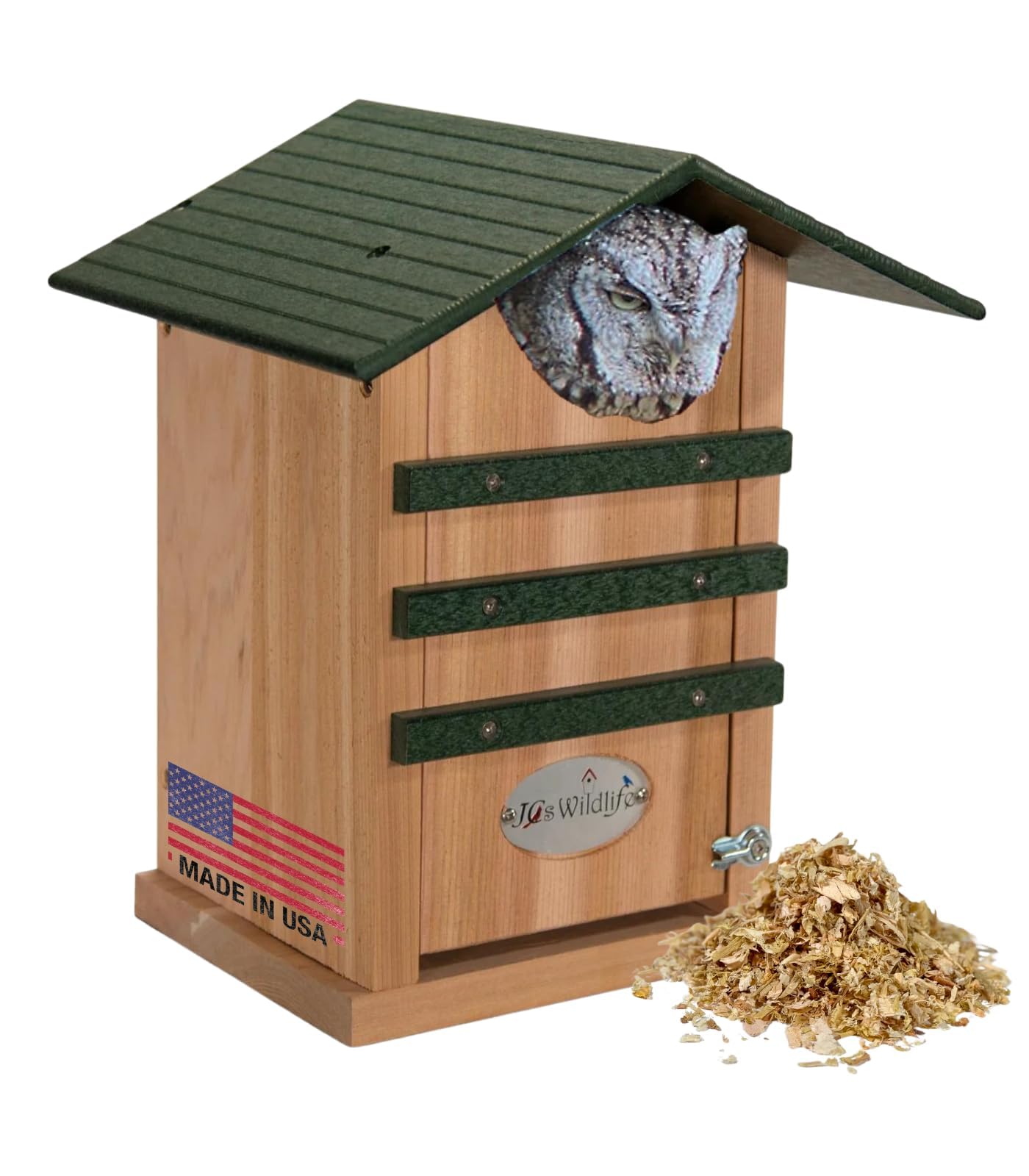
JCs Cedar Screech Owl House

Most backyard owls

Our Score 9.4/10
Check Price

Worth Noting

  • Mounting screws are weak; swap in longer deck screws
  • Small cavity suits screech owls, not barred owls
Weight
7 lb
Cleanout
Swing-up front door
Material
Cedar body, recycled poly roof
Target Species
Screech owl, saw-whet, kestrel
Read the full review

Every owl box has to come open once a year, and how it opens decides whether that job is a thirty-second check or a screwdriver and a balancing act on a ladder. On the JCs box the whole front panel swings up and out of the way in one motion, then drops back into place. No tools, no panel to set down while you work.

That door is why this is the box we send most people to first, but the rest of it holds up too. The body is cedar, which insulates and carries the natural scent cavity-nesting owls key on, and the roof is recycled poly lumber, which puts plastic exactly where a wooden box rots first. Drain holes in the floor and a vent gap under the overhang keep the cavity dry through a wet spring, and that matters more than any other single detail.

Hang it 10 to 20 feet up a mature tree, set well away from your other boxes, and put it somewhere you can see the entrance from a window, because half the pleasure is watching who turns up. A bag of pine shavings comes with it to start the nest floor, and the box runs around seven pounds, so one person on a steady ladder can manage it.

The honest comparison is with the WHITEHORSE, which gives you a bigger cavity for roughly half the money if you're willing to assemble it yourself. What the extra buys here is the door, the cedar-and-poly build, and a box that arrives ready to hang.

Bottom line: Our default pick: the swing-up front makes the yearly cleanout genuinely easy, and cedar walls under a poly roof are the right materials for a box that lives outdoors.

2

JCs Barred Owl House

JCs Barred Owl House

Barred owl woods

Our Score 9.4/10
Check Price

Worth Noting

  • Twenty-three pounds needs two people on a ladder
Weight
23 lb
Cleanout
Side swing panel
Material
Exterior-grade plywood
Cavity Height
26 in
Read the full review

Twenty-three pounds and better than two feet tall: the barred owl box is not something you tuck under one arm and carry up a ladder. It's the biggest box here, and the only one built around a barred owl's actual measurements, with a 13-inch square floor and a 26-inch drop behind the entrance.

The detail worth the money is inside. Shallow kerfs are cut into the interior walls so a nearly fledged young owl has something to grip on the climb to the opening, which is the hardest part of leaving the nest. Outside, there's no perch beneath the hole and the roof overhangs it, the two decisions that keep raccoons and crows from getting a foothold. A side panel swings open for the yearly cleanout without the box coming down.

If barred owls are what you hear in the woods at dusk, buy this one; a screech owl box a fraction of the size will sit empty. The weight and the price are the real cost of a cavity this big, so plan on a helper and a calm afternoon rather than a quick job.

Bottom line: We keep this one for barred owls: a 26-inch cavity, gripping kerfs inside and no perch outside, provided you have help getting it up the tree.

3

Kingsyard Poly Lumber Owl House

Kingsyard Poly Lumber Owl House

Low-maintenance yards

Our Score 9.4/10
Check Price

Worth Noting

  • Not every screw hole comes pre-drilled
Cleanout
Rotating latch front panel
Drainage
Four corner holes
Entrance
4 x 3 in arched
Material
Recycled poly lumber
Read the full review

A box you hang is a box you'll be reaching for years from now, and that's the case for recycled poly lumber: it doesn't rot, it doesn't split at a seam after a hard freeze, and it never needs another coat of anything. The Kingsyard is the low-maintenance pick here, and it's the one to choose where getting the ladder back out is a genuine annoyance.

Plenty of thought has gone into the rest. The entrance is a 4-by-3-inch arch rather than a plain round hole, the interior walls carry climbing grooves for young birds, and the front panel opens on a rotating latch that stays put when you let go of it. Ventilation sits high under the roof and four cut corners in the floor handle drainage. Panels, screws and a screwdriver all come in the box.

What it isn't is a big box. Roughly 10 by 9 inches on the floor and 14 inches tall, it's sized for screech owls and similar cavity nesters rather than barred owls. Hang it on a shed gable or a post you can see from the kitchen, and that size turns into an advantage: it's light, and the front comes open at eye level.

Bottom line: We reach for this one when the box will hang somewhere awkward to reach: recycled poly lumber won't rot or need repainting, and the latch opens without tools.

4

Woodlink Screech Owl House

Woodlink Screech Owl House

Kestrel-friendly box

Our Score 9.4/10
Check Price

Worth Noting

Bedding
Wood shavings included
Cleanout
Front pivots open
Entrance
3 in
Material
Inland cedar
Read the full review

Three inches is the entrance size that matters here, and it's the number this box is built to. Woodlink cuts it to Conservation Commission specifications, a three-inch hole over a cavity close to 20 inches deep. Go bigger and starlings and squirrels move in; three inches lets a screech owl or a kestrel through and keeps most of the rest out.

It's inland cedar, with a bag of shavings tucked inside the box and two Phillips head screws for the tree. The front pivots open for cleaning instead of coming away in your hand, which is a nice thing to discover halfway up a ladder.

The caveats are fit and finish. Open the front and sight along the seams before you carry it out to the tree; panels have turned up out of square, and a gap at the roofline is where water gets into cedar. If the corners don't close, send it back rather than trying to seal it.

What the quirks buy you is the most conservative design in this group: a deep, narrow cavity, a three-inch hole and a front that opens, all cut to published nest-box specifications, and it arrives assembled and ready to hang.

Bottom line: We like that this one is old-fashioned: a three-inch hole cut to published nest-box specifications, shipped assembled, with a front that opens for cleaning.

5

WHITEHORSE Large Cedar Owl House

WHITEHORSE Large Cedar Owl House

Roomier budget box

Our Score 9.2/10
Check Price

Worth Noting

  • A board can need persuading into line
Bedding
Two bags of cedar shavings
Material
Western cedar
Cavity Size
16 x 12 x 11 in
Roof Overhang
3 in
Read the full review

Sixteen inches of interior height is a lot of owl house, and it's the first thing that registers when you lift the WHITEHORSE out of the carton. A cavity that deep keeps the nest well below the entrance and gives a growing brood somewhere to go. For the money, this is the best value in the group.

The build is western cedar throughout, screwed together with decking screws rather than nailed, a small choice that tells you something about how long the maker expects it to last. The roof overhangs the entrance by three inches, shading the hole from rain and blocking a predator's reach, and the door and floor sit recessed into the frame instead of flush. Two bags of cedar shavings, a printed booklet and a step-by-step video come with it.

Assembly is the trade. It arrives as pre-cut panels and takes most people half an hour with a screwdriver, and the cuts are accurate, though a board occasionally needs persuading into line before the screws bite. Dry-fit everything on the ground first and the job runs smoothly. If you want a large cavity without paying top-pick money, start with this one.

Bottom line: We think this is the best value here: a 16-inch cedar cavity, pre-cut panels that fit, and a three-inch roof overhang over the entrance.

6

UUMENHA Carbonized Cedar Owl House

UUMENHA Carbonized Cedar Owl House

Tight budgets

Our Score 9.0/10
Check Price

Worth Noting

  • Pre-drilled holes don't always line up
Weight
3.86 lb
Material
Carbonized cedar
Cavity Size
14.5 x 9 x 7.5 in
Ventilation
Vents top and bottom
Read the full review

Carbonized cedar is the interesting part. Instead of paint or stain, the surface of the wood is burned dark, which leaves nothing to peel, blister or scrape off after a summer in the sun, and nothing inside for an owl to pick at.

That finish, along with vents at both the top and the bottom, is why this is our budget pick. Two vent bands do more than one: hot air leaves high, damp air leaves low, and the cavity stays drier through a humid July than a box with a single gap under the roof. The cedar underneath handles the weather.

The rest is straightforward. Pre-cut pieces go together in a few minutes, and it comes with screws, a bag of wood shavings and a two-year warranty. At 14.5 inches tall on a 9-by-7.5 floor it's a small-owl box, which means screech owls and kestrels rather than barred owls.

Bottom line: Our budget pick: carbonized cedar with nothing to peel, vents high and low, and a cavity that suits screech owls. Expect to add a drill.

7

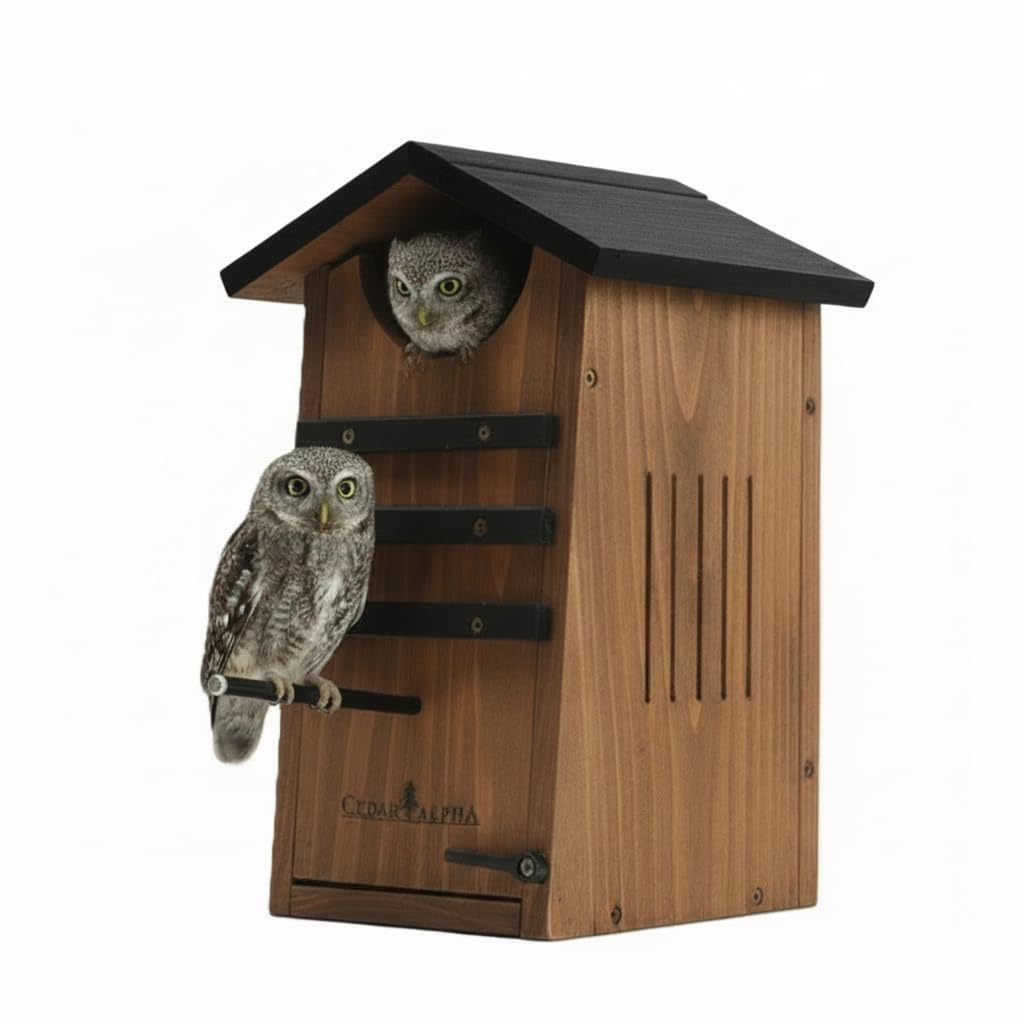
Cedar Alpha Screech Owl House

Cedar Alpha Screech Owl House

Thick cedar walls

Our Score 9.0/10
Check Price

Worth Noting

  • Screw kits have arrived incomplete
Weight
3.89 lb
Material
Solid cedar
Cavity Size
8.5 x 8.5 x 14 in
Wall Thickness
5/8 in
Read the full review

Five-eighths of an inch is thick for a cedar owl box, and it's the first thing that registers when you pick the Cedar Alpha up. It feels like joinery rather than a folded carton.

The layout is simple: an 8.5-inch square floor, 14 inches of height, and a front that opens so you can clear out last season's bedding. Cedar at this thickness insulates well and takes weather without a finish, which is what you want in something that hangs in the open for years. All the mounting hardware comes with it.

The gripes are about the kit, not the wood. Seams have arrived with gaps where the panels meet, so check the box over before it goes up and ask for a replacement if the corners don't close; a gap at the roofline is where the water gets in.

None of that changes the verdict: this is a solid cedar box at a budget price, one to inspect on arrival rather than trust. If the UUMENHA isn't available, this is the next name on the list.

Bottom line: We rate this the thickest cedar you'll get at a budget price, with a front that opens for cleaning. Check the hardware and the seams before it goes up.

8

MOBYKE Screech Owl House

MOBYKE Screech Owl House

Predator-aware setups

Our Score 9.0/10
Check Price

Worth Noting

  • Bottom board can split during assembly
Weight
5.84 lb
Material
Solid wood
Cavity Size
7.5 x 9 x 14.5 in
Exterior Perch
None
Read the full review

A perch under the entrance looks like a kindness and mostly isn't. It gives a raccoon somewhere to stand while it works at the hole, and a jay somewhere to wait. MOBYKE leaves the perch off, which is the right call and the first thing we check on any box now.

The floor has its four corners cut away, a neat way to vent and drain at once: air moves through, water leaves, and nothing pools in a seam. The planks are thicker than the price suggests, a bag of wood shavings comes with it, and two large screws handle the mounting 10 to 20 feet up.

It's a small box, roughly 9 by 7.5 inches on the floor and 14.5 inches tall, so this is screech owl territory rather than barred owl. For a small owl box with the predator details done properly, this is the one we point to.

Bottom line: We like the predator thinking here: no perch to stand on, corner vents cut into the floor, and thicker planks than you expect. Tighten the base gently.

How We Tested a Dozen Owl Houses

We started by researching more than 30 owl houses from brands known for birding and wildlife gear, then narrowed the list to 12 based on interior dimensions, entrance-hole size, materials, and mounting style. Each box was assembled on a workbench by one person with a screwdriver and drill, and we timed how long it took from opening the box to a square, finished unit. Some went together in 15 minutes with clear instructions; others had misaligned pilot holes, screws that stripped, and panels that needed convincing to fit flush.

We mounted every house at the recommended height—roughly 10 to 15 feet—on tree trunks, metal poles, and outbuilding walls, using the included hardware first and then swapping in our own where it felt flimsy or undersized. We gave each box a firm shake to see if it shifted, checked whether the bracket sat flush, and noted how easy it was to reach the access panel for cleaning. We also measured interior floor space and entrance diameters, then compared them with the needs of common backyard owls; a box that’s too small or has the wrong entrance is just a very sturdy squirrel condo.

Over nine months, we checked each box after rainstorms, heat waves, and windy days, looking for water stains inside, rusted screws, and warped panels. We paid attention to how the wood and hardware aged—some boxes weathered to a soft gray, while others splintered at the edges or showed rust bleeding from the hinges. We also compared price against performance: how many seasons the materials seemed likely to last, how easy the box was to open and clean, and whether the hardware stayed tight after repeated checks. The boxes that rose to the top were the ones we’d mount again without hesitation, because they did their job quietly and didn’t ask for a ladder every weekend.

How to Choose Owl Houses

Match the Box to the Owl You Actually Have

You can't pick a box before you know which owl will use it. Screech owls, saw-whets and kestrels want a small cavity: roughly a three-inch entrance on a box 8 to 10 inches square and 14 to 20 inches deep. Barred owls need something else entirely, a cavity around 13 inches square and better than two feet deep.

The trap here is marketing. A box described as a barn owl house but measuring nine inches square will not raise a barn owl, whatever the title says, and the dimensions on the listing are the only honest part of it. Listen at dusk for a few nights, then size the box to what you hear.

Cedar, Poly Lumber, or Exterior Plywood

All three work; they fail differently. Cedar insulates, weathers to gray without a finish and holds up for years, which is why most boxes here use it. Recycled poly lumber never rots, never needs repainting and doesn't split at a seam after a freeze; the trade is weight and a higher price. Exterior-grade plywood with an oil finish is what the big barred owl boxes are made of, where solid cedar gets heavy and costly.

Whichever you choose, leave the inside bare. Paint, stain and sealant are things an owl will pick at, and on cedar the natural scent is part of what makes the box legible to a cavity nester.

Cleanout Access Decides the Next Ten Years

Every box needs last season's bedding out and fresh shavings in, once a year, after the young have gone. The boxes that make this easy open at the front: a panel that swings up, pivots, or lifts on a latch, so you can reach the whole floor without taking the box off the tree. A box with no front access means unscrewing it from the trunk, and that job gets postponed.

Look at the floor as well. Drilled holes or cut corners drain it, and vents high under the roof keep air moving. A dry cavity is the difference between a box that gets used and one that grows mold between seasons.

Mount It High, and Skip the Perch

Ten to twenty feet up a mature tree, with a clear flight path to the entrance and well away from your other boxes. That's the standard, and it is worth the ladder. Two design decisions protect the nest once it's up: a roof that overhangs the entrance, and no perch, which gives nothing a place to stand while it works at the hole.

Check the hardware before you climb. The screws in the bag are usually the cheapest part of the kit, and a pair of long coated deck screws holds better in hardwood. A 23-pound plywood box is a two-person job; a four-pound cedar box is not.

Assembly and What Comes in the Box

Most of these arrive as pre-cut panels with labeled hardware, and half an hour with a screwdriver is realistic. That's a fair trade for a lower price, but know what you're committing to before the box is going up a ladder in October.

Nesting material is often included as a bag of shavings; if it isn't, buy some before you hang the box. Count the screws against the parts list while everything is still on the ground.

Frequently Asked Questions

Final Verdict

Most people should buy the JCs cedar screech owl box. The swing-up front turns the one job you'll actually do into a thirty-second task, and cedar under a poly roof is the combination that survives weather instead of absorbing it.

The decision changes on two things. If money is tighter or you want more room for a brood, the WHITEHORSE gives you a bigger cavity for roughly half the price, as long as you're willing to assemble it. If barred owls are calling in your woods, neither will do, and the JCs barred owl box is the only one here built to that size.