Soil & Fertilizer

Best Orchid Potting Mix of 2026

Orchid mix isn't soil. It's bark, charcoal, perlite, sometimes a handful of sphagnum — chunky stuff whose real job is holding a plant steady while letting air and water move past the roots. Get that balance wrong and you won't see it in the leaves for weeks; the roots go first. What a good bag actually fixes is the second-guessing every time you pick up the watering can, because the mix does most of the deciding for you.

"Orchid mix" covers everything from fist-sized bark to a fine, dusty blend that packs down like a brick, so the bag matters more than the label suggests. We've spent five months with 15 of them, potting up grocery-store phalaenopsis, a sprawling cattleya, and a few slipper orchids. The best were clean, chunky, and honest about piece size; the worst smothered roots in a soggy layer of fines. One thing worth knowing before you shop: bigger isn't automatically better — fat-rooted cattleyas want airy chunks, fine-rooted slippers want a smaller cut. The picks below account for both.

1

Better-Gro Orchid Bark

Top Pick
Better-Gro Orchid Bark

Custom bark blends

Our Score 9.4/10
Check Price

Worth Noting

  • Dries out fast used on its own
  • Chunk sizes vary widely
Bag
Resealable
Bark
Western fir bark
Volume
4 quarts
Read the full review

Nothing else here sells for as little, and that alone puts this bag in a lot of shopping carts. What arrives is plain western fir bark in a resealable four-quart bag, with no charcoal, no perlite and nothing else added, from the same maker as our top pick.

Bark and nothing else is not a flaw. Plenty of growers build a mix from exactly this starting point, adding perlite for drainage, charcoal for freshness or a handful of sphagnum for moisture, depending on what is going in the pot. And for orchids that want a coarse, dry, open root run, cattleyas and basket-grown vandas among them, bark at this size is closer to the right answer than a soft blended mix.

We keep a bag around for those plants, and for stretching a bag of the Special Mix when it runs low. Used straight it is a dry medium, so expect to water more often than you would with a blend, and expect the surface to shed the first few waterings until the bark has soaked through. Half an hour in a bucket before potting solves the second problem completely.

If you own one phalaenopsis and want to pot it this weekend, buy a blended mix instead. This bag is for tinkerers, and for people who already have the perlite in the garage.

Bottom line: We keep this bag on hand as the cheapest way to get good fir bark: buy it to blend your own mix, not to pot a single orchid straight from the bag.

2

SuperMoss Orchid Potting Bark

SuperMoss Orchid Potting Bark

Large orchids

Our Score 9.4/10
Check Price

Worth Noting

  • Pricey for plain bark
Bark
Douglas fir bark
Volume
4 quarts
Treatment
Not heat treated
Read the full review

The chunks are the reason to buy this bag. Douglas fir bark, cut big and fairly uniform, with the firm woody feel of material that holds its shape in a pot rather than slumping into compost by the end of the year. For a cattleya, or a vanda in a slat basket, that size is what you are after.

We liked it best for large plants and for anyone building a chunky blend for epiphytes. The pieces stay put when you water hard, and they leave plenty of air around the roots. It is also not heat treated, so look over what arrives: bark that sat damp can come in with mold on it, and a bag that smells of cellar is worth airing out in the sun before it goes anywhere near a root.

Then soak it. Dry bark straight from the bag sheds water off its surface for the first few waterings, and half an hour in a bucket gets it absorbing properly. That is the step we never skip with a bark this coarse, and the step most people skip.

Bottom line: This is the bark we reach for with large cattleyas and basket-grown vandas: big, firm Douglas fir chunks that need a soak before they go in the pot.

3

Better-Gro Special Orchid Mix

Better-Gro Special Orchid Mix

First orchid repot

Our Score 9.2/10
Check Price

Worth Noting

  • Bark runs large for four-inch pots
  • Long woody strands need trimming
Bag
Resealable
Blend
Fir bark, charcoal, sponge rock, perlite
Volume
4 quarts per bag (2 bags)
Repotting Interval
12 to 18 months
Read the full review

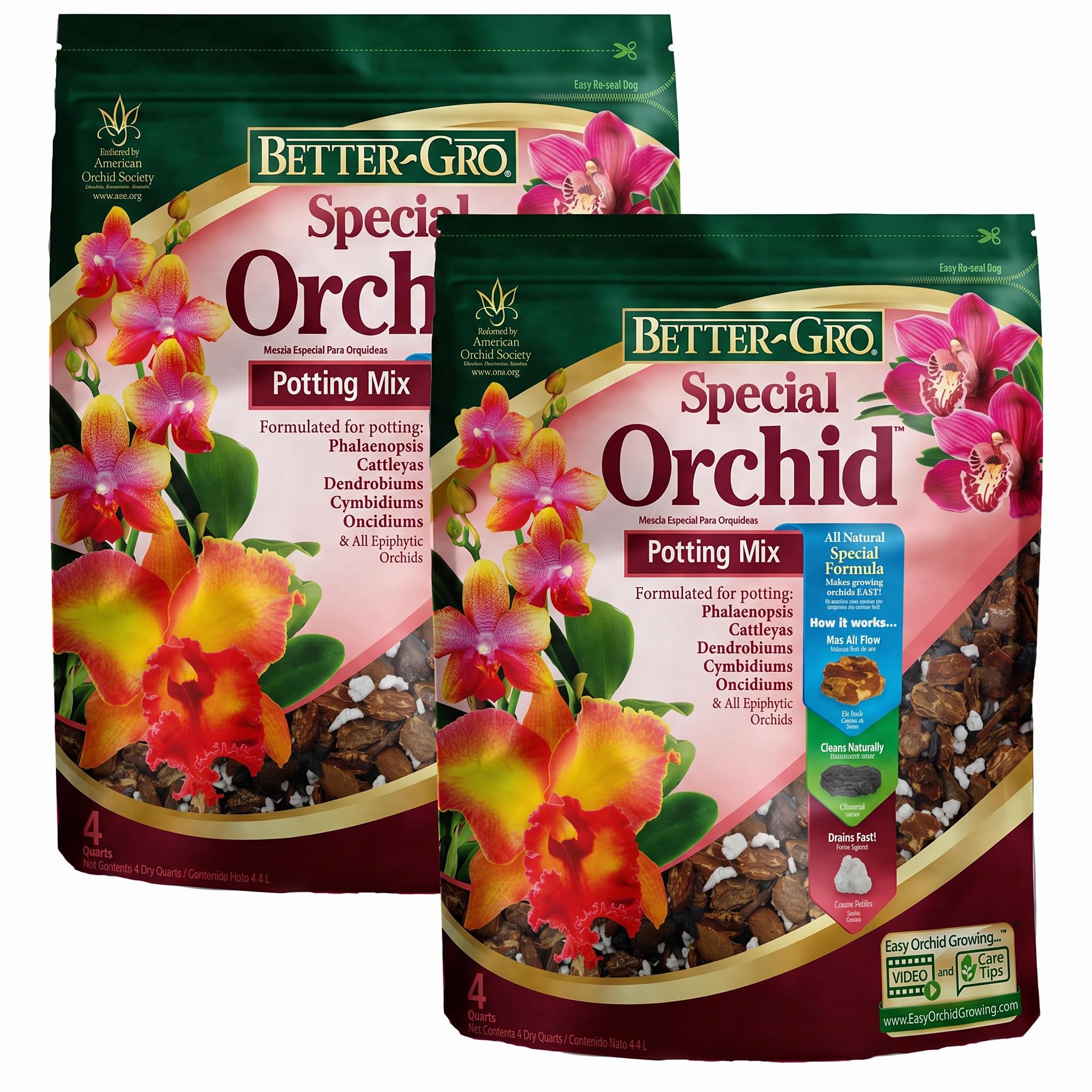
A bag of straight bark leaves you to work out the rest of the recipe. This mix arrives with the recipe already in it: western fir bark for structure, hardwood charcoal, sponge rock and coarse perlite to keep air pockets open between the pieces, all of it sized for epiphytic orchids rather than for a flower bed. For a first repot, that removes the part most people get wrong.

We compared it against the single-ingredient barks here, and the difference shows up at watering time. Chunky bark alone drains so fast that a phalaenopsis in a dry room is thirsty again two days later; the perlite and sponge rock hold a little water in the gaps without leaving roots sitting in it. That balance is what we want for ordinary houseplant orchids, and the pieces are coarse enough that the mix resists packing down into a solid block.

Particle size is where it divides. The bark in these bags runs large, and in a four-inch pot the biggest pieces leave roots hanging in air, so sort them out and save them for the base of a bigger container. Long woody strands turn up too, and scissors are quicker than fingers. Neither is a dealbreaker, but both add a few minutes to a repot.

Where the pot is six inches or bigger, or the orchid has thick roots and likes drying out between waterings, this is the bag we point people toward. Two resealable four-quart bags cover several repots, and the price sits at the low end of this group for a complete mix.

Bottom line: Our pick for most people: bark, charcoal and perlite already blended, fast-draining, and cheap for a complete mix, as long as your pot is big enough for chunky bark.

4

Miracle-Gro Orchid Potting Mix Coarse Blend

Miracle-Gro Orchid Potting Mix Coarse Blend

Large collections

Our Score 9.2/10
Check Price

Worth Noting

  • Coarse grade limits it to larger pots
Volume
24 quarts (3 bags)
Feeding
Feeds up to 6 months
Drainage
Fast-draining coarse blend
Orchid Types
Phalaenopsis, cattleya, epidendrum, dendrobium
Read the full review

Twenty-four quarts is the number that matters here: three eight-quart bags, each one enough for roughly two eight-inch containers. That is a quantity for someone repotting a whole windowsill in one afternoon, not for somebody with a single grocery-store phalaenopsis and a spare hour.

The blend itself is coarse and fast-draining, formulated for epiphytes that want to dry out between waterings, including phalaenopsis, cattleya, epidendrum and dendrobium, and it expects a container with a drain hole the way every orchid mix does. The detail worth planning around is the fertilizer: this mix feeds for up to six months, so a weekly feeding routine means you are doubling up. Hold your own fertilizer for the first few months and let the bag do that job.

We treat it as the volume option rather than the connoisseur's, and it behaves like one. Nothing in the bag is unusual, there is simply a great deal of it, and the feeding is handled for the first half year. Buy it when the job is a dozen pots and you want to open one bag and work straight through them.

Bottom line: We reach for this one when there is a whole windowsill to repot: 24 quarts of coarse, fast-draining mix with six months of fertilizer already built in.

5

Perfect Plants Orchid Potting Mix

Perfect Plants Orchid Potting Mix

A few orchids

Our Score 9.2/10
Check Price

Worth Noting

  • Bark runs large for small pots
  • Midrange price for eight quarts
Bag
Heavy-duty resealable
Blend
Pine bark, charcoal, sponge rock, coconut chips
Volume
8 quarts
Read the full review

The bag is the first thing you notice, a heavy-duty resealable one, which sounds like packaging trivia until you have poured half a sack of bark across a kitchen floor. Eight quarts is enough for a handful of orchids, and the zip top means the leftovers stay usable for the next repot instead of drying out in a bucket.

Inside it is pine bark with charcoal, sponge rock and coconut chips. The coconut is the interesting part, because it holds a little more moisture than bark alone, which suits phalaenopsis and anything else that sulks in dry indoor air, while the sponge rock and charcoal keep the mix from compacting into a dense, airless block. Roots get air, and they get a drink.

Our view is that this is the easiest bag here to live with for someone with a handful of plants and no interest in blending: open it, pot, reseal, done. Two things to weigh first. The bark runs large, so a small pot dries out faster than you expect. And you are paying for convenience rather than volume at this size. For five- and six-inch pots and a few plants at a time, both are a fair trade.

Bottom line: We like this bag for anyone with a few orchids and no interest in mixing their own: well blended, resealable, and best in pots that are not tiny.

6

Legigo Organic Orchid Bark

Legigo Organic Orchid Bark

Fine roots

Our Score 9.2/10
Check Price

Worth Noting

  • Two quarts does not go far
Bark
Pine bark
Volume
2 quarts
Particle Size
About 3/8 inch
Read the full review

Three-eighths of an inch is a real number on the listing, and it is the most useful thing about this bag. Most orchid bark here runs chunky; this is a fine grade, the size that suits seedlings, small phalaenopsis in two- and three-inch pots, and roots you are easing out of sphagnum.

It is pine bark, woody and nothing added, and it does what bark does: holds air, drains fast, and gives roots something to grip as they spread. Two quarts is the limitation. That is a small bag by any measure, and the price reflects the grade as much as the quantity.

Pine is softer than fir and breaks down sooner, which matters if you are the kind of grower who leaves a repot for three years at a stretch. In a small pot on a two-year cycle, you will not notice.

For us this is a specialist's bag rather than a first purchase. Buy it when you need a fine grade and nothing else in this group will do, whether that is seedlings, small pots or a chunky mix you want to soften, and not when you want one bag to cover every orchid on the shelf.

Bottom line: We keep this grade in mind for seedlings and small pots: 3/8-inch pine bark that will not go far in a two-quart bag, so buy it for the size rather than the volume.

7

CJGQ Organic Orchid Potting Bark

CJGQ Organic Orchid Potting Bark

Bulk custom blends

Our Score 9.2/10
Check Price

Worth Noting

  • Arrives dusty, with fines in the bag
Bark
Pine bark
Volume
9 quarts
Particle Size
About 1/2 to 1 inch
Read the full review

Nine quarts of bark in a thin plastic bag is a messy doorstep waiting to happen, and for some buyers it does: the bag splits, the bark ends up loose in the box, and a good quart of it is gone before you get it inside. Decant it into a bucket or a lidded bin as soon as it arrives and the problem never reaches your floor.

What is in the bag is decent: pine bark, chunky pieces running from about half an inch to an inch, with the airy structure orchid roots and aroid mixes both want. The size puts it in blending territory rather than straight-potting territory, since a one-inch chunk in a four-inch pot is mostly gap.

Nine quarts makes it the biggest bag of plain bark here, and that is the argument. If you mix your own substrate in volume, for orchids or for the chunky houseplant soil you keep rebuilding, one bag gets you through a season of repotting.

We treat it as a bulk ingredient rather than a finished orchid mix. If you are potting one phalaenopsis, this is far more bark than you need and far chunkier than it wants; if you are mixing for a shelf of aroids and orchids, it is the bag that keeps you stocked.

Bottom line: We keep this bag on the list for volume alone: nine quarts of chunky pine bark for custom blends, in packaging you should decant the moment it lands.

8

rePotme Phalaenopsis Dark Classic Mix

rePotme Phalaenopsis Dark Classic Mix

Dry indoor air

Our Score 9.0/10
Check Price

Worth Noting

  • Premium price for two quarts
Blend
Bark and orchid moss
Volume
2 quarts
Drainage
Engineered for fast drainage
Orchid Types
Phalaenopsis and similar
Read the full review

The most expensive mix here per quart, in the smallest bag, and we still think it earns a place, because the blend is doing something the others are not. This is bark with orchid moss worked through it, purpose-built for phalaenopsis and its close relatives: the Doritaenopsis, Doritis and Just Add Ice types that grow the same way.

The moss is the point. Moth orchids in a centrally heated house dry out faster than their roots like, and straight bark can leave them crispy between waterings; moss holds a reserve without turning the pot into a swamp, and the bark keeps enough air moving that roots are not sitting wet. It is a compromise mix, and for a phalaenopsis on a dry shelf it is the right compromise.

The catch is quantity. Two quarts fills a couple of small pots, so a shelf of orchids will eat through this bag in an afternoon. For one or two grocery-store orchids a year it is proportionate, and the bag is small enough to live in a drawer rather than on a garage shelf.

It is also the narrowest pick here, made for phalaenopsis and not the place to start if you want one bag for every orchid in the house. Cattleyas and other thick-rooted growers want the coarser, drier mixes further up this list.

Bottom line: The one we choose when a phalaenopsis keeps drying out between waterings: bark and moss together, in a bag sized for a couple of plants.

How We Tested the Best Orchid Potting Mixes

We started with every orchid mix we could find on garden-center shelves and from specialist growers, then cut the list to 15 by reading ingredient panels: how much actual bark, whether the blend was padded with peat or soil, and what range of piece sizes the label promised. We also figured cost per quart, since bags vary enormously in volume and a cheap bag that fills one pot isn't cheap.

Each mix went into the same setup — a six-inch clear pot, a plant of similar size, and the same east-facing windowsill — and where a mix came in more than one bark grade, we potted a phalaenopsis in one and a slipper orchid in the other. Repotting happened on a tarp on my kitchen floor across several Saturday mornings, and before anything went in a pot I sifted a cup of each mix through a colander: some threw up a visible cloud of dust and left a layer of fines behind, others were almost entirely clean bark. I measured the largest and smallest chunks, counted how many pots a single bag filled, and squeezed a wet handful to see which mixes matted together. Every pot got the same watering routine, and I lifted each one before and after to feel how much water it held and how many days passed before it dried out.

At four weeks and again at three months, I slid the plants out to check roots — firm and green-tipped versus brown and mushy — and watched for new root tips, new leaves, and the sour smell that means bark has broken down too far. Mixes that stayed soggy more than a week in a cool room got marked down no matter how good they looked in the bag. We're still growing these out and will update if anything shifts.

How to Choose the Right Orchid Potting Mix

Particle Size Sets Your Watering Schedule

Bark does the structural work in almost every orchid mix, and its size decides how often you end up at the sink. Half-inch to one-inch pieces leave big air gaps: water runs straight through, roots dry quickly, and the mix suits thick-rooted orchids in larger pots. Fine bark around three-eighths of an inch holds more moisture and suits seedlings and small pots, where one chunky piece leaves roots hanging in air.

The mistake we see most often is buying one grade for the whole collection. Match the grade to the pot, not to the brand, and expect to sort a few oversized chunks out of any bag that runs coarse.

Blended Mix or Straight Bark?

Straight bark is a raw ingredient; a blended mix is a finished recipe. If you are repotting your first orchid, buy the blend, because the charcoal, perlite, sponge rock or moss has already been proportioned for you and you can pot straight from the bag. If you keep several orchids with different needs, plain bark plus a tub of perlite lets you build a drier mix for a cattleya and a damper one for a phalaenopsis.

Read the ingredient list before you commit. A blend that advertises charcoal and perlite should show you a visible amount of both, not a dusting at the bottom of the bag.

Match the Mix to the Orchid

Phalaenopsis, the moth orchids sold everywhere, come from humid forest and prefer a mix that stays lightly damp, so bark with moss, coconut chips or a little peat suits them, especially in dry indoor air. Cattleyas, dendrobiums and vandas want to dry hard between waterings and do better in coarse bark with plenty of air moving through it.

If you keep a mixed shelf, buy the coarser bark and add moisture-holding material to the phalaenopsis pots. It is far easier to make a dry mix wetter than a soggy mix drier.

How Much to Buy

An eight-quart bag goes roughly into two eight-inch containers, so a windowsill of six orchids is realistically two or three bags. Buying larger saves money per quart, but only if you will use it: bark keeps well sealed and dry, and badly in a damp garage or shed.

Repotting every 12 to 18 months is the usual rhythm, so a bag that covers three years of repots is sensible. A bag that sits open next to a hose is not.

Watch for Fertilizer in the Bag

Some orchid mixes ship with fertilizer blended in, feeding for months after potting. That is convenient for a plant that has not been fed, and a trap for anyone with a weekly feeding routine, because you end up feeding twice.

If you buy a pre-fed mix, hold your own fertilizer for the first few months and let the bag run out first. If you prefer to control nutrition yourself, start with plain bark and feed on your own schedule.

Frequently Asked Questions

Final Verdict

If you want one bag that handles an ordinary houseplant orchid without fiddling, the Better-Gro Special Orchid Mix is what we tell people to buy: bark, charcoal and perlite already proportioned, fast drainage, and a price at the low end for a complete mix. Sort the biggest chunks out of small pots and it does everything a beginner asks of it.

If your collection runs to a dozen pots, the Miracle-Gro coarse blend covers the same ground in far more volume, with six months of feeding built in, and a dry-shelf phalaenopsis will be happier in the rePotme bark-and-moss mix despite the small bag.