Planters & Plant Supports

Best Nursery Pots of 2026

A nursery pot is the one piece of gear most of us never shop for — it arrives with the plant, does its job, and quietly fails a season later. The rim cracks when you squeeze it. The drainage holes clog with grit, or the base holds so much water that the roots sit in it. A good one fixes all three: it drains at a predictable rate, flexes instead of splitting, and is still in one piece when you dig it out of the garage in March.

Over the past four months, my team and I have potted up, bottom-watered, dropped, and stacked 16 of them, from 2-inch starter cells to gallon-size rounds. The lesson that surprised me most is that wall thickness matters more than any number on the listing — thin plastic flexes under the weight of wet soil and cracks at the rim within weeks. Size is the quiet trap, too: pots sold as a gallon rarely hold a gallon of mix. The ones below survived a full season of repotting; the rest went out with the recycling.

1

SwinDuck 4-Inch 28-Pack

Top Pick
SwinDuck 4-Inch 28-Pack

Small starter plants

Our Score 9.6/10
Check Price

Worth Noting

  • Only one 4-inch size
Drainage
Drainage hole
Pack Contents
28 pots with saucers
Soil Capacity
0.5 liters
Pot Dimensions
4"D x 4"W x 3.42"H
Read the full review

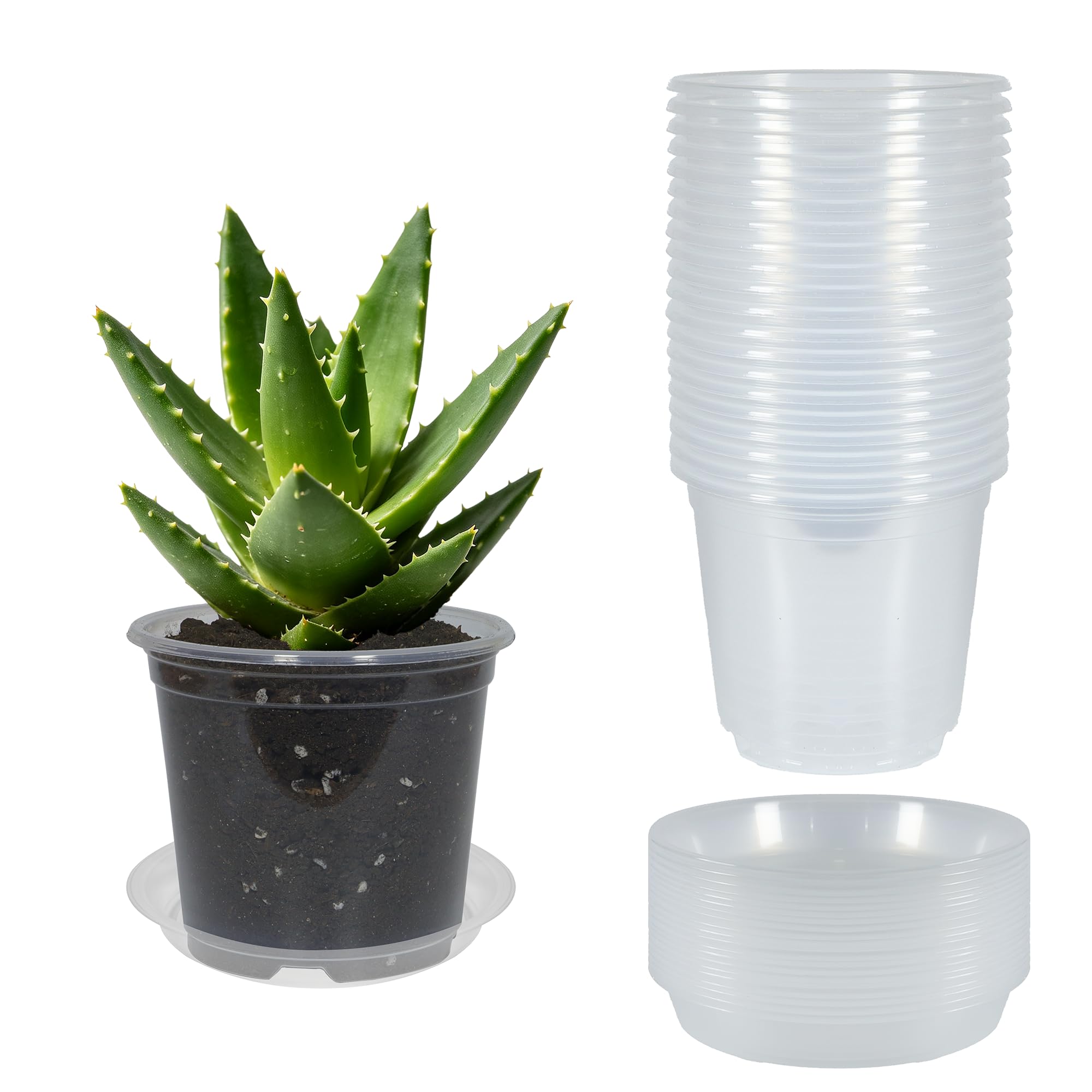
The SwinDuck set is the one we reach for first when a tray of seedlings needs a home. The 4-inch pots arrive with matching saucers, so each plant gets drainage and a place to catch the drip without a separate shopping list. That combination of size, drainage, and a saucer is why we recommend it as the default nursery pot for most gardeners.

The matte white PP feels more substantial than the thin black pots that often come in bulk packs. We noticed the walls hold their shape when we pick up a filled pot, and the saucers sit close enough to the base that a small watering does not run straight onto the shelf. The 0.5-liter capacity is right for a seedling or a small succulent, not for a plant that already has a gallon-sized root ball.

Drainage is the other reason this set works. The bottom holes let excess water out, and the saucers keep that water from spreading. We liked that the pots look tidy enough to sit on a windowsill without hiding inside a decorative pot, which is not something we can say for every nursery pot.

What we keep coming back to is the completeness of the set: pot, saucer, and a size that suits the plants most of us start indoors. The white finish is a small vanity, but it makes a tray of seedlings look intentional rather than improvised.

Bottom line: We recommend the SwinDuck set as the default for most gardeners: a sturdy 4-inch pot, a matching saucer, and enough pieces to fill a seed tray.

2

MIXC Clear 4-Inch 30-Pack

MIXC Clear 4-Inch 30-Pack

Easy transplanting

Our Score 9.6/10
Check Price

Worth Noting

  • Only one 4-inch size
Drainage
Bottom drainage holes
Pack Count
30 pots
Base Material
PP and silicone
Pot Dimensions
4"D x 4"W x 3.3"H
Read the full review

A silicone base sounds like a gimmick until you have to wrestle a root-bound seedling out of a rigid pot. The MIXC set puts a flexible green bottom on an otherwise clear 4-inch nursery pot, and that combination is the most useful transplanting feature in this group. We were skeptical at first; the base is soft enough to flex but firm once the pot is filled.

We think this is the pick for anyone who starts seeds indoors and wants to disturb roots as little as possible. The clear walls let you see when roots reach the edge, and the silicone bottom presses upward to loosen the root ball instead of making you squeeze the sides. That matters for tomatoes and peppers, which resent a torn root ball. The 30-pot count is enough for a serious tray without turning into a storage problem.

The pots feel sturdy in the hand, and the clear plastic is rigid enough to hold soil without flopping. We did not get saucers with this set, so plan on a tray or a saucer you already own. For propagation and vegetable seedlings, the base is the detail that earns it a place.

Bottom line: We choose the MIXC set when transplanting without root damage matters most; the silicone base makes it the easiest pot here to release.

3

TNTIWQ Clear 5-Inch 20-Pack

TNTIWQ Clear 5-Inch 20-Pack

5-inch starter pots

Our Score 9.6/10
Check Price

Worth Noting

  • Only one 5-inch size
Drainage
Drainage holes
Pot Size
5 Inch
Pot Color
Clear
Pack Contents
20 pots with saucers
Read the full review

Five inches is the size many seedlings need after a 4-inch pot but before a gallon container, and the TNTIWQ set stays in that middle ground. You get 20 clear pots, each with a matching saucer, so the set is ready for a windowsill or a light-filled shelf.

The clear walls make it easy to check moisture and root growth, and the drainage holes are sized for ordinary watering. The plastic feels sturdier than the thinnest clear pots in this group, and the saucers have enough of an edge to catch a normal drip. We like the 5-inch size for herbs and small houseplants; it is a practical in-between pot that does not take over a shelf.

We recommend this set for a small indoor herb garden or for anyone who wants a focused 5-inch pot. The 5-inch depth gives herbs a little more root room than a 4-inch pot without the bulk of a 6-inch one. It is a focused set rather than a bulk buy, but the included saucers and the tidy size make it a sensible package.

Bottom line: We recommend the TNTIWQ set for a tidy 5-inch pot with a saucer, especially for herbs and small houseplants that need a middle size.

4

FUIJOL Clear 4/5/6/7-Inch 20-Pack

FUIJOL Clear 4/5/6/7-Inch 20-Pack

Clear size variety

Our Score 9.4/10
Check Price

Worth Noting

Drainage
Drainage holes
Pot Color
Clear
Size Range
4+5+6+7 inch
Pack Contents
20 pots with saucers
Read the full review

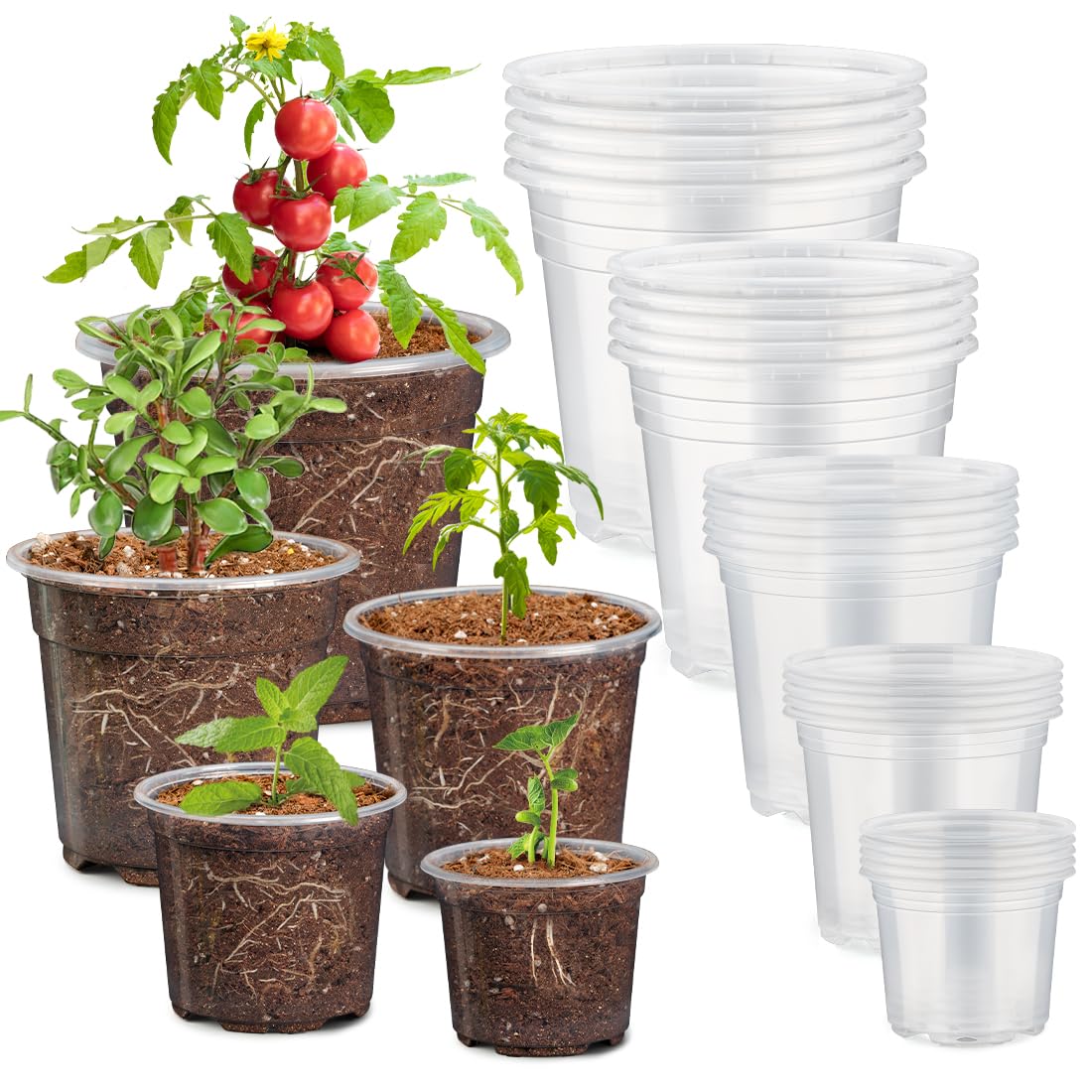
Clear nursery pots are less about style and more about information. The FUIJOL set gives you 20 clear pots in four sizes, each with a matching saucer, so you can watch roots and moisture without lifting the plant out. The largest pots are big enough for a small houseplant, while the smallest suit cuttings and herbs.

The size spread is the useful part: 4-inch pots for cuttings and small herbs, 5- and 6-inch pots for the next step, and 7-inch pots for a plant that needs more room. The saucers are a real convenience indoors, and the clear walls make it obvious when a pot is dry or when roots are circling. We found the clear plastic a genuine aid during propagation, not just a novelty.

We recommend this set for growers who want to monitor roots and step plants up without buying several separate packs. The trade-off is the clear plastic itself: it can crack when you pull apart a tight stack, so separate the pots gently before filling them. If you need pots that disappear into a decorative planter, an opaque set is the simpler choice.

Bottom line: We recommend the FUIJOL set for anyone who wants to see roots and moisture while moving plants through four sizes, with saucers included.

5

VIVOSUN 6-Inch 50-Pack

VIVOSUN 6-Inch 50-Pack

Larger starts

Our Score 9.4/10
Check Price

Worth Noting

  • No saucers included
  • Only one 6-inch size
Drainage
Nine bottom holes
Material
PP+PE plastic
Pack Count
50 pots
Pot Dimensions
4.1"D x 6"W x 5.3"H
Read the full review

Once a seedling has filled a 4-inch pot, the next move is usually a 6-inch pot, and the VIVOSUN 50-pack is built for that stage. We like the generous 6-inch width, the 5.3-inch height that holds a useful amount of soil, and the nine drainage holes that keep a heavy watering from turning the bottom into a swamp.

The red color is not decorative in a subtle way, but it is easy to spot in a crowded greenhouse or on a bench. The pots flex enough to release a root ball, though they are not as soft as a fabric bag. For tomatoes, peppers, and other plants that need more root room before going into the garden, this is the up-potting set we prefer in this group. It is a single-purpose set, and that is fine: when you need a bench full of roomy pots, the narrow focus is the advantage. They also rinse and stack easily at the end of the season.

Bottom line: We recommend the VIVOSUN 50-pack when seedlings have outgrown starter cells and need a roomier 6-inch pot before garden planting.

6

RooTrimmer Clear 3-7-Inch 30-Pack

RooTrimmer Clear 3-7-Inch 30-Pack

Widest size range

Our Score 9.4/10
Check Price

Worth Noting

  • Only six pots per size
Drainage
Drainage holes
Pot Color
Clear
Pack Count
30 pots
Size Range
3/4/5/6/7 inch
Read the full review

The RooTrimmer set covers the widest spread of sizes here: six pots each in 3, 4, 5, 6, and 7 inches. That is a different proposition from a 30-pack of one size, because it lets you follow a plant from a cutting to a 7-inch up-pot without ordering again.

The 3-inch pots suit small cuttings and succulents, while the 7-inch pots have room for a plant that is ready to leave the propagation shelf. The clear walls are useful at every stage: you can see roots reaching the edge and judge when the next size up is due. The drainage holes are sized for ordinary watering, and the plastic flexes enough to release a root ball without a fight.

We found the pots stack neatly for storage, which matters when a single order includes five sizes. The clear plastic is not the thickest in this group, so a tight nested stack needs a gentle hand. The reward is a set that covers more repotting steps than any other here.

We recommend this set for gardeners who want one order to cover a whole season of repotting. The range is the reason to choose it, and the clear walls make the progression easy to follow.

Bottom line: We recommend the RooTrimmer set when you want one order to cover cuttings through a 7-inch up-pot, with clear walls at every size.

7

Bluepro Clear 3.5/4/5-Inch 36-Pack

Bluepro Clear 3.5/4/5-Inch 36-Pack

Budget seedlings

Our Score 9.0/10
Check Price

Worth Noting

  • No saucers included
Drainage
Multiple base openings
Pot Color
Clear
Pack Count
36 pots
Size Range
3.5/4/5 Inch
Read the full review

The Bluepro pack is the lower-cost route into clear nursery pots: 36 pots split evenly across 3.5, 4, and 5 inches. The clear HDPE walls let you see roots and moisture, and the multiple base openings provide drainage without any extra hardware. The pots are light enough to carry a full tray without feeling clumsy, and the 5-inch size gives a seedling room to stretch before a bigger move.

We think this is the right first set for a new seed starter who wants three useful sizes without committing to a premium pot. The plastic flexes to help release a root ball, and the size steps are sensible for seedlings moving up. We noticed the walls are on the thin side, so these are pots to handle with a little care rather than stack under a heavy tray. For a first season, the breadth matters more than the finish.

Bottom line: We recommend the Bluepro 36-pack for a first seed-starting season when you want three clear sizes and a low-cost entry point.

8

OJYUDD Square 3-Inch 24-Pack

OJYUDD Square 3-Inch 24-Pack

Tiny succulents

Our Score 9.0/10
Check Price

Worth Noting

Drainage
Drainage holes
Pot Shape
Square
Pack Contents
24 pots with saucers
Pot Dimensions
2.8"D x 2.8"W x 3.03"H
Read the full review

A 2.8-inch square pot is a niche within a niche, but that is exactly why the OJYUDD set earns a place. The 24 pots are small enough for individual succulent pups, basil seedlings, or a classroom project, and the square footprint packs more plants onto a windowsill than round pots of the same width.

Each pot has drainage holes and comes with a matching saucer. The black plastic is plain but tidy, and the square shape keeps the pots from rolling when you move a tray. We found the small size useful for starting slow-growing herbs and for separating offsets without giving each one a full 4-inch pot.

The saucers are very small and shallow, so they catch a splash rather than a soak. That is fine for a light watering, but a heavy pour will overflow; water over a sink or empty the tray after a few minutes. The pots themselves are sturdier than their size suggests, with enough weight to stay put on a sill.

What we like most is the square shape: it turns a tiny pot into a tidy little block that sits flush against its neighbor, and the matching tray keeps the set looking deliberate. That is a small pleasure, but it is why these stay on the sill rather than in the shed.

Bottom line: We recommend the OJYUDD set for tiny succulents and windowsill seedlings where a square, saucer-backed pot saves space.

How We Chose and Tested These Nursery Pots

I started by pulling together roughly 40 pots, multi-packs and singles alike, and comparing what the listings actually promised: wall thickness, hole count and where those holes sat, top diameter, depth, and price per pot. Anything with fewer than four drainage holes, a base that rocked on a flat surface, or a rim thinner than a nickel got cut before it ever reached a potting bench.

That left 16 pots, from 2-inch starter cells to gallon rounds, which we used for four months across a sunny windowsill, a shaded porch, and a shelf under grow lights. I measured wall thickness with calipers at the rim and halfway down, and noted which ones bowed when I squeezed them. Each pot was filled with water on the bench and timed, so I could see how fast it drained and how much pooled in the bottom; then I weighed it empty and full to find out how much mix it genuinely took. The pots labeled a gallon ranged from just under to well over, which is the kind of thing that throws off a whole repotting afternoon.

Durability got its own round of abuse. Pots sat in direct sun all summer, were stacked and unstacked, dropped from waist height onto concrete, and squeezed hard to release root balls. I also potted a rootbound pothos, a fern, a tomato start, and a succulent in each style to judge how well the size and drainage suited plants with different root habits. The ones that came through without split rims, clogged holes, or a price that felt silly per pot are the ones below.

How to Choose Nursery Pots

Start with the next pot size, not the final one

A 3.5- to 4-inch pot is the usual first home for seedlings and cuttings; a 5- or 6-inch pot is the next step, and a 1-gallon container is for a plant that already has a substantial root ball. Buying a range, like the RooTrimmer set's 3- to 7-inch spread, saves a second order when plants size up. Check the actual opening and height rather than trusting a gallon label: a pot can be sold as a trade gallon and still hold less than a full gallon.

Wall thickness is a handling question

Thick walls help a pot hold its shape when you pick it up full of wet soil, and they make reuse more likely. Thin pots flex, which can help release a root ball, but they also crack when nested pots are pulled apart or when a heavy pot is moved by the rim. Clear plastic is particularly variable; the FUIJOL set shows roots well, but separate the stack gently. If you plan to reuse pots for several seasons, pay for sturdier walls rather than the largest count.

Drainage and saucers belong together indoors

Every pot here has drainage holes, but holes only work if the water has somewhere to go. A matching saucer keeps shelves and windowsills dry; a shallow saucer catches a splash, not a soaking, so empty it after watering. For a full tray, a boot tray or gravel tray is more practical than dozens of individual saucers. Outdoors, drainage matters just as much, but a saucer can hold water and breed mosquitoes if it stays full.

Clear pots buy information, not better growth

Clear walls let you see roots reaching the edge and judge soil moisture without lifting the plant. That is genuinely useful for propagation and for plants that resent disturbance. The trade-off is that clear plastic can look less tidy, and wet, fertilized soil exposed to light can grow algae on the inside. If that bothers you, slip the clear pot into an opaque cachepot and empty the outer pot after watering.

Buy enough to finish the season

Pack count is where a bargain can turn into clutter. A 30- to 36-pot set suits a serious seed-starting tray; a 50-pot set makes sense for up-potting a vegetable patch. If you need only a handful of 4-inch pots, a range pack with six of each size may leave you short of the size you use most. Reusable pots earn their storage space, so favor thicker walls over a bigger pile of thin ones.

Frequently Asked Questions

Final Verdict

For most gardeners, the SwinDuck 28-pack is the one to start with. The 4-inch size fits seedlings and small houseplants, the matching saucers keep shelves dry, and the walls feel sturdy enough to reuse. It is the set we recommend when you want one straightforward order that covers a full tray.

If transplanting is the part you dread, choose the MIXC set; its silicone base is the most useful difference in this group. If you are filling a first seed-starting tray on a tight budget, the Bluepro 36-pack gives you three clear sizes for less commitment. Match the pot to your next transplant, not the biggest count in the listing.