Pest & Weed Control

Best Mosquito Traps of 2026

Every mosquito trap is selling the same illusion: a machine that breathes and glows like a warm-blooded animal, luring egg-laying females away from your ankles and into a basket. What separates a good one from a bad one isn't the voltage or the light — it's whether it catches mosquitoes instead of moths, whether you can empty it without gagging, and whether it's quiet enough to sit beside while you eat. A trap that manages all three buys back the hour after sunset, when the patio finally cools off and everyone else has retreated inside.

I've spent six months with a dozen of them, from plug-in zappers to propane units that run all night, and one pattern held: placement beat price every time. Set twenty feet from where people sit, upwind of the shade, near whatever standing water you've been ignoring, and even a mid-priced trap fills its basket. Set it beside your chair and the best model here is just a nightlight with a fan. The picks below are the ones that kept catching — and the ones I didn't dread cleaning.

1

AMUFER Bug Zapper

Top Pick
AMUFER Bug Zapper

Open yards

Our Score 9.0/10
Check Price

Worth Noting

  • No on/off switch; unplugging is the only way
Warranty
2 years
Power Cord
5.5 ft
Grid Voltage
4400V
Stated Coverage
1/2 acre
Read the full review

Half an acre is the coverage AMUFER claims for this zapper, and that figure is really a statement about reach: 18 watts of blue-violet light behind a 4400-volt grid, throwing a glow across a yard rather than a porch. It is the pairing we like most in this set, because the bulb decides how many insects find the thing and the grid decides what happens when they do. That is why it is the pick for a backyard where the bites happen at dusk.

The 5.5-foot cord is the longest among the outdoor zappers here, which matters more than it sounds. A zapper belongs at the edge of the space, well away from the chairs, and that is almost never where the outlet is. At 2.2 pounds it hangs from a single hook or a nail without sagging, so a fence post or an eave works as well as a table.

Most of the time it makes no sound at all, and the kill is a short snap rather than the long crack a bigger grid produces. The blue-violet glow is visible from the house, which is fine on a patio and less welcome on a balcony outside a bedroom window. Nothing about the housing feels flimsy, though the plastic is the same grade as everything else at this price.

Two years of cover is the longest warranty in this group, and it is the number we care about most. Outdoor zappers are seasonal hardware: the bulb is a wear item and the electronics sit through heat, humidity and rain. A long warranty does not stop that happening, but it does mean the first failure is not the end of the purchase, and that is worth more here than another hundred volts.

Bottom line: We recommend it as the default outdoor zapper: the widest stated coverage here, the longest cord in the group, and a warranty that outlasts most of these units.

2

Jawlark Bug Zapper

Jawlark Bug Zapper

Small patios

Our Score 8.8/10
Check Price

Worth Noting

  • Loud crack for a unit this size
  • Can stay lit after the grid stops firing
UV Bulb
18W
Power Cord
5 ft
Grid Voltage
4200V
Water Resistance
IP44
Read the full review

At roughly six inches on each side, this is the smallest zapper in the roundup, and the one that fits where the others do not: under a porch railing, on a balcony shelf, off a single hook beside the door. IP44 means it handles splashes and a bit of spray, but it is a covered-outdoor unit rather than something to leave out under open sky.

The 18-watt bulb and 4200-volt grid are the same basic recipe as the rest of the class; what differs is the handling. The tray pulls out from the bottom for emptying and there is a small brush in the box for the grid. Hang it at the edge of the space and a few feet off the floor, and keep it away from the chairs, because the light is what does the attracting and anything close to it takes a share of the traffic.

Zaps are loud for the size of the unit, a sharp crack that carries across a deck, so a night of it beside a window is noticeable. The other thing worth knowing is how a zapper fails: the light can stay lit while the grid stops firing, which keeps pulling insects in and lets them leave. If the snaps stop but the glow does not, the unit is finished.

None of that undoes what this one is for. It is the least expensive of the outdoor zappers here, the easiest to hang in a tight space, and it does the same core job as units a third larger. If your mosquito problem is a terrace rather than a yard, this is where our money goes; move up to the AMUFER when you need reach and a longer warranty.

Bottom line: We keep this one for small patios and balconies: it hangs almost anywhere, shrugs off splashes, and costs the least of the outdoor zappers here.

3

ASPECTEK 20W Bug Zapper

ASPECTEK 20W Bug Zapper

Garages

Our Score 8.8/10
Check Price

Worth Noting

  • Loud crack and insect debris underneath
  • Rated for covered outdoor use only
Housing
Aluminum
Mounting
Hanging chain
UV Bulbs
Dual 20W
Grid Design
360° open
Read the full review

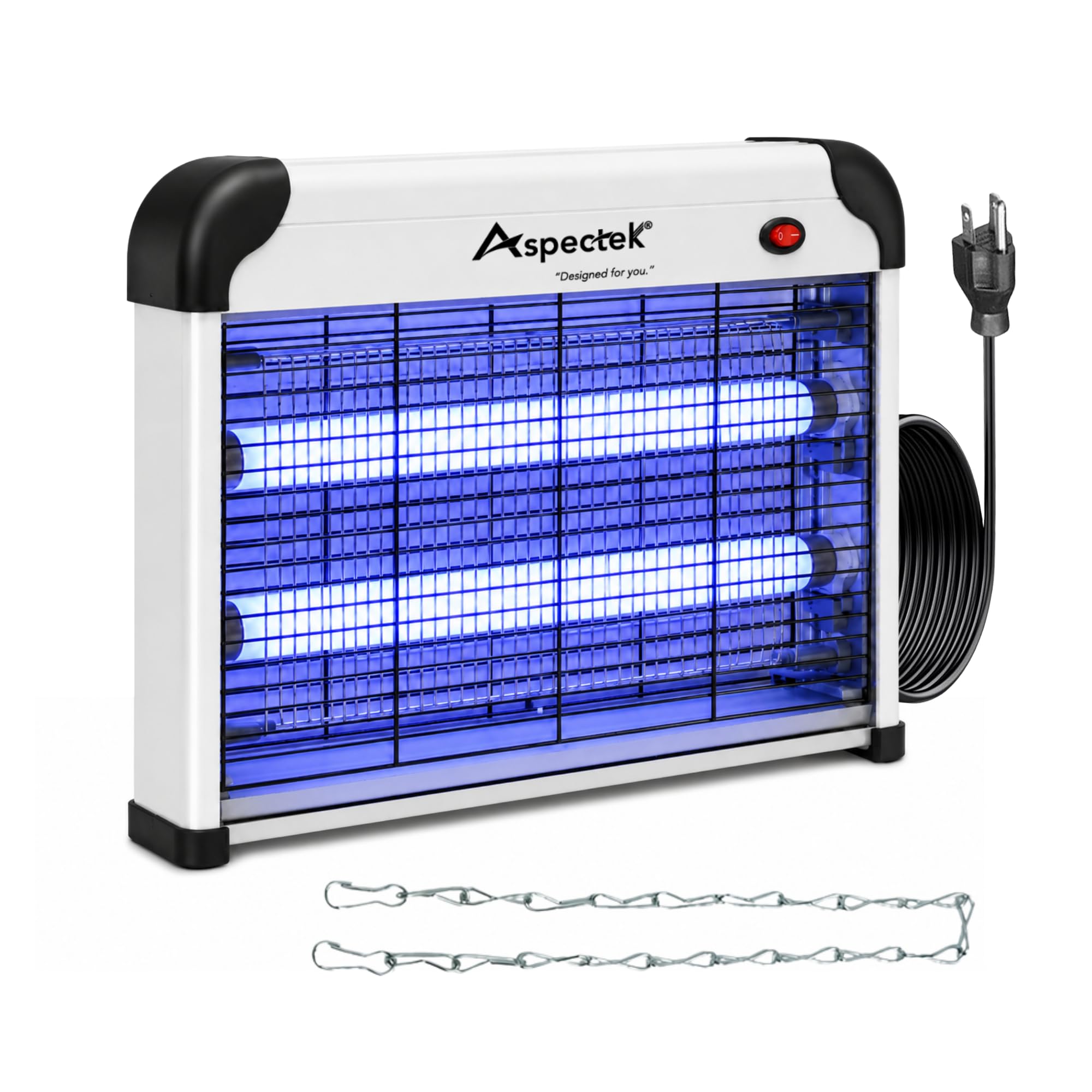
A 20-watt grid is not a subtle machine. It cracks when something large hits it, and it does not always leave the insect in one piece: the tray catches most of it and the rest lands on the floor beneath. We think that is a fair trade in a garage, where the whole point is a ruthless, indifferent killer, and a poor fit for a patio table you eat at.

The two 20W bulbs and the open 360-degree design are why it covers ground. There is no housing blocking the light, so insects come at it from every side. The aluminum body and hanging chain suit a garage wall or a porch beam, and it will sit on a flat surface too. ASPECTEK rates it for indoor and covered outdoor use, so an eave over a deck is fine and open sky is not. Bulbs are the wear item here; when one goes, the catch drops off before the light does.

We point buyers here for garages, basements and screened porches, spaces where a zap now and then is background noise and the insect count is genuinely high. For a patio you sit on, the AMUFER is the better-mannered machine: a quieter kill, less debris under it, and a cord that actually reaches.

Bottom line: For a garage or a screened porch we pick the ASPECTEK: two 20W bulbs and an open 360-degree grid do the work of a much bigger unit.

4

Klahaite Bug Zapper

Klahaite Bug Zapper

Decks

Our Score 8.8/10
Check Price

Worth Noting

  • Shortest cord of the outdoor picks
Housing
Fire-retardant ABS
Power Cord
4.6 ft
Grid Voltage
4200V
Stated Coverage
1/2 acre
Read the full review

Klahaite calls the 4.6-foot cord extended, and against the other outdoor zappers here it is actually the shortest — the AMUFER runs five and a half feet and the Jawlark five. That is not disqualifying, but it decides the job: this is a deck or porch unit that lives near an outlet, not a fence-post unit at the far end of the yard.

The rest of the specification is competitive: a 4200-volt grid, a half-acre coverage claim, and a housing in flame-retardant ABS, which is a sensible material for something that sits outside through a summer. It runs on the quiet side for a grid this size, more zap-pop than crack, and the bottom tray twists off for emptying. The bulb is the part that goes, and it tends to go early rather than late.

We like it as a second outdoor option, particularly under a wooden roof where the short cord is not a problem and the flame-retardant housing is genuinely reassuring. Given how often zapper bulbs quit, though, the AMUFER's extra reach and longer warranty are worth the small step up.

Bottom line: We like it on a covered deck where its short cord still reaches: a quiet 4200V grid in a flame-retardant housing.

5

LFSYS Fruit Fly Trap

LFSYS Fruit Fly Trap

Whole-home indoor

Our Score 8.6/10
Check Price

Worth Noting

  • Boards lose tack before they fill
Boards
Double-sided, transparent
Trap Type
Plug-in glue
In The Box
2 devices, 10 refills
Wavelengths
365nm and 396nm
Read the full review

Two plug-in units and ten adhesive refills arrive in one box, and that changes the arithmetic: one goes in the kitchen and one in the bathroom where the gnats actually are, and there are still spare boards when the first fills. The cards are transparent and sticky on both faces, so the catch shows from either side, and each unit is small enough to disappear behind a coffee machine or a plant pot.

We rate it as the practical indoor choice for a flat rather than a single room. The paired wavelengths do pull gnats and small flies, the traps are quiet and odorless, and there is nothing to spray. The boards do lose their tack before they are full, so change them on a calendar rather than on how full they look — and run them overnight in a dark room, because competing light is the fastest way to waste a card.

Bottom line: Two traps and ten refills make this our pick for a house with gnat trouble in more than one room, not just beside the bin.

6

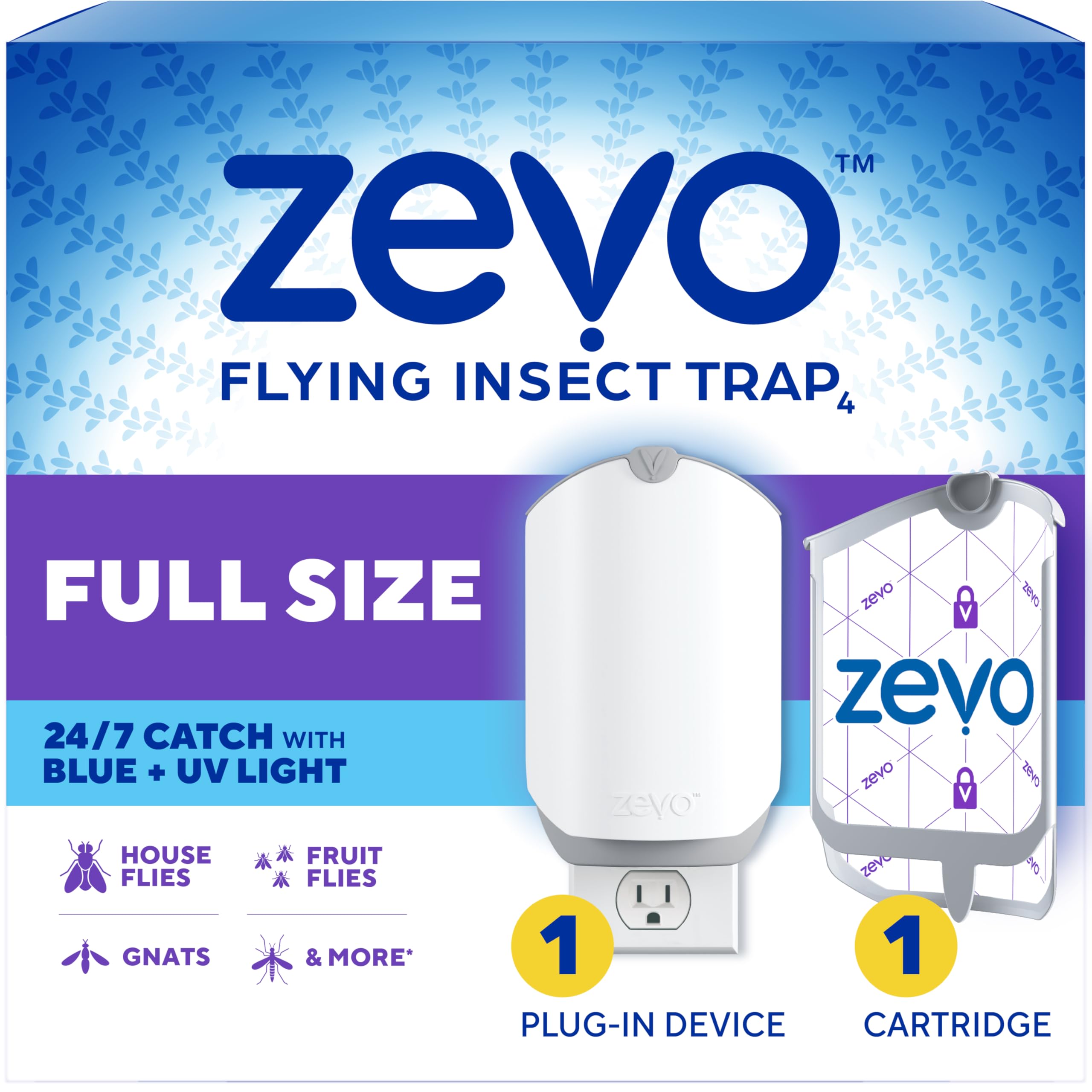
Zevo Flying Insect Trap

Zevo Flying Insect Trap

Kitchens

Our Score 8.4/10
Check Price

Worth Noting

  • Refill cartridges are an ongoing purchase
Light
Blue and UV
Trap Type
Plug-in glue
In The Box
1 base, 1 cartridge
Cartridge Life
6 weeks
Read the full review

If the mosquitoes are out in the yard and the flies are in the kitchen, this is the trap for the kitchen. It is the indoor pick we trust most for fruit flies and gnats, and it earns that on temperament as much as on catch: it is silent, it does not smell, and it does not throw anything across the counter.

The mechanism is a blue and UV light over a glue cartridge, and the design detail we appreciate is that the adhesive faces the wall. You see a soft blue glow; the catch sits on the back of the pad, out of sight. Zevo's advice to place it near the source — the fruit bowl, the bin, the potted plants — is the difference between a trap that fills and one that glows at nothing.

What it will not do is clear a mosquito problem, and the light is bright enough to be a nuisance in a bedroom, so treat it as a kitchen-counter and plant-shelf tool. The unit blinks when the cartridge is spent, which saves you the guesswork of peering at a pad that may or may not be full.

Bottom line: This is our indoor default for small flies: silent, tidy, and honest about catching gnats and fruit flies rather than yard mosquitoes.

7

Safer Home Flying Insect Trap

Safer Home Flying Insect Trap

Budget indoor

Our Score 8.4/10
Check Price

Worth Noting

  • Unreliable on larger house flies
Plug
Rotating
Trap Type
Plug-in glue
In The Box
1 trap, 2 glue cards
Stated Coverage
400 sq ft
Read the full review

This is the least expensive way into a plug-in trap here, and it is what we suggest to anyone who is not sure a glue trap belongs in their kitchen. One unit and two cards come in the box, which is enough to run the experiment.

The rotating plug is the detail that makes it usable: horizontal outlets, vertical outlets, the awkward spot behind a sofa, it fits them all. Safer rates it for 400 square feet, and the blue LED is bright enough that people leave it as a night light, which is either a bonus or the reason it does not go in a bedroom. On larger house flies it is unreliable, and that is the honest scope — gnats and fruit flies are what it catches.

Our advice is to buy it as a trial rather than a permanent answer. If the card fills in a week, the source is in that room and a two-unit kit like the LFSYS makes more sense; if it stays empty, the flies are breeding somewhere you have not looked. Either answer is worth having.

Bottom line: We suggest this as the cheapest way to find out whether a plug-in trap suits your kitchen before spending more on a multi-room kit.

How We Tested the Best Mosquito Traps

We started with a shortlist of roughly 30 models sold for residential yards and narrowed it by coverage rating, power source, and attractant — UV light alone, UV plus CO2, or a chemical lure — then cut anything whose seasonal refills cost more than the trap itself. That left 12 traps, which we ran from May through October across backyards, a screened porch, and one garden with a stubborn drainage problem. Each trap ran overnight, starting about an hour before dusk, in a rotation so that weather wasn't quietly doing the work for one model and not another.

Every morning I emptied the catch basket onto a white paper towel and sorted it — mosquitoes, moths, flies, anything with stripes — because a trap that kills a thousand insects you never cared about isn't doing you a favor. In the evenings I sat outside for half an hour and counted landings on my arms, then compared those numbers against a trap-free night in the same spot.

Setup was timed from box to running, assembly, batteries, propane and all. I stood three feet away with a decibel meter, and I also sat through dinner beside each trap to hear whether a zap could cut a conversation in half. With the yard lights off, I judged how far the lamp's glow spilled across the patio. Cleaning meant emptying and washing each unit weekly, which surfaced the narrow necks, loose lids, and filters tucked out of reach. Everything stayed outdoors through rain and wind, and we tallied what each trap cost in refills over a full season.

How to Choose Mosquito Traps

Match the trap to the insect and the room

Outdoor zappers pull insects toward UV light and kill them on a charged grid, and they earn their keep on a deck, patio or yard where the bites happen at dusk. Indoor plug-in traps use the same light over an adhesive card, and they are built for fruit flies, gnats and small flies around sinks, bins and houseplants.

Buy for the insects you actually see. A zapper on the kitchen counter kills moths and the odd housefly and does almost nothing about a gnat cloud over the fruit bowl — and a glue card on the patio will not clear a yard.

Placement decides more than wattage

UV light attracts, so a zapper beside the chairs is a delivery service. Hang it at the edge of the space, ten to twenty feet from where people sit, and switch it on a couple of hours before you go out so the numbers are down by the time you are there.

Indoors, put the trap at the source rather than in the middle of the room, and run it in the dark. A lamp, a television or a bright window will beat a plug-in trap every time, which is the single most common reason people conclude theirs does not work.

What volts, watts and acreage actually mean

The bulbs here run 15 to 20 watts. More wattage means a brighter, wider throw, which is why the 20-watt dual-bulb unit suits a garage and the compact 18-watt models suit a balcony. Grid voltage, 4200 to 4400 in this group, decides how decisively an insect is killed and how loud the snap is.

Acreage figures are best-case numbers measured in open ground. A hedge, a wall, a bright porch light or a breeze all cut them down, so treat half an acre as a description of the glow rather than a promise about your yard.

Cord, switch and housing

Most zappers here have no on-off switch — you unplug them — so an outdoor timer is a cheap addition that saves the cord and the bulb. Cords run from 4.6 to 5.5 feet, and that is the measurement to check against your outlet before ordering, along with how it mounts: a chain, a loop, or simply flat on a surface.

IP44 and IPX4 mean splash-resistant, not waterproof. If a unit is rated for indoor and covered outdoor use, keep it under an eave or a roof; an exposed fence post in open rain is a different product.

Running costs and how long they last

Adhesive traps are the silent option and they are a subscription: cards need changing every few weeks, and the refill is part of the price. Zappers have a bulb that wears out and electronics that sit through heat, humidity and rain, so a season or two is a realistic expectation — which makes a two-year warranty more useful than another hundred volts.

Whatever you buy, empty the tray weekly and wipe the grid when you do. A packed tray cuts the catch, and a dirty grid turns a clean kill into a firework.

Frequently Asked Questions

Final Verdict

AMUFER's zapper earns the default spot because it brings together the widest stated coverage here, the longest cord and the longest warranty — the two practical things that decide whether an outdoor zapper survives its first summer in the place you actually need it. Hang it at the edge of the yard, put it on a timer, and it handles the rest.

If your outdoor space is a small terrace rather than a yard, the Jawlark is the smaller, lighter, less expensive machine. If the insects are inside around the fruit bowl, skip the grid and plug in the Zevo or the LFSYS kit.