Pest & Weed Control

Best Japanese Beetle Traps of 2026

Every July, the roses I fuss over all spring turn to lace overnight. A Japanese beetle trap works on a simple premise: a floral lure pulls beetles in, baffles knock them down a funnel, and a bag underneath holds them until you tie it off. The catch is that the lure doesn't read property lines — set one in the wrong spot and you're catching beetles from three yards over, along with whatever bees wander in.

I spent a full season with 14 of them, June through August, and the differences came down to how fast the bag filled, whether beetles could crawl back out of the funnel, and whether the plastic survived a thunderstorm. What nobody tells a first-time buyer: placement matters more than the trap. Hang it downwind and away from the plants you're protecting, and empty the bag before it gets heavy — a full bag baking in the sun starts to smell and splits at the seams. The picks below are the ones that held.

1

Bonide Beetle Bagger Trap Kit

Top Pick
Bonide Beetle Bagger Trap Kit

Small yards

Our Score 8.8/10
Check Price

Worth Noting

  • Only two collection bags in the kit
Lure
Dual floral/pheromone
Coverage
Over 5,000 sq ft
Bags Included
2
Traps Included
1
Read the full review

The box holds one trap, one dual lure and two hourglass bags — everything needed to hang it the same afternoon. The bag is the part we keep looking at: it narrows to a waist below the funnel, so a beetle that drops in can't work its way back up to the opening. That small piece of shaping decides whether you are collecting beetles or feeding them.

That is why this is the trap we point a first-time buyer toward, and the reason is almost boring: there is nothing else to order. The lure pairs a floral food attractant with a pheromone, which is the fuller of the two common designs, and one trap is rated to protect 5,000 square feet — a normal lot. It also has the most consistently positive catching record of anything in this group, and assembly gives you very little to get wrong.

Two bags is the sting. In a heavy year a bag can load up faster than you expect, and replacements are sold separately, so add a pack to the same order rather than hunting for them in July with a full bag hanging in the tree. The frame itself carries over: fresh lure, fresh bags, same trap next spring.

Bottom line: For most yards this is the trap we recommend: one complete kit, a two-part lure and an hourglass bag that holds what it catches.
2

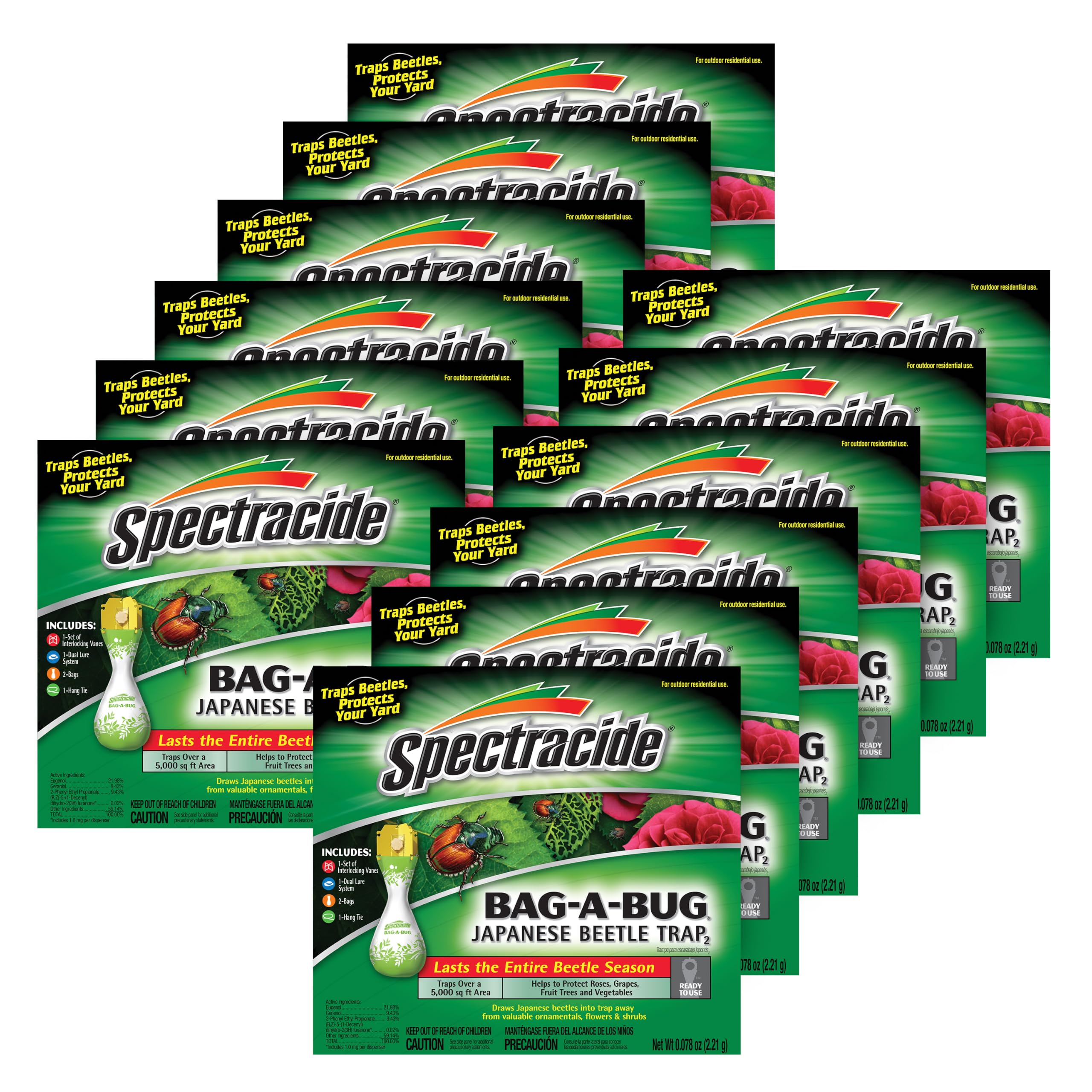
Spectracide Bag-A-Bug Trap

Spectracide Bag-A-Bug Trap

Large yards

Our Score 8.8/10
Check Price

Worth Noting

  • More traps than a small garden needs
Lure
Dual lure system
Pack Size
12-count
Replacement Bait
Sold separately
Read the full review

Most of the traps here arrive as one unit or a pair. This one arrives as a case, and that changes the strategy more than it changes the trap: instead of one lure trying to cover a whole yard, you can hang several around the perimeter and let them share the work. On a large lot, or in a summer when beetles are everywhere at once, that spread matters more than the small differences between one trap design and another.

The trap itself is a bag trap with a dual lure, doing what the others do — scent in, vanes, bag below. What stands out is the pace. In a bad year a bag fills fast, which is the whole point and also the chore, so decide where you will empty it before you hang a case of anything. Placement deserves more thought than the hardware, because a lure this attractive pulls beetles from well beyond the fence, and hanging it beside the roses is the same as inviting them in.

Our reservation is scale in the other direction. One rose bed and a scattering of beetles does not need a case of traps, and every extra trap is another bag to empty and another lure to keep fresh. If you have a half acre of lawn, a hedge line and a few fruit trees, though, this is the sensible way to buy — just price the replacement bait before you commit to a case's worth of upkeep.

Bottom line: When beetles are hitting the whole property and not just one bed, a case of dual-lure traps is the practical buy.

3

RESCUE! Japanese Beetle Trap 2-Pack

RESCUE! Japanese Beetle Trap 2-Pack

Frequent emptying

Our Score 8.6/10
Check Price

Worth Noting

  • Hanger and bag can fail within a season
Bag
Reusable, easy-lock bottom
Lure
Pheromone cartridge, full season
Placement
At least 30 ft from ornamentals
Traps Included
2
Read the full review

Every bag trap ends the same way: the bag is full, heavy and smells like something died, and you still have to get the beetles out of it. RESCUE's answer is a bag that opens along the bottom with an easy-lock closure — undo it over a bucket or a hole, tip, close, hang it back up. Of everything in this group, that is the design detail most likely to keep a trap actually working, because a trap you dread emptying is a trap that sits full.

The rest is conventional and well executed. A pheromone cartridge clips into the frame, beetles hit the green panels and drop into the bag below, and the cartridge is sold as a full-season lure, so your repeat purchase is one cartridge a year rather than a steady supply of bags. It is rated for Oriental beetles as well as Japanese ones, which is useful if the damage on your plants doesn't quite match the field guide photo — the two often feed side by side. The listing asks for at least 30 feet of distance from ornamentals, and that number does most of the work.

The pair in the box covers a typical yard: one for the worst-hit side, one for the far corner. Where it gives ground to our top pick is simplicity — you are opening and re-hanging a bag rather than dropping a full one in the bin, and some people will put that off. Be honest about which person you are.

Bottom line: The trap for anyone who will actually keep up with emptying: the bottom-opening bag turns a nasty job into a two-minute one.

4

Catchmaster Japanese Beetle Trap 6-Pack

Catchmaster Japanese Beetle Trap 6-Pack

Big properties

Our Score 8.4/10
Check Price

Worth Noting

  • Top of the price range in this group
Lure
Dual sex and floral lure
Coverage
Over 5,000 sq ft
Placement
10 to 30 ft from plants
Traps Included
6
Read the full review

Where the other picks here come one or two to a box, this one lands with six, each carrying a two-part lure — a sex attractant plus a floral one — rather than a single scent. Six is a different proposition: enough to ring a large garden, enough to split with a neighbor, and enough that you will want a plan for each one before you start hanging.

We rate it as the pick for a property rather than a planting bed: several lures working at once, coverage quoted past 5,000 square feet per trap, and more flexible placement guidance than the others — 10 to 30 feet from the plants you are protecting rather than a flat 30. That last detail matters on a small lot, where 30 feet of clear space may simply not exist.

The catch is the bags. They hang from hooks rather than locking into the frame, and wind gets under them; a bag that comes free has spilled your whole catch on the lawn. A strip of tape, a clip or a sheltered hanging spot fixes it, and once the bags are secured the traps do their job — in a heavy hatch a bag can be full within a couple of days. At the top of the price range here, that bit of DIY is what you are accepting.

Bottom line: Six strongly lured traps make this the pick for a large property where a single bed isn't the problem.

How We Tested 14 Japanese Beetle Traps Through a Full Season

We started with every trap we could get our hands on — garden center shelves, hardware store endcaps, and a long list of online listings — and filtered by lure type, bag capacity, whether the funnel had a guard to keep pollinators out, and whether refills were sold separately from the trap itself. Price per trap and how many came in a pack got weighed against how sturdy the bags felt in hand. That left 14.

From the first week of June through the end of August, they hung in a suburban backyard: a few at the edge of a rose bed, several downwind of the raspberry canes, and one out on the open lawn to see how wide a net the lure cast. Every morning before work I walked the line, opened each bag, and counted beetles, honeybees, and bumblebees separately — a trap that fills up with pollinators isn't a win. Assembly and bag changes were timed with a stopwatch, so refill time was a number rather than a feeling.

Rain and wind ran their own tests. After every storm I checked for cracked funnels, faded plastic, and bags that split at the seam, and I sniffed the lure straight out of the package and the bags after a week in the sun; a couple turned rank fast enough that emptying them became a chore. Effectiveness was judged on beetles per day per trap rather than one good week, and the traps that kept pulling after the peak were the ones that earned their spot. We'll hang them again next season and update if anything changes.

How to Choose Japanese Beetle Traps

Placement decides whether a trap helps or hurts

The lure doesn't stay politely inside your yard. It is an attractant, and it draws beetles from well beyond the fence, so a trap hung beside your roses is a trap that invites the problem to dinner. The makers that publish a distance say at least 30 feet from the plants you are protecting, and Catchmaster gives a 10-to-30-foot band.

In practice that means the far edge of the lawn, a fence line or a stake at the back of the property, with nothing you love between the trap and the beetles' approach. If the only clear spot you have is right next to the plants you care about, fix the plants and skip the trap.

Disposable bag or reusable trap

Two designs dominate. The Bonide kit takes the disposable route: the bag drops in the trash when it is full and replacements are sold separately. RESCUE takes the reusable route, with a bag that opens along the bottom so you tip the catch out and hang it back up. Neither catches better than the other.

Disposable suits anyone who doesn't want to handle beetles; reusable suits anyone willing to empty often and buy less often. If emptying is the job you know you will put off, pay for the bags instead.

How many traps, and which lure

One trap per 5,000 square feet is the coverage figure the single-trap kits quote, and it is a starting point rather than a law. Put one or two where the damage is worst, then add more if a bag fills within a couple of days.

Lure design matters less than freshness. A dual floral-and-pheromone lure, as on the Bonide and Catchmaster traps, is the fuller of the two common designs, and a spent lure catches nothing at all. Some cartridges run a full season and some bait needs refreshing partway through, so check which you are buying before you hang anything.

The upkeep nobody warns you about

The trap is the cheap part of ownership; the emptying is the ongoing one. A full bag is heavy, wet and genuinely unpleasant, and left hanging it only gets worse. Empty at half-full rather than waiting, keep a bucket or a trowel hole near the trap, and check the hanger every time.

The plastic and the bag are what fail in wind and weather, not the lure, and a trap that loses its bag has lost the entire catch. We hang these in a sheltered spot rather than the windiest corner of the yard.

Frequently Asked Questions

Final Verdict

Most yards need one good trap, and the Bonide Beetle Bagger is it: a complete kit, a two-part lure and a bag that keeps what it catches, at a budget price. Choose the RESCUE two-pack instead if you will actually empty it every few days — the bottom-opening bag earns its keep — and the Spectracide case if the beetles are working across a whole property rather than a single bed.