Poultry & Livestock

Best Livestock Wound Sprays of 2026

The first time a heifer opened her flank on a snag of fence wire, I was twenty minutes from the nearest farm store and holding a bottle whose nozzle had clogged shut sometime last spring. This is what no label tells you: a wound spray only earns its place in the barn if it actually lands on the wound, stays there through mud and rain, and holds flies off long enough for the skin to close. Everything else — color, bottle shape, price — is detail.

Shopping for one is stranger than it looks. Some formulas are thin enough to run straight off a vertical flank, and others are dyed so heavily that a two-inch scrape turns half a fleece blue and follows you all the way to shearing. We put a dozen of these through four months of real barn work — shearing nicks, wire scrapes, a long stretch of fly-heavy afternoons — and the ones that work share a few habits. Not every pick below is the gentlest or the cheapest per ounce, but each earns its keep on a different kind of wound, and the right one comes down to what you're spraying and when.

1

Neogen AluShield Aerosol Bandage

Top Pick
Neogen AluShield Aerosol Bandage

Hard-to-cover wounds

Our Score 9.6/10
Check Price

Worth Noting

  • Small 2.6 oz can covers little area
Form
Aerosol bandage
Size
2.6 oz
Animals
Small and large animals
Barrier
Water-resistant, breathable
Read the full review

Where Silver Honey treats the wound surface, AluShield does a narrower job: it puts a breathable, water-resistant film over a minor cut and keeps dirt, water, and flies off it. That makes it the pick for hard-to-cover areas—joints, lower legs, under the belly—where a bandage slides off or collects bedding.

We like it best as the second step, after the wound is clean and dry. Shake the can, apply a thin layer, and let it set; the film goes on visibly, so you can see whether you covered the whole scrape. The label states it allows the wound to breathe and protects against external irritants, which is exactly the balance you want on a pasture injury that will get dirty again. The film stayed on for several days in our use and kept the area clean.

It is not a cleanser and not a replacement for a flush on a dirty wound. We also check the nozzle before a crisis, because an aerosol bandage that spits sideways is useless when an animal is dancing.

Bottom line: We keep AluShield for cuts that need a breathable, water-resistant barrier, especially on joints and lower legs where bandages slide off.

2

Vetericyn Plus Horse Wound Spray

Vetericyn Plus Horse Wound Spray

Flushing horse wounds

Our Score 9.6/10
Check Price

Worth Noting

  • Premium price for a horse-specific bottle
  • Bulky 16-ounce bottle for small kits
Use
Cuts and skin irritations
Size
16 oz
Formula
Hypochlorous
Application
Trigger spray
Read the full review

The trigger on Vetericyn Plus Horse is the reason to choose it over a mist-only spray. It delivers enough volume to flush grit and debris out of a cut, and you can direct the stream into a scrape on a lower leg without emptying half the bottle. The formula is hypochlorous, pH-balanced, and non-irritating, and the label lists cuts, abrasions, sores, and irritations.

A 16-ounce bottle goes further than the small first-aid sprays, which matters if you are treating a horse every day. In use, horses stood quietly for it, and the spray did not seem to sting. It is a bottle we keep close to the wash rack.

We still think it earns a runner-up spot because flushing is a different job from coating. When a wound is dirty, you need volume and direction before you seal anything in. The formula is simple enough to use daily, and the trigger is easier to aim than a pump. It is a horse-specific bottle, so a mixed herd needs another product beside it.

Bottom line: Choose Vetericyn Plus Horse if you want a trigger spray with enough volume to flush grit from equine cuts and sores.

3

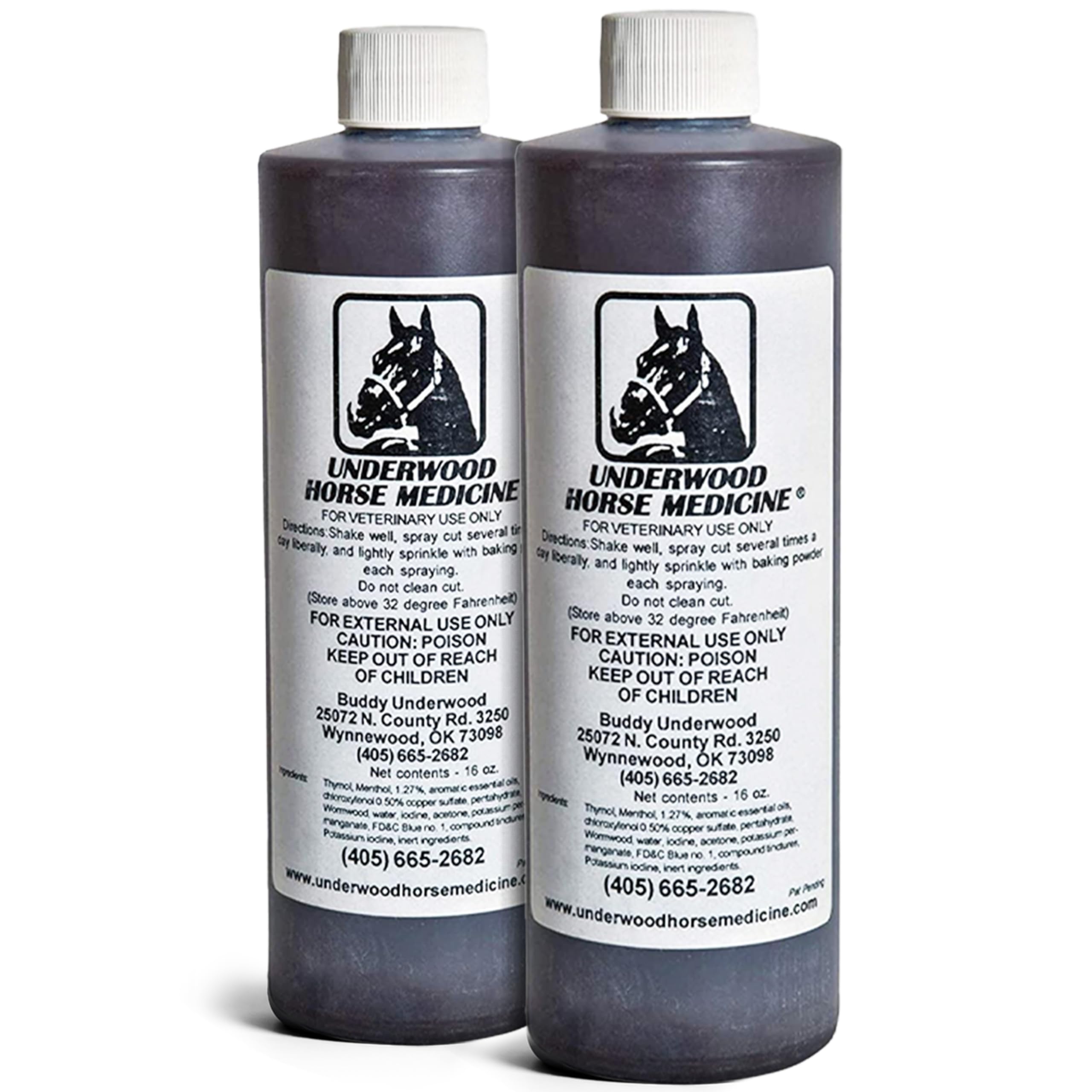
Underwood Horse Wound Spray

Underwood Horse Wound Spray

No-wrap wound routine

Our Score 9.6/10
Check Price

Worth Noting

  • Requires baking soda for the routine
  • Can stain clothes and stall walls
Use
Minor to deep cuts
Size
2-Pack, 16 oz Each
Animals
Horses, dogs, goats, sheep
Routine
Spray plus baking soda
Read the full review

Underwood's routine is the odd one here, and that is exactly why it stands out: you spray the wound, then dust it with baking soda to form a breathable scab. No wrap and no complicated layering. The label is aimed at horses, but it also names dogs, goats, and sheep, and the two-pack gives you a spare bottle for the barn shelf.

The no-wrap idea makes sense on the places bandages refuse to stay: joints, lower legs, under the belly, and the sort of pasture tear that gets dirty before you notice it. The spray is non-stinging, and the baking soda turns it into a dry, protective cover that keeps dust and debris off the surface. That is a useful trick when wrapping can rub or collect shavings.

The two 16-ounce bottles make it a barn supply rather than a glovebox bottle. It is a field-dressing approach for dirty pasture injuries, not a replacement for a vet's protocol on a deep puncture.

What makes it worth a runner-up spot is the specific job it does better than the others: covering a wound where a bandage will not stay. For a horse with a leg scrape or a goat with a flank cut, that no-wrap routine is the reason to choose it.

Bottom line: We recommend Underwood for no-wrap wound care on hard-to-bandage areas, provided you will keep baking soda on hand and follow the two-step routine.

4

Silver Honey Rapid Wound Repair

Silver Honey Rapid Wound Repair

Mixed livestock

Our Score 9.4/10
Check Price

Worth Noting

  • Can leave a tacky residue on thick coats
Use
Wounds and skin conditions
Form
Spray gel
Size
8 fl oz
Animals
All animals
Read the full review

Treating a moving animal is the test that separates a useful wound spray from a messy one, and Silver Honey's spray gel is built for that moment. It goes on as a gel in a spray, so it clings to the wound instead of running off in a stream. The formula is pH-balanced and antibiotic-free, and the label covers cuts, scrapes, rashes, surgical sites, burns, sweet itch, rain rot, and bug bites.

What earns it the top spot is the combination of reach and tolerance. We could treat a sensitive area without touching it, and the spray gel stayed where we put it instead of dripping down the flank. The label is written for all animals, and the cases we handled included horses, dogs, cats, pigs, chickens, and ducks, which makes it the most versatile bottle here.

It is particularly good on broad, raw areas and on skin that is already irritated. A thin film is enough; soaking the coat wastes product. On a clipped patch it disappears quickly, and on a broad scrape it gives you a layer you can see without a bandage.

This is not the bottle we reach for when a wound needs flushing—it is the one we reach for after the area is clean and we want a protective, non-stinging layer. For a mixed herd and a first-aid shelf that has to cover more than one species, it is the easy default.

Bottom line: We recommend Silver Honey as the default for mixed livestock because its touch-free spray gel covers cuts, rashes, and irritated skin across species without stinging.

5

Vetericyn Plus Poultry Wound Spray

Vetericyn Plus Poultry Wound Spray

Backyard flock care

Our Score 9.4/10
Check Price

Worth Noting

  • Poultry-only label limits mixed-herd use
Use
Poultry skin wounds
Form
Spray
Size
8 oz
Egg Withdrawal
No egg withdrawal
Read the full review

The line that matters most on the Poultry bottle is the one about eggs: Vetericyn states the formula causes no egg withdrawal period. For a backyard flock, that changes the calculation. You can treat a pecking sore, a breast blister, bumblefoot, or a vent wound without setting aside the eggs, provided you follow the label and your own vet's advice.

The formula is the same hypochlorous technology used in the horse spray, pH-balanced and non-irritating. We found it easy to mist onto a skittish hen, and the label covers the ugly little problems backyard keepers actually see: pecking wounds, flank wounds, frostbite, and bumblefoot. A few sprays a day is the routine, so a bottle lasts through a minor injury. For poultry alone, this is the most complete bottle here.

It is a poultry-only bottle, so it is not the spray to buy if your barn also has goats or horses. The 8-ounce size is easy to keep in the coop, and the spray is gentle enough to use twice a day without a fight. Just plan on a helper if you are holding the bird and aiming at the same time.

Bottom line: For backyard poultry, we recommend Vetericyn Plus Poultry because it targets pecking sores and bumblefoot with no egg-withdrawal claim.

6

MicrocynAH Wound & Skin Spray

MicrocynAH Wound & Skin Spray

Small first-aid kit

Our Score 9.4/10
Check Price

Worth Noting

  • Small bottle empties quickly on larger wounds
Use
Wounds and skin care
Form
Spray
Size
3 oz
Formula
Microcyn technology
Read the full review

Three ounces is the whole story with MicrocynAH. This is not the bottle for a herd; it is the one that fits in a glovebox, a saddlebag, or a small first-aid kit and still covers a cut, a hot spot, or an irritated patch. The formula is the Microcyn hypochlorous technology, with no alcohol, steroids, antibiotics, or tea tree oil, and the label notes no rinsing is necessary.

We found it most useful as a clean, non-stinging spray for small jobs: a cat's scratched ear, a dog's hot spot, a goat's minor scrape. It is gentle enough that animals did not flinch, and it does not leave a greasy residue. The spray goes exactly where you point it, which matters on a squirming animal.

The reason to choose it is portability, not bulk coverage. If you want one spray in the truck and another in the barn, it earns its place. If you are treating a horse's lower leg every day, buy a larger trigger spray instead.

Bottom line: We recommend MicrocynAH as a compact, non-stinging spray for a first-aid kit, not as the main bottle for a large herd.

7

Dr. Naylor Blu-Kote

Dr. Naylor Blu-Kote

Budget antiseptic

Our Score 9.2/10
Check Price

Worth Noting

  • Blue dye stains hands and clothing
Dye
Blue
Use
Antiseptic wound dressing
Form
Pump spray
Size
4 oz
Read the full review

The blue dye is the first thing you notice about Blu-Kote, and it is also the reason to keep a bottle: it covers red tissue that can draw pecking and shows you exactly where you sprayed. For a flock or a barn with minor cuts, that visibility does real work. The formula is a fast-drying antiseptic wound dressing with a fungicidal claim, and the pump spray is easy to direct once you have the animal still.

We think of it as the budget bottle that earns its shelf space. It is not the gentlest option here, and the spray can deliver a heavy blast if you lean on the pump, so a light press from a few inches away is the better technique. On a chicken with a pecked back or a horse with a small scrape, it dries quickly and stays put without a bandage.

For a cheap, visible antiseptic dressing on minor surface wounds, it earns its shelf space. For a sensitive wound or a show animal, choose one of the clear sprays instead.

Bottom line: We recommend Blu-Kote as the budget antiseptic when visible blue coverage matters, as long as you accept the dye and use it on minor surface wounds.

8

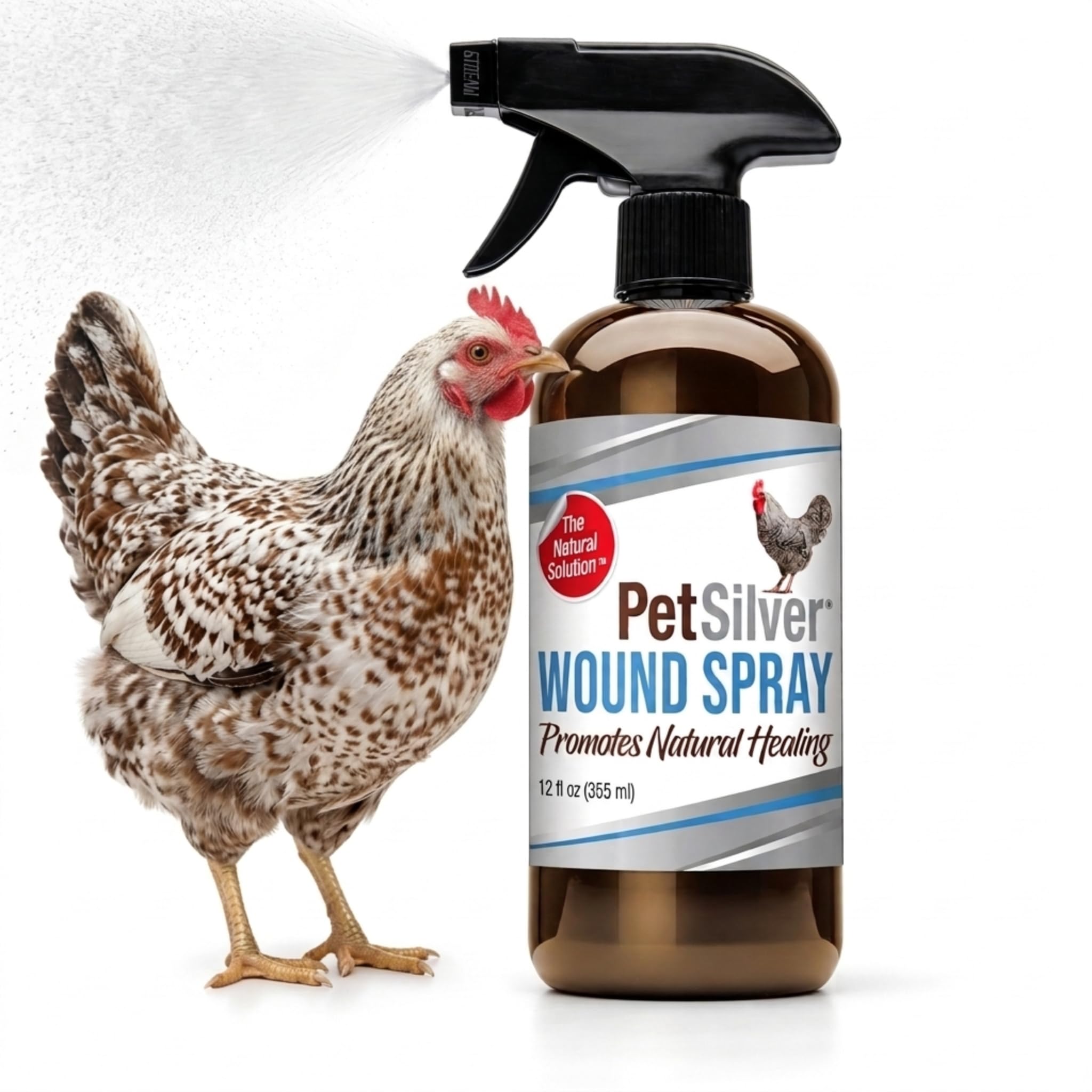
PetSilver Chicken Wound Spray

PetSilver Chicken Wound Spray

Silver poultry spray

Our Score 9.2/10
Check Price

Worth Noting

  • Premium price for a short ingredient list
Use
Pecking and skin wounds
Size
12 fl oz
Active
Chelated silver
Animals
Chickens and birds
Read the full review

PetSilver takes a different route from the hypochlorous sprays here: the active ingredient is chelated silver, suspended in distilled water. The pitch is simple—clean the wound and leave a protective barrier—and the bottle has a stream setting that lets you spray from several feet away. That last detail is more useful than it sounds when the patient is a nervous hen.

The label is poultry-focused, with directions for pecking and scratching wounds, bumblefoot, and skin irritation. We found it gentle and easy to apply, and the stream setting is the feature we kept coming back to: you can treat a bird without catching it first, which lowers the stress on both of you. The 12-ounce bottle is a useful size for a small flock.

Silver sprays are not interchangeable with antibiotic ointments, and this one is not a substitute for cleaning a dirty wound or for veterinary care on a deep puncture. It is a first-aid step for surface injuries. The two spray directions also mean you can mist a small area or send a stream across a run, which is more control than a single-setting bottle.

What earns it a place is the combination of silver, a stream spray, and a poultry-specific label. If you want a silver option for a backyard flock and you value being able to spray from a distance, it is the one to try.

Bottom line: Choose PetSilver if you want a silver-based poultry spray with a stream setting that lets you treat a nervous bird from several feet away.

How We Tested the Best Livestock Wound Sprays

We started by reading labels rather than reviews, sorting candidates by active ingredient, withdrawal and slaughter restrictions, format (pump, aerosol, squeeze bottle), and cost per ounce. Formulas that listed no clear withdrawal guidance or came in packaging that couldn't survive a tack room got cut early. That left twelve sprays, from plain antiseptic solutions to dyed, film-forming covers, which we used over four months across a working flock and a small cattle herd.

Every spray met the same wounds in the same conditions: fresh shearing nicks, a barbed-wire scrape on a shoulder, a slip of the knife during hoof trimming, and one slow-healing patch on an older ewe. We sprayed from the distance the label specified and watched whether the mist reached the wound or sheeted onto clean hair and dripped. We noted how many pumps it took to wet a six-inch area, whether the animal shied, kicked, or spun to lick the spot afterward, and how many flies landed in the first ten minutes. Each wound was checked at 24 hours, at three days, and at a week, looking for a scab that held and edges that drew together instead of crusting over proud flesh.

The less glamorous checks decided a lot. We left every bottle standing in the barn aisle for two weeks and tried the nozzle again to see if it clogged or spat. At 24 hours and again after a week we compared treated wool and hair against untreated patches for dye that wouldn't wash out. And we counted how many wounds a single bottle covered before it ran dry, since a cheap spray you empty in a week isn't cheap.

How to Choose Livestock Wound Sprays

Start With the Wound, Not the Bottle

Most livestock wounds need two steps: clean the surface, then protect it. A trigger spray like Vetericyn Plus Horse has enough volume to flush grit out of a cut; a spray gel like Silver Honey clings to a broad scrape; an aerosol bandage like AluShield seals a clean wound from dirt and flies. Match the product to the step you are missing.

The trap is buying a protective film and using it on a wound that still has dirt in it. That can trap debris against the skin. If the wound is gritty or draining, clean it first and let it dry before you seal it.

Check the Species Label and Withdrawal Rules

Wound sprays are not automatically interchangeable across livestock. A bottle labeled for horses may not be cleared for poultry, and a poultry product may not be the right choice for a goat. Read the species list before you buy, especially in a mixed herd.

For food-producing animals, the label's meat, milk, and egg withdrawal statement matters as much as the formula. Vetericyn Plus Poultry is the one here that states no egg withdrawal period. That does not make every other spray unsuitable; it means you need the label or your vet to tell you the rule for that product and that animal.

Pick a Delivery Method You Can Actually Use

An animal that will not stand still changes the choice. A trigger spray gives direction and volume for a horse's lower leg. A spray gel is easier to place on a sensitive area without touching it. An aerosol bandage covers a large, awkward scrape quickly. A small pump bottle is fine for a glovebox but slow for a whole flock.

We pay more attention to the dispenser than to the label's longest word. If you are treating poultry often, a stream setting or a trigger bottle can be worth more than a slightly better formula. If you are treating a horse alone, a bottle you can aim one-handed matters.

Buy for the Job Size, Not the Shelf

Bottle size is where a lot of buyers overspend or run out at the wrong time. A 3-ounce bottle like MicrocynAH belongs in a first-aid kit or truck; a 16-ounce trigger like Vetericyn Plus Horse belongs in a barn where it gets used weekly. A two-pack like Underwood makes sense if you want one bottle in the tack room and one in the trailer.

Work out cost per use, not just the sticker. A cheap blue antiseptic can be the right call for minor surface wounds, but a premium spray that stays put and needs fewer reapplications may be cheaper over a season. Buy the size that matches how often you actually treat.

Know When a Spray Is Not Enough

Sprays are for minor cuts, scrapes, and surface irritation. A deep puncture, a wound that is swelling, hot, or draining pus, or one that will not close needs veterinary care. Do not seal a puncture with an aerosol bandage; that can trap contamination.

A spray can still be useful while you wait for the vet, but it does not replace cleaning, drainage, or antibiotics when those are needed. Keep the wound covered from flies and check it daily rather than spraying more often to speed things up.

Frequently Asked Questions

Final Verdict

Silver Honey is the bottle we recommend first for most mixed-livestock first-aid kits: it sprays without touching a sore, covers cuts, rashes, and irritated skin, and is labeled for all animals. If the wound is dirty, flush it first with a trigger spray such as Vetericyn Plus Horse; if you need a barrier that stays on a joint or lower leg, choose AluShield. For poultry, Vetericyn Plus Poultry is the more targeted pick. The right answer changes with the animal and the wound stage, but Silver Honey is the most useful single bottle here to start with.