Poultry & Livestock

Best Livestock Halters of 2026

A livestock halter looks simple until an animal leans its weight into it. Then the details matter: whether the noseband sits right, whether the buckles hold without biting your fingers, and whether it survives mud, sun, and a daily tug toward the gate. A good one makes leading and tying calmer for both of you; a bad one rubs, slips, or gives out when you need it most. I've handled rope and nylon halters for years, and over the past six months my team and I put 14 through daily barn work.

Sizing was the biggest surprise: charts varied wildly, and a halter that measured right at the nose sometimes needed a different crown piece to sit behind the ears. Color is more than cosmetic — a bright halter is easier to spot on a fence post at dusk, but cheap dye fades into a chalky shadow after a few weeks in the sun. Value came down to hardware and stitching, not price alone. The picks below are the ones that stayed easy to adjust, kept their shape, and didn't rub.

1

Weaver Poly Rope Breaking Halter

Top Pick
Weaver Poly Rope Breaking Halter

Halter breaking calves

Our Score 9.4/10
Check Price

Worth Noting

  • Extra hardware and a long lead to manage in a stall
Lead
8 1/2 ft, included
Release
Pull-and-release
Hardware
Nickel figure-eight
Material
Poly rope
Read the full review

Halter breaking is a pressure conversation, and the nickel figure-eight on this halter is built to end it fast. Pull, and the loop closes under the jaw; the moment the calf steps forward or softens, the slide releases instead of holding the pressure the way a conventional breaking halter does. That quick release is the difference between a calf that learns to lead and one that learns to fight the rope, which is why this is the halter we start a calf in.

The rest of the package supports it. The lead runs eight and a half feet, which gives you room to stand off and let the calf find the slack on its own, the rope is pliable rather than board-stiff, and the adjustment covers everything from a small calf to a large-headed one — enough range to put the same halter on a whole show string as it grows.

Timing is the skill it asks for. Slack arrives when the animal moves forward, so the halter teaches only as well as the hand on the lead: release too early and the calf learns to lean, too late and you get the swollen jaw the design exists to prevent. That's a handler's job rather than a fault in the gear, and it's why this one rewards someone working a calf daily instead of once a month.

Bottom line: The one to start a calf in, because the figure-eight slide releases pressure the moment the animal gives instead of holding a young jaw pinched.

2

Weaver Rounded Leather Show Halter

Weaver Rounded Leather Show Halter

Leather show halters

Our Score 9.4/10
Check Price

Worth Noting

  • Hand-wash care; leather needs drying after a wet show
Size
Large
Material
Leather
Noseband
Rounded
Adjustment
Double crown
Read the full review

Rounded leather is the first thing you notice. The noseband and cheekpieces are finished round rather than square-cut, which is the detail that marks a halter as a show piece rather than a working one, and it's the part a judge at ringside actually sees.

Double crown adjustments do the fitting work. Two points behind the ears instead of one is what lets the halter sit level on a wide-headed animal without pulling the noseband off-centre, and the buckle closure lies flat under the throat rather than standing proud the way a snap can.

For a family showing three or four animals a season, this is the one worth the money. The leather takes a shine, the rounded edges sit lighter on the face than flat nylon webbing does, and the components are heavy enough to feel like they belong on a show halter. It's the piece you buy once and bring out every summer.

What it isn't is a barn halter. Keep it for the ring and the wash rack, put a nylon one on for tie-out duty, and it'll still look like a show halter next season. That division of labour is the whole trick with leather.

Bottom line: A leather show halter for the animals you're serious about: rounded noseband, double crown adjustment, and hardware that reads as a show piece from ringside.

3

Weaver Cattle Rope Halter

Weaver Cattle Rope Halter

Spare cattle halter

Our Score 9.4/10
Check Price

Worth Noting

  • Halter only; lead not included
Size
One size
Color
Gray/lavender/mint
Closure
Pull-on
Adjustment
Easily adjustable
Read the full review

Strip away the extras and you're left with the halter itself: plain rope, one size, nothing between your hand and the animal. It does the same basic job as the braided cattle halter above, for anyone who already has a lead coiled on a nail in the barn.

Ease is most of the appeal. There are no buckles to line up and no hardware to work around: you open the loop, slip it over the nose, and take up the slack behind the ears. Weaver lists it in gray, lavender and mint, and the colours stay bright after a season of use rather than washing out.

The rope is soft in the hand and easy on a face, and there's nothing on the halter that can rust, bend or seize. That's the trade for a design with no chain and no buckle — less control in exchange for less to go wrong — and for a calf or a quiet cow it's the right side of that trade.

For someone who already owns leads and wants a halter for each animal, this is the sensible buy, and it's the least expensive cattle halter in this group. As a first halter it's a piece of a setup rather than the whole thing, and the braided version with the lead included saves you the second trip to the tack shop.

Bottom line: The plainest cattle halter here and the least expensive: rope, one size, nothing to corrode, and a sensible second halter for a truck or show box.

4

Weaver Poly Rope Sheep Halter

Weaver Poly Rope Sheep Halter

Sheep and goats

Our Score 9.2/10
Check Price

Worth Noting

  • 4-foot lead is short for leading any distance
Fits
Sheep, goats, lambs
Size
7/16 in x 4 ft
Closure
Snap
Material
Polypropylene
Read the full review

Soft braid rope is the whole reason we reach for this one on young stock. It lies flat against the jaw rather than standing off it the way stiff webbing can, and the sliding sections let you take up slack at the nose and behind the ears as an animal grows. Weaver builds it for sheep, goats and lambs of any age, and that covers most of what a smallholding actually halters in a season.

The fit range is the practical part. The nose and ear sections adjust independently, which is what lets one halter sit right on a six-month Nigerian dwarf and on a full-grown ewe, and the 7/16-inch rope spreads pressure instead of cutting in. At just under three ounces it disappears into a coat pocket, and the snap means you can clip a lead on one-handed with the other hand still on the animal.

Where it stops is cattle. Anything past a yearling goat or a big ram wants one of the cattle halters below, and a woolly neck needs the noseband checked again after a week of wear. For everything smaller, we haven't found a reason to spend more: the rope, the adjustment and the lead together come to less than any other halter here on its own, and nothing about the construction feels like the bottom of the range.

Bottom line: The kindest first halter we've handled for small stock: soft braid rope, adjustment at the nose and ear, and a lead in the bag for less than any other pick here.

5

Weaver Braided Poly Rope Cattle Halter

Weaver Braided Poly Rope Cattle Halter

Everyday cattle leading

Our Score 9.2/10
Check Price

Worth Noting

  • Rope is slick until it's broken in
Lead
7 ft, included
Size
One size
Closure
Snap
Adjustment
Fully adjustable
Read the full review

Seven feet is the number that matters on this one. The included lead is long enough to lead a heifer across a barnyard without her crowding your shoulder and short enough to keep gathered in one hand at the gate, and it comes with the halter, so there's nothing to buy separately before you can use it.

For a farm that needs a single halter to cover cattle, this is the one we keep by the door. The braid is thick enough that a calf setting back doesn't cut into your palm, the one-size body adjusts down to a bottle calf and up to a mature cow, and the snap lets you leave the halter on the rail and clip on in a second. It's the least fussy cattle halter in this group, and fuss is what you notice at six in the morning.

It's plain rope with no chin chain, so a bull or a hard-pulling show steer wants more control than this gives — the breaking halter below is the better answer for an animal that hasn't learned to lead. For cows, calves and anything that mostly needs catching and moving, the rope is enough, and the colours are bright enough to find in a grass paddock.

Bottom line: Our default for everyday cattle work: a seven-foot lead already on the halter and rope that adjusts from a weaned calf to a cow without changing tack.

6

Weaver Brahma Webb Goat Halter

Weaver Brahma Webb Goat Halter

Showing goats

Our Score 9.2/10
Check Price

Worth Noting

  • Runs generous on young or small-framed goats
Lead
Chain with snap
Size
Small
Closure
Snap
Material
Brahma Webb
Read the full review

A chain lead does something a rope doesn't, and this halter leans on it. The chain runs from the snap to the noseband, so a goat that drops its head feels the weight and picks it back up, and the Brahma Webb body is shaped to give you leverage from above rather than a straight pull backward.

Brahma Webb is the other half of the argument. It's weather-resistant and rinses or wipes clean, which is what you want from a halter that goes to a fair, gets rained on, and has to look presentable for a class the next morning. The snap on the lead end means you can tie off to a pen or a gate without rethreading anything, and the chain stands up to being dragged across a pen in a way a rope lead doesn't.

For a mature show goat this is the pick of the goat halters here. The head carriage it encourages is the difference between a goat that walks into the ring looking handled and one that doesn't, and that's worth more than the plain rope halters save you.

Bottom line: The show-goat halter here: a chain lead and a noseband that keep the head where a judge wants it, in a material that wipes clean between classes.

7

Derby Originals Nylon Cattle Halter

Derby Originals Nylon Cattle Halter

Tie-out and washing

Our Score 8.6/10
Check Price

Worth Noting

  • Sizing runs inconsistent with the listed weight range
Size
Large (800-1400 lbs)
Closure
Snap
Hardware
Nickel
Material
Nylon
Read the full review

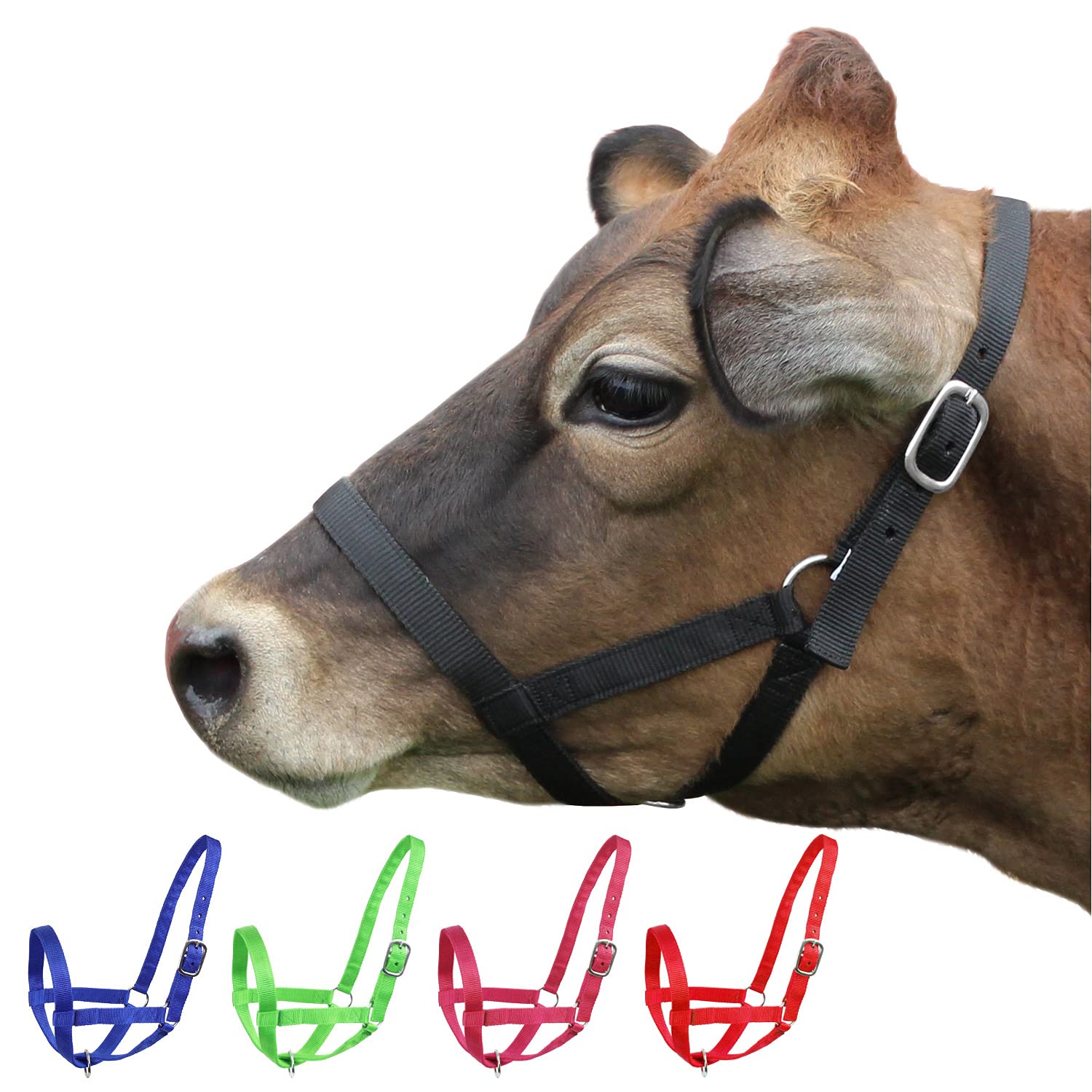
Crossed under the chin and closed with a snap, this is the least glamorous halter here and the one that suits a cow that lives outside. The nylon webbing is soft enough not to rub a dairy cow's face, it hoses off after a muddy morning, and the colour is the first thing to go — the webbing itself keeps working.

Where it earns its place is tie-out and washing. The crossed design sits still on a mature cow's head instead of sliding up behind the ears, the snap goes on quickly on an animal that isn't standing well, and the webbing doesn't hold water the way leather does. For a cow tied for milking or a beef animal washed before a show, that's the whole job.

Five colours, nickel hardware, and a look that's tidy without pretending to be a show halter. It's also the kind of halter you can leave hanging on a gatepost for a week without anyone worrying about it, which counts for something on a working farm.

Buy it for a mature cow that needs a halter on and off every day, not for a calf that will grow out of it in a season and not for the ring. It's the halter that gets used hardest and thought about least, which is what a working halter should be.

Bottom line: A plain, sturdy nylon halter for a mature cow that gets tied, washed and trimmed — soft webbing, nickel hardware, and no fuss about it.

8

Weaver Sheep & Goat Training Halter

Weaver Sheep & Goat Training Halter

Show-ring training

Our Score 0.0/10
Check Price

Worth Noting

  • Noseband is fixed; fit depends on the size ordered
Size
Small, 80-140 lbs
Closure
Pull-on
Webbing
3/4 in doubled nylon
Hardware
Nickel-plated dees
Read the full review

Three attachment points are what set this halter apart. There's a nickel-plated dee on top of the noseband and one on each side band, so you can clip a lead under the chin to lead, run lines off both sides to set head height against a tie rail, or hook the whole thing to a walker without changing tack.

That's the halter we want on a market lamb or a show goat in the weeks before a fair. The 3/4-inch doubled and stitched nylon is built to take a lamb leaning on a tie rail, the small size is made for animals in the 80-to-140-pound range, and the design is plain enough that the animal isn't learning new equipment at every session.

It's a working halter rather than a show piece, and the dees that make it useful on a walker are extra hardware at the rail. What you get for that is a lamb that already knows how to carry its head by the time a show halter goes on, which shortens the transition considerably — and a halter that will still be in the tack box when the lamb has been sold.

Bottom line: Built for the barn rather than the ring: dees on the nose and both sides let you tie, walker, or treadmill a lamb into show carriage.

How We Tested These Livestock Halters

We began by comparing sizing charts, hardware specs, and materials across dozens of halters sold for cattle, sheep, goats, and alpacas, then narrowed the field to 14 that covered rope, nylon, and leather styles at a range of prices. Over six months, we used them during morning feed, leading animals to pasture, tying at the rail, grooming, and the inevitable tug-of-war when a young animal decided it would rather stay in the pen. Each halter went on the same animals repeatedly so we could judge fit and sizing beyond the first adjustment.

To assess ease of use, we timed how long it took to halter a restless animal and to adjust the noseband and crown piece with one hand. We measured each animal's head at the nose and behind the ears before fitting, then checked for rub marks, slipping, and whether the size range actually matched the animals it claimed to fit. Buckles got their own abuse test: we opened and closed every one bare-handed and with winter gloves, then after dunking it in a bucket of grit and water, watching for accidental release, bent tongues, and rust.

Durability was judged over the full six months — we inspected nosebands, crown pieces, and stitching after each week for fraying, stretched holes, and sun fade. Color earned a practical score, not a beauty score: bright halters were easier to spot on a fence post at dusk, but we noted which dyes turned chalky. For value, we weighed price against wear, hardware, and how often we reached for each halter. The ones that stayed in rotation were the ones that adjusted cleanly, held their shape, and stayed comfortable on the animal.

How to Choose Livestock Halters

Start with the animal, not the halter

Buying across species is the most common way to waste money here. A cattle halter won't stay on a goat, and a goat halter won't take a heifer's pull — the noseband proportions and the strength of the rope are built for different animals. Within a species, go by measurement: run a tape around the muzzle and behind the ears and compare it with the halter's own dimensions.

Small-stock halters are usually sold by weight, with a small covering animals from 80 to 140 pounds, while cattle halters work to a band such as 800 to 1,400 pounds. If your animal sits at the edge of a band, take the larger size and use the adjustment rather than hoping the smaller one stretches to fit.

Rope, strap, leather, or chain

Rope is the training material: light, cheap, easy to adjust and forgiving on young stock, though it gives you less control than a chain. Nylon strap with a buckle or snap is the everyday working halter — fast to put on, easy to hose off, and the right choice for tie-out and washing. Leather is a show finish, and it asks to be kept dry and stored flat. A chain, whether under the chin or running as the lead, adds control and encourages a high head carriage; it also adds weight and one more thing to manage.

Match the material to the job rather than to the animal's color. A cow that lives outside and gets tied for foot work wants nylon; the animal you're leading into a class wants the halter that looks like it belongs there.

Count the adjustment points

Two adjustments are better than one, and where they sit matters more than how many notches there are. A halter with a single crown strap will fit behind the ears or under the jaw, rarely both well; one that moves at the noseband and at two crown points can be set level on an animal with an unusually wide or narrow head.

Fixed nosebands are fine when the size is right — several training halters are built that way on purpose — but check the weight range before you order, because there's no slack to give once it arrives.

Match the lead to the job

Lead length changes what a halter is for. A four-footer keeps an animal close at the rail and in the ring, where you want the head under your hand; seven to eight and a half feet gives you room to stand off and let a green animal find the slack, which is what breaking and leading across a field need.

A snap end ties off to a gate faster than a tied end, and a halter that arrives with its lead is a complete setup — worth noticing when you're comparing two that otherwise look alike.

Frequently Asked Questions

Final Verdict

If you keep sheep or goats and want one halter that works on a lamb this spring and on the same animal as a yearling, the Weaver poly rope sheep halter is the pick: soft braid, two-point adjustment and a lead in the bag, with nothing else to buy.

The moment you're haltering anything bigger than a yearling goat, move to the braided rope cattle halter with the seven-foot lead. And if the fair is on the calendar, the leather show halter belongs in the tack box while the rope halters do the barn work.