Poultry & Livestock

Best Livestock Scales of 2026

A livestock scale has one job: give you a number you can act on, whether you’re dosing a goat, sorting pigs, or tracking a calf’s gain. I’ve learned the hard way that a scale only earns its keep if an animal will stand on it long enough for a steady reading—and if you can operate it without a second pair of hands. A good one turns a stressful wrestling match into a two-minute check; a bad one leaves you doubting the display. We put nine livestock scales through eight months of farm use to find the ones that deliver.

The differences weren’t just in the display. Some platforms flexed under a restless animal, some took three tries to level on uneven concrete, and a few came with instructions that assumed I’d done this before. The top models felt solid underfoot, set up without a fight, and gave repeatable readings when we weighed the same animal twice. Value mattered, too—none of the strongest performers were the most complicated or the most expensive.

1

A and A VS-660

Top Pick
A and A VS-660

All-round farm scale

Our Score 9.2/10
Check Price

Worth Noting

  • 660 lb ceiling leaves no room for mature sows
  • Costs more than the 1,100 lb budget scales
Power
AC or AA batteries
Platform
43 x 20 inches
Weight Capacity
660 lb
Readout Accuracy
3.2 oz
Read the full review

Forty-three inches by twenty is the measurement that decided this one for us. A full-grown ewe, a finished market hog, or a six-month calf stands on that with all four feet down and room to shuffle, which is the difference between one clean reading and an animal you keep repositioning. Only the PEC gives you a longer platform, and nothing else here pairs this much standing room with readings this settled.

The increment is 0.2 lb, or 3.2 oz, which is the right grain for farm animals: fine enough to catch a lamb putting on a pound a week, coarse enough that a shifting hoof does not send the display hunting. The PEC and the VEVOR go finer at 0.1 lb, but unless you are tracking newborns that extra digit mostly adds noise. We paid more attention to repeatability than to resolution - the same animal on and off twice should read the same both times - and this is the scale in the group we came to trust for a second opinion.

It runs on AA batteries or mains, which matters more than it sounds: batteries let you weigh in a pen with no outlet, and the auto shut-off saves a session from a dead display. It is also light enough to carry between pens or load in the truck for a show, which is not true of everything here. The mat is the weak point. It lies on the stainless rather than locking to it, and a hog will walk it out from under its own feet; a few dabs of adhesive or a strip of double-sided tape fixes it for good.

Where this one stops is 660 lb. Keep a mature boar, breed sows, or cattle past the yearling stage and you want the 1,100 lb class - the TUFFIOM, Togarhow, or vemoko. For sheep, goats, calves, and market hogs, nothing else here does the job more convincingly, and the platform length is why.

Bottom line: We recommend it for sheep, goats, calves, and market hogs: the 43-inch platform lets an animal stand squarely, and the readings settle while it shifts.
2

IBE Supply 660 Scale

IBE Supply 660 Scale

Weighing solo

Our Score 8.8/10
Check Price

Worth Noting

  • 37-inch platform is tight for full-grown hogs
Display
Wall-mount LCD
Platform
37 x 20 inches
Weight Capacity
660 lb
Readout Accuracy
3.2 oz
Read the full review

The display on this scale detaches and hangs on a wall, and that one decision changes how a weighing goes. Instead of crouching at the platform edge to read a number through a dog's legs, you stand at the animal's shoulder, keep a hand on it, and read at eye level. The cable gives you enough slack to put the readout where you actually stand rather than where the scale happens to sit.

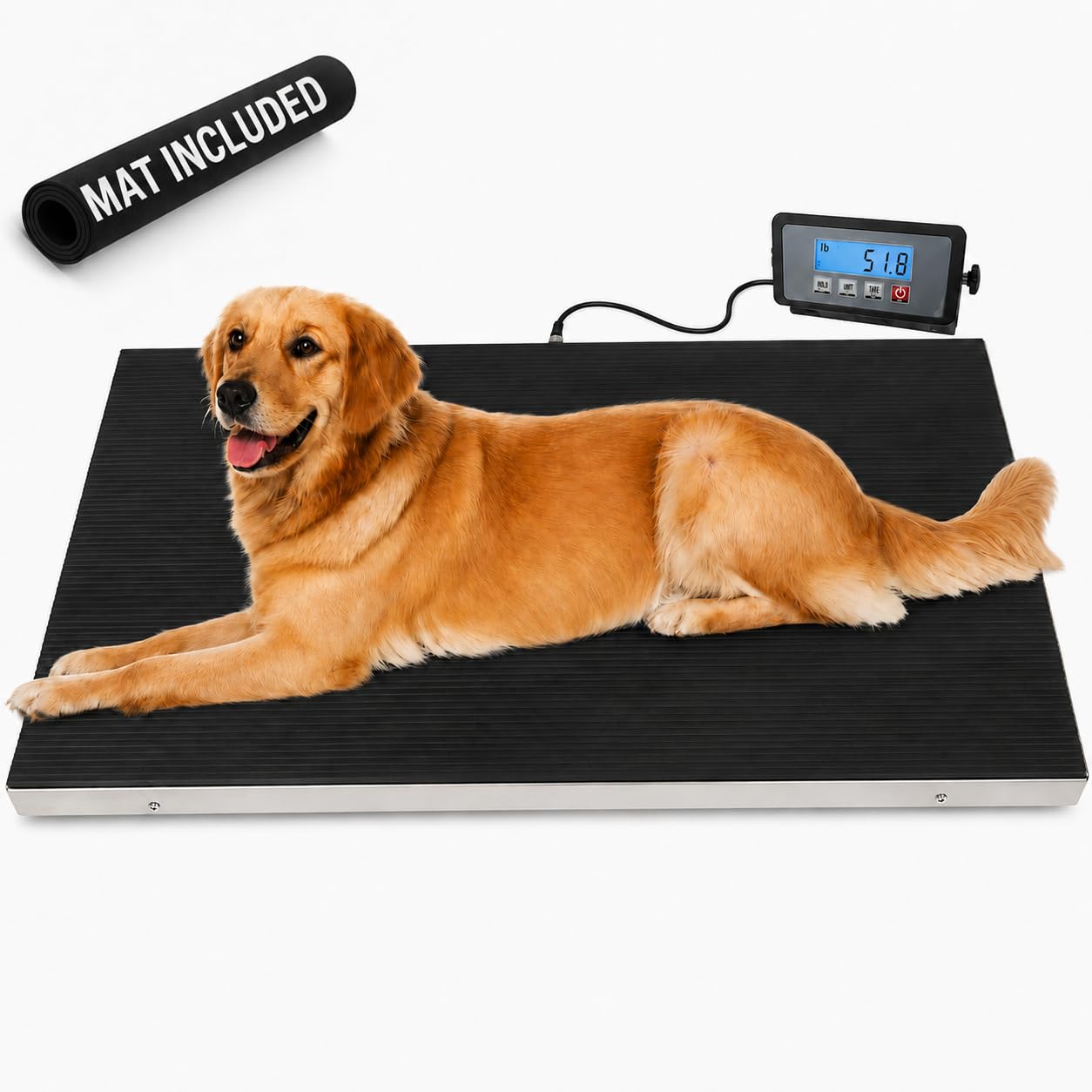
The rest holds up. The platform is 37 by 20 inches, stainless, with a removable rubber mat that lifts out for hosing down, and the frame sits low enough that a nervous dog walks on without a fight. It reads in 0.2 lb steps and covers the whole span - a three-pound puppy and a 200-pound dog, steady both times. We rank it just behind the A and A, and platform length is the only real reason: a big hog has less room to stand squarely on 37 inches.

It runs from the wall or from four AA batteries, so a pen without power is fine. Two practical notes before you buy. The mat takes the wear, so check it sits flat before an animal steps on. And the instructions are the low point - budget a session to calibrate it against a known weight before the first real weighing, because the manual will not lead you through it.

Bottom line: Buy it if you weigh animals alone: the display mounts at eye level, so you can keep a hand on the dog and still read the number.

3

PEC 700AS

PEC 700AS

Restless animals

Our Score 8.6/10
Check Price

Worth Noting

  • Mild steel frame needs a dry spot
  • The highest price in this group
Platform
44 x 22 inches
Warranty
One year
Weight Capacity
700 lb
Readout Accuracy
1.6 oz
Read the full review

An animal that steps on, steps off, and steps on again gives you three different weights. Peak hold is the answer: the scale captures the highest reading and holds it, so a ewe that plants for two seconds still leaves you with a number you can write down. It is the feature that separates this scale from the rest of the group, and it comes with the longest platform here at 44 by 22 inches.

Four shear beam load cells sit under a mild steel frame, and the scale carries 700 lb at 0.1 lb increments - the finest readout of anything with this much platform, and the one that removes the most guesswork if you weigh for a fair or track a slow gain. There is a nonslip pad, a serial output for anyone keeping records on a computer, and a one-year warranty with California-based support, which none of the others here state. We place it behind the A and A for one reason: most buyers do not need peak hold badly enough to pay for it.

The frame is the thing to plan for. Mild steel is durable, but it is not stainless, so give the scale a dry corner of the barn and keep the hose on the platform and pad rather than the frame. If you weigh the same animals week after week for a fair, the price is easier to justify than it looks - the warranty and the support line are part of what you are buying, and they are worth having when something goes wrong mid-season.

Bottom line: The pick for animals that will not settle: peak hold catches a weight mid-shuffle, and the 44-inch platform gives a show hog room to stand.

4

TUFFIOM 1100 lb Scale

TUFFIOM 1100 lb Scale

Tight budgets

Our Score 8.4/10
Check Price

Worth Noting

  • Can stop working within a few months
Power
AC adapter or 4 AA batteries
Platform
40.7 x 20.9 inches
Weight Capacity
1100 lb
Readout Accuracy
0.2 lb
Read the full review

Eleven hundred pounds of capacity for less than any other scale here is the whole pitch, and it is a real one. You get a 40.7 by 20.9-inch stainless platform, 0.2 lb readings, the AC adapter in the box, and a hidden handle for moving it. On paper it does what the premium 1,100 lb machines do. The catch is not on paper.

The catch is staying alive. In some units these stop working within a few months, and when they do the money goes with them. That is the trade, and how much it matters depends on how often you weigh. Running a handful of goats across it once a month, a scale that lasts two or three seasons is a fair deal. Weighing weekly, or weighing for a fair, pay more and stop thinking about it.

Day to day it is easy to live with. The platform wipes down, the feet adjust on a floor that is not level, and the display switches between kg, lb, and lb:oz for anyone keeping records in mixed units. The adapter stows in its own compartment underneath, which is a small thing we appreciated - it means you are not hunting for a wall wart every time you move the thing to a different pen.

Bottom line: The budget route to 1,100 lb: it does the job now and leaves you less sure how long it will keep doing it.

5

Togarhow 1100 lb Scale

Togarhow 1100 lb Scale

High capacity

Our Score 8.2/10
Check Price

Worth Noting

  • Battery power only, so keep AA spares handy
Feet
Four adjustable feet
Power
AA batteries
Weight Capacity
1100 lb
Readout Accuracy
0.1kg or 0.2Lbs
Read the full review

Eleven hundred pounds is more than most smallholdings will ever load, and it is the right ceiling if you finish hogs, keep a mature boar, or weigh a calf on the same platform as a ewe. This one is built around that number, with 0.2 lb steps so a growing pig's weekly gain still shows up on the display.

The design is quietly sensible. Four adjustable feet take the wobble out of a packed-dirt barn floor, a carry handle and a hidden compartment keep the display and cable together in storage, and the readout sits on a desk or hangs on a wall depending on whether you are weighing alone. It runs on AA batteries and warns you when they are low or when you have put more on the platform than it can take - both worth having.

Where it lands for us is the middle of the 1,100 lb class: better finished than the budget TUFFIOM, less expensive than the premium platforms, and with nothing on the spec sheet that makes us wince. What keeps it out of the top tier is that nothing stands out either. There is no peak hold to settle a moving animal, and no extra beyond a clean, competent basic scale. That is not a criticism - a fair-priced 1,100 lb platform that does the basics properly is a good thing to own.

Bottom line: A well-thought-out 1,100 lb platform for buyers who want capacity and sensible design without paying premium money.

6

vemoko 1100 lb Scale

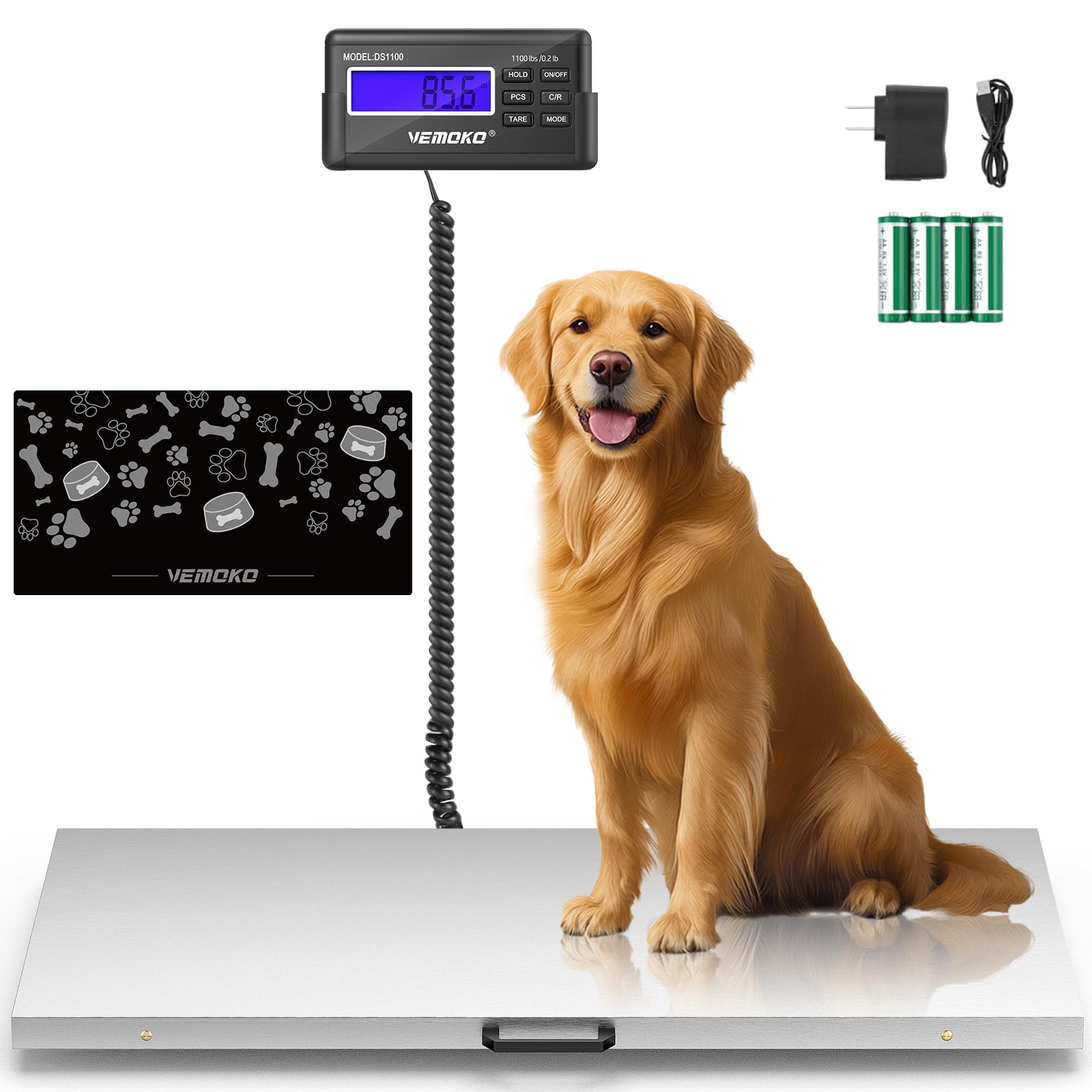
vemoko 1100 lb Scale

Messy barns

Our Score 8.2/10
Check Price

Worth Noting

  • In some units the scale will not power on
Mat
Detachable anti-slip mat
Platform
40.5 x 20.6 inches
Weight Capacity
1100 lb
Readout Accuracy
3.2 oz
Read the full review

The platform is smooth stainless with a mat that lifts off, and that combination is the most practical thing about this scale. Mud, dung, and wet bedding sweep off in one pass; the mat comes away for a hose-down and drops back flat. If your scale lives in a working barn rather than a clean clinic room, this is the one whose clean-up you will not dread.

It also splits its brain in two. One mode is tuned for a moving animal, the other for a stable load, and you switch between them with a single key - useful when the same platform weighs feed sacks on a Tuesday and goats on a Saturday. Capacity is 1,100 lb at 0.2 lb steps, the readout sits on a stand that rotates 90 degrees and reads from a wide angle, and it takes batteries or mains power.

The platform measures 40.5 by 20.6 inches, which is sensible for goats, sheep, and hogs, and the carry handle makes it something you store rather than a permanent fixture. Unit switching covers kg, lb, and oz for record-keeping. One thing to do before you rely on it: check it against a known weight, because accuracy is the thing to verify rather than assume.

So it is the scale here for a mucky barn, and the two modes give it a second job none of the others advertise. What holds it back is reliability - in some units the display throws an error code or the scale will not power on at all, which is the sort of thing that turns a bargain into a return. Buy it with a return window open and a check weight on hand, and it is a good tool for the money.

Bottom line: The pick for a muddy barn: the smooth platform and lift-out mat make it the easiest scale here to clean, with 1,100 lb behind it.

7

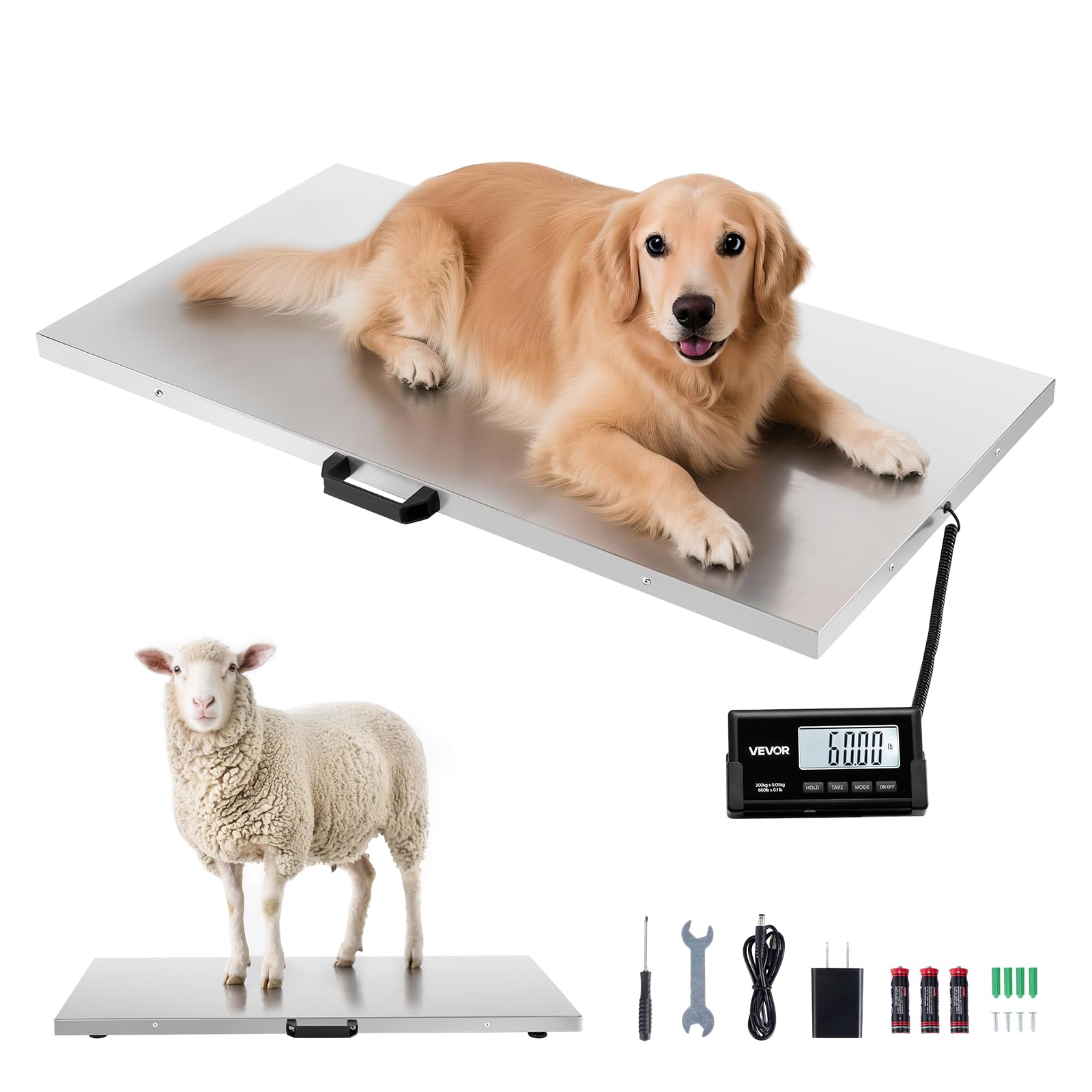
VEVOR 660 lb Scale

VEVOR 660 lb Scale

Dogs and goats

Our Score 8.2/10
Check Price

Worth Noting

  • Readings can disagree with a second scale
Material
Stainless steel
Unit Weight
33.1 lb
Weight Capacity
660 lb
Readout Accuracy
1.6 oz
Read the full review

The spec sheet is genuinely appealing: 660 lb, 0.1 lb resolution, stainless steel, a display that detaches and mounts on a wall, and three AA batteries instead of a cable. That is a finer increment than most of this group, plus a hold function that freezes the number when the animal is standing over the screen. On paper it is the value pick of the 660 lb class.

The number itself is the problem. Accuracy is this scale's weak point - readings can disagree with a second scale, and a weight that drifts makes a weekly gain meaningless. That is the one failure a livestock scale cannot absorb, because you will act on whatever it tells you. Against that: the platform is big enough for a pair of large dogs, the stainless wipes clean, 33.1 lb is a two-handed lift rather than a permanent installation, and the hold function is worth having on any scale.

We put it last among the scales here for exactly that reason. If you want a big platform on a small budget, and you will check it against a known weight before each session, it can do a job - the detachable display and the hold mode are genuinely useful. If you want to trust the number without thinking about it, spend more and get the A and A.

Bottom line: Buy it with a check weight and a return window: the platform and the display are right, but the readings are the least dependable here.

How We Tested the Best Livestock Scales

We started with a shortlist of 19 scales sold for small farms, homesteads, and 4-H setups, then narrowed it by platform size, weight range, power source, price, and what came in the box. Nine made the final cut, and we used them over eight months on a small working farm and a neighbor’s goat pen. That meant weighing goats and sheep in a barn aisle, running calves across a platform in a chute, and checking the same animals at the start and end of the test.

We unboxed each scale, followed the included instructions from assembly to first calibration, and timed how long it took one person to set up and level it on concrete, dirt, and rubber mats. Accuracy got checked by zeroing the scale, weighing a known feed sack, then weighing the same goat three times in a row; we noted whether the number settled quickly or drifted. We also nudged the platform with a boot, watched for rocking when an animal stepped on, and carried each unit by its handle or wheels from the tack room to the pen. We tried holding an animal and pressing the controls one-handed, and switching units with mucky gloves.

Durability and reliability were judged over the whole eight months: we hosed off manure, left scales in the barn aisle between sessions, and checked seams, fasteners, and display housings for rust or cracks. We kept notes on repeat weighings across the test, so a scale that wandered after a few weeks lost points even if it was accurate on day one. For value, we compared what each scale included—ramps, mats, handles, clear instructions—against how much extra work it created. The best ones were the ones we stopped thinking about.

How to Choose Livestock Scales

Capacity: buy for your heaviest animal, not your average one

Capacity is the number printed largest on every listing and the one buyers overthink. A 660 lb platform covers sheep, goats, calves up to about a year, and market hogs finished at fair weight. It does not cover a mature boar, a breeding sow already close to the ceiling before she steps on, or cattle past the yearling stage. Our rule: if your heaviest animal is within a hundred pounds of the limit, move up to the 1,100 lb class, where the TUFFIOM, Togarhow, and vemoko sit. Headroom is what you are paying for, not the last hundred pounds of the rating.

Platform size decides whether you get a whole-animal weight

Width barely varies here - 20 to 22 inches, enough for a sheep. Length is where the choice is: 37 inches on the IBE, 40 to 43 on most of the others, 44 on the PEC. An animal standing with its front feet on and its back feet off gives you a number that means nothing, and you will spend the session nudging it forward instead of writing anything down.

Measure your longest animal nose to tail while it is standing, add four or five inches, and buy the platform that clears it. The trap: capacity gets compared and length gets skipped, which is how people end up with a 660 lb scale that is too short for a 300 lb hog.

Getting a steady number out of an animal that won't stand

Two things produce a trustworthy weight: a scale that is not rocking, and a way to hold the number once the animal settles. On the first, every scale here has adjustable feet and every one of them needs a hard, flat surface - a concrete slab, or plywood over packed dirt. On the second, peak hold earns its keep; the PEC has it, and the VEVOR's hold mode freezes a reading the same way. A 0.1 lb increment sounds better than 0.2 lb, but on a moving animal the extra digit is mostly noise. Get the footing right before you pay for resolution.

Where the display goes, and how you power it

Weighing alone is the normal case, not the exception, and display placement decides whether it is possible. Several scales here let you take the readout off the frame or hang it on a wall - the IBE, TUFFIOM, Togarhow, and VEVOR all do - so you can stand at the animal's shoulder and read at eye level instead of leaning around it. Check the cable reach to your post or wall before you commit.

Power is the other half. The A and A, IBE, TUFFIOM, and vemoko run on mains or batteries; the Togarhow is AA only. Match that to where the scale actually lives, not to where you unpacked it.

Stainless, mild steel, and where the scale lives

Every platform here is stainless, and that is the part that takes the abuse - hooves, hose water, and manure. The frame underneath is where makers save money: the PEC uses mild steel and says so, which is fine in a dry barn and a slow death in a wash-down area. The non-slip mat is the consumable. It lifts out for cleaning, and on some scales it slides under a hoof, so secure it or plan to replace it. If the scale lives outdoors or gets hosed down, pay for stainless and give the frame somewhere dry.

Frequently Asked Questions

Final Verdict

The A and A VS-660 is the scale we point to first, because 43 inches of platform and a steady 0.2 lb reading cover the animals most people actually weigh - sheep, goats, calves, market hogs - and cover them without fuss. If you weigh alone, the IBE's wall-mounted display is worth stepping down in platform length for. If your animals will not stand still, or you are weighing for a fair, the PEC's peak hold and 44-inch platform earn the premium.