Poultry & Livestock

Best Livestock Hay Feeders of 2026

A cheap bale gets expensive fast once half of it is trampled into the mud. A hay feeder exists to hold forage off the ground and out of the weather, in front of animals that will waste it given the chance — and the ones that fail tend to fail loudly, with bent panels, snapped welds, and hay dragged straight through the gaps. The other half of the job is surviving the animals using it: a goat scratching its back on the frame, a horse leaning her whole weight into the bars at dinnertime.

My team and I have spent the past eight months living with 10 different feeders on real pastures and dry lots, from small square-bale units to round-bale cradles. One thing I'd tell a first-time buyer: pick the feeder by what you'll actually load into it — flakes, small squares, or a whole round bale — and by where it has to sit, before you compare price tags, because the wrong format wastes more hay than the cheapest model ever saves. Assembly counts more than the listing suggests, too. Here's what held up.

1

Premier 1 X-Tuff Hay Feeder

Top Pick
Premier 1 X-Tuff Hay Feeder

Panels and gates

Our Score 9.4/10
Check Price

Worth Noting

  • Holds about a flake, so bigger pens need several
  • Needs a panel, gate, or 2-inch board to hang on
Size
18 to 21.5 in W x 8.5 to 9 in D x 18 in H
Capacity
About one flake
Material
Hot-dip galvanized welded wire
Mounting
L-hooks over panels or 2 in boards
Read the full review

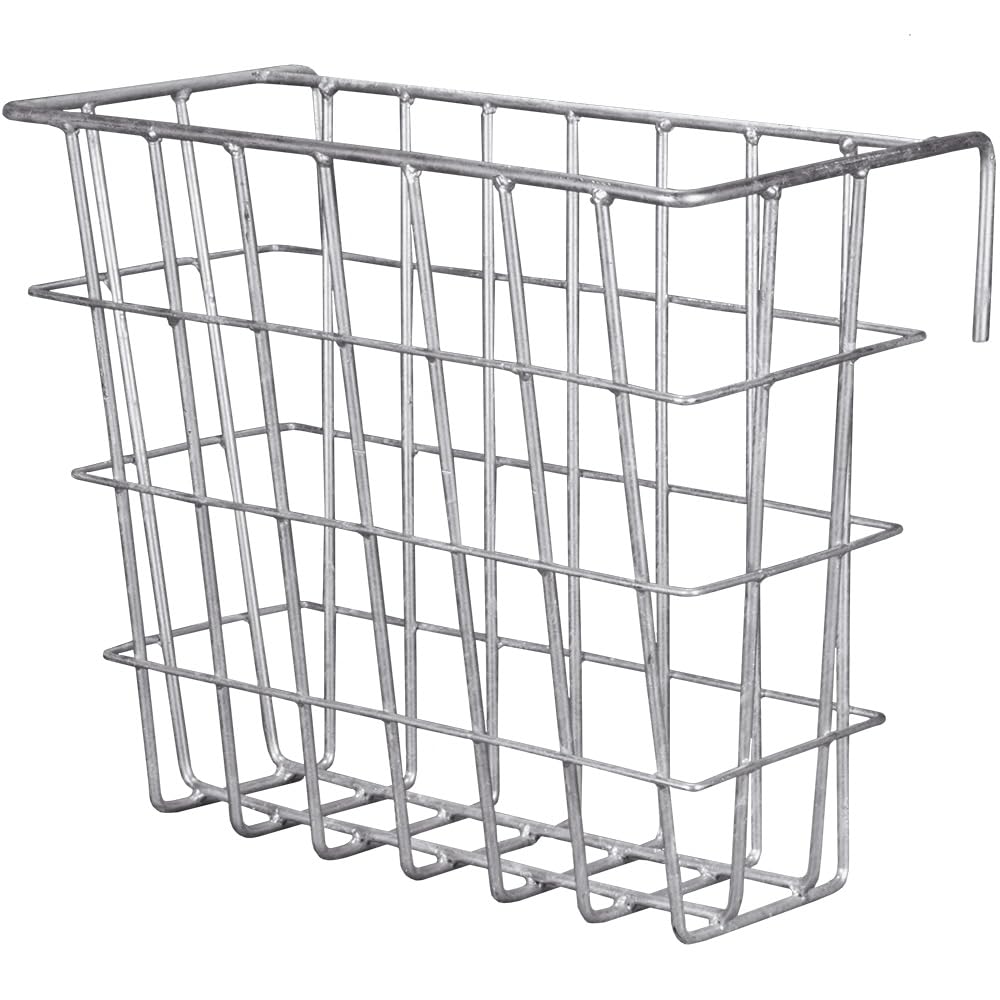
Hanging it took less time than filling it. Two inverted L-hooks drop over a gate rail or a goat panel, and the 5-inch hooks are deep enough to sit steady on a 2x4 - no drill, no bracket kit, no bag of bolts to lose. If your animals rotate between paddocks, that is the whole argument: carry the feeder to them instead of hauling hay to a fixed wall.

The frame is welded wire, hot-dip galvanized rather than painted, and at 13 pounds it has the same stoutness as the panels it hangs on. The dipped finish covers the welds, so there is no paint to chip and no bare seam to rust through after a season of weather.

Waste is where it earns its place. The side openings are deliberately small, so an adult cannot drag out more than a mouthful at a time and trample the rest into the bedding. There are holes along the bottom, too, a detail we appreciated more than expected: lambs and kids eat from the low openings while the adults work the top, so nobody gets shoved off.

Two boundaries are worth knowing before you order. It holds roughly a flake, so a pen of six goats wants two or three of these rather than one. And a playful goat can lift a hanging rack straight off a 2x6 - a bungee cord around the frame and the rail ends that in about five seconds.

Bottom line: We recommend the X-Tuff to anyone with a fence panel and a few goats: it hangs in seconds, takes head-butting, and its small openings stop the hay-dragging that wastes your winter feed.

2

VEVOR 18.5-Gallon Hay Rack

VEVOR 18.5-Gallon Hay Rack

Tight budgets

Our Score 9.0/10
Check Price

Worth Noting

  • Thin steel, so it suits small stock only
  • Openings wide enough for a goat's head
Weight
4.4 lb
Capacity
18.5 gallons
Mounting
Wall mount, hardware included
Dimensions
23.6 x 12.6 x 19.7 in
Read the full review

Four and a half pounds of steel is easy to hold against a wall with one hand, and that is most of what makes this rack useful: mark two holes, drive the supplied expansion screws, hang it, done. We had ours loaded before the wheelbarrow was empty. We think that simplicity is worth more than capacity in a small pen.

The rack is 23.6 inches wide with a multi-sided opening, so three or four goats can eat at once without crowding, and the rounded edges sit right at nose height, which is where you want them.

The catch is gauge. This is thin cold-rolled steel, fully welded and honest about what it is: fine for Nigerian Dwarfs, lambs, and small sheep, less so for a full-grown horned doe or a pony that leans. The openings are also generous enough that a determined goat can get its head inside, so hang it at chest height and watch the first few feedings before you walk away.

Bottom line: Our budget pick for small stock: light enough to hang alone in a few minutes, cheap enough to buy two, and honest about what it is - a goat and lamb feeder, not a horse feeder.

3

Country Manufacturing Combo Feeder

Country Manufacturing Combo Feeder

Stall corners

Our Score 9.0/10
Check Price

Worth Noting

  • Five-gallon bin empties quickly with several animals
Origin
Made in USA
Capacity
5 gallons
Mounting
Wall or hanging mount
Dimensions
24 x 24 x 12 in
Read the full review

Twenty-four inches square and 35 pounds of welded steel: this is a stall feeder rather than a pasture one, built to be screwed to a wall and forgotten. The 90-day warranty and the made-in-USA stamp tell you where the money goes.

We like it for a stall corner where a longer rack would foul the door. Hay sits at chest height, the bin underneath catches what falls, and the mounting hardware comes in the box. Goats clean the tray out themselves, which is the closest thing to a self-cleaning feeder in this group.

Two limits. The five-gallon bin fills fast with more than a few animals - three goats is about right, six is a crowd - and paint is the part that ages: it scuffs at the edges, and rust follows in a damp barn unless you touch it up with enamel every spring.

One more thing we noticed: kids will stand in the bin. It is sturdy enough that this is funny rather than dangerous, but you will be scooping bedding out of it.

Bottom line: A compact all-steel wall feeder for a stall corner, with a catch bin that pays for itself in saved hay and a finish that wants a dry barn.

4

Lazaluking 35.5-Inch Hay Rack

Lazaluking 35.5-Inch Hay Rack

Busy barn walls

Our Score 8.8/10
Check Price

Worth Noting

  • Misaligned holes and soft screws slow assembly
Build
Four bolt-together pieces
Front
Open slats that slow eating
Capacity
67 gallons
Mounting
Wall or wooden fence
Read the full review

Rated at 67 gallons, this is the wall rack we point at when one barn wall has to keep a whole pen busy. It mounts flat to a wall or a wooden fence, so it takes up no floor space, and the curved bottom panel adds capacity without adding length.

We like that it goes together from four pieces. Built short, it suits a kidding pen; bolted full length, it holds several flakes at once. The open slats across the front do the quiet work: goats pull smaller mouthfuls, which slows the fast eaters and keeps hay off the floor instead of underfoot.

Assembly is the part that needs patience. The panels are pre-drilled, but the holes do not always line up, and the supplied wood screws are soft enough to strip if you lean on them. Thread every bolt loosely before tightening any of them, and use your own lags for the wall.

It is light enough that one person can hold it up and mark the holes, which matters if you are mounting it alone. The mounting holes also do not sit on 16-inch centers, so a backer board is often what separates a solid hang from a rack that works loose by spring.

Bottom line: If your hay disappears faster than your goats can eat it, buy this rack: it gives you the most feeding room per dollar here, and its front slats slow the whole pen down.

5

Rugged Ranch Mini Pasture Feeder

Rugged Ranch Mini Pasture Feeder

Open pasture

Our Score 8.8/10
Check Price

Worth Noting

  • Threaded legs can arrive dented, complicating assembly
Material
15-gauge galvanized steel
Mounting
Freestanding on four legs
Catch Pan
6 in deep
Dimensions
47 x 22.5 x 38 in
Read the full review

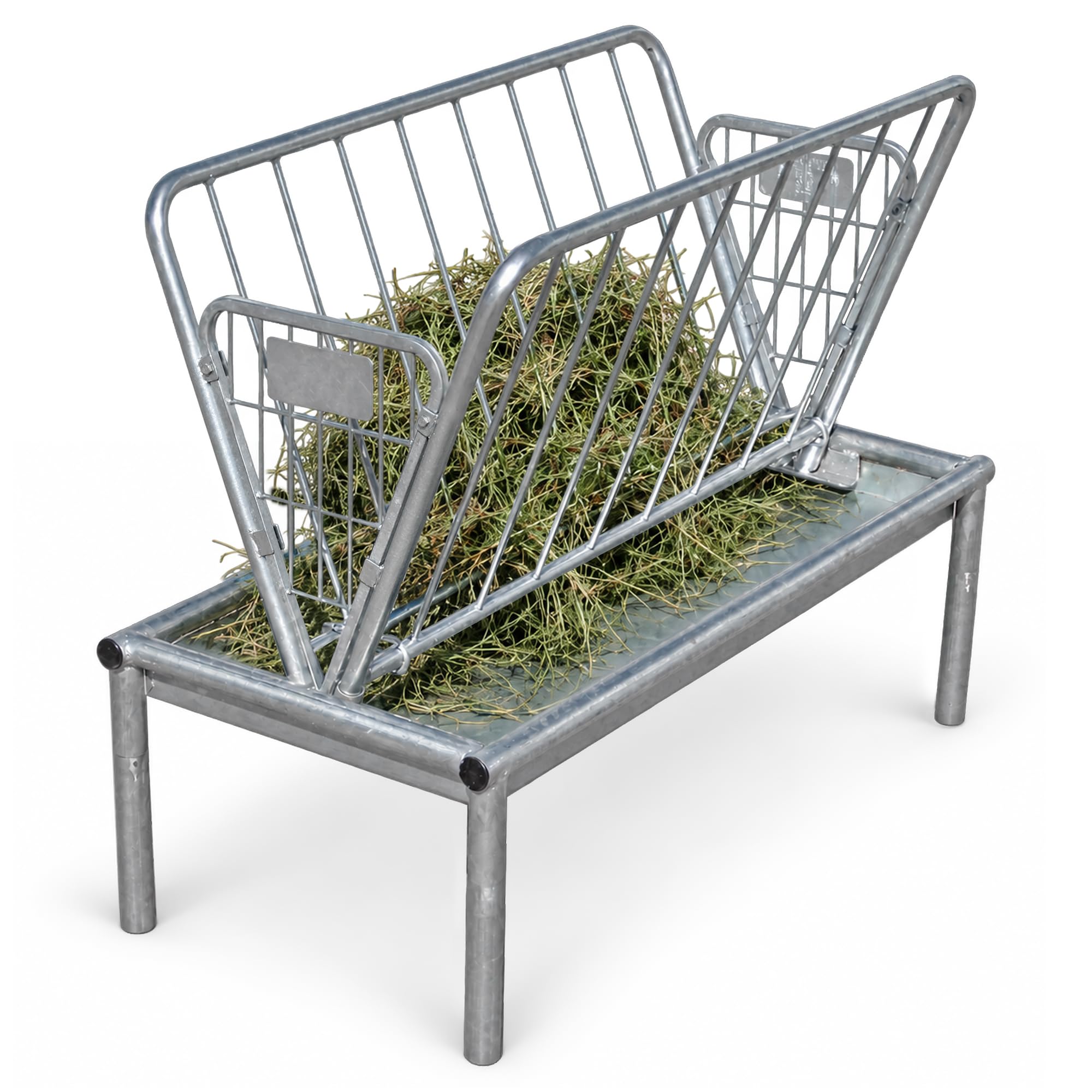
This is the most expensive feeder here, and the only one that needs no wall, panel, or gate rail to work. Four legs, a rack, and a pan: it drops into a run-in shed or a paddock corner and stays put.

The pan is why we think it earns the money. Six inches deep and as wide as the rack, it sits under the feeding slots and catches everything pulled loose, so the hay a goat drops gets eaten instead of bedding down into the mud. On ground that is already a mess, that changes your feed bill more than capacity does.

Setup is genuinely quick - four bolts and about ten minutes - but the legs are threaded, and one dented thread turns a ten-minute job into an afternoon with a file. At 68 pounds it is stable in wind and awkward to drag to a new spot on your own.

There are no drain holes in the pan, so it holds rainwater when it sits outside; two holes drilled in one corner fix that permanently. Otherwise the 15-gauge galvanized frame is the kind of thing you buy once.

Bottom line: Buy this one when there is no wall to hang anything on and you want a feeder that survives being leaned on, stood in, and left out in the weather.

6

Topyznsup 40-Inch Hay Rack

Topyznsup 40-Inch Hay Rack

Long barn walls

Our Score 8.8/10
Check Price

Worth Noting

Capacity
25 gallons
Material
Coated carbon steel
Mounting
Wall or fence, hardware included
Dimensions
40 x 10 x 15.9 in
Read the full review

Forty inches of rack and 25 gallons of capacity put this among the longest wall feeders here, and it hangs flat against a wall or a fence line with the hardware in the box.

What we appreciate is the restraint. It is a plain rack: an open-grid front that holds hay in place while animals pull clean mouthfuls, a wide top opening one person can fill from the ground, and a coated carbon steel frame that will not mind a shed wall. For a long, empty barn wall, that is usually the right answer.

It also sits lower than most at 15.9 inches tall, which suits goats and sheep eating at chest height and makes a tall horse reach down for its dinner. Check what is behind the wall before you drill: the hardware is included, but a rack this long fastened only into siding will work loose the first time something leans on it. Put it into framing or a backer plank and it stays where you hung it.

Bottom line: Our pick for a long, empty barn wall: forty inches of rack, simple to hang, and enough capacity that refilling is a once-a-day job for goats and sheep.

7

YXJSTO Wall Mount Hay Rack

YXJSTO Wall Mount Hay Rack

Hay and grain

Our Score 8.6/10
Check Price

Worth Noting

  • Bracket bolts can pull free with a leaning horse
Capacity
15 gallons
Material
Galvanized sheet, stainless screws
Mounting
Adjustable L-hooks, wall or rail
Front Mesh
4 x 4 in
Read the full review

The front of this rack is a 4x4-inch grid, and that measurement is the reason to buy it. Wide enough for a goat to get a mouthful, tight enough that it cannot haul a flake out and stamp it into the bedding - and when hay does drop, the raised trough along the bottom catches it instead of the floor.

It is one of two feeders here that handles grain as well as hay. The bottom groove holds a scoop of pellets under the rack, so a mixed ration goes out in one trip, and the double L-hooks adjust to sit on a 2x4, a round tube, or a stall rail. Painted galvanized sheet and stainless screws are the right combination for a damp barn.

The rack is heavy for its size, which is a compliment to the steel and a caution about how you hang it. The hanger brackets rely on bolts that can pull free once a horse leans back with a mouthful, so through-bolt it into a stud and use washers that actually fit the bracket slots rather than the ones in the bag. Do that, and the only thing left to think about is keeping the trough clean.

Bottom line: For a stall or a small pen, this is the tidy choice: the mesh keeps hay where you put it, the trough catches what falls, and you can scoop grain into the same frame.

8

BUYYAH 24-Gallon Hay Rack, 2-Pack

BUYYAH 24-Gallon Hay Rack, 2-Pack

Several pens

Our Score 8.4/10
Check Price

Worth Noting

  • Hollow, spot-welded bars bend under anything but small stock
Pack
Two wall racks
Capacity
24 gallons
Material
Carbon steel
Dimensions
31.5 x 15.5 x 22.5 in
Read the full review

Two 24-gallon wall racks for about the price of one mid-range feeder is the pitch, and for a barn with several pens it is a good one: one above each divider rather than a single big rack everyone crowds around.

Both went up in an afternoon with the tools from the box and nothing else, and hanging one is a two-hole job on a wall or a stall divider. At 31.5 inches wide and 22.5 inches tall, the rack puts hay at a comfortable height for goats and small sheep, and the open front gives three or four animals room to eat at once.

The steel is where they give ground. The bars are hollow, thin-wall tube, spot-welded at the joints, and that is what bends first - racks going out of shape in a season under anything pushier than a mini goat, bars letting go at the welds. Scoped honestly, this is a good buy for a small goat barn or a pen of weanlings and a poor one for horses.

Check the welds when the box arrives and send back anything already loose; that is the part that decides how long these last.

Bottom line: Buy the pair if you have several small pens and small animals: two racks spread the crowd, though neither will stand up to a horse.

9

VEVOR 2-in-1 Hay and Grain Feeder

VEVOR 2-in-1 Hay and Grain Feeder

Large goat herds

Our Score 8.2/10
Check Price

Worth Noting

  • Bent panels and weak welds on the hay holder
  • Two people needed for assembly
Feeds
10 to 12 goats
Capacity
56 gal hay and 24 gal grain
Material
Q235 carbon steel with galvanized plates
Dimensions
57.9 x 27.6 x 34.1 in
Read the full review

Twelve goats at one feeder is a different job from three, and this is the unit here built for it: 57.9 inches long, with a 56-gallon hay rack above a 24-gallon grain tray.

The two-in-one layout earns its floor space in a mixed routine. Hay goes in the top, a scoop of grain goes in the deeper pan below, and one trip with the barrow covers the whole pen. The pan also catches what gets pulled through the rack, and on a feeder this wide that is not a small amount of hay.

Build quality is where it gives ground. The carbon steel tube and galvanized plates are substantial, but panels can arrive bent and the welds on the hay holder are the first thing to let go. Assembly takes two people: the overlapping frame is clever, the instructions are thin, and a socket set makes the difference.

Set it where you want it before you build it - at 47.8 pounds and nearly five feet long, it is not something you slide around the shed on a whim. For a pasture pen where the alternative is a bale ring and a mud hole, we think it is still the most feeder for the money here.

Bottom line: For a dozen goats in a paddock, this is the feeder that ends the twice-a-day refill: hay and grain in one frame, sized so a whole pen can eat at once.

How We Tested 10 Livestock Hay Feeders

To build the list, I went through about 40 feeders sold by farm supply stores and small welding shops, then ruled out anything with an unclear bale capacity, unlisted hardware, or a footprint too wide for a standard gate. Ten made the cut: wire rings, sheet-metal creep feeders, and welded cradles built for round bales.

Each one went together on my own, outdoors, using the hand tools most people already have — I timed assembly with a stopwatch and noted where the instructions quietly assumed a second person. I measured the footprint and load height, and checked whether I could tip a full feeder upright and drag it to the paddock alone. Then the animals took over: goats stood on the top rails, a horse rubbed her shoulder against the corners, and I leaned my weight into each empty frame to see how much it took before a leg lifted.

Every week for eight months I weighed the hay going in and raked up what got pulled out and left on the ground, so waste could be compared against what each feeder cost rather than guessed at. I checked welds, hinge pins, and coated panels after rain and after the first freeze, and watched how horned goats and a pony actually reached the forage — some feeders that read well on paper had bars set too wide or too high for smaller stock. Alongside that we tracked hardware loss: the bolts that rattled loose, the pins that walked out, and the panels that started to bow.

How to Choose Livestock Hay Feeders

Start With Where It Hangs

Every feeder here is one of three things: something that hooks over a panel or gate, something that screws to a wall, or something that stands on its own legs. Decide that first, because it eliminates more products than capacity or price does. If your animals rotate between paddocks, a hanging rack like the Premier 1 travels with them; if you feed in a run-in shed with no usable wall, only a freestanding unit like the Rugged Ranch will do.

The trap is fastening. Wall racks are drilled for hardware, not for your studs, and bolt holes rarely land on 16-inch centers. Fix a backer board to the framing first and hang the rack on that. A loaded rack screwed into siding or thin plywood will pull out the first time an animal leans back with a mouthful.

Waste Control Is Where the Money Goes

Hay that lands on the ground is hay you paid for and will not get back. Two features change that: a catch pan under the rack, and openings small enough to stop an animal dragging out more than a mouthful. A pan turns dropped hay into edible hay and keeps the floor dry; slats, fine mesh, and small side openings slow fast eaters and cut the trampling that follows.

We rank waste control above raw capacity. A rack that holds four flakes and loses one to the bedding is a worse buy than one that holds two and loses none, and the difference shows up every single week of winter.

Match the Openings to the Animals

Goats, sheep, and horses need different heights, different opening sizes, and different strengths of steel. A rack that suits a pen of Nigerian Dwarfs will flex under a horse. Horned animals need openings wide enough to eat through but not so wide that a head follows the hay in.

Young stock do better with low holes or an open bottom, which is a small detail we look for on anything going into a pen with kids or lambs. Hang wall racks at chest height for the smallest animal in the pen, not the tallest.

Steel, Welds, and Weather

Gauge is the number nobody prints, so judge by weight and construction. A light rack is convenient to hang and easy to bend; a heavy one takes two people and lasts. Look at how it is joined: continuous welds hold, spot welds on thin tube are the first failure point, and hot-dip galvanizing outlasts paint in a wet barn by years.

Painted steel is fine indoors. Outdoors, plan on touching up chips and scratches, or buy the dipped finish and stop thinking about it.

Capacity and Refill Rhythm

Gallon ratings are loose, because a rack is not a bucket, so treat them as a rough comparison between products rather than a promise. What matters is how often you refill. A flake-sized hanging feeder suits two or three goats; a pen of ten needs a four- or five-foot rack, or several smaller feeders spread along the wall.

Two feeders also handle bossy animals better than one big one, because the goat at the bottom of the pecking order always has somewhere else to eat.

Frequently Asked Questions

Final Verdict

Buy the Premier 1 X-Tuff if you have a panel, a gate, or a 2-inch board to hang it on. It needs no tools, takes everything goats can throw at it, and its small openings keep hay in the rack instead of underfoot.

Two requirements change that answer. If a barn wall has to keep a whole pen eating and you want several flakes available at once, the Lazaluking rack is the better fit. If there is no wall at all, the Rugged Ranch is the one that stands up to a paddock.