Pest & Weed Control

Best Insect Foggers of 2026

Nobody looks forward to setting off a bug bomb. You tape the cabinets shut, load the dog into the car, and spend the afternoon wondering whether you'll come home to dead roaches or a greasy film on every countertop. That trade-off — dead bugs versus a full day of wiping — is what separates one fogger from another, and it's never printed on the can. The right one reaches into cracks, keeps killing for weeks rather than days, and leaves the room smelling like a room by morning.

I've emptied more cans of these than I'd like to admit, and over the past four months my team ran 14 different foggers through real infestations — a damp basement, a spider-heavy garage, a garden shed, and one rental kitchen I'm still apologizing for. We kept track of whether the trigger needed two hands, how long the odor hung around, and how much residue we were scrubbing the next morning. The picks below are the ones that earned their place.

1

Cutter Backyard Bug Control

Top Pick
Cutter Backyard Bug Control

Decks and patios

Our Score 9.0/10
Check Price

Worth Noting

  • Some cans spray a stream instead of a fog
  • 1,200 cubic feet per can treats one patio
Use
Outdoor areas
Cans Included
3
Reapplication
No more than once a day
Coverage Per Can
1,200 cu ft
Read the full review

There's no machine here. Cutter's backyard fogger is a 16-ounce aerosol can you point and spray, which makes it the one we reach for when the problem is a deck, a picnic table, or the grass strip by the grill rather than an acre of lawn. No canister, no warm-up, no fuel to store: spray the area and put it back on the shelf.

Mosquitoes, gnats, flies, wasps, and small flying moths drop on contact, and the label allows reapplication as needed up to once a day. Each can treats 1,200 cubic feet, which the label describes as an area 8 feet by 10 feet by 15 feet. That figure is the honest limit of the product, and it explains why three cans disappear quickly across a whole evening's worth of outdoor space.

The thing to check before you commit is the spray itself. Give the nozzle a two-second burst into open air; if it comes out as a stream instead of a mist, you're not treating an area, you're shooting individual flies. A can that streams rather than fogs is a real possibility, and there's no way to tell from the outside of the can.

Used as a spot treatment it's the least fuss of anything in this group. Point it at the wasps under the eaves and you're finished in ten seconds.

Bottom line: Our pick when the mosquitoes are on the deck rather than the lawn: grab a can, spray, and skip the fuel, hoses, and storage.
2

Hot Shot Fogger with Odor Neutralizer

Hot Shot Fogger with Odor Neutralizer

Whole-home indoors

Our Score 8.8/10
Check Price

Worth Noting

  • Enclosed spaces only, so no outdoor use
Use
Enclosed indoor spaces
Residue
Clear, non-staining
Claimed Residual
Up to 2 months
Coverage Per Can
2,000 cu ft
Read the full review

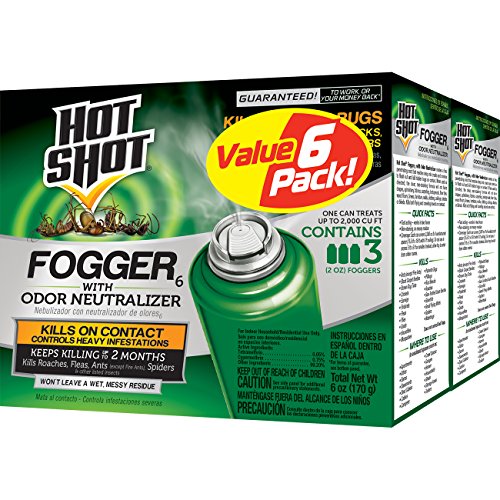
What we noticed first is what isn't there afterwards. The formula is clear and non-staining, so a treated room doesn't greet you with a wet film across the hard floors, and the odor neutralizer keeps a basement or a camper cabin from smelling like a pesticide for the rest of the week. That matters more than it sounds, because the foggers people regret are the ones they have to scrub up after.

The figures behind it are why it's our default for a problem spread across the house. Each can treats 2,000 cubic feet of unobstructed space, which is a room about 16 feet square with an 8-foot ceiling, and the label claims it keeps killing for up to two months. Hot Shot lists attics, basements, barns, boat cabins, campers, crawl spaces, garages, sheds, and storage areas alongside the ordinary apartment and house, a broader range than most of the cans here will cover.

We read the two-month number as a ceiling rather than a promise. A fog leaves a light deposit on surfaces, and how long that keeps working depends on sunlight, wiping, and foot traffic. If you're dealing with a long-running roach problem, a second can three or four weeks later is a better use of money than assuming one pass finished the job. The other boundary is the obvious one: this is a total-release can and the label calls for an enclosed space. Crack a window or run a fan and you've paid to fog the neighborhood.

Where it beats the specialist cans is breadth. The same pack handles the attic this weekend and the garage next month, and you never have to work out which formula goes where.

Bottom line: This is the can we hand someone with bugs in three rooms: 2,000 cubic feet apiece, no residue on the floor, and weeks of claimed protection.

3

Black Flag Propane Insect Fogger

Black Flag Propane Insect Fogger

Yards and patios

Our Score 8.8/10
Check Price

Worth Noting

  • Fuel canister and fogging solution cost extra
  • No residual; a breeze takes the fog with it
Power
Propane, auto start
Weight
3.7 lb
Fog Reach
10-ft cone
In The Box
Fogger only
Read the full review

The half hour before people arrive for a barbecue is where a propane fogger makes sense. You walk the yard with it, lay down a trail of fog, and by the time the grill is lit the mist has moved off and taken the mosquitoes with it. Black Flag's unit is the cordless version of that routine: no hose, no extension cord, just a tall propane canister and an auto-start button.

We like the shape of it for yard work. At 21 inches long and 3.7 pounds, it carries one-handed along a fence line and sits on the ground while you stop to talk. The 10-foot cone of odorless fog is the useful part of the specification, because you're covering ground as you walk rather than standing in one spot, and the claim is minutes of fogging for hours of control. The body is metal, so treat it like a camp stove rather than a spray can.

Budget for the consumables. What arrives is the fogger; the canister and the fogging solution are separate purchases, and a summer of cookouts burns through both. The other thing to accept is that a thermal fog has no staying power. It kills what's flying as it passes and then disperses, and a breeze will carry it off your patio and into the neighbor's hedge.

On a still evening in a defined yard, though, nothing else here works as fast. It turns whether to eat outside into no decision at all.

Bottom line: Buy this one if your problem is outside: a ten-foot odorless cone, no cord, no warm-up, and a yard you can use again the same evening.

4

Raid Deep Reach Roach Fogger

Raid Deep Reach Roach Fogger

Budget multi-room

Our Score 8.8/10
Check Price

Worth Noting

  • Small charge suits single rooms, not open-plan spaces
  • Uneven results on established roach infestations
Kills
Roaches, fleas, ants, spiders
Cans Included
4
Coverage Per Can
25 x 25 ft room
Claimed Protection
Up to 2 months
Read the full review

Four cans, four rooms, and the smallest outlay of anything in this guide. That's the pitch, and it holds up as long as your rooms are ordinary: each 1.5-ounce can treats a 25-foot by 25-foot room with an 8-foot ceiling, roughly 5,000 cubic feet.

The kill list is broad for the size: roaches, ants with the usual exceptions for fire, carpenter, harvester, and pharaoh ants, plus fleas, spiders, and mosquitoes, with a claim of protection for up to two months and no wet residue left behind. It's an EPA-registered cypermethrin formula, and the four-can pack means one goes in each bedroom instead of decanting a big can between them.

The trade-off is capacity. A 1.5-ounce charge is thin for a great room or a basement, and the label's 25-by-25 room assumes a normal ceiling and a room you can actually close. Roach results are also uneven once a population is established, which is true of every can here, so we plan for a follow-up rather than being surprised by one.

Where it fits is a whole floor of bedrooms and bathrooms: four doors, four cans, one afternoon, and no half-used can left sitting in the garage until next spring.

Bottom line: The cheapest way here to treat four ordinary rooms; just don't expect a 1.5-ounce can to fill a great room.

5

Raid Max Fogger

Raid Max Fogger

Large open rooms

Our Score 8.6/10
Check Price

Worth Noting

  • Uneven on settled, heavy roach populations
Residue
No wet residue
Formulation
Concentrated for heavy infestations
Cans Included
3
Coverage Per Can
25 x 35 ft room
Read the full review

Most fogger cans are built for a bedroom. This one is built for the room the bedroom opens onto. A single 2.1-ounce can treats up to 25 feet by 35 feet with an 8-foot ceiling, which is about 7,000 cubic feet, and against the 2,000-cubic-foot cans that make up most of this list that's more than three cans' worth of coverage from one placement.

That's the whole case for it. In an open-plan living area, a finished basement, or a garage big enough for two cars, the standard can is under-dosed by the label's own math, and under-dosing is how a fogging gets repeated. Raid also formulates this one as a concentrate for heavy infestations and says it won't leave a wet, messy residue.

We plan a second round for a settled roach population. The can kills what the fog reaches, and roaches deep in a wall void or behind a kickboard are exactly what a fog is worst at. Clear the food and water sources and expect to follow up rather than declare victory after the first afternoon.

One practical note: a 2.1-ounce charge is a lot for a small bathroom, and the label's room size is a ceiling rather than a target. If you're treating five ordinary rooms, the smaller cans are the better buy.

Bottom line: For one big open room, this is the can: a single 2.1-ounce charge treats up to 25 by 35 feet, where standard cans need three or four.

6

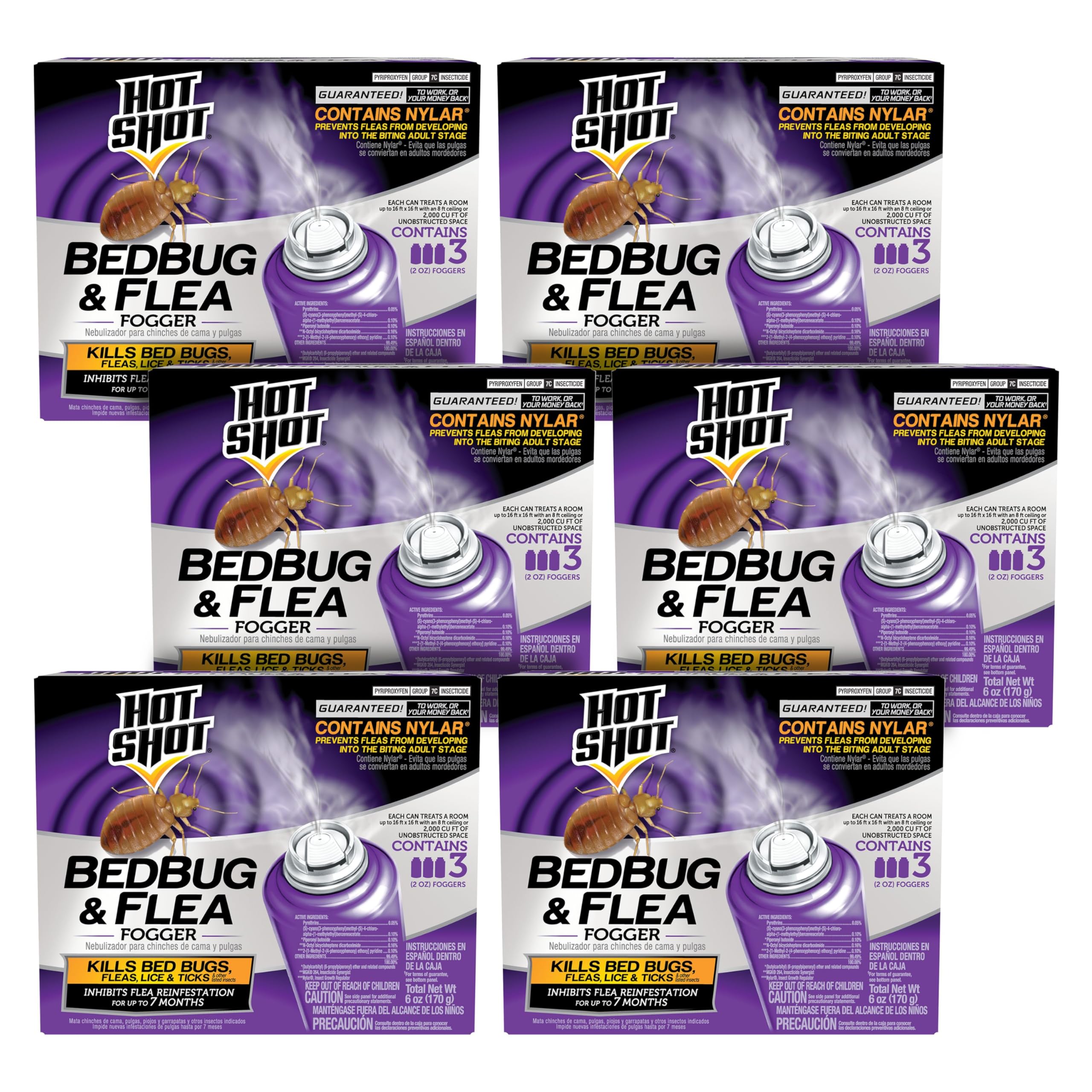
Hot Shot BedBug & Flea Fogger

Hot Shot BedBug & Flea Fogger

Fleas and bedbugs

Our Score 8.4/10
Check Price

Worth Noting

  • Fog cannot reach bedbugs inside mattresses
Use
Indoors, pet sleeping areas
Coverage Per Can
2,000 cu ft
Growth Regulator
Nylar
Flea Reinfestation
Up to 7 months
Read the full review

Nylar is what separates this can from a general-purpose fogger. It's an insect growth regulator: the adulticide kills fleas that are already there, and the regulator stops larvae from developing into the biting adults that keep the cycle going. Hot Shot claims that holds flea reinfestation down for up to seven months.

The rest of the specifications are familiar. Each can treats 2,000 cubic feet, and the label points it at apartments, attics, basements, boats, cabins, closed porches, condos, garages, homes, kitchens, and pet sleeping areas, the last two being the ones that matter when fleas are the problem. It also lists lice, ticks, and bed bugs.

For a carpeted house with fleas, this is the can we choose over a plain fogger every time, because killing adults without touching the next generation is how people end up fogging again three weeks later. Bedbugs are a claim to be skeptical about: fog hangs in the air and settles on surfaces, and bedbugs spend their lives in mattress seams, box springs, and frame joints where a fog doesn't reach. Use this for what's out in the open and treat the bedding and frame directly.

One treatment rarely ends fleas on its own: vacuum daily, wash the pet bedding hot, and use a flea product labeled for the animal. The fogger is the part that clears the room; the rest is the part that keeps it clear.

Bottom line: Choose this over a plain fogger if fleas are the problem; the Nylar growth regulator goes after the next generation, not just the adults you see.

7

ADAMS Plus Flea & Tick Fogger

ADAMS Plus Flea & Tick Fogger

Small pet areas

Our Score 8.0/10
Check Price

Worth Noting

  • Smallest coverage per can in this group
Odor
Odorless, non-staining
Cans Included
3
Coverage Per Can
375 sq ft
Flea Egg Control
Up to 7 months
Read the full review

Three hundred and seventy-five square feet per can is the number that defines this one. It's the smallest coverage in this group by a wide margin, and it tells you what ADAMS built it for: a bedroom, a kennel, a garage bay. One closed room at a time, not a whole-house fog.

Within that room it does more than fleas. The label covers fleas and ticks plus roaches, ants, spiders, mosquitoes, and hornets, prevents flea eggs from hatching, and claims up to seven months of help against reinfestation. It's odorless and non-staining, and the instruction is refreshingly concrete: set the can on covered furniture and leave the room for at least two hours.

A pack of these is what we keep for the room where the dog sleeps. The two-hour vacate window is short for a fogger, the odorless formula means the spare bedroom doesn't smell like a treatment for a week, and the egg-hatching claim is the part that actually changes a flea problem. For a kennel or a cat room, that combination is worth more than a bigger can with a broader reach.

Just do the arithmetic before you order. At 375 square feet a can, a thousand-square-foot house is a multi-can purchase, and buying for the rooms you need to treat beats assuming three cans will stretch.

Bottom line: The flea can for a single room: odorless, non-staining, and honest about its 375-square-foot limit, so buy a pack and treat what matters.

How We Tested the Best Insect Foggers

To build the shortlist, I started with roughly 30 foggers sold at hardware stores and online, then narrowed by labeled coverage, whether the can was a total-release fogger or a trigger spray, and cost per square foot of claimed coverage. Fourteen made the cut, and over four months each one went into a real infestation rather than a plastic test box. Rooms were sealed to the label's instructions — pilot lights off, pets out, windows taped — and we laid white newspaper sheets along the baseboards so the fallout would be visible.

We counted dead insects at the two-hour, 24-hour, and one-week marks, and noted where the bodies landed: out in the open, or tucked into the seam between floor and wall. That seam told us a lot. Some cans pushed a fine mist into cracks and behind appliances; others got blocked short by cabinetry and left a wet stripe down the middle of the room and little else. For trigger-style cans, we sprayed under sinks, along baseboards, and into the gap behind the refrigerator, then checked a week later for staining.

Odor and mess were judged on return. We walked in after the labeled re-entry window, rated the smell, and timed how long it took to clear with the windows open. White paper towels went over counters, shelves, and appliance tops to catch oily residue, and we noted whether it wiped off in one pass or smeared. Ease of use came down to whether one person could set the can, trigger it, and be out the door in under 30 seconds — cans with a latch that stuck or a body that tipped easily got marked down. For duration, we checked each space weekly for six weeks to see when new activity appeared, and value came last: labeled square footage against what the can actually cost.

How to Choose Insect Foggers

Start With the Space, Not the Can

Three products sit under the fogger label and they do not substitute for each other. A total-release can works by emptying itself into a closed room: set it, leave, come back hours later. A hand-held outdoor aerosol like the Cutter cans is something you aim at flying insects, and it leaves no barrier behind. A propane fogger burns solution into a dense thermal fog you walk through a yard.

The trap is buying one for the other's job. A total-release can in a room with an open window, or with the HVAC fan running, is money in the air. A propane fogger indoors is a fire and inhalation risk. Decide indoor or outdoor first and the shortlist halves itself.

Run the Coverage Math

Every can states cubic feet, and that figure, not the square footage of your house, is what you buy against. Fog doesn't travel around corners, so treat room by room: measure length by width by height and add up each closed space separately.

A 2,000-cubic-foot can covers a room about 16 feet square with an 8-foot ceiling; the 1,200-cubic-foot cans cover a patio corner. Big open rooms are where standard cans fall short, and that is where the Raid Max can earns its place at 25 by 35 feet with an 8-foot ceiling. Never split a can between two rooms, because a half dose at the label's rate is a wasted treatment.

Read the Residual Claim Carefully

Keeps killing for up to two months and prevents flea eggs hatching for up to seven months are different promises. The first is adulticide sitting on a surface. The second depends on an insect growth regulator such as Nylar, which stops larvae becoming biting adults. Both are ceilings, and both shrink with sunlight, vacuuming, and foot traffic.

If fleas are the problem, the growth regulator is worth paying for, which is why we point people at the Hot Shot bedbug and flea can or the ADAMS fogger rather than a general-purpose can. For roaches, no fog reaches every harborage, so budget for a follow-up treatment.

Prep the Room Before the Tab Goes Down

A fogger only works in an empty, sealed space, and the preparation is what separates a clean treatment from an expensive mess. We treat three things as non-negotiable: people and pets out, pilot lights and open flames off unless the label explicitly exempts them, and fish tanks covered with the pump switched off. Food, utensils, and pet bowls come out or get bagged.

Set the can on a protected surface at the height the label specifies rather than on carpet or a tablecloth, close the windows, and shut off the fan. Hot Shot's No-Mess fogger is formulated as a dry fog you can use with pilot lights lit; with everything else, plan on relighting the water heater afterwards.

Count the Cost of a Whole Treatment

The price on the can is not the cost of the treatment. With a propane fogger, you buy the canister and the fogging solution on top of the unit, every session. With cans, the cost is how many rooms you have to treat, and under-buying is the expensive mistake because it means doing the job twice.

Compare cost per treated room rather than per can. Four small cans can beat one big one across a floor of bedrooms and lose badly in a great room, and a growth-regulator can costs more per room while still being the cheaper answer for fleas.

Frequently Asked Questions

Final Verdict

Inside the house, the Hot Shot Fogger with Odor Neutralizer is the one we recommend without a caveat: 2,000 cubic feet per can, a clear formula that doesn't leave a film, and the broadest list of labeled use areas in this group. Outdoors the answer splits by job, with the Black Flag propane fogger for a yard before an evening outside and the Cutter cans for a deck you want to treat in half a minute.

If fleas are why you're shopping, start with the Nylar can and put the second treatment on the calendar before the first one goes off.